
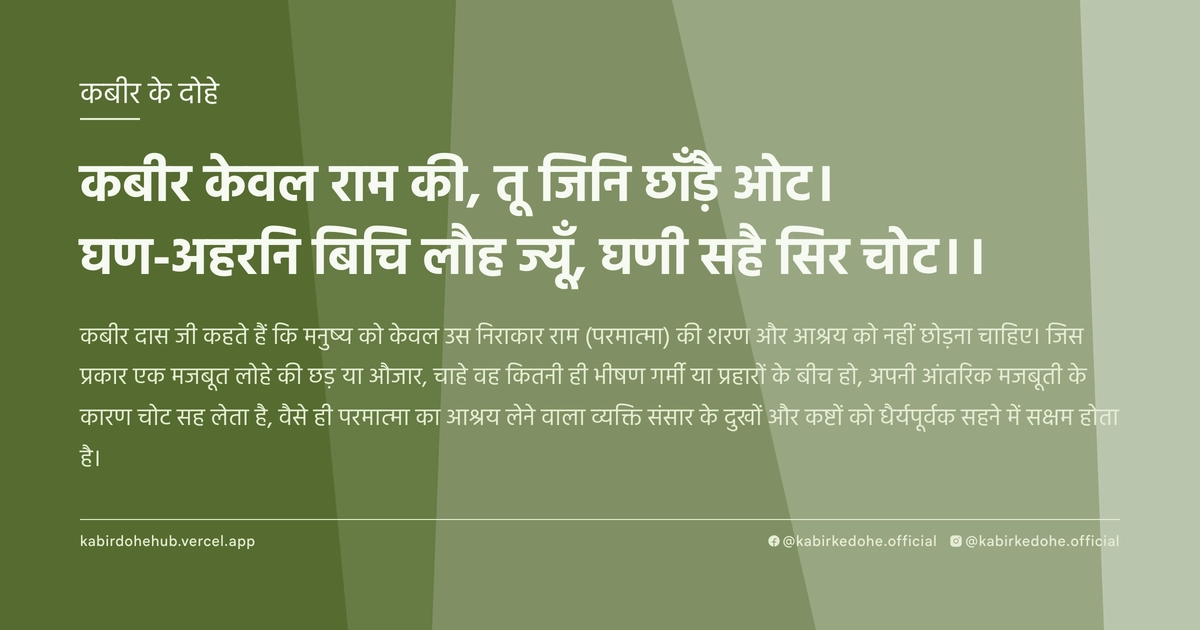
कबीर केवल राम की, तू जिनि छाँड़ै ओट।
घण-अहरनि बिचि लौह ज्यूँ, घणी सहै सिर चोट।।
Kabir keval ram ki, tu jini chhaandai ot. Ghan-aharni bichi lauh jyun, ghani sahai sir chot.
इस पृष्ठ पर इस कबीर दोहे का अर्थ (meaning), हिंदी व्याख्या और अंग्रेज़ी अनुवाद, दार्शनिक विश्लेषण और व्यावहारिक जीवन सीख दी गई है। यह दोहा प्रपत्ति (Surrender) विषय से जुड़ा है — Kabir doha meaning and explanation in Hindi and English.
अर्थ (Meaning):
कबीर दास जी कहते हैं कि मनुष्य को केवल उस निराकार राम (परमात्मा) की शरण और आश्रय को नहीं छोड़ना चाहिए। जिस प्रकार एक मजबूत लोहे की छड़ या औजार, चाहे वह कितनी ही भीषण गर्मी या प्रहारों के बीच हो, अपनी आंतरिक मजबूती के कारण चोट सह लेता है, वैसे ही परमात्मा का आश्रय लेने वाला व्यक्ति संसार के दुखों और कष्टों को धैर्यपूर्वक सहने में सक्षम होता है।
Kabir urges the seeker never to abandon the shelter and refuge of the Formless Ram (the Divine). He illustrates this with the metaphor of iron: just as a piece of iron remains resilient and endures countless heavy blows because of its inherent strength, a soul anchored in the Divine remains unshaken and steadfast despite the relentless onslaught of worldly suffering and adversity.
व्याख्या (Interpretation):
इस दोहे का शाब्दिक अर्थ है कि ईश्वर की शरण ही एकमात्र सुरक्षा है। यहाँ 'राम' दशरथ पुत्र नहीं, बल्कि 'निरुपाधिक' या निर्गुण ब्रह्म हैं जो कण-कण में व्याप्त हैं। 'ओट' का अर्थ है पर्दा या आश्रय। कबीर एक गहरे विरोधाभास का उपयोग करते हैं: लोहे का उदाहरण देकर वे बताते हैं कि आध्यात्मिक आश्रय का अर्थ दुखों से पलायन नहीं, बल्कि दुखों को सहने की आंतरिक क्षमता विकसित करना है। यह अद्वैत वेदांत के उस सिद्धांत से जुड़ा है जहाँ आत्मा को यह बोध होता है कि वह स्वयं ब्रह्म है, और इसलिए संसार की कोई भी बाहरी चोट उसे नष्ट नहीं कर सकती। माया के प्रभाव में मनुष्य बाहरी सहारे खोजता है, जबकि वास्तविक सुरक्षा केवल उस आंतरिक सत्य (आत्मा) में है जो अविनाशी है। जब साधक अपनी पहचान को अहंकार से हटाकर परमात्मा में विलीन करता है, तो वह 'लौह' की तरह अडिग हो जाता है।
Literally, the verse asserts that Divine refuge is the only true sanctuary. Here, 'Ram' does not refer to the mythological king, but to the Nirgun Brahman—the formless, attributeless Absolute pervading all existence. 'Ot' signifies a shield or shelter. Kabir employs a profound paradox: seeking Divine shelter is not about escaping suffering, but about developing the internal fortitude to endure it. This aligns with Advaita Vedanta, where the realization of the Atman-Brahman non-duality renders the soul impervious to the transient pains of the material world. While the ego seeks external validation and protection, the true seeker finds an internal anchor. The metaphor of iron suggests that spiritual alignment transforms the fragile human psyche into a resilient force. By dissolving the separate 'I' into the Universal 'I', the practitioner transcends the duality of pleasure and pain, recognizing that the essence of the self is untouched by the hammers of fate.
दार्शनिक विश्लेषण (Philosophical Analysis):
कबीर का यह दर्शन उनके समय के धार्मिक पाखंड और कर्मकांडों के विरुद्ध एक सशक्त प्रतिक्रिया था। उन्होंने देखा कि लोग मोक्ष के लिए बाहरी तीर्थों, कठिन उपवासों और जातिगत श्रेष्ठता के भ्रम में फंसे थे। कबीर ने 'निरगुण भक्ति' का मार्ग प्रशस्त किया, जहाँ ईश्वर किसी मंदिर या मस्जिद में नहीं, बल्कि मनुष्य के भीतर 'श्वास' के रूप में विद्यमान है। यह विचार सूफी मत के 'फना' (अहंकार का विनाश) और वेदांत के 'अहं ब्रह्मास्मि' का एक अद्भुत संगम है।
यहाँ 'लोहे' का प्रतीक अत्यंत महत्वपूर्ण है। लोहा अग्नि में तपकर और चोट खाकर ही आकार लेता है। इसी प्रकार, कबीर का मानना था कि आध्यात्मिक परिपक्वता केवल सुखों में नहीं, बल्कि विपरीत परिस्थितियों में धैर्य रखने से आती है। वे सिखाते हैं कि जब तक मनुष्य स्वयं को शरीर और नाम-रूप से जोड़कर देखता है, वह चोट महसूस करता है। लेकिन जब वह स्वयं को उस निराकार राम का हिस्सा मानता है, तो वह 'साक्षी' भाव में आ जाता है।
यह विश्लेषण हमें बताता है कि कबीर ने जाति और वर्ग की सीमाओं को तोड़कर एक ऐसे सार्वभौमिक सत्य की बात की, जो केवल अनुभव (Anubhav) पर आधारित था। उनके लिए ज्ञान वह नहीं जो शास्त्रों में लिखा है, बल्कि वह है जो जीवन की भट्टी में तपकर निकला है। वे ritualism (कर्मकांड) को एक ढोंग मानते थे क्योंकि वह बाहरी दिखावा है, जबकि 'राम की ओट' एक आंतरिक मनोवैज्ञानिक रूपांतरण है।
मनोवैज्ञानिक स्तर पर, यह दोहा 'resilience' या लचीलेपन की बात करता है। जब व्यक्ति का केंद्र (Center) स्थिर होता है, तो बाहरी तूफान उसे विचलित नहीं करते। अहंकार का विसर्जन ही वह प्रक्रिया है जिससे मनुष्य 'लोहे' जैसा मजबूत बनता है। जो व्यक्ति अपनी पहचान को अपनी उपलब्धियों या सामाजिक स्थिति से जोड़ता है, वह कांच की तरह टूट जाता है; लेकिन जो अपनी पहचान को अनंत से जोड़ता है, वह अविनाशी हो जाता है।
अंततः, कबीर यह स्पष्ट करते हैं कि भक्ति कोई पलायन नहीं है, बल्कि वास्तविकता का सामना करने का साहस है। यह एक ऐसी स्थिति है जहाँ साधक संसार में रहते हुए भी संसार से ऊपर उठ जाता है, ठीक वैसे ही जैसे कमल कीार कीचड़ में रहकर भी उससे अछूता रहता है।
Kabir’s philosophy serves as a potent critique of the religious hypocrisy and rigid ritualism prevalent during his era. He observed a society fragmented by caste hierarchies and obsessed with external piety—pilgrimages, fasting, and idol worship. In response, Kabir championed 'Nirgun Bhakti,' asserting that the Divine is not confined to a temple or mosque but resides within the very breath of the practitioner. This perspective creates a bridge between the Sufi concept of 'Fana' (the annihilation of the ego) and the Vedantic realization of 'Aham Brahmasmi' (I am Brahman).
The symbolism of 'iron' is pivotal here. Iron attains its utility and strength only after enduring the heat of the forge and the strikes of the hammer. Similarly, Kabir posits that spiritual maturity is not achieved through comfort, but through the alchemy of suffering and patience. He suggests that as long as a human identifies with the transient body and social labels, they remain vulnerable to the 'blows' of existence. However, by shifting identity to the Formless Ram, one enters the state of the 'Sakshi' or the Witness.
This analysis reveals that Kabir’s teachings were rooted in 'Anubhav' (direct experience) rather than scriptural dogma. He rejected ritualism as a superficial mask, proposing instead a profound psychological transformation. By stripping away the layers of the ego, the seeker discovers an immutable core that is neither born nor destroyed. This is the essence of the non-dual path: the realization that the observer and the observed are one.
Psychologically, the verse addresses the concept of resilience. When a person's internal center is anchored in the Absolute, external turbulence cannot destabilize them. Those who anchor their identity in worldly achievements or social status are like glass—fragile and prone to shattering. Conversely, those anchored in the Infinite become like iron—enduring and steadfast. The 'shelter' Kabir speaks of is not a physical place, but a state of consciousness.
Ultimately, Kabir clarifies that devotion is not an escape from reality but the courage to face it. It is the art of living in the world without being 'of' the world. Like a lotus blooming in the mud, the practitioner remains immersed in the complexities of human life while remaining spiritually untouched, transforming every hardship into a stepping stone toward liberation.
मूल संदेश (Core Message):
- बाहरी सहारे रेत की तरह हैं, केवल आंतरिक सत्य स्थायी है।
- दुख से भागना समाधान नहीं, बल्कि उसे सहने की शक्ति पाना लक्ष्य है।
- अहंकार का विसर्जन ही वास्तविक मानसिक मजबूती का आधार है।
- परमात्मा कोई बाहरी व्यक्ति नहीं, बल्कि आपकी अपनी चेतना का उच्चतम रूप है।
- स्थिरता वह नहीं जो तूफानों को रोक दे, बल्कि वह है जो तूफानों में भी न डगमगाए।
- External supports are like shifting sands; only the internal Truth is permanent.
- The goal is not to escape suffering, but to cultivate the strength to endure it.
- The dissolution of the ego is the only foundation for true mental resilience.
- The Divine is not an external entity, but the highest realization of your own consciousness.
- Stability is not the absence of storms, but the ability to remain unshaken within them.
व्यावहारिक उदाहरण (Practical Example):
एक समय की बात है, वाराणसी के घाटों पर माधव नाम का एक वृद्ध बुनकर रहता था। माधव का जीवन अत्यंत कठिन था; उसकी आँखों की रोशनी कम हो रही थी और उसके परिवार पर कर्ज का भारी बोझ था। उसके आस-पास के लोग उसे सलाह देते कि वह किसी बड़े मंदिर के पुजारी की शरण ले या महंगे अनुष्ठान करे ताकि उसकी किस्मत बदल सके।
माधव ने उन सब बाहरी आडंबरों को ठुकरा दिया। उसने कबीर की वाणी को सुना था कि 'परमात्मा भीतर है'। उसने तय किया कि वह अपनी हर मुश्किल को ईश्वर की एक परीक्षा मानेगा और केवल उस निराकार शक्ति पर भरोसा रखेगा।
एक दिन, शहर के एक रसूखदार व्यापारी ने माधव के साथ धोखाधड़ी की और उसका सारा माल हड़प लिया। माधव के पास अब न तो कपड़ा था और न ही उसे बेचने के पैसे। उसके साथी बुनकर उसे कोसने लगे और कहने लगे कि उसकी 'भक्ति' ने उसे बर्बाद कर दिया।
लेकिन माधव विचलित नहीं हुआ। उसने अपनी फटी हुई चटाई पर बैठकर शांति से कहा, 'यह चोट भी उसी की है, और इसे सहने की शक्ति भी वही देगा।' उसने शिकायत करना छोड़ दिया और अपनी बची-कुची ताकत से फिर से धागे बुनना शुरू किया।
उसकी इस अगाध शांति और अडिगता ने धीरे-धीरे लोगों का ध्यान खींचा। लोग यह देखकर हैरान थे कि जिस व्यक्ति के पास खोने के लिए कुछ नहीं था, उसके चेहरे पर एक ऐसी चमक और शांति थी जो बड़े-बड़े अमीरों के पास नहीं थी।
एक दिन, उसी व्यापारी का बेटा, जो मानसिक तनाव से जूझ रहा था, माधव के पास आया। उसने पूछा, 'बाबा, आपके पास कुछ नहीं है, फिर भी आप इतने स्थिर कैसे हैं?'
माधव ने मुस्कुराते हुए जवाब दिया, 'बेटा, जब तुम अपनी नाव को किनारे के खंभे से बांधते हो, तो लहरें उसे हिलाती हैं। लेकिन जब तुम नाव को गहरे समुद्र के तल से जोड़ देते हो, तो तूफान भी तुम्हारा कुछ नहीं बिगाड़ सकते। मैंने खुद को उस अनंत राम से जोड़ लिया है।'
व्यापारी का बेटा यह सुनकर स्तब्ध रह गया। उसे समझ आया कि असली सुरक्षा धन में नहीं, बल्कि उस आंतरिक स्थिरता में है जिसे माधव ने प्राप्त किया था।
माधव की यह 'लोहे जैसी' सहनशक्ति उसकी कमजोरी नहीं, बल्कि उसकी सबसे बड़ी ताकत बन गई। उसने न केवल अपना कर्ज चुकाया, बल्कि अपने पूरे समुदाय को यह सिखाया कि बाहरी सहारा एक भ्रम है, और केवल आंतरिक परमात्मा ही एकमात्र सच्चा आश्रय है।
Once, on the ghats of Varanasi, lived an elderly weaver named Madhav. His life was fraught with hardship; his eyesight was failing, and his family was burdened by crushing debt. Those around him urged him to seek the patronage of powerful priests or perform expensive rituals to change his fate.
Madhav rejected these external pretenses. He had heard the words of Kabir—that the Divine resides within. He decided to view every struggle as a divine test and placed his absolute trust in the Formless Power.
One day, a wealthy merchant in the city cheated Madhav, seizing his entire stock of fabric. Madhav was left with nothing—no goods to sell and no money to sustain himself. His fellow weavers mocked him, claiming that his 'devotion' had led him to ruin.
Yet, Madhav remained undisturbed. Sitting on his tattered mat, he calmly remarked, 'This blow is also from Him, and the strength to endure it will also come from Him.' He ceased complaining and began to spin threads again with whatever strength he had left.
His profound peace and steadfastness gradually drew the attention of others. People were astonished to see that a man who had lost everything possessed a radiance and serenity that the wealthiest citizens lacked.
One day, the merchant's son, who was struggling with severe mental anxiety, approached Madhav. He asked, 'Baba, you have nothing, yet how are you so stable?'
Madhav smiled and replied, 'My son, when you tie your boat to a pier on the shore, the waves toss it around. But when you anchor your boat to the very floor of the deep ocean, even the fiercest storm cannot move you. I have anchored myself to the Infinite Ram.'
The son was stunned. He realized that true security did not lie in wealth, but in the internal stability that Madhav had cultivated.
Madhav's 'iron-like' endurance became his greatest strength. He eventually cleared his debts, but more importantly, he taught his entire community that external support is an illusion, and only the internal Divine is the true sanctuary.
Through this 'Kabir Twist,' Madhav transformed his suffering into a bridge of liberation, proving that the shelter of the Divine is not a shield against pain, but the power to remain unbroken by it.
अभ्यास मार्गदर्शन (Practice Guidance):
- प्रतिदिन 20 मिनट 'साक्षी भाव' का अभ्यास करें: अपने जीवन में आने वाली समस्याओं को एक तीसरे व्यक्ति की तरह देखें, जैसे आप किसी फिल्म को देख रहे हों।
- आत्म-पूछताछ जर्नल: हर रात लिखें कि आज किस घटना ने आपको विचलित किया और आप उस स्थिति में 'लोहे' की तरह स्थिर कैसे रह सकते थे।
- व्यवहार परिवर्तन: जब भी कोई आपकी आलोचना करे या आप पर कोई संकट आए, तो तुरंत प्रतिक्रिया देने के बजाय 10 गहरी सांसें लें और मन में कहें, 'मैं उस अनंत का अंश हूँ, यह परिस्थिति क्षणभंगुर है।'
- नैदानिक चेकलिस्ट (Diagnostic Checklist): क्या मैं बाहरी लोगों की तारीफ या बुराई से अपनी खुशी तय कर रहा हूँ? क्या मैं संकट आने पर घबरा जाता हूँ? यदि हाँ, तो इसका अर्थ है कि मेरा आश्रय अभी भी 'बाहरी' है, 'आंतरिक' नहीं।
- Practice 'Witness Consciousness' for 20 minutes daily: Observe the challenges in your life as if you are a third-party observer watching a movie, detaching your identity from the drama.
- Self-Inquiry Journaling: Every night, record an event that disturbed your peace and analyze how you could have remained as resilient as 'iron' in that specific moment.
- Behavioral Shift: When faced with criticism or crisis, instead of reacting impulsively, take 10 deep breaths and remind yourself: 'I am a part of the Infinite; this situation is transient.'
- Diagnostic Checklist: Do I derive my happiness from external validation or criticism? Do I panic when faced with unexpected hardship? If yes, it indicates that your 'shelter' is still external rather than internal.
चिंतन प्रश्न (Reflection Questions):
- मेरा 'डिजिटल अहंकार' (सोशल मीडिया इमेज) मुझे कितना विचलित करता है जब मुझे अपेक्षित प्रशंसा नहीं मिलती?
- मैं किन बाहरी 'ओट' (सहारों) पर सबसे अधिक निर्भर हूँ—पैसा, पद, या लोगों की राय?
- क्या मेरी शांति दूसरों के व्यवहार पर निर्भर है? यदि हाँ, तो क्या मैं वास्तव में स्वतंत्र हूँ?
- मेरे जीवन का वह कौन सा 'प्रहार' था जिसने मुझे तोड़ा, और क्या मैं अब उसे एक आध्यात्मिक अवसर के रूप में देख सकता हूँ?
- यदि मेरी सारी सामाजिक पहचान छीन ली जाए, तो मेरे भीतर क्या बचेगा?
- How much does my 'digital ego' (social media image) disturb me when I do not receive the expected validation?
- Which external 'shelters' am I most dependent upon—wealth, status, or the opinions of others?
- Is my inner peace contingent upon the behavior of others? If so, am I truly free?
- Which 'blow' in my life broke me, and can I now reframe that trauma as a spiritual opportunity for growth?
- If all my social identities were stripped away, what would remain of me?