
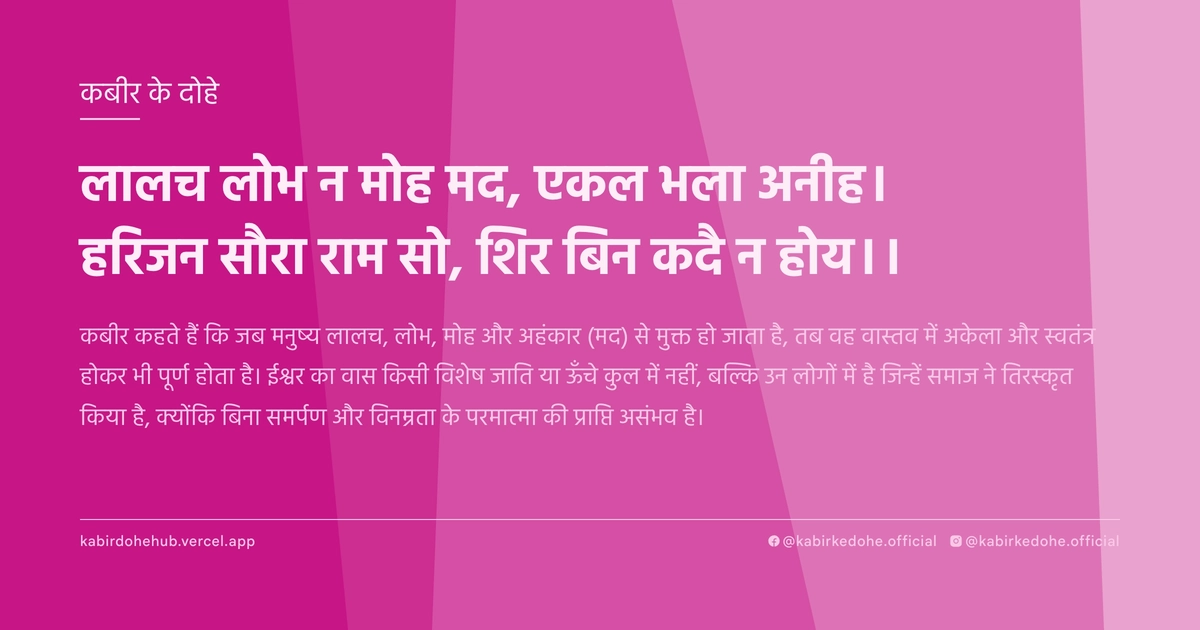
लालच लोभ न मोह मद, एकल भला अनीह।
हरिजन सौरा राम सो, शिर बिन कदै न होय।।
Lalach lobh na moh mad, ekal bhala anih. Harijan saura ram so, shir bin kadai na hoye.
इस पृष्ठ पर इस कबीर दोहे का अर्थ (meaning), हिंदी व्याख्या और अंग्रेज़ी अनुवाद, दार्शनिक विश्लेषण और व्यावहारिक जीवन सीख दी गई है। यह दोहा लोभ (Greed) विषय से जुड़ा है — Kabir doha meaning and explanation in Hindi and English.
अर्थ (Meaning):
कबीर कहते हैं कि जब मनुष्य लालच, लोभ, मोह और अहंकार (मद) से मुक्त हो जाता है, तब वह वास्तव में अकेला और स्वतंत्र होकर भी पूर्ण होता है। ईश्वर का वास किसी विशेष जाति या ऊँचे कुल में नहीं, बल्कि उन लोगों में है जिन्हें समाज ने तिरस्कृत किया है, क्योंकि बिना समर्पण और विनम्रता के परमात्मा की प्राप्ति असंभव है।
Kabir asserts that when a human is liberated from greed, attachment, and the intoxication of ego, they find a profound, solitary wholeness. He emphasizes that the Divine does not reside in social hierarchies or ritual purity, but within the marginalized and the humble, for without the complete surrender of the ego, one can never truly encounter the Eternal.
व्याख्या (Interpretation):
इस दोहे का शाब्दिक अर्थ है कि लोभ और अहंकार का त्याग ही सच्ची मुक्ति है। रूपक के तौर पर, 'मद' वह पर्दा है जो आत्मा और परमात्मा के बीच खड़ा है। निर्गुण भक्ति के अनुसार, ईश्वर किसी मूर्ति या मंदिर में नहीं, बल्कि शुद्ध चेतना में है। यहाँ 'हरिजन' और 'सौरा' का उल्लेख सामाजिक रूढ़ियों पर प्रहार है, जो यह दर्शाता है कि आध्यात्मिक पात्रता जाति से नहीं, बल्कि आंतरिक शुद्धि से आती है। यह अद्वैत वेदांत के उस सिद्धांत को पुष्ट करता है जहाँ आत्मा और ब्रह्म एक हैं, और केवल माया (अहंकार) ही इस एकता को बाधित करती है। अंततः, 'शिर' का अर्थ यहाँ अहंकार के विसर्जन से है; जैसे बिना सिर के शरीर नहीं चलता, वैसे ही बिना अहंकार के विनाश के मोक्ष संभव नहीं है।
Literally, the verse claims that shedding greed and pride is the only path to liberation. Metaphorically, 'Mad' (intoxication/pride) is the veil obscuring the Atman from Brahman. In the context of Nirgun Bhakti, the Divine is formless and omnipresent, residing not in idols but in pure consciousness. The mention of 'Harijan' and 'Saura' (marginalized castes) is a subversive critique of ritual purity, suggesting that spiritual merit is decoupled from social status. This aligns with Advaita Vedanta, where the illusion of separation (Maya) is dismantled through the realization of non-duality. The 'head' (shir) serves as a potent symbol for the ego; just as a body cannot function without a head, the spiritual journey cannot culminate without the total annihilation of the self-important identity.
दार्शनिक विश्लेषण (Philosophical Analysis):
कबीर का यह दोहा उनके युग के कट्टरपंथी धार्मिक वातावरण के विरुद्ध एक सशक्त विद्रोह है। उन्होंने देखा कि धर्म केवल कर्मकांडों और जातिगत श्रेष्ठता का साधन बन गया था। इस दर्शन में, वे सूफी मत के 'फना' (अहंकार का विनाश) और वेदांत के 'अहम ब्रह्मास्मि' का समन्वय करते हैं। उनके लिए, लालच और मोह केवल मानसिक विकार नहीं, बल्कि आध्यात्मिक बाधाएँ हैं जो जीव को संसार के चक्र में फँसाए रखती हैं।
वे इस बात पर जोर देते हैं कि ईश्वर की खोज बाहर नहीं, बल्कि भीतर की रिक्तता में है। जब व्यक्ति 'अनीह' (इच्छा रहित) हो जाता है, तब वह शून्य में प्रवेश करता है, और वही शून्य पूर्णता है। यह विचार कि ईश्वर दलितों और वंचितों में बसता है, उस समय की सामाजिक संरचना को चुनौती देता था और यह स्थापित करता था कि भक्ति का मार्ग सबके लिए खुला है।
मनोवैज्ञानिक स्तर पर, कबीर यहाँ 'अहंकार के विलोपन' की बात कर रहे हैं। जब तक 'मैं' जीवित है, तब तक 'वह' (परमात्मा) प्रकट नहीं हो सकता। यह द्वैत से अद्वैत की ओर संक्रमण है। वे चेतावनी देते हैं कि जो व्यक्ति अपनी सामाजिक स्थिति या ज्ञान का अहंकार करता है, वह वास्तव में ईश्वर से सबसे दूर है।
सूफीवाद के प्रभाव में, कबीर प्रेम को ही सर्वोच्च ज्ञान मानते हैं। लोभ और मोह प्रेम के विपरीत हैं क्योंकि वे 'पाने' की इच्छा से जुड़े हैं, जबकि सच्चा प्रेम 'मिट जाने' की प्रक्रिया है। यह विसर्जन ही वह बिंदु है जहाँ मनुष्य और ईश्वर का भेद समाप्त हो जाता है।
अंततः, यह विश्लेषण हमें बताता है कि मुक्ति किसी बाहरी अनुष्ठान से नहीं, बल्कि आंतरिक रूपांतरण से आती है। कबीर का मार्ग 'सहज मार्ग' है, जहाँ जीवन की साधारण गतिविधियों के बीच ही सर्वोच्च सत्य का अनुभव किया जा सकता है, बशर्ते कि हृदय में कोई विकार न हो।
This Doha represents a fierce rebellion against the dogmatic religious atmosphere of Kabir's era, where spirituality had been reduced to ritualistic purity and caste superiority. Kabir synthesizes the Sufi concept of 'Fana' (annihilation of the self) with the Vedantic realization of 'Aham Brahmasmi'. For him, greed and attachment are not merely psychological flaws but spiritual obstructions that bind the soul to the cycle of Samsara.
He emphasizes that the search for the Divine is not an outward journey but an inward descent into emptiness. When a seeker becomes 'Anih' (desireless), they enter the state of Shunya (void), which paradoxically is the state of absolute fullness. By asserting that the Divine resides in the marginalized, Kabir dismantles the social hierarchy, proving that spiritual eligibility is determined by purity of heart, not by birth.
Psychologically, Kabir is addressing the dissolution of the ego. As long as the 'I' persists, the 'Thou' (Divine) cannot manifest. This is the transition from duality to non-duality. He warns that those who cling to their social status or intellectual pride are the furthest from the Truth, as pride creates a barrier that no ritual can penetrate.
Influenced by Sufism, Kabir views love as the supreme knowledge. Greed and attachment are the antithesis of love because they are rooted in the desire to possess, whereas true spiritual love is the process of disappearing. This dissolution is the exact point where the distinction between the individual soul and the universal consciousness vanishes.
Ultimately, this analysis reveals that liberation is not achieved through external rites but through internal transmutation. Kabir proposes the 'Sahaj Marg' (the Natural Path), where the highest truth is experienced amidst the mundane activities of life, provided the heart is cleansed of all impurities.
मूल संदेश (Core Message):
- लालच और मोह आत्मा की दृष्टि को धुंधला कर देते हैं।
- अहंकार वह दीवार है जो मनुष्य को परमात्मा से अलग करती है।
- ईश्वर सामाजिक श्रेणियों में नहीं, बल्कि शुद्ध हृदय में बसता है।
- विनम्रता ही वह एकमात्र कुंजी है जो मोक्ष का द्वार खोलती है।
- स्वयं को मिटाना ही वास्तव में स्वयं को पाना है।
- Greed and attachment cloud the spiritual vision of the soul.
- Ego is the wall that separates the human from the Divine.
- God dwells not in social hierarchies, but in a pure heart.
- Humility is the only key that unlocks the door to liberation.
- To erase the self is to truly find the Self.
व्यावहारिक उदाहरण (Practical Example):
एक समय की बात है, वाराणसी के घाटों पर माधव नाम का एक अत्यंत विद्वान पंडित रहता था। माधव को अपने वेदों के ज्ञान और अपने कुल की शुद्धता पर बहुत गर्व था। वह हर समय इस बात का अहंकार करता था कि वह ईश्वर के सबसे करीब है क्योंकि वह कठिन अनुष्ठान करता था।
उसी शहर में एक बूढ़ा मोची था, जिसका नाम रामू था। रामू समाज की नजरों में 'अछूत' था और दिन भर फटे जूते सिलता था। वह गरीब था, लेकिन उसका हृदय करुणा से भरा था और वह चुपचाप ईश्वर का नाम जपता रहता था।
एक दिन माधव ने देखा कि रामू एक घायल कुत्ते की सेवा कर रहा था और अपनी रोटी का आधा हिस्सा उसे खिला रहा था। माधव ने उपहास करते हुए कहा, "तुम जैसे लोग कभी मोक्ष नहीं पा सकते, क्योंकि तुम्हें न तो मंत्र आते हैं और न ही तुम शुद्ध कुल से हो।"
रामू ने विनम्रता से मुस्कुराकर कहा, "पंडित जी, मैं तो बस एक तुच्छ सेवक हूँ। मेरे पास न ज्ञान है न पद, बस यह हृदय है जिसमें वह सबका वास करता है।"
उस रात माधव को एक विचित्र सपना आया। उसने देखा कि वह एक विशाल पर्वत पर चढ़ने की कोशिश कर रहा है, लेकिन उसका अहंकार एक भारी पत्थर की तरह उसके गले में लटका है, जिससे वह आगे नहीं बढ़ पा रहा।
तभी उसने देखा कि रामू बहुत सहजता से उस पर्वत के शिखर पर खड़ा है, क्योंकि उसके पास ढोने के लिए कोई अहंकार का बोझ नहीं था। वह पूरी तरह हल्का और मुक्त था।
माधव की नींद खुली और वह पसीने से तर-बतर था। उसे अचानक कबीर की पंक्तियाँ याद आईं कि ईश्वर उन लोगों में है जिन्हें दुनिया तुच्छ समझती है। उसे अहसास हुआ कि उसकी विद्वत्ता केवल एक मानसिक बोझ थी।
अगले दिन, माधव अपनी सारी किताबें एक तरफ रखकर रामू के पास गया और उसके पैरों में गिर पड़ा। उसने महसूस किया कि वास्तविक ज्ञान किताबों में नहीं, बल्कि अहंकार के विसर्जन और निस्वार्थ सेवा में है।
माधव ने अपना जीवन बदल लिया। अब वह केवल पूजा-पाठ नहीं करता था, बल्कि गरीबों की सेवा में अपना समय बिताने लगा। उसने सीखा कि जब तक 'मैं' नहीं मिटता, तब तक 'राम' नहीं मिलते।
इस प्रकार, एक अहंकारी विद्वान एक विनम्र मोची के माध्यम से सत्य के मार्ग पर चला। उसका जीवन अब दिखावे से मुक्त होकर वास्तविक शांति की ओर अग्रसर हो गया।
Once, on the ghats of Varanasi, lived a scholar named Madhav. He was profoundly learned in the Vedas and took immense pride in the perceived purity of his lineage. He believed he was closest to the Divine because of his rigorous adherence to complex rituals.
In the same city lived an elderly cobbler named Ramu. In the eyes of society, Ramu was an 'untouchable,' spending his days stitching worn-out shoes. He was impoverished, yet his heart overflowed with compassion, and he constantly chanted the name of the Divine in silence.
One day, Madhav observed Ramu tending to a wounded dog, feeding it half of his own meager meal. Madhav mocked him, saying, "People like you can never attain liberation; you know no mantras, nor do you belong to a pure caste."
Ramu smiled humbly and replied, "Pandit ji, I am but a lowly servant. I possess neither knowledge nor status, only this heart in which He resides for everyone."
That night, Madhav had a strange dream. He saw himself trying to climb a massive mountain, but his ego was like a heavy boulder tied around his neck, preventing him from ascending.
Then he saw Ramu standing effortlessly at the peak of the mountain, for he carried no burden of pride. He was completely light, transparent, and free.
Madhav woke up drenched in sweat. He suddenly recalled Kabir's words that the Divine dwells in those whom the world deems insignificant. He realized that his scholarship was merely a mental burden.
The next day, Madhav set aside his books, approached Ramu, and fell at his feet. He understood that true knowledge is not found in texts, but in the dissolution of the ego and selfless service.
Madhav transformed his life. He no longer focused solely on rituals but dedicated his time to serving the poor. He learned that until the 'I' is erased, the 'Divine' cannot be found.
Thus, an arrogant scholar found the path to truth through a humble cobbler. His life shifted from a performance of piety to a lived experience of genuine peace.
अभ्यास मार्गदर्शन (Practice Guidance):
- प्रतिदिन 20 मिनट मौन ध्यान करें, जहाँ आप अपने भीतर उठने वाले 'मैं' (अहंकार) के विचारों को केवल एक साक्षी की तरह देखें, बिना किसी निर्णय के।
- एक 'अहंकार डायरी' लिखें: दिन भर में ऐसे क्षणों को नोट करें जब आपने अपनी श्रेष्ठता सिद्ध करने की कोशिश की या किसी को छोटा महसूस कराया।
- सप्ताह में एक बार किसी ऐसे व्यक्ति की निस्वार्थ सेवा करें जिसे समाज उपेक्षित मानता है, और इस प्रक्रिया में अपनी आंतरिक प्रतिरोधक क्षमता (Resistance) को पहचानें।
- निदान चेकलिस्ट: क्या मैं दूसरों की प्रशंसा पर निर्भर हूँ? क्या मैं अपनी उपलब्धियों का श्रेय केवल स्वयं को देता हूँ? क्या मुझे दूसरों की सफलता से जलन होती है? यदि हाँ, तो अहंकार अभी जीवित है।
- Practice 20 minutes of silent meditation daily, observing the arising thoughts of 'I' (ego) as a detached witness without judgment.
- Maintain an 'Ego Journal': Note moments throughout the day when you attempted to prove your superiority or made someone else feel inferior.
- Engage in selfless service once a week for someone marginalized by society, consciously observing your internal resistance to this act.
- Diagnostic Checklist: Am I dependent on external validation? Do I claim sole credit for my achievements? Do I feel resentment toward others' success? If yes, the ego is still active.
चिंतन प्रश्न (Reflection Questions):
- मेरी वह कौन सी 'पहचान' है जिसे खोने के डर से मैं सबसे ज्यादा डरता हूँ?
- क्या मेरी धार्मिक या नैतिक मान्यताएं वास्तव में करुणा से प्रेरित हैं, या वे केवल मेरी श्रेष्ठता की भावना को पुष्ट करती हैं?
- यदि समाज से मेरा पद, पैसा और प्रतिष्ठा छीन ली जाए, तो मेरे भीतर क्या बचेगा?
- मैं किन लोगों को अनजाने में 'छोटा' समझता हूँ, और यह धारणा मेरे किस डर से जुड़ी है?
- क्या मेरा 'डिजिटल व्यक्तित्व' (सोशल मीडिया) मेरे वास्तविक आंतरिक शून्य को छिपाने का एक माध्यम है?
- Which 'identity' am I most terrified of losing, and why does it define me?
- Are my religious or moral beliefs truly driven by compassion, or do they merely reinforce a sense of superiority?
- If my status, wealth, and reputation were stripped away, what would remain of me?
- Whom do I unconsciously perceive as 'inferior,' and what fear does this perception stem from?
- Is my 'digital persona' merely a mask to hide the internal void of my existence?