
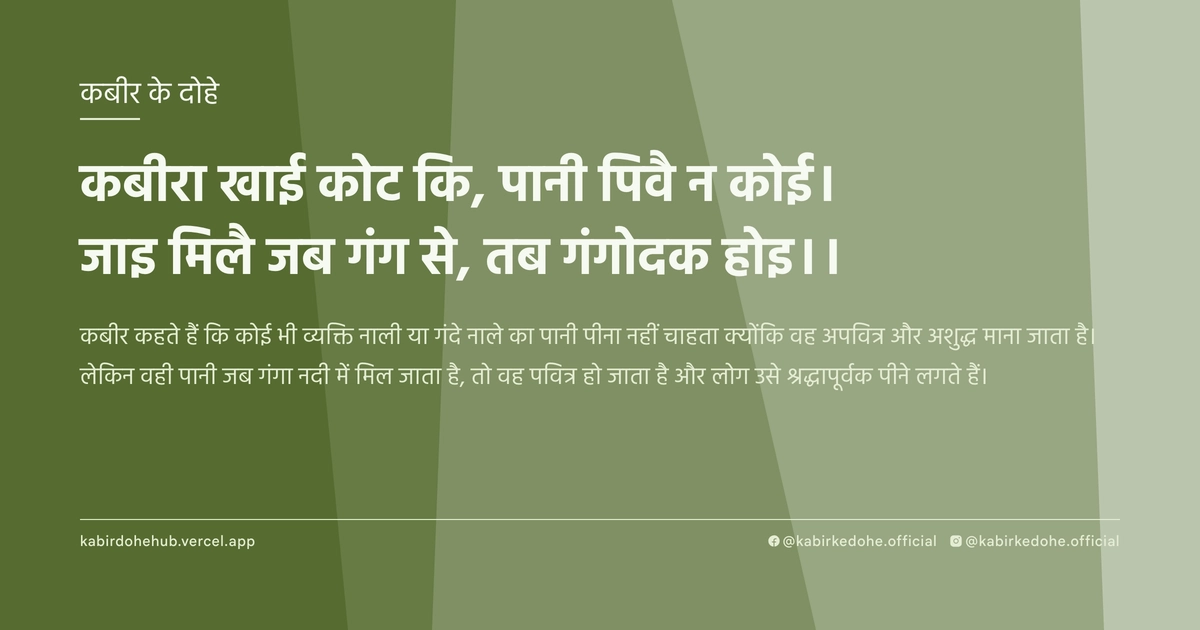
कबीरा खाई कोट कि, पानी पिवै न कोई।
जाइ मिलै जब गंग से, तब गंगोदक होइ।।
Kabira khai kot ki, paani pivai na koi. Jai milai jab gang se, tab gangodak hoye.
इस पृष्ठ पर इस कबीर दोहे का अर्थ (meaning), हिंदी व्याख्या और अंग्रेज़ी अनुवाद, दार्शनिक विश्लेषण और व्यावहारिक जीवन सीख दी गई है। यह दोहा प्रपत्ति (Surrender) विषय से जुड़ा है — Kabir doha meaning and explanation in Hindi and English.
अर्थ (Meaning):
कबीर कहते हैं कि कोई भी व्यक्ति नाली या गंदे नाले का पानी पीना नहीं चाहता क्योंकि वह अपवित्र और अशुद्ध माना जाता है। लेकिन वही पानी जब गंगा नदी में मिल जाता है, तो वह पवित्र हो जाता है और लोग उसे श्रद्धापूर्वक पीने लगते हैं।
Kabir observes that no one desires to drink water from a gutter or a sewage drain due to its impurity. However, once that very same water merges into the holy Ganges, it is transformed and revered as sacred water, which people then consume with great devotion.
व्याख्या (Interpretation):
शाब्दिक रूप से, यह दोहा जल की शुद्धि की बात करता है, लेकिन आध्यात्मिक स्तर पर यह आत्मा के रूपांतरण का प्रतीक है। 'खाई कोट' या नाली मानवीय अहंकार, वासनाओं और सांसारिक अशुद्धियों का प्रतिनिधित्व करती है, जो व्यक्ति को ईश्वर से अलग करती है। 'गंगा' यहाँ उस परम चेतना या निर्गुण ब्रह्म का प्रतीक है, जिसमें विलीन होने पर व्यक्तिगत पहचान समाप्त हो जाती है। यह अद्वैत वेदांत के उस सिद्धांत को दर्शाता है जहाँ जीव (व्यष्टि) जब ब्रह्म (समष्टि) में मिलता है, तो उसकी सारी अशुद्धियाँ समाप्त हो जाती हैं। यह विरोधाभास है कि जो वस्तु घृणित थी, वह परमात्मा के संपर्क में आते ही पूजनीय हो गई। इस प्रकार, यह दोहा बताता है कि मुक्ति बाहरी कर्मकांडों से नहीं, बल्कि पूर्ण समर्पण और विलय से संभव है।
Literally, the couplet speaks of the purification of water, but on a spiritual plane, it symbolizes the transmutation of the soul. The 'gutter' represents human ego, desires, and worldly impurities that alienate the individual from the Divine. The 'Ganges' serves as a metaphor for the Supreme Consciousness or Nirgun Brahman, where the dissolution of the individual identity occurs. This aligns with the Advaita Vedanta principle where the Jiva (individual soul), upon merging with Brahman (Universal Soul), sheds all impurities. The central paradox lies in the fact that something once loathed becomes venerable upon contacting the Divine. Thus, the verse asserts that liberation is achieved not through external rituals, but through total surrender and ontological merging.
दार्शनिक विश्लेषण (Philosophical Analysis):
कबीर का यह दोहा उनके युग के सामाजिक और धार्मिक पाखंड पर एक गहरा प्रहार है। उस समय समाज जाति और जन्म के आधार पर 'शुद्ध' और 'अशुद्ध' का निर्धारण करता था। कबीर इस द्वैत को चुनौती देते हुए यह तर्क देते हैं कि पवित्रता किसी बाहरी स्रोत या जन्म से नहीं, बल्कि उस परम तत्व के साथ एकाकार होने से आती है। वे यहाँ 'निर्गुण भक्ति' का समर्थन कर रहे हैं, जहाँ ईश्वर किसी विशेष मंदिर या मूर्ति में नहीं, बल्कि हर कण में व्याप्त है।
दार्शनिक रूप से, यह सूफीवाद के 'फना' (अस्तित्व का मिट जाना) के सिद्धांत से मिलता-जुलता है। जिस प्रकार नाली का पानी अपनी अलग पहचान खोकर गंगा बन जाता है, उसी प्रकार साधक जब अपने 'मैं' (अहंकार) को मिटा देता है, तो वह परमात्मा का ही रूप हो जाता है। यहाँ माया वह भ्रम है जो हमें यह विश्वास दिलाता है कि हम अलग और अशुद्ध हैं।
कबीर कर्मकांडीय शुद्धता (Ritual Purity) का उपहास करते हैं। वे बताते हैं कि यदि कोई व्यक्ति बाहरी तौर पर पवित्र होने का ढोंग करे लेकिन भीतर से अहंकार से भरा हो, तो वह नाली के पानी के समान है। वास्तविक शुद्धि केवल आंतरिक रूपांतरण से आती है।
अद्वैत वेदांत के अनुसार, आत्मा और परमात्मा मूलतः एक ही हैं। अज्ञानता के कारण हम स्वयं को सीमित और दूषित महसूस करते हैं। जब ज्ञान की गंगा प्रवाहित होती है, तो यह बोध होता है कि अशुद्धि केवल एक भ्रम थी।
अंततः, यह विश्लेषण हमें यह समझने पर मजबूर करता है कि मनुष्य का मूल्य उसके वर्तमान हालात या सामाजिक स्थिति से नहीं, बल्कि उसकी आध्यात्मिक क्षमता और समर्पण से तय होता है। यह अहंकार के विसर्जन की प्रक्रिया है, जहाँ 'बूंद' का 'सागर' में मिल जाना ही अंतिम सत्य है।
This couplet by Kabir is a profound critique of the social and religious hypocrisy of his era. At the time, society determined 'purity' and 'impurity' based on caste and birth. Kabir challenges this duality, arguing that purity does not stem from an external source or lineage, but from unification with the Supreme Element. He advocates for 'Nirgun Bhakti,' where the Divine is not confined to a temple or idol but permeates every atom of existence.
Philosophically, this mirrors the Sufi concept of 'Fana' (the annihilation of the self). Just as the gutter water loses its distinct identity to become the Ganges, the seeker, by erasing the 'I' (ego), becomes a manifestation of the Divine. Maya is the illusion that convinces us we are separate and tainted.
Kabir mocks ritualistic purity. He suggests that a person who pretends to be pure externally while remaining filled with ego is akin to gutter water. True purification occurs only through internal transmutation and the realization of the formless truth.
According to Advaita Vedanta, the Atman (individual soul) and Brahman (Universal Soul) are fundamentally one. Due to Avidya (ignorance), we perceive ourselves as limited and impure. When the 'Ganges of Knowledge' flows, the realization dawns that impurity was merely a conceptual error.
Ultimately, this analysis forces us to understand that a human's value is not determined by their current circumstances or social status, but by their spiritual capacity and surrender. It is the process of dissolving the ego, where the 'drop' merging into the 'ocean' is the ultimate truth.
मूल संदेश (Core Message):
- बाहरी अशुद्धता केवल एक भ्रम है, वास्तविक अशुद्धता अहंकार है।
- जब 'मैं' मिटता है, तब केवल 'वह' (परमात्मा) शेष रहता है।
- समर्पण ही वह प्रक्रिया है जो तुच्छ को दिव्य बनाती है।
- पवित्रता किसी स्थान में नहीं, बल्कि चेतना के विलय में है।
- अद्वैत का सत्य यह है कि हम कभी अशुद्ध थे ही नहीं।
- External impurity is a mere illusion; the only true impurity is the ego.
- When the 'I' vanishes, only the 'Divine' remains.
- Surrender is the alchemy that transforms the trivial into the divine.
- Purity resides not in a place, but in the merging of consciousness.
- The truth of Non-duality is that we were never actually impure.
व्यावहारिक उदाहरण (Practical Example):
एक समय की बात है, वाराणसी के घाटों पर माधव नाम का एक वृद्ध नाविक रहता था। माधव का जीवन संघर्षों से भरा था और समाज उसे एक 'निम्न' व्यक्ति मानता था क्योंकि वह दिन भर गंदगी और कीचड़ के बीच नाव चलाता था। वह खुद को भी समाज की नजरों से देखने लगा था—एक ऐसा व्यक्ति जो केवल गंदगी बटोरता है और जिसका जीवन एक नाली की तरह अर्थहीन है।
माधव के मन में गहरी कुंठा थी। वह अक्सर सोचता कि क्या उसके जैसा व्यक्ति कभी शांति पा सकता है? वह मंदिर के बाहर खड़ा होकर देखता कि कैसे लोग पवित्रता की बातें करते हैं, जबकि वे खुद भीतर से ईर्ष्या और क्रोध से भरे होते थे। माधव ने खुद को 'अशुद्ध' मान लिया था और अपनी आत्मा की गरिमा को पूरी तरह भुला दिया था।
एक दिन, माधव की मुलाकात एक घुमक्कड़ संत से हुई। संत ने माधव की उदासी को देखा और उससे पूछा, 'तुम इतने दुखी क्यों हो?' माधव ने जवाब दिया, 'महाराज, मैं एक तुच्छ नाविक हूँ, मेरा पूरा जीवन कीचड़ और गंदगी में बीता है। मैं कभी पवित्र नहीं हो सकता।'
संत मुस्कुराए और उन्होंने माधव को नदी के किनारे एक छोटी सी नाली दिखाई जो सीधे गंगा में गिर रही थी। संत ने कहा, 'देखो माधव, यह नाली का पानी कितना गंदा है। कोई इसे छूना भी नहीं चाहता। लेकिन देखो, जैसे ही यह पानी गंगा की लहरों में मिलता है, यह खुद गंगा बन जाता है। क्या अब तुम इसे गंदा कहोगे?'
माधव चुप रहा। संत ने आगे कहा, 'तेरा जीवन भी इस नाली की तरह है। तूने अपनी पहचान अपनी परिस्थितियों और समाज के लेबल से जोड़ ली है। लेकिन तू वास्तव में वह पानी है, जिसकी नियति गंगा में मिलना है। जिस दिन तू अपने अहंकार और इस विचार को छोड़ देगा कि तू 'अशुद्ध' है, तू उसी क्षण उस परमात्मा का हिस्सा बन जाएगा।'
इस बात ने माधव के भीतर कुछ बदल दिया। उसने महसूस किया कि उसकी 'अशुद्धता' उसकी परिस्थिति नहीं, बल्कि उसका यह विश्वास था कि वह अलग और छोटा है। उसने बाहरी दुनिया की परवाह करना छोड़ दिया और अपने भीतर के प्रेम और सेवा को जगाया।
अब माधव केवल नाव नहीं चलाता था, बल्कि वह हर यात्री की मदद निस्वार्थ भाव से करने लगा। उसने अपने जीवन की गंदगी को सेवा की गंगा में मिला दिया। वह अब खुद को नाविक नहीं, बल्कि उस अनंत प्रवाह का एक हिस्सा मानने लगा।
समय के साथ, माधव का व्यवहार इतना शांत और करुणामयी हो गया कि वही लोग जो उसे 'अशुद्ध' कहते थे, अब उसके पास मानसिक शांति और मार्गदर्शन के लिए आने लगे। माधव ने यह सिद्ध कर दिया कि जब व्यक्ति अपनी सीमित पहचान को मिटाकर सार्वभौमिक प्रेम में विलीन हो जाता है, तो वह स्वयं पवित्रता का स्रोत बन जाता है।
Once, on the ghats of Varanasi, lived an elderly boatman named Madhav. Madhav's life was fraught with struggle, and society viewed him as 'lowly' because he spent his days navigating through silt and grime. He began to see himself through the eyes of society—as a man who only gathered filth, whose life was as meaningless as a gutter.
Madhav harbored a deep sense of resentment. He often wondered if someone like him could ever find peace. He would stand outside temples, watching people speak of purity while they themselves were consumed by envy and rage. Madhav had accepted the label of 'impure' and completely forgotten the dignity of his own soul.
One day, Madhav encountered a wandering saint. Noticing Madhav's melancholy, the saint asked, 'Why are you so sorrowful?' Madhav replied, 'Maharaj, I am a lowly boatman; my entire life has been spent in mud and filth. I can never be pure.'
The saint smiled and pointed to a small drain flowing directly into the Ganges. He said, 'Look, Madhav, how dirty this drain water is. No one wants to touch it. But look, the moment this water merges with the waves of the Ganges, it becomes the Ganges itself. Would you call it dirty now?'
Madhav remained silent. The saint continued, 'Your life is like this drain. You have tied your identity to your circumstances and the labels of society. But you are actually that water, whose destiny is to merge with the Ganges. The day you let go of your ego and the belief that you are "impure," you will instantly become a part of the Divine.'
These words triggered a shift within Madhav. He realized that his 'impurity' was not his situation, but his belief that he was separate and insignificant. He stopped caring about the external world and awakened the love and service within him.
Now, Madhav didn't just row boats; he began helping every passenger with selfless devotion. He merged the filth of his existence into the Ganges of service. He no longer saw himself as a boatman, but as a part of that infinite flow.
Over time, Madhav's demeanor became so serene and compassionate that the very people who once called him 'impure' began seeking him out for mental peace and guidance. Madhav proved that when a person dissolves their limited identity into universal love, they themselves become a source of purity.
अभ्यास मार्गदर्शन (Practice Guidance):
- प्रतिदिन 20 मिनट मौन ध्यान करें, जहाँ आप कल्पना करें कि आपका व्यक्तिगत अहंकार (मैं) एक छोटी बूंद है जो एक विशाल आध्यात्मिक महासागर में विलीन हो रही है।
- स्व-पूछताछ जर्नल: प्रतिदिन लिखें कि आज आपने किस बात पर अपनी 'श्रेष्ठता' या 'हीनता' महसूस की। विश्लेषण करें कि यह भावना किस 'लेबल' या 'अहंकार' से उपजी है।
- व्यवहार परिवर्तन: दिन में कम से कम एक बार ऐसे व्यक्ति की मदद करें जिसे समाज 'अवांछित' या 'अशुद्ध' मानता है, और उस प्रक्रिया में स्वयं के भीतर के भेदभाव को पहचानें और मिटाएं।
- निदान चेकलिस्ट: क्या आप अभी भी अपनी गलतियों के लिए दूसरों को दोष देते हैं? क्या आप अपनी पहचान अपने पद या जाति से जोड़ते हैं? यदि हाँ, तो आप अभी भी 'नाली के पानी' की सीमित पहचान में हैं।
- Practice 20 minutes of silent meditation daily, visualizing your individual ego (the 'I') as a tiny drop merging into a vast spiritual ocean.
- Self-Inquiry Journaling: Record moments where you felt 'superior' or 'inferior' today. Analyze which 'label' or 'ego-construct' triggered this feeling.
- Behavioral Shift: At least once a day, serve someone whom society deems 'undesirable' or 'impure,' and in doing so, consciously identify and dissolve your own internal biases.
- Diagnostic Checklist: Do you still blame others for your failures? Do you define your identity by your rank or caste? If yes, you are still clinging to the limited identity of the 'gutter water'.
चिंतन प्रश्न (Reflection Questions):
- मेरे जीवन में वह 'नाली' क्या है—वह कौन सी आदत या विचार है जिसे मैं अपनी पहचान मान चुका हूँ?
- मैं किन लोगों को 'अशुद्ध' या 'निम्न' मानता हूँ, और यह धारणा मेरे अपने किस डर को छिपा रही है?
- यदि मेरी सामाजिक पहचान (नाम, पद, जाति) छीन ली जाए, तो क्या मेरे भीतर कुछ बचेगा जिसे मैं 'पवित्र' कह सकूँ?
- क्या मेरा धर्म और आध्यात्मिकता मुझे दूसरों से अलग कर रहे हैं या मुझे सबके साथ जोड़ रहे हैं?
- मैं अपनी 'पवित्रता' को सिद्ध करने के लिए बाहरी दिखावों का सहारा क्यों लेता हूँ?
- What is the 'gutter' in my life—which habit or thought have I mistaken for my identity?
- Whom do I perceive as 'impure' or 'lowly,' and what internal fear does this prejudice hide?
- If my social identity (name, rank, caste) were stripped away, would anything remain within me that I could call 'pure'?
- Is my practice of religion and spirituality separating me from others or connecting me to everyone?
- Why do I rely on external displays to prove my 'purity' to the world?