
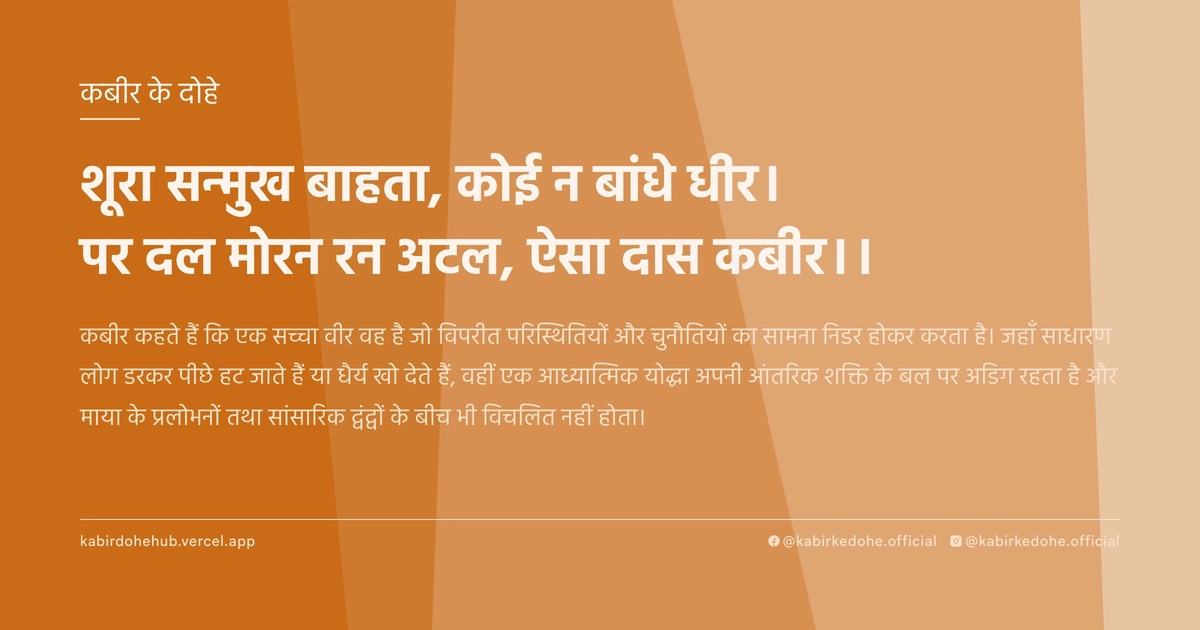
शूरा सन्मुख बाहता, कोई न बांधे धीर।
पर दल मोरन रन अटल, ऐसा दास कबीर।।
Shura sanmukh bahta, koi na bandhe dheer. Par dal moran ran atal, aisa das kabir.
इस पृष्ठ पर इस कबीर दोहे का अर्थ (meaning), हिंदी व्याख्या और अंग्रेज़ी अनुवाद, दार्शनिक विश्लेषण और व्यावहारिक जीवन सीख दी गई है। यह दोहा धैर्य (Patience) विषय से जुड़ा है — Kabir doha meaning and explanation in Hindi and English.
अर्थ (Meaning):
कबीर कहते हैं कि एक सच्चा वीर वह है जो विपरीत परिस्थितियों और चुनौतियों का सामना निडर होकर करता है। जहाँ साधारण लोग डरकर पीछे हट जाते हैं या धैर्य खो देते हैं, वहीं एक आध्यात्मिक योद्धा अपनी आंतरिक शक्ति के बल पर अडिग रहता है और माया के प्रलोभनों तथा सांसारिक द्वंद्वों के बीच भी विचलित नहीं होता।
Kabir asserts that a true warrior is one who faces adversity and challenges with unwavering courage. While ordinary individuals may falter or lose their composure in the face of hardship, the spiritual seeker remains steadfast, anchored by inner strength, remaining unmoved by the temptations of Maya or the turbulence of worldly conflicts.
व्याख्या (Interpretation):
इस दोहे का शाब्दिक अर्थ एक ऐसे योद्धा से है जो युद्ध के मैदान में अडिग रहता है। लेकिन आध्यात्मिक स्तर पर, 'रण' या युद्ध बाहरी नहीं, बल्कि आंतरिक है—यह अहंकार और आत्मा के बीच का संघर्ष है। 'शूरा' यहाँ उस साधक का प्रतीक है जिसने अपनी इंद्रियों पर विजय प्राप्त कर ली है। यह निर्गुण भक्ति का सार है, जहाँ ईश्वर किसी मूर्ति में नहीं, बल्कि उस साहस में है जो सत्य को स्वीकार करने के लिए आवश्यक है। माया हमें भ्रमित करती है और भयभीत करती है, लेकिन जो व्यक्ति अद्वैत वेदांत के सत्य को जान लेता है कि वह और ब्रह्म एक ही हैं, वह मृत्यु और हानि के भय से मुक्त हो जाता है। यहाँ 'अटल' होने का अर्थ जड़ता नहीं, बल्कि वह स्थिरता है जो गहरे ध्यान और आत्म-साक्षात्कार से आती है।
Literally, the verse describes a warrior standing firm in the heat of battle. Metaphorically, however, the 'battlefield' is not external but internal—the perpetual conflict between the ego (Ahankara) and the True Self (Atman). The 'warrior' symbolizes the seeker who has conquered their senses. This aligns with Nirgun Bhakti, where the Divine is not found in idols but in the courage required to face the Absolute Truth. Maya creates illusions of separation and fear; yet, the one who realizes the non-duality of Advaita Vedanta—that the individual soul and Brahman are one—becomes liberated from the fear of loss or death. Being 'atal' or steadfast does not imply rigidity, but rather the profound stability born of deep meditation and self-realization, allowing the seeker to remain centered amidst the chaos of existence.
दार्शनिक विश्लेषण (Philosophical Analysis):
कबीर का यह दोहा उनके युग के सामाजिक और धार्मिक पाखंडों के विरुद्ध एक विद्रोह है। उस समय धर्म केवल कर्मकांडों और बाहरी दिखावे तक सीमित था। कबीर ने 'वीरता' की परिभाषा को शारीरिक युद्ध से हटाकर मानसिक और आध्यात्मिक युद्ध की ओर मोड़ दिया। उन्होंने सिखाया कि असली वीरता मंदिर या मस्जिद जाने में नहीं, बल्कि अपने भीतर के अंधकार से लड़ने में है।
यह विचार सूफी मत के 'नफ्स' (अहंकार) के विनाश से मेल खाता है। सूफीवाद में भी यह माना जाता है कि जब तक मनुष्य अपने निचले स्वभाव को नहीं मारता, वह ईश्वर से नहीं मिल सकता। कबीर का 'अटल' होना इसी अहंकार के विसर्जन की प्रक्रिया है। जब 'मैं' मिट जाता है, तब केवल वह बचता है जो अविनाशी है।
अद्वैत वेदांत के परिप्रेक्ष्य में, यह दोहा माया के पर्दे को हटाने की बात करता है। संसार एक रणभूमि है जहाँ सुख और दुख, लाभ और हानि निरंतर बदलते रहते हैं। जो व्यक्ति इस द्वैत (duality) से ऊपर उठ जाता है, वह वास्तव में 'शूरा' है। वह जानता है कि बाहरी परिस्थितियाँ उसकी आंतरिक शांति को प्रभावित नहीं कर सकतीं।
कबीर ने जाति और वर्ण व्यवस्था को पूरी तरह नकार दिया। उनके लिए वीरता किसी विशेष कुल या जाति की बपौती नहीं थी, बल्कि यह किसी भी व्यक्ति द्वारा प्राप्त की जा सकती थी जो सत्य के मार्ग पर चलने का साहस रखता हो। यह सामाजिक समानता का एक सशक्त संदेश था, जो यह बताता है कि आध्यात्मिक उत्थान के लिए केवल संकल्प और साधना की आवश्यकता है।
अंततः, यह दोहा मनोवैज्ञानिक रूपांतरण की बात करता है। भय मनुष्य की सबसे बड़ी कमजोरी है। जब साधक यह अनुभव करता है कि वह उस अनंत परमात्मा का अंश है, तो भय समाप्त हो जाता है। यह रूपांतरण व्यक्ति को एक 'दास' (समर्पण) से एक 'शूरा' (विजेता) में बदल देता है, जहाँ समर्पण ही उसकी सबसे बड़ी शक्ति बन जाता है।
This couplet is a rebellion against the social and religious hypocrisies of Kabir's era, where spirituality was reduced to mere rituals and outward displays. Kabir redefines 'valor' by shifting it from physical combat to the psychological and spiritual struggle within. He teaches that true bravery lies not in visiting temples or mosques, but in confronting the darkness within one's own consciousness.
This concept resonates deeply with the Sufi notion of the annihilation of the 'Nafs' (the lower ego). In Sufism, it is believed that until the ego is slain, union with the Divine is impossible. Kabir's 'steadfastness' is the process of this ego-dissolution. When the 'I' vanishes, only that which is eternal remains, rendering the seeker invincible to worldly suffering.
From the lens of Advaita Vedanta, the verse speaks of piercing the veil of Maya. The world is depicted as a battlefield of opposites—pleasure and pain, gain and loss. The one who transcends this duality is the true 'warrior.' Such a person recognizes that external circumstances cannot disturb the inherent stillness of the Atman.
Kabir explicitly rejected the caste system and social hierarchies. For him, spiritual valor was not the birthright of any specific caste or lineage but was accessible to anyone with the courage to walk the path of Truth. This was a powerful assertion of social equality, suggesting that spiritual evolution requires only resolve and disciplined practice.
Ultimately, the verse addresses a psychological transformation. Fear is the primary human limitation. When a seeker experiences their identity as a part of the Infinite Divine, fear evaporates. This shift transforms the individual from a 'slave' of circumstances into a 'warrior' of the spirit, where total surrender to the Divine becomes their greatest strength.
मूल संदेश (Core Message):
- बाहरी संघर्ष केवल आंतरिक कमजोरी का प्रतिबिंब होते हैं।
- सच्ची वीरता अहंकार का त्याग और सत्य का स्वीकार है।
- स्थिरता वह शक्ति है जो तूफान में भी दीपक को जलते रखती है।
- भय का अंत केवल आत्म-साक्षात्कार और परमात्मा में विश्वास से संभव है।
- अडिग रहना ही माया के जाल को काटने का एकमात्र तरीका है।
- जब 'मैं' मिटता है, तब अविनाशी आत्मा का साहस प्रकट होता है।
- External conflicts are merely reflections of internal weaknesses.
- True valor is the renunciation of ego and the acceptance of Truth.
- Stability is the power that keeps the lamp lit even in a storm.
- The end of fear is possible only through self-realization and faith in the Divine.
- Remaining steadfast is the only way to cut through the web of Maya.
- When the 'I' vanishes, the courage of the indestructible Soul emerges.
व्यावहारिक उदाहरण (Practical Example):
एक समय की बात है, वाराणसी के घाटों पर माधव नाम का एक वृद्ध बुनकर रहता था। माधव का जीवन अत्यंत सरल था, लेकिन उसके मन में एक गहरी बेचैनी थी। वह समाज के नियमों और लोगों की आलोचनाओं से बहुत डरता था। यदि कोई उसके काम में कमी निकालता, तो वह कई दिनों तक उदास रहता। वह खुद को एक कमजोर व्यक्ति मानता था जो परिस्थितियों के आगे झुक जाता है।
एक दिन माधव की मुलाकात एक घुमक्कड़ संत से हुई, जिसने उसे कबीर का यह दोहा सुनाया। संत ने उससे कहा, "माधव, तुम बाहरी दुनिया के शोर से डरते हो क्योंकि तुमने अपने भीतर के योद्धा को नहीं जगाया। असली युद्ध वह नहीं जो तलवारों से लड़ा जाए, बल्कि वह है जो तुम हर दिन अपने डर के खिलाफ लड़ते हो।"
माधव ने इस बात पर विचार किया। उसने तय किया कि अब वह अपनी शांति दूसरों के शब्दों में नहीं खोजेगा। कुछ समय बाद, शहर में एक भीषण बाढ़ आई। कई लोग घबराकर भाग रहे थे, चीख-चिल्ला रहे थे और अपनी संपत्ति बचाने की कोशिश में एक-दूसरे को धक्का दे रहे थे। चारों ओर अफरा-तफरी मची थी।
माधव ने देखा कि उसके पड़ोसी डर के मारे सुन्न हो गए थे। उसने अपनी पुरानी आदत के अनुसार डरना शुरू किया, लेकिन तभी उसे कबीर के शब्द याद आए—"रण अटल"। उसने महसूस किया कि यदि वह खुद घबराया हुआ रहेगा, तो दूसरों की मदद कैसे करेगा?
अचानक माधव के भीतर एक अजीब सा बदलाव आया। उसने अपनी घबराहट को स्वीकार किया और उसे किनारे कर दिया। उसने शांत मन से एक मजबूत रस्सी खोजी और एक छोटी नाव की मदद से उन लोगों को बाहर निकालना शुरू किया जो पानी में फंसे थे।
लोग हैरान थे कि जो माधव कल तक एक छोटी सी आलोचना से कांप जाता था, वह आज मौत के सामने इतना शांत और अडिग कैसे खड़ा है। उसने किसी की मदद के बदले कुछ नहीं मांगा और न ही वह अपनी वीरता का बखान कर रहा था।
जब बाढ़ का पानी उतरा, तो माधव का जीवन बदल चुका था। उसने महसूस किया कि उसकी असली ताकत उसकी मांसपेशियों में नहीं, बल्कि उसके मन की स्थिरता में थी। उसने सीखा कि विपरीत परिस्थितियों में विचलित न होना ही सच्ची वीरता है।
अब माधव केवल कपड़े नहीं बुनता था, बल्कि वह लोगों को मानसिक मजबूती का पाठ भी पढ़ाता था। उसने समझ लिया था कि जब हम स्वयं को उस परमात्मा से जोड़ लेते हैं, तो दुनिया का कोई भी तूफान हमें हिला नहीं सकता।
माधव अब एक 'शूरा' बन चुका था—एक ऐसा योद्धा जिसने अपने भीतर के भय को जीत लिया था। उसकी शांति अब उसकी ढाल थी और उसका धैर्य उसका शस्त्र।
यह बदलाव उसके व्यवहार में स्पष्ट था; वह अब आलोचनाओं पर मुस्कुराता और कठिन समय में दूसरों के लिए सहारा बनता। उसने जान लिया था कि अडिग रहना ही जीवन की सबसे बड़ी जीत है।
Once, in the ghats of Varanasi, lived an elderly weaver named Madhav. Madhav's life was simple, but he carried a deep internal restlessness. He was terrified of social norms and the criticism of others. If someone found a flaw in his weaving, he would remain despondent for days, viewing himself as a weak man who succumbed to circumstances.
One day, Madhav met a wandering saint who recited this Doha of Kabir. The saint told him, "Madhav, you fear the noise of the external world because you have not awakened the warrior within. The real battle is not fought with swords, but against the fear you face every single day."
Madhav pondered this. He decided that he would no longer seek his peace in the words of others. Sometime later, a devastating flood hit the city. People were panicking, screaming, and pushing one another in a desperate attempt to save their belongings. Chaos reigned everywhere.
Madhav noticed his neighbors were paralyzed by fear. He initially began to panic as well, but then Kabir's words echoed in his mind—"Ran Atal" (Steadfast in battle). He realized that if he remained terrified, he could never help anyone else.
Suddenly, a strange shift occurred within Madhav. He acknowledged his fear and consciously set it aside. With a calm mind, he found a sturdy rope and used a small boat to rescue those trapped in the rising waters.
People were astonished. The same Madhav who used to tremble at a minor criticism was now standing calm and resolute in the face of death. He asked for nothing in return and did not boast of his bravery.
When the waters receded, Madhav's life had changed. He realized that his true strength lay not in his muscles, but in the stability of his mind. He learned that remaining unmoved in the face of adversity is the highest form of valor.
From then on, Madhav did not just weave cloth; he taught people about mental fortitude. He understood that when one connects themselves to the Divine, no worldly storm can shake them.
Madhav had become a 'Shoora'—a warrior who had conquered his internal fear. His peace became his shield, and his patience became his weapon.
This transformation was evident in his behavior; he now smiled at criticism and became a pillar of support for others during hardships. He had discovered that remaining steadfast is the ultimate victory of life.
अभ्यास मार्गदर्शन (Practice Guidance):
- प्रतिदिन 20 मिनट का मौन ध्यान करें, जहाँ आप अपने भीतर उठने वाले भय और असुरक्षाओं को केवल एक साक्षी (observer) की तरह देखें, बिना उनसे जुड़े।
- एक 'साहस पत्रिका' (Courage Journal) बनाएँ। हर दिन एक ऐसी स्थिति लिखें जहाँ आपने अपनी प्रतिक्रिया को नियंत्रित किया और आवेग के बजाय धैर्य को चुना।
- जब भी आप तनाव महसूस करें, स्वयं से पूछें: "क्या यह डर वास्तविक है या यह केवल मेरी माया (भ्रम) है?" इस प्रश्न के माध्यम से अपनी चेतना को वर्तमान क्षण में वापस लाएँ।
- व्यवहार परिवर्तन: जानबूझकर ऐसी छोटी स्थितियों में खुद को डालें जो आपको असहज करती हैं (जैसे किसी अजनबी से बात करना या अपनी गलती स्वीकार करना), ताकि आप अपने सामाजिक भय को जीत सकें।
- डायग्नोस्टिक चेकलिस्ट: यदि आप दूसरों की राय से विचलित होते हैं, छोटी समस्याओं पर अत्यधिक प्रतिक्रिया देते हैं, या कठिन समय में हार मान लेते हैं, तो इसका अर्थ है कि आपका 'आंतरिक योद्धा' अभी सुप्त है।
- Practice 20 minutes of silent meditation daily, observing the fears and insecurities arising within you as a detached witness, without identifying with them.
- Maintain a 'Courage Journal.' Every day, record a situation where you controlled your reaction and chose patience over impulse.
- Whenever you feel stressed, ask yourself: "Is this fear real, or is it merely my Maya (illusion)?" Use this inquiry to bring your consciousness back to the present moment.
- Behavioral Shift: Deliberately place yourself in small, uncomfortable situations (such as initiating a conversation with a stranger or admitting a mistake) to conquer social anxieties.
- Diagnostic Checklist: If you are easily swayed by others' opinions, overreact to minor inconveniences, or surrender quickly during hardships, it indicates that your 'inner warrior' is still dormant.
चिंतन प्रश्न (Reflection Questions):
- मेरे जीवन का वह कौन सा 'युद्ध' है जिसे मैं टालने की कोशिश कर रहा हूँ, और वह डर वास्तव में क्या है?
- क्या मेरी 'शांति' वास्तव में आंतरिक है, या यह केवल तब तक है जब तक परिस्थितियाँ मेरे अनुकूल हैं?
- मैं अपनी सार्वजनिक छवि (Public Image) को बचाने के लिए अपने आंतरिक सत्य से कितना समझौता करता हूँ?
- मेरे भीतर का वह कौन सा अहंकार है जो मुझे वास्तव में 'अटल' होने से रोक रहा है?
- यदि आज मेरी सारी सामाजिक पहचान छीन ली जाए, तो क्या मेरे पास कोई ऐसा आंतरिक आधार बचेगा जो मुझे स्थिर रख सके?
- क्या मैं अपनी कमजोरियों को 'स्वभाव' कहकर उन्हें बदलने के साहस से बच रहा हूँ?
- What is the 'battle' in my life that I am trying to avoid, and what is the actual root of that fear?
- Is my 'peace' truly internal, or does it only exist as long as circumstances are favorable?
- How much do I compromise my internal truth just to protect my public image and social identity?
- Which part of my ego is preventing me from becoming truly 'steadfast' and centered?
- If all my social identities were stripped away today, would I have an internal foundation to keep me stable?
- Am I avoiding the courage to change by labeling my weaknesses as simply 'my nature'?