
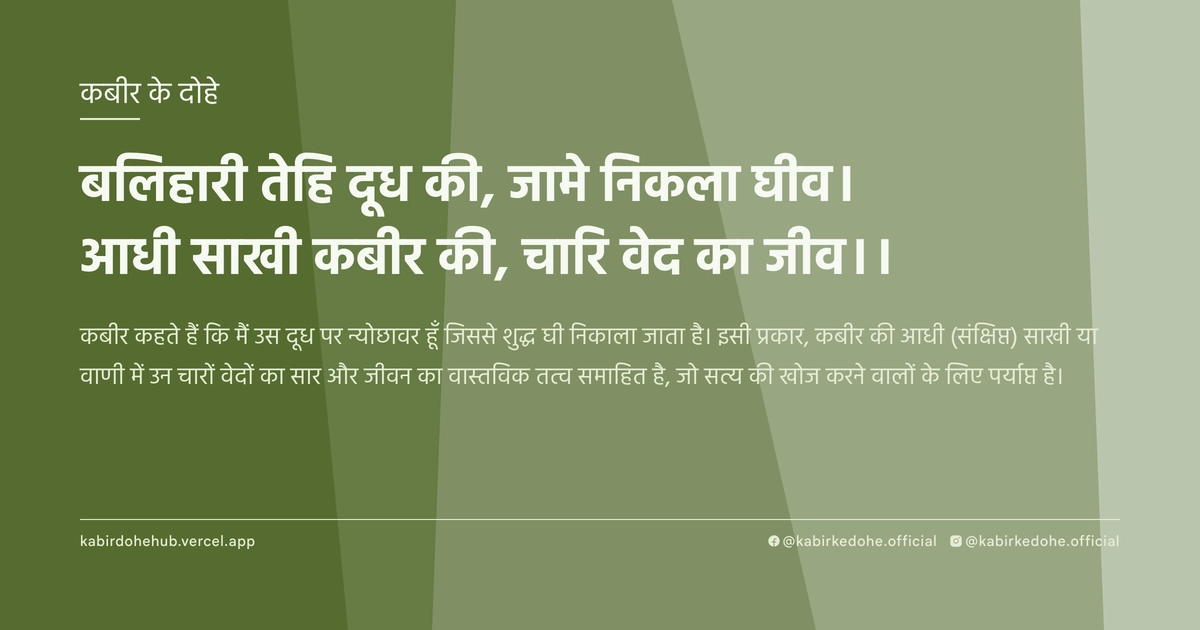
बलिहारी तेहि दूध की, जामे निकला घीव।
आधी साखी कबीर की, चारि वेद का जीव।।
Balihari tehi doodh ki, jaame nikla gheev. Aadhi saakhi kabeer ki, chaari ved ka jeev.
इस पृष्ठ पर इस कबीर दोहे का अर्थ (meaning), हिंदी व्याख्या और अंग्रेज़ी अनुवाद, दार्शनिक विश्लेषण और व्यावहारिक जीवन सीख दी गई है। यह दोहा सत्य (Truth) विषय से जुड़ा है — Kabir doha meaning and explanation in Hindi and English.
अर्थ (Meaning):
कबीर कहते हैं कि मैं उस दूध पर न्योछावर हूँ जिससे शुद्ध घी निकाला जाता है। इसी प्रकार, कबीर की आधी (संक्षिप्त) साखी या वाणी में उन चारों वेदों का सार और जीवन का वास्तविक तत्व समाहित है, जो सत्य की खोज करने वालों के लिए पर्याप्त है।
Kabir expresses his profound reverence for the milk from which pure clarified butter (ghee) is extracted. Similarly, he asserts that his brief, intuitive verses contain the distilled essence of the four Vedas, providing the vital spark and ultimate truth necessary for spiritual liberation.
व्याख्या (Interpretation):
यहाँ दूध और घी का रूपक ज्ञान और उसके सार के बीच के संबंध को दर्शाता है। जिस प्रकार घी दूध का सबसे शुद्ध और concentrated रूप है, उसी प्रकार कबीर की वाणी वेदों के विशाल ज्ञान का निचोड़ है। यह 'निर्गुण भक्ति' की ओर संकेत करता है, जहाँ बाहरी कर्मकांडों के बजाय आंतरिक सत्य की खोज महत्वपूर्ण है। कबीर यह तर्क देते हैं कि सत्य को पाने के लिए हज़ारों श्लोकों को रटने की आवश्यकता नहीं है, बल्कि एक सरल, प्रत्यक्ष अनुभव पर्याप्त है। यह अद्वैत वेदांत के उस सिद्धांत से मेल खाता है जहाँ आत्मा और ब्रह्म की एकता को सरल बोध के माध्यम से प्राप्त किया जा सकता है। माया वह दूध है जिसमें सत्य (घी) छिपा हुआ है, और साधक का कार्य उस सत्य को मथकर अलग करना है।
The metaphor of milk and ghee illustrates the relationship between expansive knowledge and its concentrated essence. Just as ghee is the purest, most potent extract of milk, Kabir's verses are the distilled quintessence of the vast Vedic scriptures. This points toward Nirgun Bhakti, where internal realization supersedes external ritualism. Kabir argues that spiritual liberation does not require the rote memorization of thousands of verses but a single, direct experience of Truth. This aligns with Advaita Vedanta, where the non-duality of Atman and Brahman is realized through intuitive insight. Maya is the milk—the complex medium—within which the Truth (ghee) is hidden; the seeker's task is to churn this existence to extract the divine essence.
दार्शनिक विश्लेषण (Philosophical Analysis):
कबीर का यह दोहा उनके युग के धार्मिक पाखंड और शास्त्र-केंद्रित कट्टरता पर एक तीखा प्रहार है। उस समय ज्ञान केवल संस्कृत जानने वाले उच्च वर्गों तक सीमित था, जिससे आम जनता आध्यात्मिक सत्य से दूर थी। कबीर ने इस 'ज्ञान के एकाधिकार' को चुनौती दी और घोषणा की कि सत्य किसी विशेष भाषा या कठिन ग्रंथ का मोहताज नहीं है।
दार्शनिक स्तर पर, यह विचार 'सार-तत्व' (Essence) की खोज है। वेदों की विशालता में सत्य बिखरा हुआ है, लेकिन कबीर उसे 'साखी' (साक्ष्य/गवाही) के रूप में प्रस्तुत करते हैं। यह सूफी मत के 'इश्क' और 'मारिफत' के समान है, जहाँ ईश्वर को बाहरी किताबों में नहीं, बल्कि हृदय के भीतर अनुभव किया जाता है।
कबीर का दृष्टिकोण 'अद्वैत' है। वे मानते हैं कि जब अहंकार (अहं) मिट जाता है, तो व्यक्ति को पता चलता है कि वह स्वयं ही वह सत्य है जिसकी वह खोज कर रहा था। वेदों का ज्ञान यदि केवल बौद्धिक चर्चा तक सीमित रहे, तो वह दूध की तरह भारी रहता है; लेकिन जब वह अनुभव में बदलता है, तो वह घी की तरह हल्का और शुद्ध हो जाता है।
यहाँ 'चारि वेद का जीव' का अर्थ है कि वेदों की आत्मा या प्राण। कबीर यह नहीं कह रहे कि वेद गलत हैं, बल्कि यह कि वेदों का उद्देश्य केवल शब्दों को पढ़ना नहीं, बल्कि उस 'जीव' या चेतना को जाग्रत करना है जो शब्दों के पार है।
अंततः, यह दोहा व्यक्ति को बाहरी प्रमाणों से हटाकर आंतरिक प्रमाण (Self-evidence) की ओर ले जाता है। यह मनोवैज्ञानिक रूपांतरण की प्रक्रिया है, जहाँ साधक बाहरी शोर को शांत कर अपने भीतर की सूक्ष्म ध्वनि को सुनता है, जिससे उसकी चेतना का विस्तार होता है।
This couplet is a sharp critique of the religious hypocrisy and scripture-centric orthodoxy of Kabir's era. During his time, spiritual knowledge was monopolized by the Sanskrit-literate elite, alienating the masses from the actual experience of Truth. Kabir challenged this 'monopoly of knowledge,' asserting that Truth is not hostage to a specific language or a complex tome.
Philosophically, this is a quest for the 'Tattva' or Essence. While Truth is scattered across the vastness of the Vedas, Kabir presents it as 'Sakhi' (witness/evidence). This mirrors the Sufi concepts of 'Ishq' (divine love) and 'Ma'rifat' (gnosis), where the Divine is experienced within the heart rather than through external texts.
Kabir's perspective is fundamentally Advaitic. He posits that once the ego (Aham) is annihilated, the seeker realizes they are the very Truth they were searching for. If Vedic knowledge remains merely an intellectual exercise, it remains as heavy as milk; however, when it transforms into direct experience, it becomes as pure and light as ghee.
By 'the life of the four Vedas,' Kabir refers to the soul or the vital spark of the scriptures. He does not claim the Vedas are incorrect, but rather that their purpose is not the recitation of words, but the awakening of the consciousness that exists beyond language.
Ultimately, this verse shifts the seeker's gaze from external validation to internal evidence. It is a process of psychological transformation where the practitioner silences the external noise to hear the subtle inner voice, leading to the expansion of consciousness.
मूल संदेश (Core Message):
- सूचना का ढेर ज्ञान नहीं है, अनुभव ही वास्तविक सत्य है।
- बाहरी कर्मकांड केवल खोल हैं, आंतरिक प्रेम ही असली सार है।
- सत्य सरल है; जटिलता केवल अहंकार की रचना है।
- शास्त्रों का उद्देश्य उन्हें पढ़ना नहीं, बल्कि उनके सार को जीना है।
- जब 'मैं' मिटता है, तब संपूर्ण ब्रह्मांड का सार प्रकट होता है।
- A heap of information is not wisdom; experience is the only reality.
- External rituals are mere shells; internal love is the true essence.
- Truth is simple; complexity is merely a construct of the ego.
- The purpose of scriptures is not to read them, but to embody their essence.
- When the 'I' vanishes, the essence of the entire universe is revealed.
व्यावहारिक उदाहरण (Practical Example):
वाराणसी के एक पुराने घाट पर रहने वाले एक वृद्ध विधवा, जानकी, का जीवन केवल कठोर नियमों और सामाजिक मर्यादाओं के इर्द-गिर्द घूमता था। वह प्रतिदिन घंटों मंत्रों का जाप करती और शास्त्रों के कठिन नियमों का पालन करती, लेकिन उसके मन में हमेशा एक अधूरापन और दूसरों के प्रति एक अनकहा क्रोध रहता था। उसे लगता था कि वह बहुत धार्मिक है क्योंकि वह 'विधि' का पालन कर रही है।
एक दिन, वह एक साधारण से बुनकर के पास बैठी, जो कबीर के पदों को गुनगुना रहा था। उस बुनकर ने जानकी से कहा, 'माँ, आप समुद्र के किनारे खड़े होकर पानी की परिभाषा पढ़ रही हैं, लेकिन आपने अभी तक एक घूँट पानी पिया नहीं है।'
जानकी को यह बात चुभी, लेकिन उसने गहराई से सोचा। उसने महसूस किया कि उसकी पूरी भक्ति केवल 'दूध' (बाहरी नियमों) की तरह थी—विशाल लेकिन भारी। उसमें 'घी' (प्रेम और करुणा) गायब था।
उसने धीरे-धीरे मंत्रों के रटने के बजाय, अपने भीतर के मौन को सुनना शुरू किया। उसने देखा कि जिस ईश्वर को वह किताबों में खोज रही थी, वह वास्तव में उसके पड़ोस के उस गरीब बच्चे की मुस्कान में था जिसे वह अब तक अनदेखा करती थी।
उसने अपनी कठोरता को त्याग दिया और सरल प्रेम को अपना लिया। वह अब घंटों पूजा नहीं करती थी, बल्कि हर छोटे कार्य को ईश्वर की सेवा मानकर करने लगी।
उसका व्यवहार बदल गया। जो लोग उससे डरते थे, अब वे उससे प्रेम करने लगे। उसकी आँखों में एक ऐसी शांति थी जो पहले कभी नहीं देखी गई थी।
उसने पाया कि हज़ारों श्लोकों का सार केवल एक शब्द में था: 'करुणा'।
यह जानकी का 'कबीर ट्विस्ट' था—शास्त्रों के बोझ से मुक्त होकर, वह उस सार को जी रही थी जिसे कबीर ने 'घी' कहा था। उसका जीवन अब एक बोझ नहीं, बल्कि एक सुगंधित अनुभव बन गया था।
Janaki, an elderly widow living on an ancient ghat in Varanasi, lived a life strictly governed by rigid rules and social propriety. She spent hours daily chanting mantras and following complex scriptural injunctions, yet her heart harbored a persistent sense of emptiness and an unspoken resentment toward others. She believed she was profoundly religious because she adhered to the 'method.'
One day, she sat beside a simple weaver who was humming Kabir's verses. The weaver looked at her and said, 'Mother, you are standing on the shore of the ocean reading the definition of water, but you have not yet taken a single sip.'
Janaki felt stung by the remark, but she pondered it deeply. She realized that her entire devotion had been like 'milk'—vast and voluminous, yet heavy and opaque. The 'ghee'—the essence of love and compassion—was missing.
Slowly, instead of rote chanting, she began to listen to the silence within. She discovered that the God she had been searching for in books was actually present in the smile of the poor child in her neighborhood, whom she had long ignored.
She shed her rigidity and embraced simple, unconditional love. She no longer performed hours of ritualistic worship; instead, she began to treat every small act of service as a divine offering.
Her demeanor transformed. Those who once feared her now loved her. A serenity settled in her eyes that had never been seen before.
She realized that the essence of thousands of verses was contained in a single word: 'Compassion.'
This was Janaki's 'Kabir Twist'—liberating herself from the burden of scriptures to live the essence that Kabir called 'ghee.' Her life was no longer a chore of piety, but a fragrant experience of being.
अभ्यास मार्गदर्शन (Practice Guidance):
- दैनिक चिंतन: प्रतिदिन 15 मिनट मौन बैठें और विचार करें कि आपके जीवन में 'दूध' (बाहरी दिखावा/जानकारी) क्या है और 'घी' (वास्तविक अनुभव/सत्य) क्या है।
- स्व-पूछताछ जर्नल: लिखें कि किन धार्मिक या सामाजिक नियमों के कारण आप अपने आंतरिक स्वभाव से दूर हो रहे हैं। क्या ये नियम आपको मुक्त कर रहे हैं या बांध रहे हैं?
- व्यवहारिक परिवर्तन: किसी एक जटिल धार्मिक अनुष्ठान को छोड़कर, उसकी जगह किसी अनजान व्यक्ति के प्रति निस्वार्थ करुणा का कार्य करें।
- नैदानिक चेकलिस्ट: क्या मैं सत्य को केवल पढ़ रहा हूँ? क्या मेरा ज्ञान मुझे विनम्र बना रहा है या अहंकारी? क्या मैं दूसरों में वही दिव्यता देखता हूँ जो मैं किताबों में पढ़ता हूँ?
- Daily Contemplation: Sit in silence for 15 minutes daily and reflect on what constitutes the 'milk' (external show/information) and the 'ghee' (actual experience/truth) in your life.
- Self-Inquiry Journal: Document the religious or social rules that are distancing you from your inner nature. Are these rules liberating you or binding you?
- Behavioral Shift: Replace one complex ritualistic practice with a spontaneous act of selfless compassion toward a stranger.
- Diagnostic Checklist: Am I merely reading the truth? Is my knowledge making me humble or arrogant? Do I perceive the same divinity in others that I read about in books?
चिंतन प्रश्न (Reflection Questions):
- क्या मेरी धार्मिक पहचान मेरे वास्तविक मानवीय गुणों को दबा रही है?
- मैं अपनी बौद्धिक श्रेष्ठता का उपयोग दूसरों को समझने के लिए करता हूँ या उन्हें नीचा दिखाने के लिए?
- यदि मेरे जीवन से सभी शास्त्र और परंपराएं हटा दी जाएं, तो क्या मेरे भीतर कोई सत्य शेष रहेगा?
- क्या मैं सत्य की खोज कर रहा हूँ, या केवल अपनी मान्यताओं की पुष्टि (confirmation bias) कर रहा हूँ?
- मेरे जीवन का 'घी' क्या है—वह कौन सी एक चीज है जो मेरे अस्तित्व को वास्तव में सार्थक बनाती है?
- Is my religious identity suppressing my authentic human qualities?
- Do I use my intellectual superiority to understand others or to diminish them?
- If all scriptures and traditions were removed from my life, would any truth remain within me?
- Am I searching for the Truth, or merely seeking confirmation of my existing biases?
- What is the 'ghee' of my life—the one thing that truly makes my existence meaningful?