
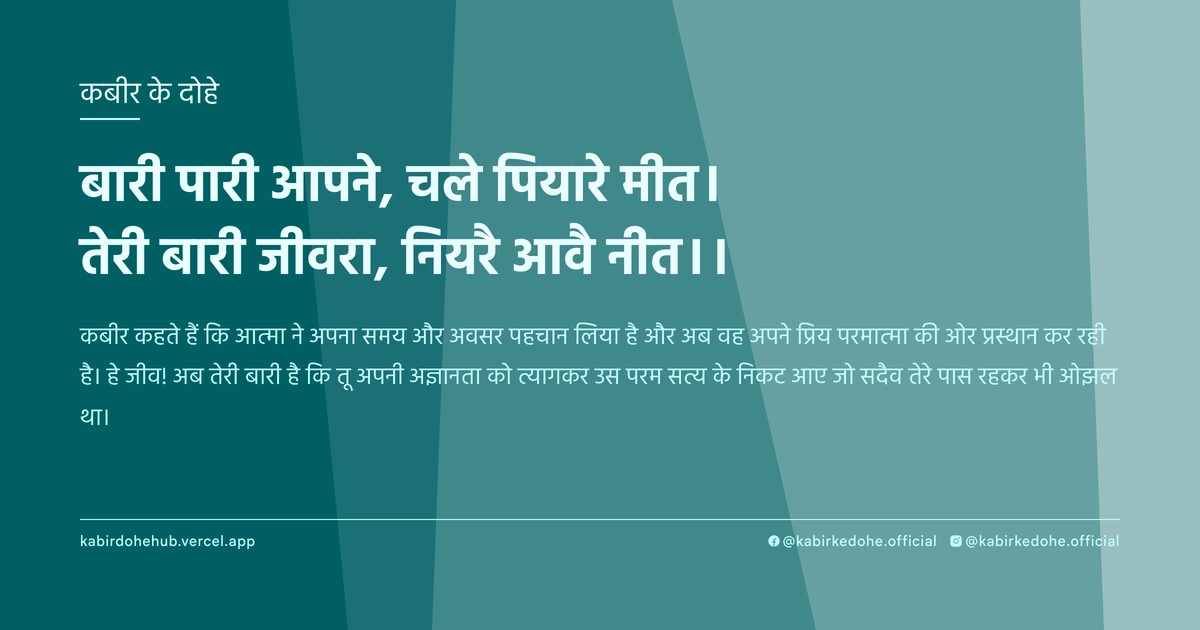
बारी पारी आपने, चले पियारे मीत।
तेरी बारी जीवरा, नियरै आवै नीत।।
Baari paari aapne, chale piyare meet. Teri baari jeevra, niyare aavai neet.
इस पृष्ठ पर इस कबीर दोहे का अर्थ (meaning), हिंदी व्याख्या और अंग्रेज़ी अनुवाद, दार्शनिक विश्लेषण और व्यावहारिक जीवन सीख दी गई है। यह दोहा मृतुक्यता (Mortality) विषय से जुड़ा है — Kabir doha meaning and explanation in Hindi and English.
अर्थ (Meaning):
कबीर कहते हैं कि आत्मा ने अपना समय और अवसर पहचान लिया है और अब वह अपने प्रिय परमात्मा की ओर प्रस्थान कर रही है। हे जीव! अब तेरी बारी है कि तू अपनी अज्ञानता को त्यागकर उस परम सत्य के निकट आए जो सदैव तेरे पास रहकर भी ओझल था।
Kabir proclaims that the soul has recognized its appointed time and is now journeying toward its beloved Divine. He calls out to the individual soul, urging it to realize that its own turn has come to shed ignorance and draw near to the Eternal Truth that has always been present yet remained unseen.
व्याख्या (Interpretation):
इस दोहे का शाब्दिक अर्थ है कि एक प्रेमी मित्र (आत्मा) अपनी बारी आने पर परमात्मा से मिलने चला गया है। रूपकात्मक स्तर पर, 'बारी' का अर्थ है वह आध्यात्मिक परिपक्वता जहाँ जीव को अपनी नश्वरता का बोध होता है। यह निर्गुण भक्ति का सार है, जहाँ ईश्वर किसी मंदिर या मस्जिद में नहीं, बल्कि स्वयं के भीतर स्थित है। माया का पर्दा हटने पर आत्मा और ब्रह्म की अभिन्नता (अद्वैत) प्रकट होती है। यहाँ 'जीवरा' शब्द का प्रयोग आत्मा की मासूमियत और उसकी विस्मृति को दर्शाता है। यह विरोधाभास है कि जिसे हम बाहर खोज रहे हैं, वह वास्तव में हमारे सबसे निकट है। अंततः, यह दोहा आत्मा के व्यक्तिगत अहंकार के विलीनीकरण और सार्वभौमिक चेतना में विलय की प्रक्रिया को दर्शाता है।
Literally, the verse describes a beloved friend (the soul) departing upon their turn to meet the Divine. Metaphorically, 'Baari' (turn) signifies the moment of spiritual ripening when the soul awakens to its own mortality and eternal nature. This is the essence of Nirgun Bhakti, where the Divine is not found in external shrines but within the self. As the veil of Maya (illusion) lifts, the non-duality of Atman and Brahman is revealed. The term 'Jeevra' highlights the soul's innocence and its state of forgetfulness. The central paradox is that the Truth we seek externally is actually our closest companion. Ultimately, the Doha depicts the annihilation of the individual ego and the subsequent merger into universal consciousness.
दार्शनिक विश्लेषण (Philosophical Analysis):
कबीर का यह दोहा उस युग की उपज है जहाँ धर्म बाहरी कर्मकांडों और जातिगत श्रेष्ठता में फँसा हुआ था। कबीर ने इन सभी कृत्रिम विभाजनों को नकारते हुए 'सहज' मार्ग पर बल दिया। वे बताते हैं कि मोक्ष किसी बाहरी अनुष्ठान से नहीं, बल्कि आंतरिक रूपांतरण से मिलता है।
अद्वैत वेदांत के परिप्रेक्ष्य में, यह दोहा 'अहं ब्रह्मास्मि' की अनुभूति है। जब जीव यह समझ जाता है कि वह परमात्मा से अलग नहीं है, तो उसकी 'बारी' आती है—अर्थात वह द्वैत से अद्वैत की ओर बढ़ता है। यह केवल मृत्यु के बाद की यात्रा नहीं, बल्कि जीवित रहते हुए अहंकार की मृत्यु है।
सूफी मत के 'फना' (annihilation) के सिद्धांत से इसकी गहरी समानता है। जिस प्रकार एक बूंद समुद्र में मिलकर अपना अस्तित्व खो देती है लेकिन समुद्र बन जाती है, वैसे ही आत्मा परमात्मा में विलीन होती है। कबीर यहाँ प्रेम को ही एकमात्र सेतु मानते हैं।
मनोवैज्ञानिक स्तर पर, यह दोहा 'स्व' (Self) की खोज की बात करता है। हम अक्सर दूसरों की उपलब्धियों या सामाजिक भूमिकाओं में अपनी पहचान ढूंढते हैं, लेकिन वास्तविक पहचान तब मिलती है जब हम बाहरी शोर को शांत कर अपने भीतर के मौन को सुनते हैं।
अतः, यह संदेश केवल धार्मिक नहीं बल्कि अस्तित्ववादी है। यह मनुष्य को उसकी वास्तविक स्थिति से अवगत कराता है और उसे याद दिलाता है कि समय सीमित है, और सत्य की ओर प्रस्थान करना ही जीवन का एकमात्र सार्थक उद्देश्य है।
This Doha emerged from an era where religion was stifled by external rituals and caste hierarchies. Kabir rejected these artificial divisions, emphasizing the 'Sahaj' (natural) path. He asserts that liberation is not achieved through ritualistic performance but through profound internal transformation.
From the perspective of Advaita Vedanta, this verse is an embodiment of 'Aham Brahmasmi' (I am Brahman). When the soul realizes it is not separate from the Divine, its 'turn' arrives—transitioning from duality to non-duality. This is not merely a journey after death, but the death of the ego while still alive.
There is a profound resonance with the Sufi concept of 'Fana' (annihilation). Just as a drop loses its identity to become the ocean, the soul merges into the Divine. Kabir posits that love is the only bridge capable of spanning this gap.
Psychologically, the Doha addresses the quest for the True Self. We often seek identity in social roles or external achievements, but true identity is found only when we silence the external noise and listen to the inner stillness.
Thus, the message is existential rather than purely religious. It alerts the human being to their actual state and reminds them that time is finite, and the journey toward Truth is the only meaningful purpose of existence.
मूल संदेश (Core Message):
- बाहरी खोज एक भ्रम है; सत्य केवल भीतर है।
- अहंकार का विसर्जन ही परमात्मा से मिलन का एकमात्र मार्ग है।
- समय की प्रतीक्षा न करें, वर्तमान क्षण ही मोक्ष का द्वार है।
- प्रेम और समर्पण ही वह सेतु हैं जो जीव को शिव बनाते हैं।
- जब 'मैं' मिटता है, तभी 'वह' प्रकट होता है।
- External searching is an illusion; Truth resides only within.
- The dissolution of ego is the sole path to union with the Divine.
- Do not wait for a time; the present moment is the gateway to liberation.
- Love and surrender are the bridges that transform the soul into the Divine.
- Only when the 'I' vanishes does the 'He' manifest.
व्यावहारिक उदाहरण (Practical Example):
वाराणसी के एक पुराने घाट पर रहने वाले एक वृद्ध बुनकर थे, जिनका नाम माधव था। माधव जीवन भर केवल रेशमी वस्त्र बुनते रहे, लेकिन उनका मन हमेशा इस बात से परेशान रहता था कि वे अपनी जाति और पेशे के कारण कभी 'पवित्र' नहीं हो पाएंगे।
वे देखते थे कि पंडित और विद्वान बड़े-बड़े ग्रंथों की बातें करते थे, लेकिन उनके व्यवहार में अहंकार था। माधव ने अपनी पूरी उम्र केवल बाहरी शुद्धता के नियमों का पालन करने में बिता दी, यह सोचकर कि एक दिन वे ईश्वर के करीब पहुँचेंगे।
एक दिन, एक फकीर उनके पास आया और उनसे कहा, 'माधव, तू धागों को जोड़कर कपड़ा तो बना रहा है, लेकिन अपनी आत्मा के धागे को उस परमात्मा से जोड़ना भूल गया। तू बाहर की सफाई में इतना व्यस्त है कि भीतर की गंदगी देख ही नहीं पाया।'
माधव को लगा जैसे किसी ने उनके सामने दर्पण रख दिया हो। उन्होंने महसूस किया कि वे जिस 'बारी' का इंतजार कर रहे थे, वह किसी बाहरी अनुमति या मृत्यु के बाद की घटना नहीं थी, बल्कि इसी क्षण का बोध था।
उन्होंने अपनी सारी धार्मिक ग्रंथ-पद्धतियों और जातिगत हीनता को त्याग दिया। उन्होंने महसूस किया कि उनकी करघे की आवाज़ ही वास्तव में परमात्मा का संगीत है, यदि उसे पूरी जागरूकता के साथ सुना जाए।
अब माधव ने केवल कपड़े बुनना शुरू नहीं किया, बल्कि हर धागे के साथ प्रेम और समर्पण को बुनना शुरू किया। उनके चेहरे पर एक ऐसी शांति आ गई जो बड़े-बड़े विद्वानों के पास नहीं थी।
उनके पड़ोस के लोग हैरान थे कि माधव अब किसी से डरते नहीं थे और न ही किसी से श्रेष्ठता का भाव रखते थे। वे अब केवल एक बुनकर नहीं, बल्कि एक जागृत आत्मा बन चुके थे।
अंत में, माधव ने समझा कि ईश्वर तक पहुँचने के लिए किसी विशेष 'बारी' या समय की आवश्यकता नहीं है; बस अहंकार का विसर्जन ही वह द्वार है जिससे परमात्मा निकट आ जाते हैं।
In the ancient ghats of Varanasi lived an elderly weaver named Madhav. For his entire life, Madhav wove exquisite silk fabrics, yet his mind was plagued by the belief that he could never be 'pure' due to his caste and profession.
He observed priests and scholars quoting vast scriptures, yet their behavior was steeped in arrogance. Madhav spent his years adhering to external rules of purity, believing that one day he would eventually be granted access to the Divine.
One day, a wandering dervish approached him and said, 'Madhav, you are joining threads to make cloth, but you have forgotten to join the thread of your soul to the Divine. You are so busy with external cleanliness that you cannot see the grime within.'
Madhav felt as if a mirror had been held up to his soul. He realized that the 'turn' he was waiting for was not an external permission or an event after death, but a realization available in this very moment.
He abandoned all rigid scriptural dogmas and the feeling of caste-based inferiority. He realized that the rhythmic clacking of his loom was, in fact, the music of the Divine, if heard with total awareness.
Madhav did not stop weaving; instead, he began weaving love and surrender into every single thread. A profound peace settled upon his face, a serenity that even the most learned scholars lacked.
His neighbors were astonished to see that Madhav no longer feared anyone, nor did he feel superior to anyone. He was no longer just a weaver; he had become an awakened soul.
Ultimately, Madhav understood that reaching the Divine requires no specific 'turn' or appointed time; the dissolution of the ego is the only gateway through which the Divine becomes imminent.
अभ्यास मार्गदर्शन (Practice Guidance):
- प्रतिदिन 20 मिनट मौन रहकर यह विचार करें कि 'मैं' कौन हूँ—क्या मैं मेरा नाम, मेरा पेशा या मेरी सामाजिक स्थिति हूँ, या मैं वह साक्षी हूँ जो इन सबको देख रहा है?
- एक डायरी लिखें जिसमें आप उन क्षणों को दर्ज करें जब आपका अहंकार (Ego) आपको सत्य देखने से रोकता है। पूछें: 'इस समय मुझे क्या चीज़ रोक रही है?'
- व्यवहार परिवर्तन: दिन में कम से कम एक बार किसी ऐसे व्यक्ति की निस्वार्थ सेवा करें जिससे आप घृणा करते हैं, ताकि आपके भीतर का 'द्वैत' समाप्त हो सके।
- निदान चेकलिस्ट: यदि आप अभी भी दूसरों में दोष ढूंढ रहे हैं या अपनी धार्मिक पहचान पर गर्व कर रहे हैं, तो समझें कि आपकी 'बारी' अभी नहीं आई है। यदि आप हर जीव में उसी एक तत्व को देखते हैं, तो आप निकट हैं।
- Spend 20 minutes daily in silence, contemplating: 'Who am I?'—Am I my name, my profession, or my social status, or am I the witness observing all these?
- Maintain a journal recording moments where your ego prevents you from seeing the truth. Ask: 'What exactly is blocking me at this moment?'
- Behavioral Shift: At least once a day, perform a selfless act of service for someone you dislike, in order to dissolve the duality within you.
- Diagnostic Checklist: If you are still finding faults in others or taking pride in your religious identity, recognize that your 'turn' has not yet arrived. If you see the same single element in every living being, you are drawing near.
चिंतन प्रश्न (Reflection Questions):
- आपकी वह कौन सी सामाजिक या धार्मिक पहचान है जिसे आप खोने से सबसे ज्यादा डरते हैं?
- यदि आज आपकी 'बारी' आ जाए, तो क्या आपके भीतर कोई ऐसा बोझ है जो आपको हल्का होने से रोक रहा है?
- आपकी डिजिटल पहचान (सोशल मीडिया) आपके वास्तविक आंतरिक स्वरूप को कितना छिपाती है?
- क्या आप वास्तव में सत्य की खोज कर रहे हैं, या केवल अपनी मान्यताओं की पुष्टि करना चाहते हैं?
- वह कौन सा सूक्ष्म अहंकार है जो आपको यह महसूस कराता है कि आप दूसरों से अधिक 'आध्यात्मिक' हैं?
- क्या आप मौन में रहने की क्षमता रखते हैं, या आप शोर का उपयोग सत्य से बचने के लिए करते हैं?
- Which social or religious identity are you most afraid of losing?
- If your 'turn' came today, is there any internal burden preventing you from becoming light?
- How much does your digital identity (social media) mask your actual internal nature?
- Are you truly seeking the Truth, or are you merely seeking confirmation of your own beliefs?
- What is that subtle ego that makes you feel more 'spiritual' than others?
- Do you possess the capacity to remain in silence, or do you use noise to evade the Truth?