
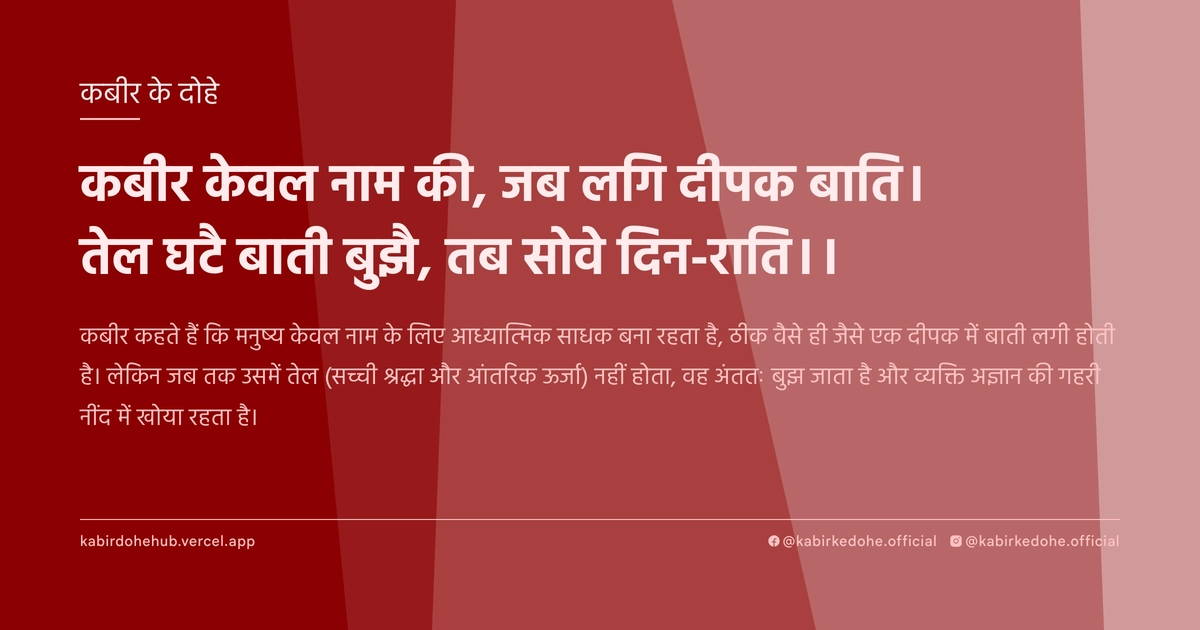
कबीर केवल नाम की, जब लगि दीपक बाति।
तेल घटै बाती बुझै, तब सोवे दिन-राति।।
Kabir keval naam ki, jab lagi deepak baati. Tel ghate baati bujhai, tab sove din-raati.
इस पृष्ठ पर इस कबीर दोहे का अर्थ (meaning), हिंदी व्याख्या और अंग्रेज़ी अनुवाद, दार्शनिक विश्लेषण और व्यावहारिक जीवन सीख दी गई है। यह दोहा अनित्य (Impermanence) विषय से जुड़ा है — Kabir doha meaning and explanation in Hindi and English.
अर्थ (Meaning):
कबीर कहते हैं कि मनुष्य केवल नाम के लिए आध्यात्मिक साधक बना रहता है, ठीक वैसे ही जैसे एक दीपक में बाती लगी होती है। लेकिन जब तक उसमें तेल (सच्ची श्रद्धा और आंतरिक ऊर्जा) नहीं होता, वह अंततः बुझ जाता है और व्यक्ति अज्ञान की गहरी नींद में खोया रहता है।
Kabir asserts that many claim spiritual identity in name only, resembling a lamp that possesses a wick but lacks oil. When the fuel of genuine devotion and inner awareness is exhausted, the flame of consciousness extinguishes, leaving the soul slumbering in the darkness of ignorance.
व्याख्या (Interpretation):
इस दोहे में दीपक और बाती का रूपक मानव शरीर और अहंकार का प्रतीक है। बाती वह बाहरी दिखावा या धार्मिक पहचान है जिसे दुनिया देखती है, जबकि तेल वह आंतरिक प्राणशक्ति और निरंतर अभ्यास (Sadhana) है जो आत्मा को जाग्रत रखता है। निर्गुण भक्ति के परिप्रेक्ष्य में, केवल मंत्रों का जाप या बाहरी अनुष्ठान 'बाती' के समान हैं; यदि उनमें आत्म-साक्षात्कार की तड़प (तेल) नहीं है, तो वे व्यर्थ हैं। यह माया के उस भ्रम को दर्शाता है जहाँ व्यक्ति अपनी धार्मिक पहचान को ही अपनी आध्यात्मिक उपलब्धि मान लेता है। जब यह मिथ्या अहंकार समाप्त होता है, तो व्यक्ति को अहसास होता है कि वह अब तक अज्ञान की नींद में था। अद्वैत वेदांत के अनुसार, यह नींद 'अविद्या' है जो आत्मा और ब्रह्म के अभेद को छुपा लेती है।
In this verse, the lamp and wick serve as metaphors for the human vessel and the egoic identity. The wick represents the external facade or religious labels that society recognizes, while the oil symbolizes the internal life-force and consistent spiritual practice (Sadhana) required to sustain consciousness. Within the framework of Nirgun Bhakti, mere ritualistic chanting or outward piety is like a dry wick; without the 'oil' of intense longing for the Formless Divine, such efforts are futile. This highlights the deception of Maya, where an individual mistakes their religious identity for actual spiritual realization. When this false construct collapses, the soul realizes it has been slumbering in the darkness of ignorance. According to Advaita Vedanta, this sleep is 'Avidya' (nescience), the veil that obscures the non-duality of the Atman and Brahman.
दार्शनिक विश्लेषण (Philosophical Analysis):
कबीर का यह प्रहार उस समय के धार्मिक पाखंड पर था जहाँ लोग केवल तिलक, माला या विशेष वस्त्रों से अपनी पवित्रता सिद्ध करते थे। वे स्पष्ट करते हैं कि आध्यात्मिकता कोई सामाजिक पदवी नहीं है, बल्कि एक आंतरिक रूपांतरण है। यहाँ 'तेल' का अर्थ है वह निरंतर जागरूकता जो अहंकार को गला देती है।
सूफी मत के 'फना' (अहंकार का विनाश) और अद्वैत के 'अहं ब्रह्मास्मि' के बीच एक सेतु है—दोनों ही बाहरी आवरणों को हटाने की बात करते हैं। कबीर का तर्क है कि यदि साधना केवल बौद्धिक या यांत्रिक है, तो वह तेल विहीन बाती की तरह है जो केवल अंधेरे में भ्रम पैदा करती है।
ऐतिहासिक रूप से, कबीर ने जाति और धर्म के संकीर्ण दायरे को तोड़कर 'सहज' मार्ग की वकालत की। उनके लिए, ईश्वर मंदिर या मस्जिद में नहीं, बल्कि उस आंतरिक ज्योति में है जो निरंतर प्रज्वलित रहे। ritualism का विरोध यहाँ केवल बाहरी विरोध नहीं, बल्कि मनोवैज्ञानिक मुक्ति का आह्वान है।
मनोवैज्ञानिक स्तर पर, यह दोहा हमें चेतावनी देता है कि हम अपनी 'आध्यात्मिक छवि' (Spiritual Ego) के मोह में न फंसें। जब हम खुद को 'भक्त' या 'ज्ञानी' कहते हैं, तो हम वास्तव में एक नई दीवार खड़ी कर रहे होते हैं। असली ज्ञान उस समय आता है जब यह छवि टूटती है।
अंततः, कबीर यह समझाते हैं कि मोक्ष कोई भविष्य की घटना नहीं है, बल्कि वर्तमान में जागृत रहने की अवस्था है। जो व्यक्ति केवल नाम का साधक है, वह वास्तव में आध्यात्मिक मृत्यु की स्थिति में है, भले ही वह जीवित शरीर में घूम रहा हो।
Kabir’s critique is directed at the religious hypocrisy of his era, where sanctity was often performed through tilaks, beads, or specific attire. He clarifies that spirituality is not a social title or a badge of identity, but a profound internal transmutation. Here, 'oil' represents the continuous awareness and sincerity that erodes the ego.
There is a bridge between the Sufi concept of 'Fana' (annihilation of the self) and the Advaitic 'Aham Brahmasmi'—both emphasize the stripping away of external layers. Kabir argues that if spiritual practice is merely intellectual or mechanical, it is like a wick without oil, creating only an illusion of light in the darkness.
Historically, Kabir advocated for the 'Sahaj' (natural) path, breaking the narrow confines of caste and organized religion. For him, the Divine resides not in temples or mosques, but in the internal flame of consciousness that must be kept burning through constant vigilance.
On a psychological level, this verse warns against the 'Spiritual Ego.' When we label ourselves as 'devotees' or 'seekers,' we often construct a new wall of separation. True realization occurs only when this curated identity is dismantled and the seeker vanishes into the seeking.
Ultimately, Kabir explains that liberation is not a future event but a state of present-moment wakefulness. One who is a seeker in name only is effectively in a state of spiritual slumber, regardless of their physical activity or religious affiliations.
मूल संदेश (Core Message):
- बाहरी पहचान आध्यात्मिक प्रगति का प्रमाण नहीं है।
- बिना आंतरिक तड़प के अनुष्ठान केवल एक मृत परंपरा है।
- अहंकार का विसर्जन ही वास्तविक ज्ञान का तेल है।
- जागरूकता के बिना धर्म केवल एक गहरी नींद है।
- सच्ची भक्ति प्रदर्शन में नहीं, बल्कि आत्म-विलय में है।
- External identity is not evidence of spiritual progress.
- Rituals without inner longing are merely dead traditions.
- The dissolution of ego is the only true fuel for enlightenment.
- Religion without awareness is simply a profound slumber.
- True devotion lies not in performance, but in self-annihilation.
व्यावहारिक उदाहरण (Practical Example):
एक समय की बात है, वाराणसी के घाटों पर माधव नाम का एक वृद्ध बुनकर रहता था। माधव पूरे शहर में अपनी धार्मिकता के लिए प्रसिद्ध था। वह हर सुबह सबसे पहले गंगा स्नान करता, घंटों माला जपता और अपने माथे पर एक बड़ा सा तिलक लगाता। लोग उसे 'महात्मा' कहकर बुलाते और उससे आशीर्वाद लेते।
माधव को अपनी इस छवि पर बहुत गर्व था। वह मन ही मन सोचता था कि वह शहर के बाकी लोगों से कहीं अधिक पवित्र और जाग्रत है। उसकी पूरी दिनचर्या एक मशीन की तरह थी—नियमबद्ध, सटीक, लेकिन भावना शून्य।
एक दिन उसकी मुलाकात एक घुमंतू फकीर से हुई। फकीर ने माधव की माला और तिलक को देखा और मुस्कुराते हुए पूछा, 'माधव, यह दीपक तो सुंदर है, पर क्या इसमें तेल है?'
माधव हैरान रह गया। उसने कहा, 'मैं प्रतिदिन घंटों जाप करता हूँ, क्या यह तेल नहीं है?' फकीर ने शांति से उत्तर दिया, 'जाप तो बाती है, लेकिन क्या उस जाप में अहंकार का विसर्जन है? क्या तुम्हारी करुणा तुम्हारे तिलक से बड़ी है?'
उस रात माधव सो नहीं सका। उसने महसूस किया कि वह अब तक केवल एक 'भक्त की भूमिका' निभा रहा था। वह दूसरों को छोटा समझता था क्योंकि वह खुद को बड़ा मान बैठा था। उसकी धार्मिकता केवल एक बाहरी आवरण थी, जिसके भीतर शून्य था।
अगले कुछ महीनों तक माधव ने माला जपना कम कर दिया और दूसरों की सेवा करना शुरू किया। उसने देखा कि एक बीमार पड़ोसी की मदद करना उसे उस शांति के करीब ले जाता है, जिसे वह घंटों के जाप में नहीं पा सका था।
उसने सीखा कि वास्तविक 'तेल' विनम्रता और निस्वार्थ प्रेम है। जब उसने अपनी 'महात्मा' वाली छवि को त्याग दिया, तब उसके भीतर की वास्तविक ज्योति प्रज्वलित हुई।
अब वह केवल नाम का साधक नहीं था; वह वास्तव में जाग गया था। उसकी आँखों में अब अहंकार का गर्व नहीं, बल्कि सबके लिए करुणा थी।
Once, in the ghats of Varanasi, lived an elderly weaver named Madhav. Madhav was renowned throughout the city for his piety. He bathed in the Ganges first thing every morning, spent hours chanting with beads, and wore a prominent tilak on his forehead. People called him 'Mahatma' and sought his blessings.
Madhav took immense pride in this image. He secretly believed he was far more pure and awakened than the rest of the town. His entire routine was like a machine—disciplined and precise, yet devoid of genuine emotion.
One day, he encountered a wandering fakir. The fakir looked at Madhav’s beads and tilak and asked with a smile, 'Madhav, this lamp is beautiful, but does it contain any oil?'
Madhav was bewildered. He replied, 'I chant for hours every day; is that not the oil?' The fakir calmly answered, 'The chanting is the wick, but is there a dissolution of ego within that chant? Is your compassion greater than your tilak?'
Madhav could not sleep that night. He realized he had merely been playing the 'role of a devotee.' He had looked down upon others because he had convinced himself of his own superiority. His piety was but an external shell, hollow within.
Over the next few months, Madhav reduced his mechanical chanting and began serving others. He discovered that helping a sick neighbor brought him closer to the peace that hours of rote prayer had failed to provide.
He learned that the true 'oil' is humility and selfless love. When he abandoned the image of being a 'Mahatma,' the authentic light within him finally ignited.
He was no longer a seeker in name only; he had truly awakened. His eyes no longer held the pride of ego, but the radiance of universal compassion.
अभ्यास मार्गदर्शन (Practice Guidance):
- प्रतिदिन 15 मिनट मौन बैठें और स्वयं से पूछें: 'क्या मेरी धार्मिक पहचान मेरे अहंकार को बढ़ा रही है?'
- एक 'अहंकार डायरी' लिखें, जहाँ आप उन क्षणों को दर्ज करें जब आपने अपनी श्रेष्ठता महसूस की, और फिर उसे स्वीकार कर विसर्जित करें।
- सेवा का ऐसा कार्य करें जिसके बारे में किसी को पता न चले, ताकि 'परोपकारी' होने का मानसिक सुख भी समाप्त हो जाए।
- निदान चेकलिस्ट: यदि आप दूसरों के गलत कार्यों पर तुरंत निर्णय लेते हैं, तो समझें कि आपकी 'बाती' तो जल रही है, पर 'तेल' (करुणा) कम है।
- Sit in silence for 15 minutes daily and ask: 'Is my spiritual identity fueling my ego or dissolving it?'
- Maintain an 'Ego Journal' to record moments where you felt superior to others, then consciously surrender those feelings.
- Perform an act of service in total anonymity, ensuring that even the psychological reward of being 'charitable' is eliminated.
- Diagnostic Checklist: If you find yourself judging others' spiritual failures instantly, recognize that your 'wick' is present, but the 'oil' of compassion is lacking.
चिंतन प्रश्न (Reflection Questions):
- यदि मुझसे मेरी सभी धार्मिक और सामाजिक पहचानें छीन ली जाएँ, तो मेरे भीतर क्या बचेगा?
- क्या मैं वास्तव में सत्य की खोज कर रहा हूँ, या मैं केवल 'सत्य खोजने वाले' की छवि का आनंद ले रहा हूँ?
- मेरे जीवन में ऐसा कौन सा अनुष्ठान है जो केवल आदत बन गया है और जिसका आध्यात्मिक अर्थ समाप्त हो चुका है?
- जब मैं दूसरों को उपदेश देता हूँ, तो क्या वह मेरी करुणा से निकलता है या मेरी श्रेष्ठता की भावना से?
- क्या मेरी शांति बाहरी परिस्थितियों पर निर्भर है, या वह उस तेल की तरह है जो हर तूफान में जलता रहता है?
- If all my religious and social identities were stripped away, what would remain within me?
- Am I truly seeking the Truth, or am I merely enjoying the image of being a 'seeker of Truth'?
- Which rituals in my life have become mere habits, losing their original spiritual essence?
- When I offer advice to others, does it stem from genuine compassion or a subconscious sense of superiority?
- Is my peace dependent on external conditions, or is it like the oil that burns steadily despite the storm?