
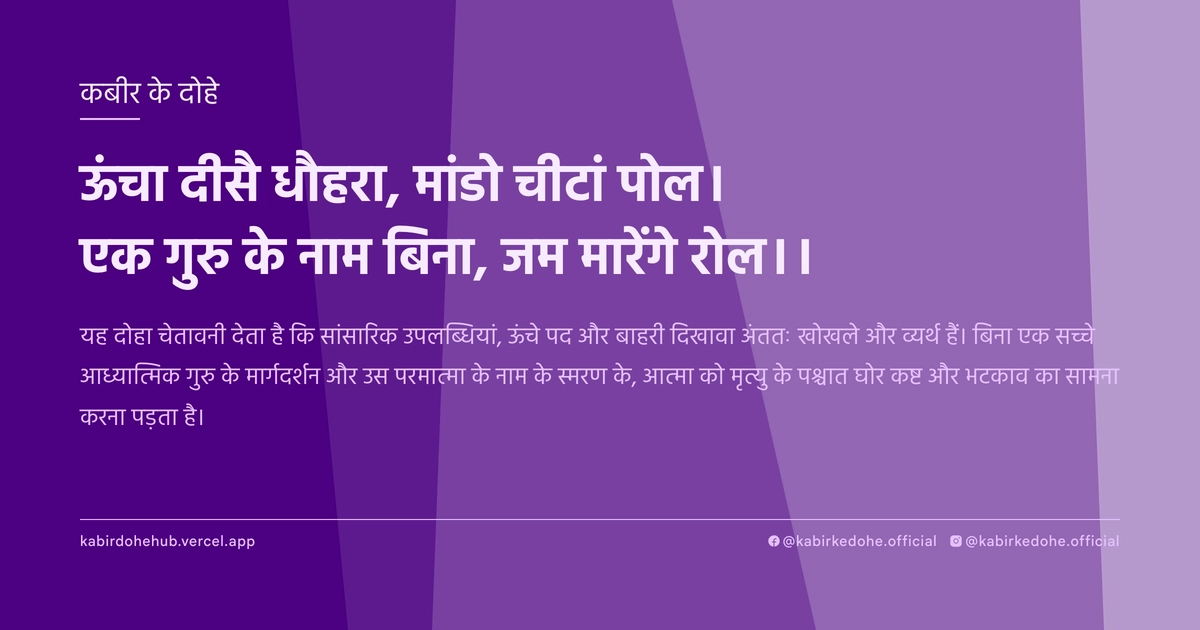
ऊंचा दीसै धौहरा, मांडो चीटां पोल।
एक गुरु के नाम बिना, जम मारेंगे रोल।।
Ooncha deesai dhauhra, mando chitan pol. Ek guru ke naam bina, jam marenge rol.
इस पृष्ठ पर इस कबीर दोहे का अर्थ (meaning), हिंदी व्याख्या और अंग्रेज़ी अनुवाद, दार्शनिक विश्लेषण और व्यावहारिक जीवन सीख दी गई है। यह दोहा गुरु महत्व (The Guru's Importance) विषय से जुड़ा है — Kabir doha meaning and explanation in Hindi and English.
अर्थ (Meaning):
यह दोहा चेतावनी देता है कि सांसारिक उपलब्धियां, ऊंचे पद और बाहरी दिखावा अंततः खोखले और व्यर्थ हैं। बिना एक सच्चे आध्यात्मिक गुरु के मार्गदर्शन और उस परमात्मा के नाम के स्मरण के, आत्मा को मृत्यु के पश्चात घोर कष्ट और भटकाव का सामना करना पड़ता है।
This couplet warns that worldly achievements, high status, and outward displays of grandeur are ultimately hollow and futile. Without the guidance of a true spiritual master and the remembrance of the Divine Name, the soul faces immense suffering and disorientation upon the arrival of death.
व्याख्या (Interpretation):
यहाँ 'धौहरा' और 'पोल' बाहरी चमक-धमक और अहंकार के प्रतीक हैं। कबीर कहते हैं कि मनुष्य दुनिया में अपनी प्रतिष्ठा को ऊंचा दिखाने का प्रयास करता है, लेकिन आंतरिक रूप से वह रिक्त और अज्ञानी बना रहता है। यह 'माया' का जाल है जो हमें वास्तविकता से दूर ले जाता है। जब तक साधक को एक ऐसे गुरु नहीं मिलते जो उसे 'अहं' से 'शिवा' (परमात्मा) की ओर ले जाए, वह जन्म-मृत्यु के चक्र में फंसा रहता है। यह दोहा निर्गुण भक्ति की उस परंपरा को रेखांकित करता है जहाँ बाहरी कर्मकांडों के बजाय आंतरिक रूपांतरण और गुरु-तत्त्व की अनिवार्यता पर बल दिया गया है।
Here, 'dhauhra' and 'pol' symbolize outward splendor and the ego's facade. Kabir suggests that humans strive to project a high status in the world, yet remain internally void and ignorant. This is the snare of 'Maya' (illusion) that distances us from the Truth. Until a seeker finds a Guru who can lead them from the 'I' (ego) to the 'Divine' (Brahman), they remain trapped in the cycle of birth and death. This verse underscores the Nirgun Bhakti tradition, emphasizing internal transformation and the necessity of the Guru-principle over external rituals.
दार्शनिक विश्लेषण (Philosophical Analysis):
कबीर का यह दोहा उस सामाजिक और धार्मिक पाखंड पर प्रहार करता है जहाँ व्यक्ति अपनी जाति, पद या धार्मिक बाहरी प्रतीकों के माध्यम से श्रेष्ठता सिद्ध करने का प्रयास करता है। उनके समय में, ब्राह्मणवादी और सूफी कट्टरपंथ दोनों ने बाहरी पहचान को महत्व दिया था, जिसे कबीर ने 'चीटां पोल' या सफेद दिखावे के रूप में संबोधित किया है। वे तर्क देते हैं कि आध्यात्मिक उत्थान किसी बाहरी आवरण से नहीं, बल्कि आंतरिक शुद्धि से आता है।
अद्वैत वेदांत के परिप्रेक्ष्य में, यह दोहा 'अविद्या' (अज्ञान) की चर्चा करता है। जब तक जीव स्वयं को शरीर और पद के साथ जोड़कर देखता है, वह द्वैत में जीता है। गुरु का कार्य इस भ्रम को तोड़ना है। गुरु केवल एक व्यक्ति नहीं, बल्कि वह चेतना है जो शिष्य को यह अहसास कराती है कि वह स्वयं ब्रह्म है।
सूफीवाद के 'फना' (अहंकार का विनाश) के सिद्धांत से इसे जोड़कर देखा जा सकता है। जब तक 'मैं' जीवित है, तब तक परमात्मा का अनुभव असंभव है। 'जम मारेंगे रोल' का अर्थ केवल मृत्यु के देवता का भय नहीं है, बल्कि उस मानसिक पीड़ा और अस्तित्वगत संकट का संकेत है जो तब उत्पन्न होता है जब व्यक्ति अपनी पूरी पहचान बाहरी उपलब्धियों पर टिका देता है और अंत में उन्हें खो देता है।
कबीर का दृष्टिकोण क्रांतिकारी था क्योंकि उन्होंने मोक्ष के लिए किसी विशेष मंदिर या मस्जिद की आवश्यकता को नकार दिया। उन्होंने 'नाम' (शब्द या ध्वनि) को सर्वोच्च साधन माना, जो किसी भी जाति या धर्म के व्यक्ति के लिए उपलब्ध है। यह लोकतांत्रिक आध्यात्मिकता का आह्वान है।
अंततः, यह विश्लेषण हमें यह समझने पर मजबूर करता है कि वास्तविक 'ऊंचाई' भौतिक नहीं, बल्कि नैतिक और आध्यात्मिक है। अहंकार का विसर्जन ही एकमात्र मार्ग है जिससे आत्मा उस अनंत शांति को प्राप्त कर सकती है जहाँ मृत्यु का भय समाप्त हो जाता है।
Kabir's couplet strikes at the social and religious hypocrisy of his era, where individuals sought superiority through caste, rank, or external religious symbols. In his time, both Brahmanical and Sufi orthodoxies emphasized outward identity, which Kabir addresses as 'chitan pol' or the hollow white facade. He argues that spiritual elevation comes not from an external shell, but from internal purification.
From the perspective of Advaita Vedanta, this verse discusses 'Avidya' (ignorance). As long as the soul identifies itself with the body and social status, it lives in duality. The Guru's role is to shatter this illusion. The Guru is not merely a person, but the consciousness that makes the disciple realize they are, in fact, Brahman.
This can be linked to the Sufi concept of 'Fana' (the annihilation of the ego). As long as the 'I' persists, the experience of the Divine is impossible. 'Jam marenge rol' does not merely refer to the fear of the God of Death, but signifies the mental agony and existential crisis that arise when one anchors their entire identity in external achievements, only to lose them in the end.
Kabir's approach was revolutionary because he rejected the need for specific temples or mosques for liberation. He championed 'Naam' (the Word or Sound) as the supreme means, accessible to anyone regardless of caste or creed. This is a call for a democratic spirituality.
Ultimately, this analysis forces us to understand that true 'height' is not material, but moral and spiritual. The dissolution of the ego is the only path through which the soul can attain that infinite peace where the fear of death ceases to exist.
मूल संदेश (Core Message):
- बाहरी प्रतिष्ठा एक भ्रम है जो आत्मा को अंधा कर देती है।
- अहंकार का विसर्जन ही वास्तविक आध्यात्मिक ऊंचाई है।
- गुरु का मार्गदर्शन अज्ञान के अंधेरे को मिटाने का एकमात्र साधन है।
- परमात्मा का नाम ही मृत्यु के भय से मुक्ति दिलाता है।
- सत्य आंतरिक है, बाहरी आडंबर केवल समय की बर्बादी है।
- External prestige is an illusion that blinds the soul.
- The dissolution of ego is the only true spiritual height.
- The Guru's guidance is the sole means to erase the darkness of ignorance.
- Remembrance of the Divine Name alone liberates one from the fear of death.
- Truth is internal; outward pretension is merely a waste of time.
व्यावहारिक उदाहरण (Practical Example):
वाराणसी के एक पुराने घाट पर रहने वाले एक वृद्ध विधवा, जानकी, का जीवन अत्यंत सरल था। उन्होंने अपना पूरा जीवन दूसरों की सेवा और मंदिर की सफाई में बिताया था, लेकिन उनके मन में हमेशा एक टीस रहती थी कि उन्होंने जीवन में कोई 'बड़ी' उपलब्धि हासिल नहीं की। वे अक्सर उन अमीर व्यापारियों को देखती थीं जो बड़े दान देते थे और समाज में बहुत सम्मान पाते थे। जानकी को लगता था कि उनकी सादगी उनकी विफलता है।
एक दिन, शहर का एक बहुत बड़ा विद्वान, जिसने कई शास्त्र पढ़े थे और जिसका नाम पूरे देश में था, जानकी के पास आया। वह विद्वान मानसिक तनाव और गहरे अवसाद से जूझ रहा था। उसने जानकी से पूछा, "आप इतनी शांति से कैसे रह पाती हैं? मेरे पास ज्ञान है, सम्मान है, लेकिन मन में अशांति का सागर है।"
जानकी ने मुस्कुराकर कहा, "बेटा, तुमने बहुत ऊंचे महल बनाए हैं, लेकिन क्या तुमने अपने भीतर के घर की सफाई की? जिसे तुम उपलब्धि कहते हो, वह केवल एक बाहरी आवरण है। असली शांति तो उस नाम में है जो अहंकार को मिटा दे।"
विद्वान को अचानक अहसास हुआ कि उसकी सारी डिग्रियां और सम्मान उसके अहंकार की 'पोल' थे। उसने महसूस किया कि वह बाहरी दुनिया में तो ऊंचा दिख रहा था, लेकिन भीतर से वह पूरी तरह खाली और डरा हुआ था।
उसने जानकी को अपना गुरु मान लिया। उसने अपनी बाहरी प्रतिष्ठा का मोह छोड़ दिया और मौन साधना का अभ्यास शुरू किया। उसने सीखा कि कैसे अपनी पहचान को 'विद्वान' से हटाकर 'सेवक' में बदलना है।
धीरे-धीरे उसका अहंकार गलने लगा। उसने पाया कि जब वह खुद को छोटा महसूस करता है, तो उसे ब्रह्मांड की विशालता का अनुभव होता है।
उसने अपनी संपत्ति का उपयोग गरीबों के लिए किया, लेकिन अब वह इसे 'दान' नहीं, बल्कि 'समर्पण' मानता था।
उसका जीवन अब बाहरी दिखावे से मुक्त था। जब वह अंततः अपनी अंतिम सांसें ले रहा था, तो उसके चेहरे पर कोई भय नहीं था, क्योंकि उसने 'नाम' और 'गुरु' के माध्यम से अपने अहंकार को पहले ही विसर्जित कर दिया था।
उसने जान लिया था कि ऊंचे पदों का घमंड मृत्यु के समय किसी काम नहीं आता, केवल आंतरिक सत्य ही साथ निभाता है।
इस प्रकार, जानकी की सादगी ने एक अहंकारी विद्वान को वास्तविक मोक्ष का मार्ग दिखाया।
Janaki, an elderly widow living on an old ghat in Varanasi, led an extremely simple life. She spent her years serving others and cleaning the temple, yet a lingering ache remained in her heart—a feeling that she had achieved nothing 'great' in life. She often watched wealthy merchants who gave lavish donations and received immense social respect. Janaki felt her simplicity was a failure.
One day, a renowned scholar, whose fame spanned the country and who had mastered numerous scriptures, came to Janaki. This scholar was struggling with severe mental stress and deep depression. He asked Janaki, "How do you remain so peaceful? I have knowledge, I have honor, yet there is an ocean of unrest within me."
Janaki smiled and replied, "Son, you have built very high palaces, but have you cleaned the house within? What you call achievement is merely an external shell. True peace lies in the Name that erases the ego."
The scholar suddenly realized that all his degrees and accolades were merely the 'facade' of his ego. He felt that while he appeared high in the eyes of the world, he was internally void and terrified.
He accepted Janaki as his Guru. He let go of the attachment to his external prestige and began practicing the discipline of silence. He learned how to shift his identity from being a 'scholar' to being a 'servant'.
Slowly, his ego began to dissolve. He discovered that when he felt small, he could experience the vastness of the universe.
He used his wealth for the poor, but he no longer viewed it as 'charity'—he saw it as 'surrender'.
His life was now free from outward pretension. When he finally drew his last breaths, there was no fear on his face, for he had already dissolved his ego through the 'Name' and the 'Guru'.
He had realized that the pride of high positions is useless at the moment of death; only internal truth remains.
Thus, Janaki's simplicity showed an arrogant scholar the path to true liberation.
अभ्यास मार्गदर्शन (Practice Guidance):
- प्रतिदिन 20 मिनट मौन बैठें और विचार करें कि आपकी कौन सी उपलब्धियां वास्तव में आपकी हैं और कौन सी केवल सामाजिक मुखौटे हैं।
- एक 'अहंकार डायरी' लिखें: उन क्षणों को दर्ज करें जब आपने अपनी श्रेष्ठता सिद्ध करने के लिए झूठ बोला या दिखावा किया, फिर उन्हें स्वीकार कर क्षमा मांगें।
- सेवा का अभ्यास करें: सप्ताह में एक बार ऐसा कार्य करें जिसमें आपको कोई श्रेय न मिले और आपकी पहचान गुप्त रहे।
- निदान चेकलिस्ट: क्या आप दूसरों की प्रशंसा पर अत्यधिक निर्भर हैं? क्या आप अपनी उपलब्धियों के खोने के विचार से डरते हैं? यदि हाँ, तो आप 'पोल' (दिखावे) में जी रहे हैं।
- Sit in silence for 20 minutes daily and contemplate which of your achievements are truly yours and which are merely social masks.
- Maintain an 'Ego Diary': Record moments where you lied or pretended to prove your superiority, then acknowledge them and seek internal forgiveness.
- Practice selfless service: Once a week, perform a task where you receive no credit and your identity remains anonymous.
- Diagnostic Checklist: Are you overly dependent on the praise of others? Do you fear the thought of losing your achievements? If yes, you are living in the 'pol' (facade).
चिंतन प्रश्न (Reflection Questions):
- यदि आज आपकी सारी पदवियां और संपत्ति छीन ली जाएं, तो आपके भीतर क्या बचेगा?
- आप अपनी सार्वजनिक छवि को बनाए रखने के लिए अपने वास्तविक स्वरूप का कितना गला घोंटते हैं?
- क्या आपका 'आध्यात्मिक अभ्यास' भी आपके अहंकार को संतुष्ट करने का एक तरीका बन गया है?
- आप किस 'गुरु' या सिद्धांत का अनुसरण कर रहे हैं—एक जो आपकी प्रशंसा करता है, या एक जो आपके भ्रम को तोड़ता है?
- मृत्यु के समय आप अपने साथ क्या ले जाना चाहेंगे: दुनिया की वाहवाही या आत्मा की शांति?
- If all your titles and wealth were stripped away today, what would remain within you?
- How much of your true self do you stifle to maintain your public image?
- Has your 'spiritual practice' also become a way to satisfy your ego?
- Which 'Guru' or principle are you following—one who praises you, or one who shatters your illusions?
- At the moment of death, what would you rather carry: the applause of the world or the peace of the soul?