
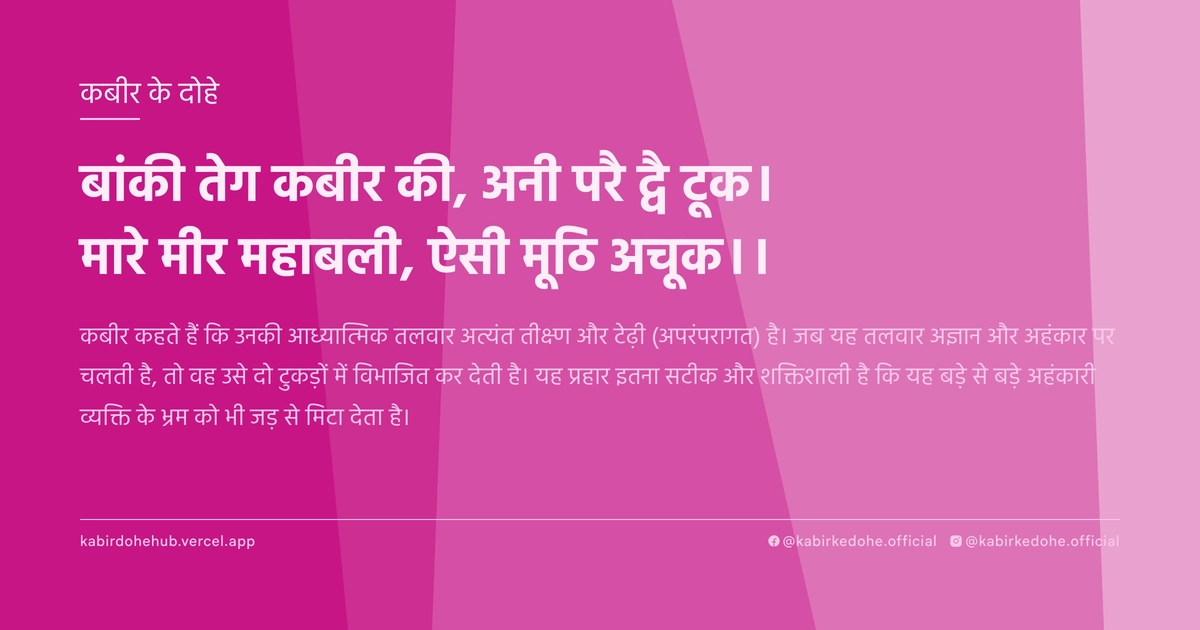
बांकी तेग कबीर की, अनी परै द्वै टूक।
मारे मीर महाबली, ऐसी मूठि अचूक।।
Baanki teg kabir ki, ani parai dvai took. Maare meer mahabali, aisi moothi achook.
इस पृष्ठ पर इस कबीर दोहे का अर्थ (meaning), हिंदी व्याख्या और अंग्रेज़ी अनुवाद, दार्शनिक विश्लेषण और व्यावहारिक जीवन सीख दी गई है। यह दोहा सत्य (Truth) विषय से जुड़ा है — Kabir doha meaning and explanation in Hindi and English.
अर्थ (Meaning):
कबीर कहते हैं कि उनकी आध्यात्मिक तलवार अत्यंत तीक्ष्ण और टेढ़ी (अपरंपरागत) है। जब यह तलवार अज्ञान और अहंकार पर चलती है, तो वह उसे दो टुकड़ों में विभाजित कर देती है। यह प्रहार इतना सटीक और शक्तिशाली है कि यह बड़े से बड़े अहंकारी व्यक्ति के भ्रम को भी जड़ से मिटा देता है।
Kabir declares that his spiritual sword is uniquely curved and razor-sharp. When this blade strikes the veil of ignorance and ego, it cleaves it into two distinct pieces. This strike is so precise and potent that it annihilates even the most formidable delusions of the powerful and arrogant.
व्याख्या (Interpretation):
शाब्दिक रूप से, कबीर यहाँ एक तलवार का रूपक उपयोग कर रहे हैं, लेकिन यह कोई भौतिक शस्त्र नहीं बल्कि 'ज्ञान' (Gyan) की तलवार है। 'बांकी' शब्द यह दर्शाता है कि उनका मार्ग सीधा या पारंपरिक नहीं है; वह रूढ़ियों को चुनौती देता है। यह तलवार 'द्वैत' (duality) को काटती है—अर्थात वह भ्रम कि आत्मा और परमात्मा अलग हैं। निरगुण भक्ति के संदर्भ में, यह तलवार माया के पर्दों को चीरकर शुद्ध चेतना को प्रकट करती है। जब 'मीर महाबली' (अहंकार का प्रतीक) इस प्रहार का सामना करता है, तो उसका मिथ्या अस्तित्व समाप्त हो जाता है। यह अद्वैत वेदांत के उस सत्य को उजागर करता है जहाँ केवल एक ही तत्व शेष रहता है।
Literally, Kabir employs the metaphor of a sword, yet this is no physical weapon but the 'Sword of Knowledge' (Gyan). The term 'Banki' (curved/crooked) signifies that his path is not linear or conventional; it deliberately defies orthodoxies. This blade severs 'Duality'—the illusion that the Atman and Brahman are separate. In the context of Nirgun Bhakti, this sword pierces the veils of Maya to reveal pure consciousness. When the 'Mighty Peer' (a symbol of the inflated ego) faces this strike, his false identity is obliterated. This mirrors the Advaita Vedanta truth where, upon the removal of ignorance, only the singular, non-dual reality remains.
दार्शनिक विश्लेषण (Philosophical Analysis):
कबीर का यह दोहा उस युग की प्रतिक्रिया है जहाँ धर्म केवल कर्मकांडों और बाहरी आडंबरों तक सीमित था। उन्होंने देखा कि लोग मंदिर-मस्जिद और जातिगत श्रेष्ठता के अहंकार में डूबे थे। उनकी 'बांकी तेग' वास्तव में वह सत्य है जो सामाजिक और धार्मिक पाखंडों को काट देता है। यह दृष्टिकोण सूफी मत के 'फना' (अहंकार का विनाश) और अद्वैत के 'अहं ब्रह्मास्मि' के बीच एक सेतु बनाता है।
यहाँ 'अनी' या 'अहंकार' को काटना मनोवैज्ञानिक रूपांतरण की प्रक्रिया है। कबीर तर्क देते हैं कि जब तक मनुष्य अपनी पहचान को शरीर, नाम या पद से जोड़ता है, वह सत्य से दूर रहता है। यह तलवार उस पहचान को नष्ट करती है ताकि वास्तविक स्वरूप प्रकट हो सके। यह कोई हिंसक कृत्य नहीं, बल्कि एक आध्यात्मिक शल्य चिकित्सा (surgery) है।
ऐतिहासिक रूप से, कबीर ने ब्राह्मणवादी और मौलवी वर्चस्व दोनों को चुनौती दी। उनकी भाषा सीधी और प्रहारक थी क्योंकि सत्य को धीरे-धीरे नहीं, बल्कि एक झटके में अनुभव किया जाना चाहिए। यह 'अचूक' प्रहार उस क्षण को दर्शाता है जब साधक को 'बोध' (enlightenment) होता है और सारा भ्रम एक पल में ढह जाता है।
दार्शनिक स्तर पर, यह दोहा 'विवेक' (discernment) की शक्ति का वर्णन करता है। विवेक वह क्षमता है जो नित्य (eternal) और अनित्य (transient) के बीच भेद कर सके। जब विवेक जागता है, तो वह माया के जालों को वैसे ही काट देता है जैसे एक तेज तलवार कपड़े को काटती है।
अंततः, कबीर यह संदेश देते हैं कि आध्यात्मिक प्रगति के लिए साहस आवश्यक है। सत्य का मार्ग कोमल नहीं होता; यह अक्सर हमारे पुराने विश्वासों और प्रिय भ्रमों को नष्ट करता है। यह विनाश ही वास्तव में सृजन की पहली शर्त है, क्योंकि जब तक पुराना 'मैं' नहीं मरता, तब तक 'परमात्मा' का अनुभव संभव नहीं है।
This couplet is a visceral reaction to an era where religion had devolved into mere ritualism and outward displays of piety. Kabir observed a society blinded by the arrogance of caste superiority and sectarian divides. His 'curved sword' is the Truth that slices through social and religious hypocrisy without hesitation. This perspective builds a bridge between the Sufi concept of 'Fana' (annihilation of the self) and the Advaita realization of 'Aham Brahmasmi'.
Cutting the 'Ani' or ego is presented here as a process of psychological transformation. Kabir argues that as long as a human identifies with the body, a name, or a social rank, they remain estranged from the Truth. The sword destroys this false identity to unveil the authentic Self. This is not an act of violence, but a spiritual surgery required for liberation.
Historically, Kabir challenged both the Brahmanical and the Clerical hegemonies of his time. His language was blunt and piercing because Truth is not always a gradual whisper; sometimes it is a sudden thunderbolt. The 'unfailing' strike represents the moment of 'Bodhi' or enlightenment, where the entire structure of delusion collapses in a single instant.
On a philosophical plane, this verse describes the power of 'Viveka' (spiritual discernment). Viveka is the capacity to distinguish between the Eternal (Nitya) and the Transient (Anitya). When discernment awakens, it severs the webs of Maya just as a sharp blade slices through fabric, leaving no room for ambiguity.
Ultimately, Kabir emphasizes that courage is indispensable for spiritual progress. The path to Truth is not gentle; it often demands the destruction of our cherished beliefs and comforting illusions. This destruction is the prerequisite for creation, for until the illusory 'I' perishes, the experience of the Universal Divine remains impossible.
मूल संदेश (Core Message):
- अहंकार वह पर्दा है जो सत्य को ओझल करता है।
- ज्ञान की तलवार केवल भ्रम को काटती है, व्यक्ति को नहीं।
- सच्ची शक्ति विनम्रता में है, वर्चस्व में नहीं।
- द्वैत का अंत ही अद्वैत की शुरुआत है।
- आंतरिक रूपांतरण के लिए पुराने 'मैं' का विनाश अनिवार्य है।
- Ego is the veil that obscures the ultimate Truth.
- The sword of knowledge severs only the illusion, not the person.
- True power resides in humility, not in dominance.
- The end of duality is the beginning of non-dual oneness.
- The destruction of the old 'I' is essential for inner transformation.
व्यावहारिक उदाहरण (Practical Example):
वाराणसी के घाटों पर रहने वाला एक वृद्ध बुनकर था, जिसका नाम माधव था। माधव अपनी कला में निपुण था, लेकिन उसे अपनी श्रेष्ठता का बहुत अहंकार था। वह मानता था कि उसके द्वारा बुने गए वस्त्र शहर के सबसे महंगे बाज़ारों में बिकते हैं, इसलिए वह स्वयं को अन्य बुनकरों से ऊपर समझता था। वह अक्सर नए सीखने वालों का उपहास करता और उन्हें तुच्छ मानता था।
एक दिन, एक फकीर उसके पास आया। फकीर के कपड़े फटे हुए थे, लेकिन उसकी आँखों में एक अजीब सी चमक थी। माधव ने घमंड से कहा, "हे फकीर, देखो मेरे वस्त्रों की बारीकी, क्या तुमने कभी ऐसी कला देखी है?" फकीर मुस्कुराया और उसने माधव के सबसे महंगे रेशमी कपड़े को देखा और फिर माधव की आँखों में झाँका।
फकीर ने शांति से कहा, "माधव, तूने धागों को तो बहुत बारीकी से जोड़ा है, लेकिन अपनी आत्मा के धागों को अहंकार की गांठों में उलझा लिया है। यह रेशम तो समय के साथ पुराना होकर फट जाएगा, लेकिन तेरा यह घमंड तुझे कभी मुक्त नहीं होने देगा।"
माधव को पहले तो यह बात चुभी, लेकिन फकीर के शब्दों में एक ऐसी तीव्रता थी जैसे कोई तलवार चली हो। उसे महसूस हुआ कि उसकी पूरी पहचान केवल उसके काम और उसकी प्रशंसा पर टिकी थी। वह यह भूल गया था कि वह भी उसी मिट्टी का हिस्सा है जिससे अन्य सभी बने हैं।
उस रात माधव सो नहीं सका। उसे लगा कि उसका 'महाबली' अहंकार, जिसे वह अपनी उपलब्धि समझता था, वास्तव में एक बोझ था। उसने महसूस किया कि वह अपनी कला का स्वामी नहीं, बल्कि उसका दास बन गया था।
अगली सुबह, माधव ने अपना व्यवहार बदल दिया। उसने उन युवा बुनकरों को बुलाना शुरू किया जिन्हें वह पहले दुत्कारता था। उसने उन्हें न केवल तकनीक सिखाई, बल्कि उनके साथ बैठकर उनकी समस्याओं को सुना।
उसने पाया कि जब उसने अपनी श्रेष्ठता का मुखौटा उतारा, तो उसे एक ऐसी शांति मिली जो रेशमी कपड़ों की चमक से कहीं अधिक मूल्यवान थी। उसका अहंकार टूट चुका था, और उसकी जगह एक गहरी करुणा ने ले ली थी।
माधव अब भी बेहतरीन वस्त्र बुनता था, लेकिन अब वह उन्हें अपनी श्रेष्ठता सिद्ध करने के लिए नहीं, बल्कि सेवा के भाव से बुनता था।
उसकी कला में अब एक नई गहराई थी, क्योंकि वह अब केवल धागों से नहीं, बल्कि प्रेम से बुन रहा था।
यह माधव के जीवन का 'कबीर ट्विस्ट' था—जहाँ ज्ञान की एक तीखी चोट ने उसे एक अहंकारी कलाकार से एक विनम्र इंसान बना दिया।
In the ghats of Varanasi lived an elderly weaver named Madhav. Madhav was a master of his craft, but he harbored a profound arrogance regarding his skill. He believed that because his textiles were sold in the city's most expensive markets, he was inherently superior to all other weavers. He often mocked novices, treating them with utter disdain.
One day, a wandering dervish arrived at his doorstep. The dervish wore tattered rags, yet his eyes possessed an extraordinary luminosity. Madhav, with a smirk, said, "Look, O Fakir, at the intricacy of my weave. Have you ever seen such artistry?"
The dervish smiled, glanced at the expensive silk, and then looked deep into Madhav's eyes. He replied calmly, "Madhav, you have woven the threads with great precision, but you have entangled the threads of your soul in the knots of ego. This silk will fade and tear with time, but this pride of yours will never let you be free."
Initially, Madhav felt stung, but there was a piercing intensity in the dervish's words, like a sword strike. He suddenly realized that his entire identity was anchored only to his work and the praise he received. He had forgotten that he was made of the same clay as everyone else.
That night, Madhav could not sleep. He felt that his 'mighty' ego, which he had mistaken for achievement, was actually a heavy burden. He realized he was not the master of his art, but its slave.
The next morning, Madhav transformed his behavior. He began inviting the young weavers he had previously shunned. He didn't just teach them technique; he sat with them and listened to their struggles.
He discovered that once he stripped away the mask of superiority, he found a peace far more valuable than the luster of silk. His ego had been shattered, and in its place, a deep compassion had grown.
Madhav continued to weave exquisite fabrics, but no longer to prove his dominance; he did it as an act of service.
There was now a new depth in his art, for he was no longer weaving with mere threads, but with love.
This was the 'Kabir Twist' in Madhav's life—where a sharp strike of truth transformed him from an arrogant artisan into a humble human being.
अभ्यास मार्गदर्शन (Practice Guidance):
- प्रतिदिन 15 मिनट मौन बैठें और अपने भीतर उठने वाले 'मैं' (अहंकार) के विचारों को केवल एक साक्षी की तरह देखें, बिना किसी निर्णय के।
- एक 'अहंकार डायरी' बनाएँ: उन क्षणों को लिखें जब आपको लगा कि आप दूसरों से श्रेष्ठ हैं या जब आपको अपनी प्रशंसा की तीव्र इच्छा हुई। विश्लेषण करें कि वह भावना कहाँ से आई।
- सचेत व्यवहार परिवर्तन: दिन में कम से कम एक बार किसी ऐसे व्यक्ति की मदद करें जिसे आप सामान्यतः अनदेखा करते हैं, और यह सुनिश्चित करें कि इस कार्य का श्रेय आप स्वयं न लें।
- निदान चेकलिस्ट: क्या मैं दूसरों की गलती पर तुरंत प्रतिक्रिया देता हूँ? क्या मुझे अपनी बात मनवाने की तीव्र इच्छा होती है? क्या मैं अपनी पहचान अपने पद या संपत्ति से जोड़ता हूँ? यदि हाँ, तो 'ज्ञान की तलवार' के प्रयोग की आवश्यकता है।
- Sit in silence for 15 minutes daily and observe the thoughts of 'I' (ego) arising within you, acting solely as a witness without judgment.
- Maintain an 'Ego Journal': Record moments when you felt superior to others or experienced an intense craving for validation. Analyze the root of that emotion.
- Conscious Behavioral Shift: At least once a day, help someone you typically overlook, ensuring that you seek no credit or recognition for the act.
- Diagnostic Checklist: Do I react instantly to others' mistakes? Do I feel a compulsive need to be right? Do I tie my identity to my status or possessions? If yes, the 'Sword of Knowledge' must be applied.
चिंतन प्रश्न (Reflection Questions):
- यदि आज आपकी सारी उपलब्धियाँ, पद और पहचान छीन ली जाएँ, तो आपके पास क्या बचेगा?
- आपकी वह कौन सी 'पवित्र' धारणा है जिसे आप चुनौती दिए जाने पर क्रोध के साथ defend करते हैं?
- क्या आपका डिजिटल व्यक्तित्व (Social Media) आपके वास्तविक आंतरिक संघर्षों को छिपाने का एक मुखौटा है?
- आप दूसरों में जो कमियाँ देखते हैं, क्या वे वास्तव में आपके अपने ही व्यक्तित्व के अनसुलझे हिस्से हैं?
- क्या आप वास्तव में सत्य की खोज कर रहे हैं, या केवल उस सत्य की जो आपकी मान्यताओं की पुष्टि करे?
- वह कौन सा डर है जो आपको पूरी तरह से 'शून्य' होने से रोकता है?
- If all your achievements, titles, and identities were stripped away today, what would remain of you?
- Which of your 'sacred' beliefs do you defend with anger when challenged?
- Is your digital persona a mask used to conceal your actual internal conflicts?
- Are the flaws you perceive in others actually unresolved fragments of your own personality?
- Are you truly seeking the Truth, or only a truth that confirms your existing biases?
- What is the specific fear that prevents you from becoming completely 'void' or empty?