
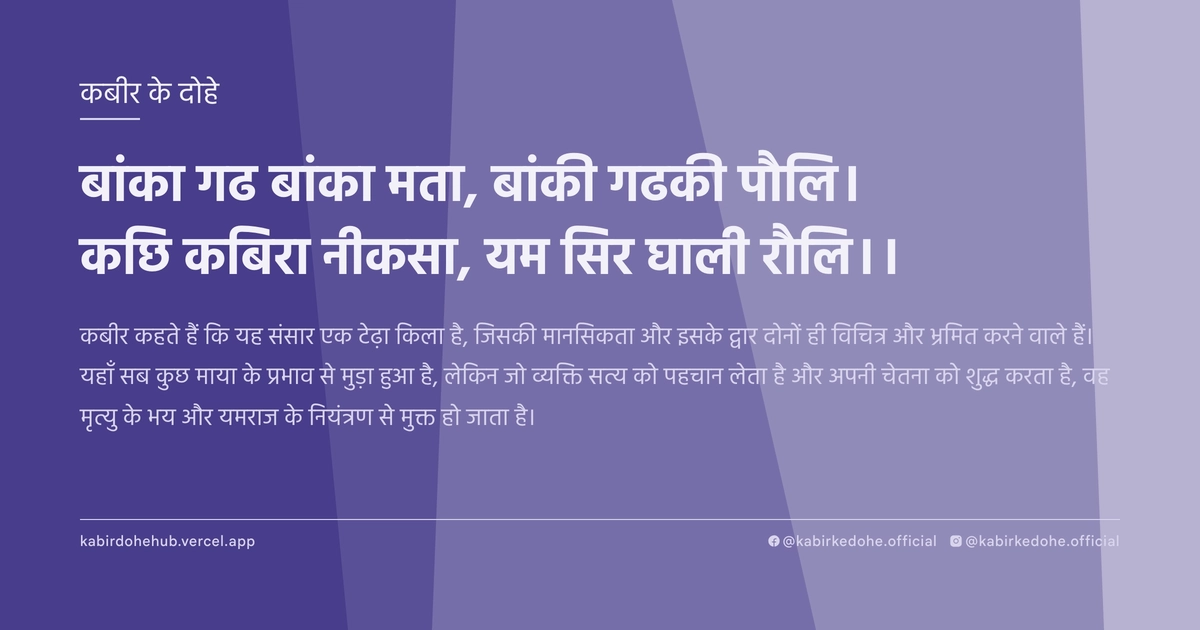
बांका गढ बांका मता, बांकी गढकी पौलि।
कछि कबिरा नीकसा, यम सिर घाली रौलि।।
Baanka gadh baanka mata, baanki gadhki pauli. Kachi kabira neeksa, yam sir ghaali rauli.
इस पृष्ठ पर इस कबीर दोहे का अर्थ (meaning), हिंदी व्याख्या और अंग्रेज़ी अनुवाद, दार्शनिक विश्लेषण और व्यावहारिक जीवन सीख दी गई है। यह दोहा मुक्ति (Liberation) विषय से जुड़ा है — Kabir doha meaning and explanation in Hindi and English.
अर्थ (Meaning):
कबीर कहते हैं कि यह संसार एक टेढ़ा किला है, जिसकी मानसिकता और इसके द्वार दोनों ही विचित्र और भ्रमित करने वाले हैं। यहाँ सब कुछ माया के प्रभाव से मुड़ा हुआ है, लेकिन जो व्यक्ति सत्य को पहचान लेता है और अपनी चेतना को शुद्ध करता है, वह मृत्यु के भय और यमराज के नियंत्रण से मुक्त हो जाता है।
Kabir describes the world as a crooked fortress, where both the mindset of the inhabitants and the gateways of existence are distorted by illusion. He suggests that while the world is skewed by ego and desire, the one who attains spiritual clarity and purity transcends the fear of death, leaving even the Lord of Death, Yamraj, defeated and bewildered.
व्याख्या (Interpretation):
यहाँ 'बांका गढ' (टेढ़ा किला) मानव शरीर और इस भौतिक जगत का प्रतीक है, जो माया के कारण सीधा नहीं दिखता। 'मता' मन की उस स्थिति को दर्शाता है जो द्वैत और अहंकार में फंसी है। कबीर यह समझा रहे हैं कि जब तक हम बाहरी कर्मकांडों और सामाजिक मुखौटों में उलझे रहते हैं, हम इस टेढ़े किले के बंदी बने रहते हैं। निर्गुण भक्ति का मार्ग इस किले की दीवारों को ढहाने का मार्ग है। जब साधक अपनी आत्मा (Atman) को ब्रह्म (Brahman) के साथ एकाकार कर लेता है, तो वह द्वैत के भ्रम से मुक्त हो जाता है। यह मुक्ति ही वह 'नीकसा' या शुद्धता है जो यमराज के पाश को काट देती है। अंततः, यह दोहा बताता है कि मृत्यु केवल उनके लिए सत्य है जो शरीर को ही अपनी पहचान मानते हैं; जो चेतना को पहचान लेते हैं, वे अमर हो जाते हैं।
The 'Banka Gadh' (crooked fortress) serves as a potent metaphor for the human body and the material world, both distorted by the veil of Maya. 'Mata' refers to the skewed consciousness of the ego, trapped in duality and superficiality. Kabir posits that as long as we cling to ritualism and social masks, we remain prisoners of this warped architecture. The path of Nirgun Bhakti is the process of dismantling these walls to realize the formless truth. By recognizing the non-duality of Atman and Brahman, the seeker transcends the illusion of separation. This spiritual purity is the 'Neeksa' that renders the grip of Yamraj, the deity of death, powerless. Ultimately, the Doha asserts that death is only a reality for those who identify with the perishable body; those who realize their eternal consciousness become deathless.
दार्शनिक विश्लेषण (Philosophical Analysis):
कबीर का यह दोहा उनके युग के सामाजिक और धार्मिक पाखंड पर एक गहरा प्रहार है। उस समय धर्म केवल बाहरी प्रतीकों, तीर्थों और कठोर नियमों तक सीमित था, जिसे कबीर 'टेढ़ापन' कहते हैं। वे तर्क देते हैं कि यदि ईश्वर सर्वव्यापी है, तो उसे किसी विशेष मंदिर या मस्जिद के 'टेढ़े द्वारों' में खोजने की आवश्यकता नहीं है। यह विचार अद्वैत वेदांत के करीब है, जहाँ जगत को 'मिथ्या' माना गया है और केवल ब्रह्म को सत्य।
सूफी मत के 'फना' (अहंकार का विनाश) की अवधारणा यहाँ स्पष्ट दिखती है। जब तक 'मैं' का अस्तित्व है, तब तक हम इस टेढ़े किले के बंदी हैं। जैसे ही अहंकार मिटता है, व्यक्ति उस अनंत शून्य में विलीन हो जाता है जहाँ जन्म और मृत्यु का कोई अर्थ नहीं रह जाता। कबीर यहाँ कर्मकांडों के बजाय आंतरिक रूपांतरण पर जोर देते हैं।
मनोवैज्ञानिक स्तर पर, यह दोहा हमारे संज्ञानात्मक पूर्वाग्रहों (cognitive biases) की बात करता है। हम दुनिया को वैसा नहीं देखते जैसी वह है, बल्कि वैसा देखते हैं जैसे हम हैं। हमारा अहंकार एक ऐसा फिल्टर है जो सत्य को टेढ़ा कर देता है। इस फिल्टर को हटाना ही वास्तविक ज्ञान है।
कबीर का विद्रोह केवल बाहरी नहीं था, बल्कि वह चेतना के स्तर पर था। वे कहते हैं कि यमराज (मृत्यु) केवल शरीर का अंत करता है, आत्मा का नहीं। लेकिन जो व्यक्ति जीवन भर माया के मोह में रहा, उसके लिए मृत्यु एक भयानक सत्य है। इसके विपरीत, जो जागृत है, उसके लिए मृत्यु केवल एक वस्त्र बदलने जैसी प्रक्रिया है।
अंततः, यह दर्शन हमें सिखाता है कि मुक्ति किसी बाहरी स्थान पर जाने से नहीं, बल्कि अपने भीतर के 'टेढ़ेपन' को सीधा करने से मिलती है। यह आत्म-साक्षात्कार की वह प्रक्रिया है जहाँ साधक यह जान लेता है कि वह स्वयं वह अनंत चेतना है जिसे वह बाहर खोज रहा था।
This Doha is a profound critique of the social and religious hypocrisy of Kabir's era. During his time, spirituality was reduced to external symbols, pilgrimages, and rigid dogmas, which Kabir characterizes as 'crookedness.' He argues that if the Divine is omnipresent, there is no need to seek it through the distorted gateways of institutionalized religion. This aligns closely with Advaita Vedanta, which views the empirical world as 'Maya' (illusion) and only Brahman as the ultimate reality.
The Sufi concept of 'Fana' (the annihilation of the ego) is vividly present here. As long as the 'I' exists, the individual remains a prisoner of the crooked fortress. Once the ego is dissolved, the seeker merges into the infinite void where the cycle of birth and death ceases to exist. Kabir emphasizes internal transformation over external ritualism, suggesting that the only true liberation is the death of the false self.
Psychologically, the poem addresses our cognitive biases. We do not perceive the world as it is, but as we are. Our ego acts as a distorting lens, bending truth to fit our desires and fears. Removing this lens is the essence of spiritual enlightenment. The 'crookedness' is not in the world, but in the perception of the observer.
Kabir's rebellion was not merely social but ontological. He suggests that Yamraj (Death) only claims the physical form, not the essence. For those steeped in material attachment, death is a terror; for the awakened, it is merely a transition, like changing a garment. The fear of death is a symptom of the ego's refusal to accept its own insignificance.
Ultimately, this philosophy teaches that liberation is not found in a distant heaven or through a specific ritual, but by straightening the internal distortions of the heart. It is the process of self-realization where the seeker discovers that they are the very infinite consciousness they were searching for externally.
मूल संदेश (Core Message):
- संसार एक भ्रम है, इसे सत्य मानकर इसमें न फंसें।
- अहंकार ही वह टेढ़ा किला है जो हमें सत्य से दूर रखता है।
- आंतरिक शुद्धता ही मृत्यु के भय का एकमात्र समाधान है।
- बाहरी कर्मकांड व्यर्थ हैं; केवल आत्म-बोध ही वास्तविक मुक्ति है।
- जब 'मैं' मिटता है, तब अनंत चेतना का उदय होता है।
- सत्य सीधा है, लेकिन हमारी दृष्टि इसे टेढ़ा देखती है।
- The world is a mirage; do not mistake the illusion for the ultimate truth.
- The ego is the crooked fortress that isolates us from the Divine.
- Internal purity is the only antidote to the fear of death.
- External rituals are hollow; only self-realization brings true liberation.
- When the 'I' dissolves, the infinite consciousness awakens.
- Truth is straight; it is only our perception that bends it.
व्यावहारिक उदाहरण (Practical Example):
एक समय की बात है, वाराणसी के घाटों पर रामदीन नाम का एक पुराना नाविक रहता था। रामदीन का पूरा जीवन दूसरों को नदी पार कराने में बीता, लेकिन उसका अपना मन हमेशा ईर्ष्या और क्रोध के 'टेढ़ेपन' से भरा रहता था। वह अक्सर अन्य नाविकों से झगड़ता और अपनी छोटी सी नाव को ही अपनी पूरी दुनिया मानता था।
एक दिन उसकी मुलाकात एक शांत साधु से हुई। साधु ने रामदीन की नाव में बैठकर उसे एक बात कही, "तेरी नाव तो सीधी है, लेकिन तेरा मन टेढ़ा है। तू इस टेढ़ेपन के किले में कैद है, इसलिए तुझे शांति नहीं मिलती।"
रामदीन को पहले तो यह बात समझ नहीं आई। उसने सोचा कि वह तो मेहनत करता है, फिर उसका मन टेढ़ा कैसे हो सकता है? लेकिन साधु ने उसे एक प्रयोग दिया: "अगले सात दिनों तक, जो भी यात्री तेरी नाव पर आए, उसे तू केवल एक सेवा मान, अपना अधिकार नहीं।"
शुरुआत में रामदीन को बहुत कठिनाई हुई। जब कोई यात्री उसे कम पैसे देता या बदतमीजी करता, तो उसका पुराना 'टेढ़ा' स्वभाव जाग उठता। लेकिन उसने साधु की बात याद रखी और अपनी प्रतिक्रिया को रोकने की कोशिश की।
धीरे-धीरे उसने महसूस किया कि जब वह अपनी 'अधिकार भावना' (ego) को छोड़ता है, तो उसे गुस्सा नहीं आता। उसने देखा कि वह जिसे 'दुश्मन' समझता था, वे भी उसी तरह के संघर्षों से जूझ रहे थे जैसे वह था।
एक दिन एक बहुत ही अहंकारी व्यक्ति उसकी नाव पर आया और उसे नीचा दिखाने लगा। रामदीन ने मुस्कुराकर उसे पार कराया। उस व्यक्ति ने हैरान होकर पूछा, "तुमने मुझ पर चिल्लाया क्यों नहीं?"
रामदीन ने उत्तर दिया, "क्योंकि मैंने जान लिया है कि मेरा गुस्सा केवल मेरे अपने किले की दीवारें ऊँची कर रहा था। अब मैं उस किले से बाहर आ गया हूँ।"
उस क्षण रामदीन को एक असीम शांति का अनुभव हुआ। उसे समझ आया कि 'यम' या मृत्यु का भय केवल तब तक है जब तक हम अपनी छोटी पहचान से चिपके रहते हैं।
उसकी पूरी जीवनशैली बदल गई। वह अब केवल एक नाविक नहीं था, बल्कि घाट पर आने वाले हर व्यक्ति के लिए एक मार्गदर्शक बन गया। उसने सीखा कि सेवा ही वह कुंजी है जो टेढ़े किले के द्वार खोलती है।
रामदीन की कहानी हमें सिखाती है कि जब हम अपने आंतरिक विकारों को पहचान कर उन्हें त्याग देते हैं, तो हम जीवन के सबसे बड़े भय—मृत्यु और विफलता—से ऊपर उठ जाते हैं।
Once, on the ghats of Varanasi, lived an old boatman named Ramdeen. Ramdeen had spent his entire life ferrying others across the river, yet his own mind was perpetually filled with the 'crookedness' of jealousy and anger. He frequently clashed with other boatmen and viewed his small boat as the center of his entire universe.
A chance encounter with a serene monk changed his trajectory. While sailing, the monk remarked, "Your boat is straight, Ramdeen, but your mind is crooked. You are imprisoned in a fortress of your own distortions, which is why you find no peace."
Ramdeen was initially confused. He believed his hard work made him a good man; how could his mind be crooked? The monk gave him a simple practice: "For the next seven days, treat every passenger not as a source of income or a subject of your authority, but as an act of selfless service."
Initially, this was grueling. When passengers underpaid him or were rude, his old 'crooked' nature surged. However, he consciously recalled the monk's words and practiced restraint, observing his anger without reacting to it.
Gradually, he realized that his anger was fueled by his sense of entitlement. He began to see that the people he considered 'enemies' or 'difficult' were merely fighting their own invisible battles, just as he had been.
One day, a particularly arrogant man boarded his boat and began insulting him. Instead of reacting, Ramdeen smiled and ferried him across with grace. The man, bewildered, asked, "Why didn't you shout back at me?"
Ramdeen replied, "Because I realized that my anger was only building the walls of my own prison. I have finally stepped outside that fortress."
In that moment, Ramdeen experienced a profound sense of liberation. He understood that the fear of 'Yam' or death is only present as long as we cling to a fragile, ego-driven identity.
His entire existence transformed. He was no longer just a boatman; he became a beacon of peace for everyone visiting the ghats. He discovered that selfless service is the key that unlocks the gates of the crooked fortress.
Ramdeen's story illustrates that when we identify and dissolve our internal distortions, we transcend the greatest fears of life—failure, loss, and eventually, death itself.
अभ्यास मार्गदर्शन (Practice Guidance):
- दैनिक आत्म-अवलोकन: हर रात सोने से पहले विचार करें कि आज दिन भर में आपने कितनी बार 'टेढ़ापन' (अहंकार, क्रोध, ईर्ष्या) दिखाया। इसे बिना निर्णय के केवल देखें।
- मौन साधना: प्रतिदिन 20 मिनट पूर्ण मौन में बैठें। अपने विचारों को एक बहती नदी की तरह देखें, उनमें उलझें नहीं। यह आपको 'किले' की दीवारों से अलग होने में मदद करेगा।
- सेवा का अभ्यास: सप्ताह में एक बार ऐसा कार्य करें जिसमें आपको कोई श्रेय न मिले और जो आपके स्वभाव के विपरीत हो (जैसे किसी ऐसे व्यक्ति की मदद करना जिससे आपकी अनबन हो)।
- डायग्नोस्टिक चेकलिस्ट: क्या आप दूसरों की सफलता से जलते हैं? क्या आप अपनी पहचान अपने पद या संपत्ति से जोड़ते हैं? क्या आप मृत्यु के विचार से भयभीत हैं? यदि हाँ, तो आप अभी भी 'बांका गढ' में हैं।
- Daily Self-Observation: Before sleep, reflect on the moments you exhibited 'crookedness' (ego, anger, or jealousy). Observe these patterns without judgment to create distance from them.
- Silence Practice: Spend 20 minutes daily in absolute silence. Observe your thoughts as a flowing river without engaging with them, helping you detach from the 'fortress' of the mind.
- Anonymity in Service: Once a week, perform an act of kindness that brings you no credit and is contrary to your habit (e.g., helping someone you dislike).
- Diagnostic Checklist: Do you feel resentment at others' success? Do you tie your identity to your status or possessions? Does the thought of death trigger deep anxiety? If yes, you are still residing within the 'Banka Gadh'.
चिंतन प्रश्न (Reflection Questions):
- मेरे जीवन का वह कौन सा 'टेढ़ापन' है जिसे मैं अपनी 'सिद्धांत' या 'मजबूरी' कहकर सही ठहराता हूँ?
- यदि आज मेरी सारी सामाजिक पहचान (नाम, पद, रिश्ता) छीन ली जाए, तो मेरे भीतर क्या बचेगा?
- मैं अपनी डिजिटल छवि (Social Media Ego) को बनाए रखने के लिए अपनी वास्तविक शांति का कितना बलिदान कर रहा हूँ?
- क्या मेरा धर्म मुझे दूसरों से जोड़ रहा है, या यह मेरे और दूसरों के बीच एक दीवार (किला) बना रहा है?
- मृत्यु का भय वास्तव में किसका भय है—शरीर के अंत का, या उस अहंकार का जो कभी मिटना नहीं चाहता?
- What 'crookedness' in my life do I justify as a 'principle' or a 'necessity'?
- If all my social identities (name, title, relationships) were stripped away today, what would remain of me?
- How much of my inner peace am I sacrificing to maintain my digital persona and social ego?
- Is my spirituality connecting me to others, or is it building a fortress of superiority between us?
- Is the fear of death actually a fear of the body's end, or a fear of the ego's inevitable dissolution?