
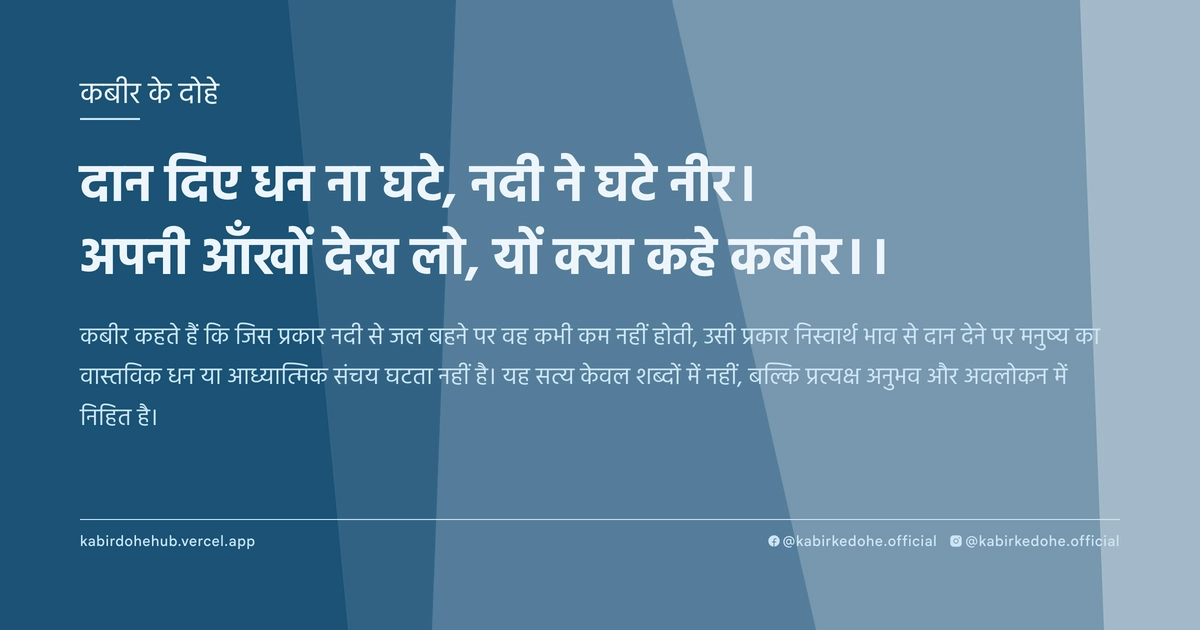
दान दिए धन ना घटे, नदी ने घटे नीर।
अपनी आँखों देख लो, यों क्या कहे कबीर।।
Daan diye dhan na ghate, nadi ne ghate neer. Apni aankhon dekh lo, yon kya kahe kabir.
इस पृष्ठ पर इस कबीर दोहे का अर्थ (meaning), हिंदी व्याख्या और अंग्रेज़ी अनुवाद, दार्शनिक विश्लेषण और व्यावहारिक जीवन सीख दी गई है। यह दोहा दान (Generosity) विषय से जुड़ा है — Kabir doha meaning and explanation in Hindi and English.
अर्थ (Meaning):
कबीर कहते हैं कि जिस प्रकार नदी से जल बहने पर वह कभी कम नहीं होती, उसी प्रकार निस्वार्थ भाव से दान देने पर मनुष्य का वास्तविक धन या आध्यात्मिक संचय घटता नहीं है। यह सत्य केवल शब्दों में नहीं, बल्कि प्रत्यक्ष अनुभव और अवलोकन में निहित है।
Kabir asserts that just as a river does not diminish its volume by flowing and giving its water to the earth, the true wealth of a human being—spiritual and material—does not decrease through selfless giving. He urges the seeker to observe this cosmic law through their own eyes rather than relying on hearsay.
व्याख्या (Interpretation):
शाब्दिक अर्थ यह है कि दान से संपत्ति कम नहीं होती। परंतु गहरा आध्यात्मिक अर्थ यह है कि 'धन' यहाँ केवल मुद्रा नहीं, बल्कि प्रेम, करुणा और चेतना है। यह निर्गुण भक्ति का सार है जहाँ आत्मा स्वयं को ब्रह्मांडीय प्रवाह का हिस्सा मानती है। जब हम 'मैं' और 'मेरा' के अहंकार को त्यागकर देते हैं, तो हम वास्तव में उस अद्वैत स्थिति में पहुँचते हैं जहाँ देने वाला और लेने वाला एक ही ब्रह्म हैं। माया हमें यह विश्वास दिलाती है कि संचय ही सुरक्षा है, जबकि सत्य यह है कि प्रवाह ही जीवन है। कबीर यहाँ विरोधाभास का उपयोग कर रहे हैं: जो पकड़ कर रखता है वह खो देता है, और जो मुक्त करता है वह अनंत हो जाता है।
Literally, the verse suggests that charity does not deplete wealth. Metaphorically, 'wealth' refers not to currency, but to the abundance of love, compassion, and consciousness. This aligns with Nirgun Bhakti, where the soul recognizes itself as part of a cosmic flow. When one gives without the ego of 'I' and 'mine,' they enter the state of Advaita (non-duality), where the giver and receiver are one and the same Brahman. Maya creates the illusion that hoarding equals security, whereas the truth is that flow is the essence of life. Kabir employs a paradox: he who clings loses, and he who releases becomes infinite, bridging the gap between the finite self and the formless Absolute.
दार्शनिक विश्लेषण (Philosophical Analysis):
कबीर का यह दोहा मध्यकालीन भारत के उस सामाजिक परिवेश में लिखा गया था जहाँ धार्मिक कर्मकांडों और बाहरी दिखावे का बोलबाला था। उन्होंने इस बात पर प्रहार किया कि दान केवल पुण्य कमाने का साधन नहीं होना चाहिए, बल्कि यह अहंकार के विसर्जन की एक प्रक्रिया है। कबीर का दृष्टिकोण सूफीवाद के 'फना' (अहंकार का विनाश) और वेदांत के 'अद्वैत' के करीब है, जहाँ व्यक्तिगत पहचान का विलीनीकरण सार्वभौमिक चेतना में होता है।
यहाँ 'नदी' का प्रतीक अत्यंत महत्वपूर्ण है। नदी कभी अपने जल को संचित नहीं करती; यदि वह ऐसा करे, तो वह तालाब बन जाएगी और अंततः सड़ जाएगी। इसी प्रकार, मानवीय चेतना यदि केवल संचय (hoarding) पर केंद्रित रहे, तो वह आध्यात्मिक रूप से मृत हो जाती है। कबीर हमें सिखाते हैं कि उदारता कोई नैतिक कर्तव्य नहीं, बल्कि प्रकृति का मौलिक नियम है।
वे जाति और वर्ण व्यवस्था द्वारा थोपे गए उन विभाजनों को चुनौती देते हैं जो यह तय करते हैं कि कौन किसे दे सकता है। उनके लिए, मानवता ही एकमात्र धर्म है। जब एक व्यक्ति बिना किसी भेदभाव के दान करता है, तो वह वास्तव में अपनी सामाजिक पहचान की सीमाओं को तोड़ रहा होता है।
मनोवैज्ञानिक स्तर पर, यह दोहा 'अभाव की मानसिकता' (Scarcity Mindset) को 'प्रचुरता की मानसिकता' (Abundance Mindset) में बदलने का आह्वान है। डर कि 'मेरे पास कम हो जाएगा' ही वह बंधन है जो आत्मा को मुक्त होने से रोकता है।
अंततः, कबीर यह स्पष्ट करते हैं कि सत्य किसी शास्त्र या गुरु के शब्दों में नहीं, बल्कि स्वयं के प्रत्यक्ष अनुभव ('अपनी आँखों देख लो') में है। यह अनुभवजन्य ज्ञान ही वास्तविक मोक्ष का मार्ग है, जो किसी भी बाहरी अनुष्ठान से ऊपर है।
This couplet was composed during a medieval Indian era dominated by rigid religious rituals and external displays of piety. Kabir attacks the notion that charity should be a mere tool for accumulating spiritual merit (punya); instead, he presents it as a process of ego dissolution. His perspective converges with the Sufi concept of 'Fana' (annihilation of the self) and the Vedantic principle of 'Advaita,' where individual identity merges into universal consciousness.
The metaphor of the 'river' is pivotal. A river never hoards its water; if it did, it would become a stagnant pond and eventually decay. Similarly, if human consciousness focuses solely on accumulation, it becomes spiritually stagnant. Kabir teaches that generosity is not a moral obligation but a fundamental law of nature.
He challenges the caste-based divisions of his time that dictated who was eligible to give or receive. For Kabir, humanity is the only true religion. By giving without discrimination, an individual shatters the artificial boundaries of social identity.
Psychologically, this verse is a call to shift from a 'Scarcity Mindset'—the fear that resources will run out—to an 'Abundance Mindset.' The fear of loss is the primary shackle preventing the soul's liberation.
Ultimately, Kabir emphasizes that truth does not reside in scriptures or the words of a priest, but in direct personal experience ('see with your own eyes'). This empirical realization is the only authentic path to liberation, transcending all external rituals.
मूल संदेश (Core Message):
- संचय भय का प्रतीक है, जबकि प्रवाह विश्वास का।
- सच्चा धन वह है जिसे छीना नहीं जा सकता।
- अहंकार का विसर्जन ही वास्तविक प्रचुरता का द्वार है।
- देने वाला और लेने वाला वास्तव में एक ही चेतना हैं।
- बाहरी कर्मकांडों से ऊपर उठकर करुणा को अपनाएं।
- सत्य शास्त्रों में नहीं, बल्कि प्रत्यक्ष अनुभव में है।
- Accumulation is a symbol of fear; flow is a symbol of faith.
- True wealth is that which cannot be stolen or depleted.
- The dissolution of ego is the gateway to real abundance.
- The giver and the receiver are essentially the same consciousness.
- Rise above external rituals to embrace pure compassion.
- Truth resides not in scriptures, but in direct experience.
व्यावहारिक उदाहरण (Practical Example):
वाराणसी के एक पुराने घाट पर माधव नाम का एक वृद्ध बुनकर रहता था। माधव के पास बहुत कम था, लेकिन उसका हृदय करुणा से भरा था। वह अक्सर अपनी मेहनत से बनाई गई सूती चादरों का एक हिस्सा उन राहगीरों को दे देता था जो ठंड से ठिठुर रहे होते थे।
गाँव के अन्य बुनकर माधव का मज़ाक उड़ाते थे। वे कहते थे, 'माधव, तुम मूर्ख हो। तुम अपनी कमाई बाँट रहे हो, एक दिन तुम भूखे मर जाओगे।' माधव बस मुस्कुराता और कहता, 'नदी का पानी कभी कम नहीं होता।'
एक समय ऐसा आया जब शहर में भीषण अकाल पड़ा। व्यापार ठप हो गया और अमीर बुनकरों के गोदामों में रखे कपड़े बेकार हो गए क्योंकि खरीदने वाला कोई नहीं था। वे लोग तनाव और चिंता में डूब गए, क्योंकि उनका पूरा अस्तित्व उनके संचय पर टिका था।
लेकिन माधव के साथ कुछ अलग था। जिन लोगों की उसने निस्वार्थ मदद की थी, वे अब उसकी मदद के लिए आगे आए। किसी ने उसे अनाज दिया, तो किसी ने उसके घर की मरम्मत में हाथ बँटाया।
माधव ने महसूस किया कि उसने जो 'दान' दिया था, वह वास्तव में 'संबंधों' और 'प्रेम' के रूप में उसके पास वापस लौट आया था। उसका धन कम नहीं हुआ, बल्कि उसका विस्तार हो गया था।
एक दिन एक अहंकारी व्यापारी ने उससे पूछा, 'तुम्हारे पास अब भी शांति कैसे है, जबकि हम सब परेशान हैं?'
माधव ने उत्तर दिया, 'मैंने कभी कुछ पकड़ा ही नहीं था, तो खोने का डर कैसा? मैंने तो बस उस प्रवाह का हिस्सा बनने की कोशिश की जो सबको जोड़ता है।'
उस व्यापारी ने पहली बार महसूस किया कि उसकी तिजोरियाँ वास्तव में उसकी जेल थीं, जबकि माधव की उदारता उसकी स्वतंत्रता थी।
इस 'कबीर ट्विस्ट' ने व्यापारी के जीवन को बदल दिया। उसने अपनी संपत्ति का एक बड़ा हिस्सा सामुदायिक रसोई के लिए दान कर दिया और पहली बार अनुभव किया कि देने का सुख पाने के सुख से कहीं अधिक गहरा है।
माधव की कहानी यह सिद्ध करती है कि जब हम स्वयं को ब्रह्मांड के प्रवाह से जोड़ते हैं, तो हम कभी रिक्त नहीं होते।
On an ancient ghat in Varanasi lived an elderly weaver named Madhav. Madhav possessed very little, yet his heart overflowed with compassion. He often gave away portions of the cotton sheets he painstakingly wove to travelers shivering in the winter cold.
Other weavers in the village mocked him. They would say, 'Madhav, you are a fool. You are giving away your earnings; one day you will starve.' Madhav would simply smile and reply, 'The river's water never diminishes.'
A time came when a severe famine struck the region. Trade collapsed, and the warehouses of the wealthy weavers were filled with clothes that no one could afford to buy. These men sank into deep anxiety, for their entire existence was anchored in their accumulation.
However, something different happened with Madhav. The people he had selflessly helped now stepped forward to support him. Some brought him grain, while others helped repair his leaking roof.
Madhav realized that the 'charity' he had given had returned to him in the form of 'relationships' and 'love.' His wealth had not decreased; rather, it had expanded into a social and spiritual network.
One day, an arrogant merchant asked him, 'How do you still have peace while we are all in turmoil?'
Madhav replied, 'I never held onto anything tightly, so why should I fear loss? I only tried to become part of the flow that connects everyone.'
For the first time, the merchant realized that his vaults were actually his prisons, while Madhav's generosity was his freedom.
This 'Kabir Twist' transformed the merchant's life. He donated a significant portion of his wealth to a community kitchen and experienced for the first time that the joy of giving is far deeper than the joy of receiving.
Madhav's story proves that when we align ourselves with the universal flow, we are never truly empty.
अभ्यास मार्गदर्शन (Practice Guidance):
- दैनिक चिंतन: प्रतिदिन 10 मिनट इस विचार पर ध्यान केंद्रित करें कि आप इस ब्रह्मांड के एक छोटे हिस्से नहीं, बल्कि संपूर्ण ब्रह्मांड का एक प्रवाह हैं।
- अनाम दान: सप्ताह में एक बार ऐसी मदद करें जिसका श्रेय आपको न मिले। यह आपके भीतर के 'कर्ता' (Ego) को मिटाने का अभ्यास है।
- आत्म-पूछताछ जर्नल: लिखें कि 'जब मैं किसी को कुछ देता हूँ, तो क्या मेरे मन में खोने का डर होता है?' इस डर के मूल कारण की खोज करें।
- निदान चेकलिस्ट: यदि आप किसी की मदद करते समय यह सोचते हैं कि 'मैं कितना महान हूँ', तो आप अभी भी माया में हैं। यदि आप महसूस करते हैं कि 'यह तो मेरा ही हिस्सा था जो वहां गया', तो आप सत्य के करीब हैं।
- Daily Contemplation: Spend 10 minutes daily meditating on the idea that you are not a small part of the universe, but the entire universal flow manifesting as an individual.
- Anonymous Giving: Once a week, perform an act of kindness where you receive no credit. This is an exercise in dissolving the 'Doer' (Ego).
- Self-Inquiry Journaling: Write about the feeling: 'When I give, do I feel a fear of loss?' Trace the root of this scarcity fear.
- Diagnostic Checklist: If you feel 'I am so great for helping' after an act of charity, you are still trapped in Maya. If you feel 'I was simply returning a part of myself to myself,' you are approaching the Truth.
चिंतन प्रश्न (Reflection Questions):
- मेरी वह कौन सी 'मानसिक संपत्ति' है जिसे मैं साझा करने से डरता हूँ?
- क्या मेरा दान वास्तव में निस्वार्थ है, या यह मेरी सामाजिक छवि को सुधारने का एक निवेश है?
- यदि मेरा सारा बाहरी परिचय (पद, पैसा, प्रतिष्ठा) छीन लिया जाए, तो मेरे भीतर क्या शेष बचेगा?
- मैं अपनी डिजिटल पहचान (Social Media) के माध्यम से कितनी 'दिखावटी उदारता' प्रदर्शित करता हूँ?
- क्या मैं दूसरों की सफलता को अपनी कमी के रूप में देखता हूँ, या ब्रह्मांड की प्रचुरता के रूप में?
- मेरे जीवन में 'नदी' की तरह बहने वाले तत्व क्या हैं, और मैं उन्हें कहाँ रोक रहा हूँ?
- What is the 'mental property' or knowledge I am afraid to share with others?
- Is my charity truly selfless, or is it an investment in polishing my social image?
- If all my external identities (title, money, status) were stripped away, what would remain within me?
- How much 'performative generosity' do I exhibit through my digital ego on social media?
- Do I view others' success as my own lack, or as a manifestation of universal abundance?
- What elements in my life are meant to flow like a river, and where am I blocking them?