
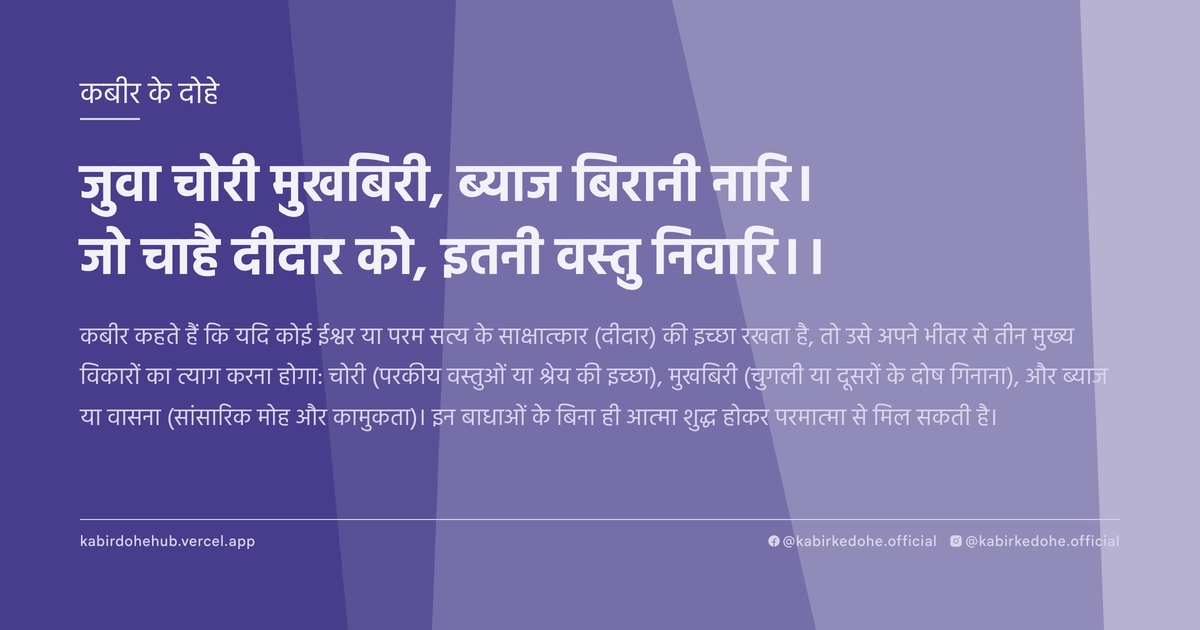
जुवा चोरी मुखबिरी, ब्याज बिरानी नारि।
जो चाहै दीदार को, इतनी वस्तु निवारि।।
Juwa chori mukhibiri, byaaj birani nari. Jo chahai deedar ko, itni vastu nivari.
इस पृष्ठ पर इस कबीर दोहे का अर्थ (meaning), हिंदी व्याख्या और अंग्रेज़ी अनुवाद, दार्शनिक विश्लेषण और व्यावहारिक जीवन सीख दी गई है। यह दोहा वैराग्य (Detachment) विषय से जुड़ा है — Kabir doha meaning and explanation in Hindi and English.
अर्थ (Meaning):
कबीर कहते हैं कि यदि कोई ईश्वर या परम सत्य के साक्षात्कार (दीदार) की इच्छा रखता है, तो उसे अपने भीतर से तीन मुख्य विकारों का त्याग करना होगा: चोरी (परकीय वस्तुओं या श्रेय की इच्छा), मुखबिरी (चुगली या दूसरों के दोष गिनाना), और ब्याज या वासना (सांसारिक मोह और कामुकता)। इन बाधाओं के बिना ही आत्मा शुद्ध होकर परमात्मा से मिल सकती है।
Kabir asserts that anyone yearning for the divine vision (Didaar) must first purge three fundamental impurities from their consciousness: theft (the desire for what belongs to others or false credit), betrayal/backbiting (the act of exposing others' flaws), and the 'interest' of worldly lust or attachment. Only after eliminating these psychic burdens can the soul attain the purity required for spiritual realization.
व्याख्या (Interpretation):
यह दोहा शाब्दिक रूप से अनैतिक व्यवहार के त्याग की बात करता है, परंतु इसका गहरा आध्यात्मिक अर्थ 'अहंकार' के विसर्जन से है। 'चोरी' यहाँ केवल भौतिक चोरी नहीं, बल्कि दूसरे के अस्तित्व या श्रेय को हड़पने की मानसिक प्रवृत्ति है। 'मुखबिरी' उस द्वैत को दर्शाती है जहाँ हम स्वयं को श्रेष्ठ और दूसरों को त्रुटिपूर्ण देखते हैं। 'ब्याज' उस मानसिक निवेश को कहते हैं जो हम सांसारिक सुखों में करते हैं, जिसकी उम्मीद में हम वर्तमान क्षण को खो देते हैं। यह निरगुण भक्ति का मार्ग है, जहाँ ईश्वर मंदिर या मस्जिद में नहीं, बल्कि एक शुद्ध हृदय में निवास करता है। जब माया का पर्दा हटता है, तब आत्मा और ब्रह्म की एकता (अद्वैत) का अनुभव होता है।
While literally addressing unethical conduct, this couplet serves as a profound metaphor for the dissolution of the ego. 'Theft' transcends material stealing; it represents the psychological impulse to usurp another's identity or claim credit for divine grace. 'Backbiting' symbolizes the duality of the mind that perceives a separation between the self and the 'other,' fueling judgment. 'Interest' refers to the karmic and emotional investments we make in transient worldly pleasures, creating a cycle of longing and suffering. This aligns with Nirgun Bhakti, where the Formless Divine is realized not through ritual, but through the scrubbing of the psychic mirror. The central paradox is that to 'see' the Divine, one must first become 'invisible' by removing the egoic layers of Maya.
दार्शनिक विश्लेषण (Philosophical Analysis):
कबीर का यह दोहा उनके युग के सामाजिक और धार्मिक पाखंड पर एक कड़ा प्रहार है। उन्होंने देखा कि लोग बाहरी कर्मकांडों, जैसे तीर्थयात्रा या माला जपने में लीन थे, जबकि उनके भीतर ईर्ष्या और वासना जीवित थी। कबीर का दर्शन 'सहज मार्ग' है, जो यह मानता है कि आध्यात्मिक उन्नति के लिए किसी बाहरी गुरु या मंदिर की आवश्यकता नहीं, बल्कि आंतरिक शुद्धि अनिवार्य है।
अद्वैत वेदांत के दृष्टिकोण से, ये तीन विकार—चोरी, मुखबिरी और वासना—अज्ञान (Avidya) के रूप में कार्य करते हैं। ये आत्मा को शरीर और सामाजिक पहचान से बांध देते हैं, जिससे वह अपनी वास्तविक प्रकृति (ब्रह्म) को भूल जाती है। जब तक मन इन विकारों से भरा है, वह एक गंदे दर्पण की तरह है जिसमें ईश्वर का प्रतिबिंब नहीं दिख सकता।
सूफी मत के 'नफ्स' (नफ्स-ए-अम्मारा या निम्न इच्छाएं) के सिद्धांत के साथ इसका गहरा संबंध है। सूफीवाद में भी माना जाता है कि जब तक इंसान अपनी निम्न प्रवृत्तियों को नियंत्रित नहीं करता, वह 'फना' (अहंकार का विनाश) की स्थिति में नहीं पहुँच सकता। कबीर यहाँ 'दीदार' शब्द का प्रयोग कर रहे हैं, जो सूफी परंपरा का एक प्रमुख शब्द है, जो ईश्वर के प्रत्यक्ष दर्शन की तीव्र लालसा को दर्शाता है।
कबीर जाति और वर्ग के भेदभाव को नकारते हुए यह स्पष्ट करते हैं कि मोक्ष किसी विशेष कुल में जन्म लेने से नहीं, बल्कि चरित्र की पवित्रता से मिलता है। वे ritualism (कर्मकांड) के बजाय ethical living (नैतिक जीवन) को प्राथमिकता देते हैं। उनके लिए धर्म का अर्थ है—सत्य का आचरण करना।
मनोवैज्ञानिक स्तर पर, यह दोहा मानसिक ऊर्जा के रिसाव को रोकने की बात करता है। जब हम दूसरों की बुराई करते हैं या लालच में रहते हैं, तो हमारी चेतना बिखर जाती है। एकाग्रता और शांति केवल तभी संभव है जब मन इन बाहरी शोर-शराबों से मुक्त होकर अंतर्मुखी हो जाए। यह अहंकार के पूर्ण विसर्जन की प्रक्रिया है।
This Doha is a scathing critique of the social and religious hypocrisy of Kabir's era. He observed a society obsessed with external rituals—pilgrimages and repetitive chanting—while harboring deep-seated envy and lust. Kabir's philosophy of 'Sahaj Marg' (the Natural Path) posits that spiritual evolution requires no external temple or priest, but rather a rigorous internal purification.
From the lens of Advaita Vedanta, these three vices—theft, backbiting, and lust—function as 'Avidya' (ignorance). They tether the Atman to the illusory identity of the body and social status, obscuring the realization of Brahman. As long as the mind is cluttered with these distortions, it remains a clouded mirror, incapable of reflecting the Divine Light.
There is a profound resonance here with the Sufi concept of 'Nafs' (the lower self). Sufism teaches that until the 'Nafs-e-Ammara' (the commanding self) is subdued, the seeker cannot achieve 'Fana' (annihilation of the ego). Kabir's use of the word 'Didaar' (divine vision) explicitly bridges the gap between the Bhakti movement and Sufi mysticism, emphasizing a direct, experiential encounter with Truth.
By rejecting the necessity of caste or creed for salvation, Kabir democratizes spirituality. He asserts that liberation is not a birthright of the elite but a reward for the ethically pure. He prioritizes 'Sadachar' (right conduct) over 'Karmakand' (ritualism), arguing that a single act of genuine honesty is worth more than a thousand superficial prayers.
Psychologically, this teaching addresses the leakage of mental energy. When the mind is preoccupied with the flaws of others or the greed for more, its focus is fragmented. Spiritual stillness is only possible when the consciousness ceases its outward projection and turns inward. This is the process of ego-death, where the 'I' is replaced by the Universal 'One.'
मूल संदेश (Core Message):
- बाहरी आडंबर व्यर्थ हैं, आंतरिक शुद्धि ही एकमात्र मार्ग है।
- दूसरों की बुराई करना स्वयं के आध्यात्मिक पतन का निमंत्रण है।
- लालच और वासना आत्मा और परमात्मा के बीच की सबसे बड़ी दीवारें हैं।
- सत्य का साक्षात्कार केवल एक निष्कपट हृदय में ही संभव है।
- अहंकार का विसर्जन ही वास्तविक 'दीदार' या दर्शन है।
- External rituals are futile; internal purity is the only authentic path.
- Criticizing others is an invitation to one's own spiritual decline.
- Greed and lust are the tallest walls separating the soul from the Divine.
- The realization of Truth is possible only within a guileless heart.
- The dissolution of the ego is the only true 'Didaar' or vision.
व्यावहारिक उदाहरण (Practical Example):
वाराणसी के घाटों पर रहने वाले एक वृद्ध विधवा, जानकी, का जीवन अत्यंत कठिन था। वह दूसरों के घरों में छोटे-मोटे काम करके अपना गुजारा करती थी। जानकी के मन में एक गहरी टीस थी; वह अक्सर अपने पड़ोस की अन्य विधवाओं की बुराई करती थी कि वे उससे अधिक चतुर हैं या उन्हें अधिक दान मिलता है। यह 'मुखबिरी' उसके मन को अशांत रखती थी।
एक दिन वह एक संत के पास गई और पूछा कि उसे शांति क्यों नहीं मिलती। संत ने उसे कबीर का यह दोहा सुनाया। जानकी को अहसास हुआ कि वह बाहरी दुनिया में गरीबी से लड़ रही थी, लेकिन उसके भीतर 'ईर्ष्या की चोरी' चल रही थी—वह दूसरों की शांति और संतोष को चुराना चाहती थी।
उसने तय किया कि वह अब किसी की बुराई नहीं करेगी। शुरुआत में यह कठिन था। जब उसकी सहेलियाँ किसी और की निंदा करतीं, तो वह चुप रहती। धीरे-धीरे उसका मन शांत होने लगा। उसने महसूस किया कि जब वह दूसरों के दोष नहीं देखती, तो उसके अपने दुख कम होने लगते हैं।
कुछ समय बाद, उसने देखा कि वह अब केवल अपने काम पर ध्यान देती है। उसने अपनी छोटी सी कमाई में से एक हिस्सा उन लोगों को देना शुरू किया जो उससे भी अधिक गरीब थे। यह उसके भीतर की 'ब्याज' (लालच) की प्रवृत्ति का अंत था।
उसकी दिनचर्या बदल गई। वह सुबह उठकर केवल मौन रहकर गंगा को देखती। अब उसे किसी मंदिर में जाने या लंबी प्रार्थनाएं करने की आवश्यकता महसूस नहीं होती थी।
एक शाम, जब वह घाट पर बैठी थी, उसे एक असीम शांति का अनुभव हुआ। उसे लगा कि वह और वह बहती नदी, वह आकाश और वह ईश्वर, सब एक ही हैं।
उसकी आँखों में आँसू थे, लेकिन वे दुख के नहीं, बल्कि उस 'दीदार' के थे जिसकी तलाश वह वर्षों से कर रही थी। उसने पाया कि ईश्वर बाहर नहीं, बल्कि उसके भीतर की शुद्धि में था।
जानकी अब केवल एक विधवा नहीं थी, वह एक जागृत आत्मा बन चुकी थी। उसकी सादगी और मौन अब पूरे मोहल्ले के लिए प्रेरणा बन गए थे।
Janaki, an elderly widow living on the ghats of Varanasi, led a life of extreme hardship. She survived by doing odd jobs in various households. Deep within, Janaki harbored a simmering resentment; she frequently engaged in 'mukhbiri,' gossiping about other widows in her colony, claiming they were more cunning or received more alms than she did. This habit kept her mind in a state of perpetual turbulence.
One day, she approached a wandering mystic and asked why she could not find peace despite her piety. The mystic recited this specific Doha of Kabir. Janaki suddenly realized that while she was poor in material wealth, she was practicing a 'theft of peace'—trying to steal the contentment of others by belittling them.
She resolved to stop all forms of backbiting. Initially, it was an agonizing struggle. When her peers would gather to criticize someone, Janaki would remain resolutely silent. Slowly, the noise in her mind began to subside, and she noticed that as she stopped seeing the flaws in others, her own burdens felt lighter.
Over time, her focus shifted. She stopped calculating how much she lacked and began to share a small portion of her meager earnings with those even more destitute than herself. This was the annihilation of 'byaaj'—the greed for more and the attachment to scarcity.
Her daily routine transformed. She spent her mornings in absolute silence, watching the flow of the Ganges. She no longer felt the need for elaborate rituals or long, scripted prayers to feel connected to the Divine.
One evening, while sitting on the stone steps of the ghat, she was overcome by a sense of infinite serenity. She felt a sudden collapse of the boundary between herself, the river, the sky, and the Creator. Everything merged into one.
Tears streamed down her face—not of sorrow, but of the 'Didaar' she had sought for decades. She realized that the Divine was not hidden in a temple, but was revealed through the purity of her own heart.
Janaki was no longer just a marginalized widow; she had become an awakened soul. Her silence and simplicity became a living sanctuary for everyone in her community.
अभ्यास मार्गदर्शन (Practice Guidance):
- दैनिक मौन अभ्यास: प्रतिदिन 30 मिनट पूर्ण मौन रहें। जब भी किसी की बुराई करने की इच्छा हो, तो रुकें और स्वयं से पूछें, 'क्या यह मेरी आत्मा को शुद्ध कर रहा है?'
- आत्म-निरीक्षण जर्नल: रात को सोने से पहले लिखें कि आज आपने कितनी बार ईर्ष्या महसूस की या किसी के प्रति नकारात्मक विचार रखे। इसे बिना निर्णय के केवल देखें।
- सेवा का संकल्प: सप्ताह में एक बार किसी ऐसे व्यक्ति की मदद करें जिससे आपका वैचारिक मतभेद हो, ताकि 'अहंकार' और 'द्वैत' का नाश हो।
- डायग्नोस्टिक चेकलिस्ट: क्या मैं दूसरों की सफलता से जलता हूँ? (चोरी), क्या मैं दूसरों की कमियाँ ढूँढता हूँ? (मुखबिरी), क्या मैं भविष्य के सुखों के लालच में वर्तमान को खो रहा हूँ? (ब्याज)। यदि हाँ, तो शुद्धि की आवश्यकता है।
- Daily Silence Practice: Spend 30 minutes in absolute silence. Whenever the urge to criticize or gossip arises, pause and ask, 'Is this act purifying my soul or polluting it?'
- Self-Inquiry Journaling: Before sleep, record instances where you felt envy or harbored negative thoughts about others. Observe these patterns without judgment.
- The Resolve of Service: Once a week, perform a selfless act for someone with whom you have a conflict, specifically to dissolve the ego and the sense of 'otherness.'
- Diagnostic Checklist: Do I feel a sting of envy at another's success? (Theft), Do I instinctively seek flaws in others? (Backbiting), Am I sacrificing my present peace for a greedy hope of future gain? (Interest). If yes, the mirror needs cleaning.
चिंतन प्रश्न (Reflection Questions):
- मैं अपनी सार्वजनिक छवि को बनाए रखने के लिए अपने भीतर किन 'चोरियों' (झूठ या दिखावे) का सहारा लेता हूँ?
- जब मैं दूसरों की आलोचना करता हूँ, तो वास्तव में मैं अपने किस आंतरिक घाव को छिपाने की कोशिश कर रहा होता हूँ?
- मेरे जीवन में 'ब्याज' क्या है—वह कौन सी इच्छा है जो मुझे वर्तमान क्षण में जीने से रोक रही है?
- यदि मेरा पूरा सामाजिक परिचय (नाम, पद, जाति) छीन लिया जाए, तो मेरे पास क्या बचेगा?
- क्या मैं ईश्वर को खोजने का दावा करता हूँ, जबकि मैं अपने ही भीतर के अंधकार को स्वीकार करने से डरता हूँ?
- What 'thefts' (lies or pretenses) do I employ to maintain my curated public identity?
- When I criticize others, which internal wound am I actually attempting to camouflage?
- What is the 'interest' in my life—which specific craving prevents me from being fully present?
- If my entire social identity (name, rank, caste) were stripped away, what would remain of 'me'?
- Do I claim to seek God while remaining terrified of acknowledging the shadows within my own heart?