
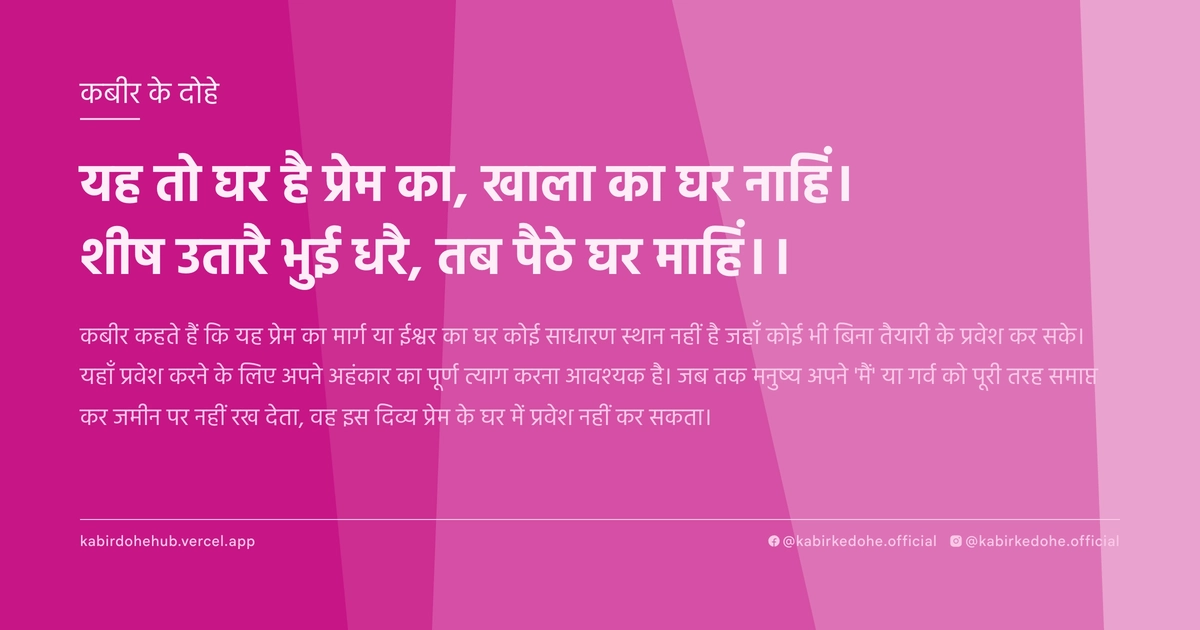
यह तो घर है प्रेम का, खाला का घर नाहिं।
शीष उतारै भुई धरै, तब पैठे घर माहिं।।
Yeh to ghar hai prem ka, khala ka ghar nahin. Sheesh utarai bhui dharai, tab paithé ghar mahin.
इस पृष्ठ पर इस कबीर दोहे का अर्थ (meaning), हिंदी व्याख्या और अंग्रेज़ी अनुवाद, दार्शनिक विश्लेषण और व्यावहारिक जीवन सीख दी गई है। यह दोहा प्रपत्ति (Surrender) विषय से जुड़ा है — Kabir doha meaning and explanation in Hindi and English.
अर्थ (Meaning):
कबीर कहते हैं कि यह प्रेम का मार्ग या ईश्वर का घर कोई साधारण स्थान नहीं है जहाँ कोई भी बिना तैयारी के प्रवेश कर सके। यहाँ प्रवेश करने के लिए अपने अहंकार का पूर्ण त्याग करना आवश्यक है। जब तक मनुष्य अपने 'मैं' या गर्व को पूरी तरह समाप्त कर जमीन पर नहीं रख देता, वह इस दिव्य प्रेम के घर में प्रवेश नहीं कर सकता।
Kabir asserts that the abode of Divine Love is not a common place or a casual gathering where one can enter without preparation. To enter this sacred space, one must completely surrender their ego. Only when a seeker figuratively removes their head—the seat of pride—and places it upon the ground, can they truly enter the home of Love.
व्याख्या (Interpretation):
इस दोहे में 'घर' आत्मा के वास्तविक स्वरूप या परमात्मा के मिलन स्थल का प्रतीक है। 'खाला का घर' एक मुहावरा है जिसका अर्थ है ऐसी जगह जहाँ कोई भी बिना किसी अनुशासन या मर्यादा के आ-जा सके। कबीर यहाँ एक गहरे विरोधाभास का उपयोग कर रहे हैं: प्रेम कोमल है, लेकिन उसकी शर्त कठोर है। 'शीष उतारना' शारीरिक मृत्यु नहीं, बल्कि 'अहंकार की मृत्यु' है। यह निर्गुण भक्ति का सार है, जहाँ भक्त को यह समझना होता है कि जब तक 'मैं' मौजूद हूँ, तब तक 'वह' (ईश्वर) नहीं मिल सकता। यह अद्वैत वेदांत के उस सिद्धांत को दर्शाता है जहाँ व्यक्ति की पृथक पहचान का विलीनीकरण ब्रह्म में होता है। माया हमें यह विश्वास दिलाती है कि हमारी पहचान हमारे पद, ज्ञान या संपत्ति में है, जबकि वास्तविक प्रवेश केवल शून्य होने पर ही संभव है।
In this couplet, the 'home' symbolizes the realization of the True Self or the union with the Divine. The phrase 'khaala ka ghar' refers to a place of casual entry, devoid of discipline or sanctity. Kabir employs a profound paradox: while Love is infinitely gentle, the price of admission is absolute. 'Removing the head' is not a literal act of violence but a metaphor for the 'death of the ego.' This is the essence of Nirgun Bhakti, where the seeker realizes that as long as the 'I' exists, the 'Thou' cannot be experienced. It aligns with Advaita Vedanta, where the illusion of separation (Maya) must dissolve for the Atman to merge with Brahman. The central paradox is that one must lose their identity to find their true existence; the head, representing the intellect and pride, must be laid low to enter the realm of the heart.
दार्शनिक विश्लेषण (Philosophical Analysis):
कबीर का यह दर्शन उस समय के धार्मिक पाखंडों पर एक कड़ा प्रहार था, जहाँ लोग केवल बाहरी कर्मकांडों, जैसे तीर्थयात्रा या माला जपने से मोक्ष की आशा करते थे। कबीर स्पष्ट करते हैं कि ईश्वर किसी मंदिर या मस्जिद में नहीं, बल्कि प्रेम की उस अवस्था में है जहाँ अहंकार शून्य हो जाता है। यह दृष्टिकोण सूफी मत के 'फ़ना' (अहंकार का विनाश) के सिद्धांत से गहराई से मेल खाता है, जहाँ साधक अपनी व्यक्तिगत इच्छाओं को ईश्वर की इच्छा में विलीन कर देता है।
ऐतिहासिक रूप से, कबीर ने जाति और वर्ग के भेदों को नकार दिया क्योंकि अहंकार केवल उच्च वर्ग में नहीं, बल्कि निम्न वर्ग की हीन भावना में भी होता है। उनके लिए, 'शीष उतारना' सामाजिक स्थिति के गर्व को त्यागना है। यह एक मनोवैज्ञानिक रूपांतरण की प्रक्रिया है। जब हम कहते हैं कि हम 'ज्ञानी' हैं, तो वह ज्ञान ही एक दीवार बन जाता है। कबीर उस दीवार को गिराने की बात करते हैं।
अद्वैत वेदांत के अनुसार, अविद्या (अज्ञान) ही वह पर्दा है जो हमें सत्य देखने से रोकता है। यह अविद्या 'अहंकार' के रूप में प्रकट होती है। कबीर का 'प्रेम का घर' वास्तव में वह चेतना है जहाँ द्वैत (दो होने का भाव) समाप्त हो जाता है। यहाँ प्रेम कोई भावना नहीं, बल्कि एक आध्यात्मिक अनुशासन है।
अक्सर लोग इस दोहे को केवल विनम्रता के रूप में देखते हैं, लेकिन यह उससे कहीं अधिक गहरा है। यह 'अस्तित्व के विसर्जन' की बात है। यह उस बिंदु की ओर इशारा करता है जहाँ व्यक्ति अपनी सारी परिभाषाएँ—नाम, धर्म, पेशा—छोड़कर केवल एक 'साक्षी' बन जाता है।
अंततः, कबीर यह समझाते हैं कि आध्यात्मिक मार्ग पर सबसे बड़ा अवरोध बाहरी बाधाएँ नहीं, बल्कि आंतरिक 'मैं' है। जब तक हम अपनी श्रेष्ठता का भ्रम पाले रखते हैं, हम सत्य के द्वार पर खड़े तो हो सकते हैं, लेकिन भीतर प्रवेश नहीं कर सकते। यह पूर्ण समर्पण की मांग है, जो कि भक्ति मार्ग की सर्वोच्च अवस्था है।
Kabir’s philosophy serves as a scathing critique of the religious hypocrisy of his era, where salvation was sought through external rituals, pilgrimages, or the mechanical chanting of beads. He clarifies that the Divine does not reside in structures of stone or wood, but in a state of Love where the ego is completely annihilated. This perspective resonates deeply with the Sufi concept of 'Fana' (annihilation of the self), where the seeker dissolves their individual will into the Divine Will.
Historically, Kabir rejected caste and class distinctions, recognizing that ego manifests not only as pride in the high-born but also as a sense of inferiority in the marginalized. For him, 'removing the head' means shedding the pride of social standing. This is a process of psychological transmutation. When a person claims to be 'learned,' that very knowledge often becomes a barrier. Kabir advocates for the demolition of this intellectual wall.
According to Advaita Vedanta, Avidya (ignorance) is the veil that prevents us from perceiving the Truth. This ignorance manifests as the 'Ahamkara' or ego. Kabir’s 'home of love' is actually the state of consciousness where duality ceases to exist. Here, Love is not a mere emotion but a rigorous spiritual discipline.
Common literalist interpretations often mistake this for simple humility. However, it is far more radical; it is the 'dissolution of existence.' It points toward the moment when an individual sheds all definitions—name, religion, profession—and becomes a mere witness to the Truth.
Ultimately, Kabir teaches that the greatest obstacle on the spiritual path is not external adversity but the internal 'I.' As long as we cherish the illusion of our own superiority or uniqueness, we may stand at the threshold of Truth, but we cannot enter. It is a demand for total surrender, which is the pinnacle of the Bhakti path.
मूल संदेश (Core Message):
- अहंकार वह एकमात्र पर्दा है जो ईश्वर और आत्मा के बीच खड़ा है।
- प्रेम कोई भावना नहीं, बल्कि अहंकार के पूर्ण विसर्जन की प्रक्रिया है।
- बाहरी पवित्रता एक भ्रम है; वास्तविक पवित्रता विनम्रता में निहित है।
- जब 'मैं' समाप्त होता है, तभी 'सत्य' का उदय होता है।
- समर्पण ही वह एकमात्र कुंजी है जो दिव्य द्वार खोलती है।
- The ego is the sole veil standing between the soul and the Divine.
- Love is not a mere emotion, but the process of total ego dissolution.
- External purity is an illusion; true sanctity resides in absolute humility.
- Only when the 'I' vanishes does the 'Truth' emerge.
- Surrender is the only key that unlocks the doors of Divine Love.
व्यावहारिक उदाहरण (Practical Example):
वाराणसी के घाटों पर रहने वाले एक वृद्ध विधवा, जानकी, की कहानी है। जानकी ने अपना पूरा जीवन धर्म के कठोर नियमों और अपनी 'पवित्रता' के अहंकार में बिताया था। वह मानती थी कि वह अन्य महिलाओं से अधिक धार्मिक है क्योंकि वह सबसे कठिन उपवास रखती थी और कभी किसी अशुद्ध व्यक्ति से बात नहीं करती थी। उसका यह 'धार्मिक गर्व' उसके चारों ओर एक अदृश्य दीवार बन गया था, जिससे वह दूसरों को तुच्छ समझने लगी थी।
एक दिन, घाट की सीढ़ियों पर एक अत्यंत बीमार और बदहाल भिखारी गिरा हुआ था, जिसे समाज ने अछूत मानकर छोड़ दिया था। जानकी ने पहले उसे घृणा से देखा और अपनी पवित्रता बचाने के लिए दूर हट गई। लेकिन तभी उसकी नज़र एक छोटे बच्चे पर पड़ी, जो बिना किसी संकोच के उस भिखारी के घावों को अपने फटे हुए दुपट्टे से पोंछ रहा था। उस बच्चे की आँखों में कोई निर्णय नहीं था, केवल करुणा थी।
जानकी को अचानक महसूस हुआ कि उसकी सारी पूजा, उसके सारे व्रत और उसकी 'पवित्रता' वास्तव में उसके अहंकार का एक आवरण थे। वह जिसे धर्म समझ रही थी, वह वास्तव में उसका 'शीष' (गर्व) था जिसे उसने बहुत ऊँचा उठा रखा था। उसे एहसास हुआ कि वह प्रेम के घर के बाहर खड़ी है, जबकि वह बच्चा, जिसके पास कोई धार्मिक ज्ञान नहीं था, पहले से ही उस घर के भीतर है।
उस क्षण जानकी का हृदय टूट गया। उसने पहली बार महसूस किया कि उसकी श्रेष्ठता का भाव ही उसे ईश्वर से दूर रख रहा था। उसने अपने भीतर के उस 'धार्मिक अहंकार' को उतारा और जमीन पर रख दिया। उसने आगे बढ़कर उस भिखारी का हाथ थामा और उसे सहारा दिया।
जैसे ही उसने अपनी श्रेष्ठता का त्याग किया, उसे एक ऐसी शांति का अनुभव हुआ जो उसने दशकों के उपवासों में भी नहीं पाया था। उसकी आँखों से आँसू बहने लगे, और उसे लगा कि जैसे उसके भीतर की सारी कड़वाहट धुल गई है।
अब जानकी केवल पूजा नहीं करती थी, बल्कि वह हर उस व्यक्ति में ईश्वर को देखने लगी जिसे समाज ने ठुकरा दिया था। उसने अपनी पवित्रता की परिभाषा बदल दी; अब उसके लिए पवित्रता का अर्थ था—बिना किसी भेदभाव के सेवा करना।
उसका व्यवहार पूरी तरह बदल गया। वह अब घाट पर अन्य महिलाओं को उपदेश नहीं देती थी, बल्कि उनकी मदद करती थी। उसका चेहरा अब कठोर नहीं, बल्कि प्रेममयी और सौम्य हो गया था।
जानकी ने जान लिया था कि प्रेम के घर में प्रवेश करने के लिए किसी विशेष मंत्र की आवश्यकता नहीं है, बल्कि केवल अपने 'मैं' को मिटाने की आवश्यकता है। यही उसका 'शीष उतारना' था, जिसने उसे वास्तव में मुक्त कर दिया।
Consider the story of Janaki, an elderly widow living on the ghats of Varanasi. Janaki had spent her entire life adhering to the strictest religious codes, cultivating a deep sense of pride in her 'purity.' She believed she was more spiritual than others because she observed the most rigorous fasts and avoided contact with anyone she deemed 'impure.' This religious pride became an invisible wall, leading her to view others with subtle contempt.
One day, a severely ill and destitute beggar collapsed on the stone steps of the ghat, abandoned by society as an untouchable. Janaki initially looked at him with disgust and stepped away to preserve her sanctity. However, she noticed a small child, oblivious to social norms, gently wiping the beggar's wounds with a tattered piece of cloth. There was no judgment in the child's eyes, only pure compassion.
In that moment, Janaki realized that her prayers, her fasts, and her perceived purity were merely a cloak for her ego. What she had mistaken for righteousness was actually her 'head' (pride) held too high. She understood that she was standing outside the home of Love, while the child, possessing no formal religious knowledge, was already inside.
Janaki felt a sudden, violent breaking within her heart. She realized that her sense of superiority was the very thing separating her from the Divine. She figuratively 'removed her head'—the pride of her piety—and laid it upon the ground.
For the first time, she reached out and held the beggar's hand, offering him support. As she surrendered her superiority, she experienced a profound peace that decades of asceticism had never provided. Tears streamed down her face, washing away years of accumulated bitterness.
From that day forward, Janaki stopped seeing people through the lens of purity and impurity. She began to see the Divine in every discarded soul. Her definition of sanctity shifted from ritual avoidance to selfless service.
Her behavior transformed completely. She no longer lectured other women on the ghats; instead, she served them. Her face, once hardened by judgment, became soft and radiant with love.
Janaki had learned that entering the home of Love requires no special mantra, only the willingness to erase the 'I.' This was her act of 'removing the head,' and it was the only thing that truly set her free.
अभ्यास मार्गदर्शन (Practice Guidance):
- प्रतिदिन 15 मिनट मौन ध्यान करें, जहाँ आप अपनी सभी उपलब्धियों, पदों और पहचानों को एक कागज पर लिखकर मानसिक रूप से उन्हें त्यागने का अभ्यास करें।
- स्व-पूछताछ जर्नल: प्रतिदिन लिखें कि आज किस क्षण में मुझे लगा कि मैं किसी से 'बेहतर' हूँ? उस भावना के मूल में कौन सा अहंकार था?
- व्यवहारिक परिवर्तन: सप्ताह में एक बार किसी ऐसे व्यक्ति की निस्वार्थ सेवा करें जिसे आप व्यक्तिगत या सामाजिक रूप से अपने से 'नीचा' या 'विपरीत' समझते हैं।
- निदान चेकलिस्ट: यदि आप दूसरों की गलती पर तुरंत क्रोधित होते हैं या अपनी प्रशंसा सुनकर संतुष्ट महसूस करते हैं, तो समझें कि आपका 'शीष' अभी भी ऊँचा है और आप प्रेम के घर के बाहर हैं।
- Practice 15 minutes of daily silent meditation, mentally listing your achievements, titles, and identities, and consciously visualizing yourself releasing them to the universe.
- Self-Inquiry Journaling: Record every instance during the day when you felt 'superior' to someone else. Analyze the specific root of that ego—was it knowledge, morality, or status?
- Behavioral Shift: Once a week, perform a selfless act of service for someone whom you personally or socially perceive as 'lower' or 'opposite' to you.
- Diagnostic Checklist: If you find yourself reacting with immediate irritation to others' mistakes or feeling a surge of satisfaction from praise, recognize that your 'head' is still held high and you remain outside the home of Love.
चिंतन प्रश्न (Reflection Questions):
- मेरे जीवन का वह कौन सा 'गर्व' है जिसे मैं कभी नहीं छोड़ना चाहता, यहाँ तक कि ईश्वर के सामने भी?
- क्या मेरी धार्मिकता या नैतिकता वास्तव में करुणा से उपजी है, या यह दूसरों को छोटा दिखाने का एक सूक्ष्म तरीका है?
- यदि आज मेरी सारी सामाजिक पहचान (नाम, पद, प्रतिष्ठा) छीन ली जाए, तो मेरे भीतर क्या बचेगा?
- मैं किन लोगों को 'अपात्र' मानता हूँ, और क्या यह निर्णय मेरे अपने अहंकार का प्रतिबिंब है?
- क्या मैं वास्तव में प्रेम करना चाहता हूँ, या मैं केवल 'प्रेम करने वाले' की छवि पसंद करता हूँ?
- What is the one piece of 'pride' in my life that I am unwilling to surrender, even before the Divine?
- Is my morality truly born of compassion, or is it a subtle tool to make others feel inferior?
- If all my social identities—name, title, reputation—were stripped away today, what would remain of me?
- Who do I deem 'unworthy,' and is this judgment merely a reflection of my own ego's need for superiority?
- Do I actually desire to love, or am I merely enamored with the image of being 'a loving person'?