
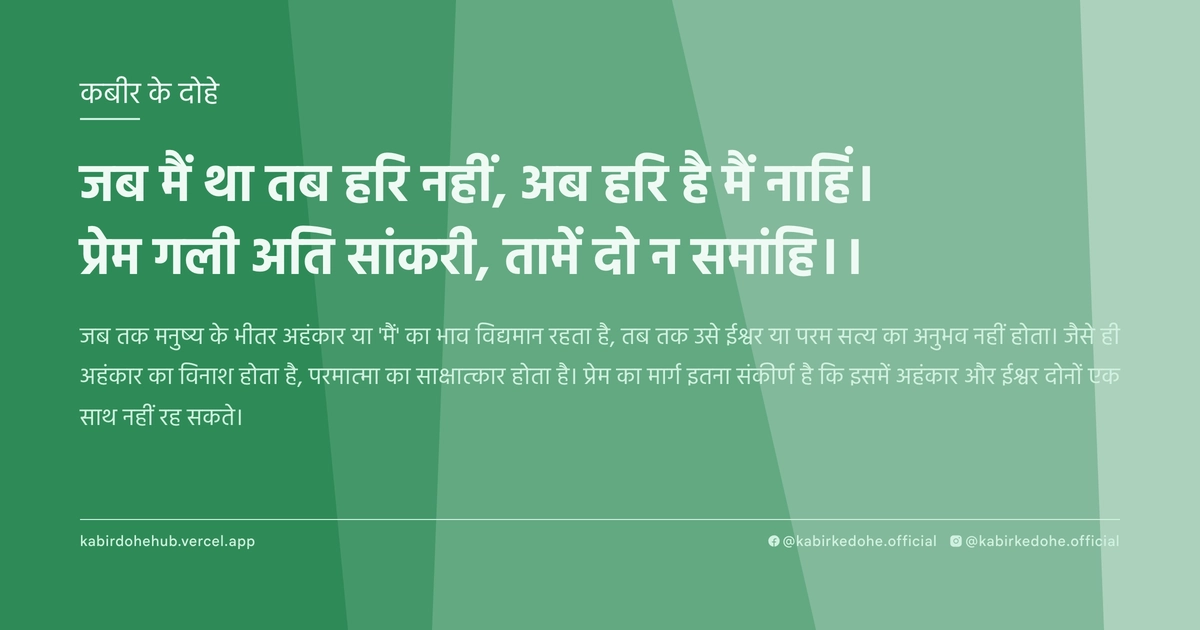
जब मैं था तब हरि नहीं, अब हरि है मैं नाहिं।
प्रेम गली अति सांकरी, तामें दो न समांहि।।
Jab main tha tab hari nahi, ab hari hai main nahin. Prem gali ati sankari, taame do na samahin.
इस पृष्ठ पर इस कबीर दोहे का अर्थ (meaning), हिंदी व्याख्या और अंग्रेज़ी अनुवाद, दार्शनिक विश्लेषण और व्यावहारिक जीवन सीख दी गई है। यह दोहा अहंकार (The Ego) विषय से जुड़ा है — Kabir doha meaning and explanation in Hindi and English.
अर्थ (Meaning):
जब तक मनुष्य के भीतर अहंकार या 'मैं' का भाव विद्यमान रहता है, तब तक उसे ईश्वर या परम सत्य का अनुभव नहीं होता। जैसे ही अहंकार का विनाश होता है, परमात्मा का साक्षात्कार होता है। प्रेम का मार्ग इतना संकीर्ण है कि इसमें अहंकार और ईश्वर दोनों एक साथ नहीं रह सकते।
As long as the ego, the sense of 'I', persists within a human being, the experience of the Divine or Absolute Truth remains absent. The moment the ego is annihilated, the Divine is realized. The path of love is so narrow that it cannot accommodate both the ego and the Divine simultaneously.
व्याख्या (Interpretation):
यह दोहा द्वैत और अद्वैत के बीच के संघर्ष को दर्शाता है। 'मैं' यहाँ केवल व्यक्तिगत पहचान नहीं, बल्कि वह मिथ्या अहंकार है जो आत्मा को परमात्मा से अलग मानता है। कबीर कहते हैं कि यह अहंकार एक पर्दे की तरह है। जब तक यह पर्दा है, हरि (परम तत्व) अदृश्य हैं। जैसे ही साधक अपनी सीमित पहचान को त्यागता है, वह पाता है कि वह स्वयं ही वह अनंत है जिसे वह खोज रहा था। 'प्रेम गली' का रूपक यह बताता है कि भक्ति कोई बाहरी क्रिया नहीं, बल्कि एक आंतरिक संकुचन है जहाँ केवल एक ही सत्ता रह सकती है। यह शून्य की अवस्था है जहाँ 'स्व' का विलोपन ही 'सर्व' का मिलन है।
This couplet illustrates the conflict between duality and non-duality. The 'I' here is not merely personal identity, but the illusory ego (Ahankara) that perceives a separation between the Atman and Brahman. Kabir posits that this ego acts as a veil; as long as it persists, the Divine remains hidden. Once the seeker relinquishes this limited identity, they realize they are the very Infinite they were seeking. The metaphor of the 'narrow lane of love' suggests that devotion is not an external ritual but an internal contraction where only one entity can exist. It is the state of Shunya (void) where the dissolution of the 'self' is the only gateway to the 'All'.
दार्शनिक विश्लेषण (Philosophical Analysis):
कबीर का यह दर्शन निर्गुण भक्ति और अद्वैत वेदांत के संगम पर स्थित है। ऐतिहासिक रूप से, कबीर ने उस समय के कर्मकांडीय धर्म का विरोध किया जहाँ ईश्वर को बाहरी मंदिरों या मस्जिदों में खोजा जाता था। उन्होंने तर्क दिया कि ईश्वर किसी स्थान पर नहीं, बल्कि चेतना की एक अवस्था में है।
यहाँ 'मैं' का अर्थ है 'माया' द्वारा निर्मित वह भ्रम जो हमें यह विश्वास दिलाता है कि हम शरीर, नाम या जाति हैं। जब तक यह पहचान बनी रहती है, हम सत्य से दूर रहते हैं। सूफी मत के 'फना' (अहंकार का विनाश) की अवधारणा यहाँ स्पष्ट दिखती है, जहाँ प्रेमी अपने अस्तित्व को मिटाकर प्रिय (ईश्वर) में विलीन हो जाता है।
दार्शनिक रूप से, यह दोहा बताता है कि ज्ञान और अहंकार परस्पर विरोधी हैं। यदि आप मानते हैं कि 'आप' जानते हैं, तो वह 'जानने वाला' ही बाधा है। वास्तविक ज्ञान वह है जहाँ ज्ञाता और ज्ञेय का भेद समाप्त हो जाए।
कबीर जाति और वर्ग के भेदों को इसी 'मैं' का विस्तार मानते थे। यदि कोई व्यक्ति खुद को उच्च जाति का मानकर दूसरे को नीचा समझता है, तो वह 'मैं' के जाल में फँसा है और हरि से कोसों दूर है।
अंततः, यह मनोवैज्ञानिक रूपांतरण की प्रक्रिया है। यह केवल बौद्धिक समझ नहीं, बल्कि एक अनुभवजन्य सत्य है। जब अहंकार टूटता है, तो जो शेष बचता है, वही शुद्ध चेतना या हरि है। यह विलोपन दुखद नहीं, बल्कि परम आनंददायक है क्योंकि यह सीमित से असीमित की ओर ले जाता है।
Kabir's philosophy here sits at the intersection of Nirgun Bhakti and Advaita Vedanta. Historically, Kabir challenged the ritualistic religions of his era that sought the Divine in external temples or mosques, arguing instead that God resides within a specific state of consciousness.
The 'I' refers to the illusion created by Maya, which convinces us that we are defined by our body, name, or caste. As long as this identity persists, we remain estranged from the Truth. The Sufi concept of 'Fana' (annihilation of the self) is evident here, where the lover erases their existence to merge with the Beloved.
Philosophically, this doha asserts that ego and enlightenment are mutually exclusive. If one believes 'I' know the truth, the 'I' who claims knowledge becomes the primary obstacle. True gnosis occurs only when the distinction between the knower and the known vanishes.
Kabir viewed caste and class distinctions as extensions of this 'I'. Anyone claiming superiority based on birth is trapped in the ego's web and thus distant from the Divine.
Ultimately, this is a process of psychological transformation. It is not a mere intellectual exercise but an experiential reality. When the ego shatters, what remains is pure consciousness or Hari. This dissolution is not tragic but ecstatic, as it marks the transition from the finite to the Infinite.
मूल संदेश (Core Message):
- अहंकार वह पर्दा है जो परमात्मा को ओझल करता है।
- सत्य की प्राप्ति के लिए स्वयं के मिथ्या बोध का त्याग अनिवार्य है।
- प्रेम और अहंकार एक ही हृदय में सह-अस्तित्व नहीं रख सकते।
- जब 'मैं' मिटता है, तब केवल अनंत शेष रहता है।
- मुक्ति बाहरी यात्रा नहीं, बल्कि आंतरिक विलोपन है।
- The ego is the veil that obscures the Divine.
- Relinquishing the false sense of self is mandatory for realizing Truth.
- Love and ego cannot coexist within the same heart.
- When the 'I' vanishes, only the Infinite remains.
- Liberation is not an external journey, but an internal dissolution.
व्यावहारिक उदाहरण (Practical Example):
वाराणसी के घाटों पर रहने वाला एक वृद्ध विधवा, जिसे समाज ने हाशिए पर धकेल दिया था, अपनी दिनचर्या में केवल भिक्षा और प्रार्थना पर निर्भर थी। वह वर्षों तक इस दुख में रही कि समाज ने उसे ठुकराया और वह 'अकेली' और 'असहाय' है। उसका यह 'मैं'—एक पीड़ित स्त्री की पहचान—उसे आंतरिक शांति से दूर रख रही थी।
एक दिन उसने एक संत को सुना जो कह रहे थे कि दुख व्यक्ति को नहीं, बल्कि उस 'पहचान' को होता है जिसे वह ओढ़े रहता है। उसने विचार किया कि वह जिसे 'अपना दुख' कह रही है, वह वास्तव में उसकी उस छवि का दुख है जिसे उसने दुनिया के लिए बनाया था।
उसने धीरे-धीरे अपनी इस 'पीड़ित' पहचान को छोड़ना शुरू किया। उसने महसूस किया कि वह केवल एक शरीर नहीं है जिसे समाज ने नकारा, बल्कि वह उस अनंत चेतना का हिस्सा है जो कभी अकेली नहीं होती।
उसने अपनी छोटी सी कुटिया को अन्य बेसहारा महिलाओं के लिए एक आश्रय बना लिया। अब वह खुद को 'बेचारी' नहीं, बल्कि 'सेवा का माध्यम' मानने लगी।
जैसे-जैसे उसका 'मैं' (पीड़ित होने का अहंकार) कम हुआ, उसके भीतर एक असीम करुणा जागी। उसने पाया कि जब उसने अपनी व्यथा को पकड़ना छोड़ा, तो वह स्वयं प्रेम बन गई।
अब वह घाटों पर बैठकर केवल मंत्र नहीं पढ़ती थी, बल्कि उसकी उपस्थिति ही दूसरों के लिए शांति बन गई थी। लोग उसके पास अपनी समस्याएँ लेकर आने लगे।
उसने पाया कि जब तक वह अपनी 'बेचारगी' को संजोए हुए थी, वह ईश्वर से दूर थी। जैसे ही उसने उस पहचान को विसर्जित किया, उसे अपने भीतर ही वह शांति मिली जिसे वह मंदिर की मूर्तियों में खोज रही थी।
यह उसका 'कबीर ट्विस्ट' था: अपनी सबसे बड़ी कमजोरी (अकेलापन) को अहंकार के स्तर से हटाकर उसे सार्वभौमिक प्रेम में बदल देना। अब वह 'मैं' नहीं थी, वह केवल 'प्रेम' थी।
An elderly widow living on the ghats of Varanasi, marginalized by society, relied solely on alms and prayer. For years, she lived in the agony that society had rejected her, clinging to the identity of being 'alone' and 'helpless'. This 'I'—the identity of a victim—kept her distant from inner peace.
One day, she heard a saint remark that suffering does not belong to the person, but to the 'identity' the person clings to. She contemplated that what she called 'her sorrow' was actually the sorrow of the image she had constructed for the world.
Slowly, she began to shed this 'victim' identity. She realized she was not merely a body rejected by society, but a part of that infinite consciousness that is never truly alone.
She turned her small hut into a shelter for other destitute women. She stopped seeing herself as 'pitiful' and began seeing herself as a 'medium for service'.
As her 'I' (the ego of being a victim) diminished, an immense compassion awakened within her. She discovered that when she stopped clutching her grief, she herself became love.
Now, sitting on the ghats, she didn't just recite mantras; her very presence became a source of peace for others. People began seeking her for solace.
She realized that as long as she cherished her 'misery', she was distant from the Divine. The moment she dissolved that identity, she found within herself the peace she had sought in temple idols.
This was her 'Kabir Twist': shifting her greatest weakness (loneliness) from the level of ego to the level of universal love. She was no longer the 'I'; she was simply 'Love'.
अभ्यास मार्गदर्शन (Practice Guidance):
- दैनिक आत्म-निरीक्षण: दिन के अंत में उन क्षणों को लिखें जब आपने 'मैं सही हूँ' या 'मेरा अपमान हुआ' महसूस किया। विश्लेषण करें कि उस समय 'मैं' ने कैसे सत्य को ढका।
- साक्षी भाव का अभ्यास: जब क्रोध या अहंकार जागे, तो कहें 'यह विचार आ रहा है', न कि 'मैं क्रोधित हूँ'। स्वयं को विचार से अलग करें।
- सेवा बिना पहचान के: किसी की मदद करें लेकिन यह सुनिश्चित करें कि उस व्यक्ति को या आपके मन को यह पता न चले कि मदद किसने की। 'दाता' के अहंकार को मिटाएं।
- डायग्नोस्टिक चेकलिस्ट: क्या आप अभी भी अपनी उपलब्धियों का श्रेय खुद ले रहे हैं? क्या आप दूसरों की आलोचना करते समय श्रेष्ठता महसूस करते हैं? यदि हाँ, तो 'मैं' अभी भी मौजूद है।
- Daily Self-Inquiry: At the end of the day, journal moments where you felt 'I am right' or 'I was insulted'. Analyze how the 'I' obscured the truth in those moments.
- Practice of Witness Consciousness: When anger or ego arises, say 'This thought is occurring', rather than 'I am angry'. Detach the observer from the thought.
- Anonymous Service: Help someone while ensuring neither the recipient nor your own mind clings to the identity of the 'giver'. Erase the ego of the benefactor.
- Diagnostic Checklist: Do you still take sole credit for your achievements? Do you feel a sense of superiority while criticizing others? If yes, the 'I' is still present.
चिंतन प्रश्न (Reflection Questions):
- यदि आपकी सारी उपलब्धियाँ, पद और संबंध छीन लिए जाएँ, तो वास्तव में 'आप' कौन बचेंगे?
- क्या आपका 'आध्यात्मिक मार्ग' भी आपके अहंकार को पोषण दे रहा है (जैसे यह सोचना कि आप दूसरों से अधिक जागरूक हैं)?
- आपकी डिजिटल पहचान (सोशल मीडिया) आपके वास्तविक स्वरूप को कितना ढक रही है?
- वह कौन सा डर है जो आपको 'मैं' को छोड़ने से रोकता है?
- क्या आप वास्तव में प्रेम करना चाहते हैं, या आप केवल 'प्रेम करने वाले' की छवि चाहते हैं?
- If all your achievements, titles, and relationships were stripped away, who would you actually be?
- Is your 'spiritual path' also feeding your ego (e.g., thinking you are more conscious than others)?
- To what extent does your digital identity (social media) obscure your true essence?
- What is the specific fear that prevents you from letting go of the 'I'?
- Do you truly wish to love, or do you merely desire the image of being 'one who loves'?