
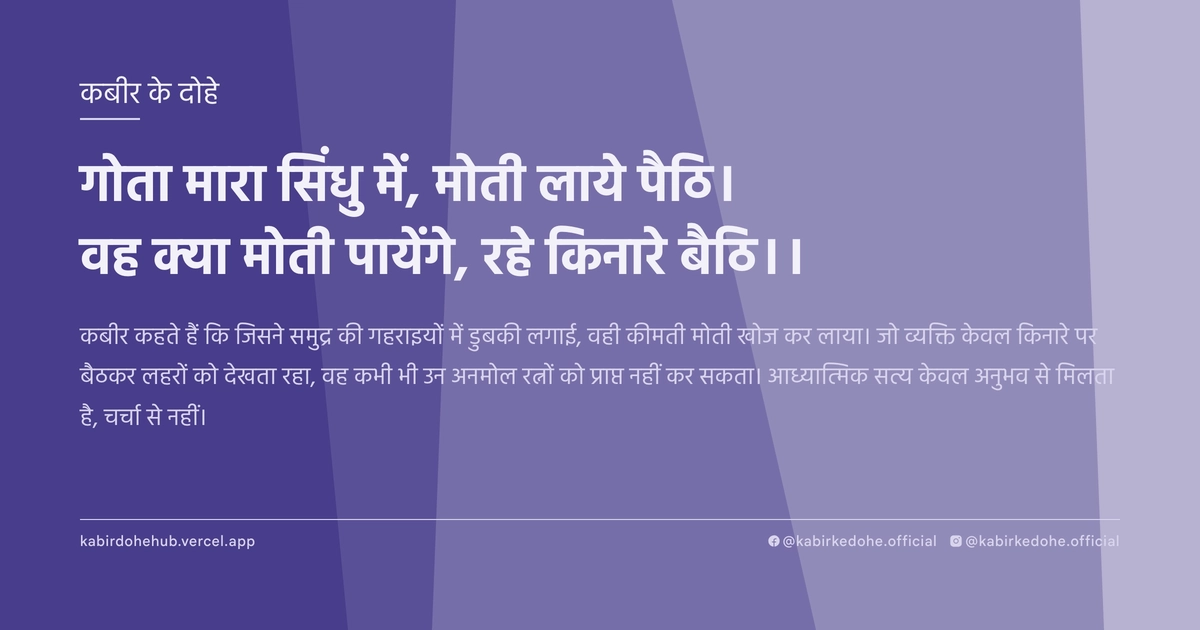
गोता मारा सिंधु में, मोती लाये पैठि।
वह क्या माेती पायेंगे, रहे किनारे बैठि।।
Gota maara sindhu me, moti laaye paithi. Vah kya moti paayenge, rahe kinare baithi.
इस पृष्ठ पर इस कबीर दोहे का अर्थ (meaning), हिंदी व्याख्या और अंग्रेज़ी अनुवाद, दार्शनिक विश्लेषण और व्यावहारिक जीवन सीख दी गई है। यह दोहा जागृति (The Wake-up Call) विषय से जुड़ा है — Kabir doha meaning and explanation in Hindi and English.
अर्थ (Meaning):
कबीर कहते हैं कि जिसने समुद्र की गहराइयों में डुबकी लगाई, वही कीमती मोती खोज कर लाया। जो व्यक्ति केवल किनारे पर बैठकर लहरों को देखता रहा, वह कभी भी उन अनमोल रत्नों को प्राप्त नहीं कर सकता। आध्यात्मिक सत्य केवल अनुभव से मिलता है, चर्चा से नहीं।
Kabir asserts that only the one who dared to dive deep into the ocean of existence managed to retrieve the precious pearls. Those who remained seated safely on the shore, merely observing the waves, can never attain those priceless treasures. Spiritual truth is realized through direct experience, not through theoretical discussion.
व्याख्या (Interpretation):
यह दोहा अनुभवजन्य ज्ञान की प्रधानता को दर्शाता है। 'सिंधु' यहाँ संसार या चेतना के अनंत विस्तार का प्रतीक है, और 'मोती' उस आत्म-साक्षात्कार या मोक्ष का प्रतीक है जिसे साधक खोजता है। किनारे पर बैठना बौद्धिक अहंकार और शास्त्र-ज्ञान के प्रति आसक्ति को दर्शाता है, जहाँ व्यक्ति केवल दूसरों के अनुभवों को पढ़ता है। गोता लगाना 'साधना' और 'समर्पण' की प्रक्रिया है, जहाँ साधक अपने अहंकार को डुबोकर शून्य में उतरता है। यह निर्गुण भक्ति का सार है, जहाँ ईश्वर किसी मंदिर या किताब में नहीं, बल्कि स्वयं के भीतर की गहराई में मिलता है। जब तक साधक माया के तट को छोड़कर अंतर्मन की गहराई में नहीं उतरता, तब तक अद्वैत का अनुभव असंभव है। यह विरोधाभास है कि सत्य सबके सामने है, फिर भी केवल वही इसे पाता है जो डूबने का साहस रखता है।
This couplet emphasizes the primacy of experiential knowledge over theoretical learning. The 'ocean' symbolizes the vast expanse of existence or consciousness, while the 'pearls' represent self-realization or liberation that the seeker pursues. Sitting on the shore represents intellectual vanity and an attachment to scriptural knowledge, where one merely reads about the experiences of others. Diving represents the process of 'Sadhana' and 'Surrender,' where the seeker drowns their ego to descend into the void. This is the essence of Nirgun Bhakti, where the Divine is found not in temples or books, but in the depths of one's own being. Until the seeker leaves the shores of Maya and plunges into the inner depths, the experience of Advaita (non-duality) remains impossible. It is a paradox that truth is omnipresent, yet only those who dare to drown their identity can retrieve it.
दार्शनिक विश्लेषण (Philosophical Analysis):
कबीर का यह दृष्टिकोण उनके युग के कट्टरपंथी कर्मकांडों और केवल शास्त्रों के रटने की प्रवृत्ति पर एक तीखा प्रहार है। उस समय धर्म केवल बाहरी दिखावे और पुरोहिती वर्ग के नियंत्रण में था। कबीर ने 'सहज' मार्ग का समर्थन किया, जो किसी बाहरी मध्यस्थ के बिना सीधे परमात्मा से जुड़ने की बात करता है।
दार्शनिक स्तर पर, यह अद्वैत वेदांत के उस सिद्धांत से मेल खाता है जहाँ 'ज्ञानी' वह नहीं है जिसने पढ़ा है, बल्कि वह है जिसने 'अनुभव' किया है। ज्ञान (Information) और बोध (Realization) के बीच का अंतर ही इस दोहे का केंद्र है। कबीर यहाँ सूफी मत के 'फना' (अहंकार का विनाश) की बात कर रहे हैं, क्योंकि जब तक 'मैं' (किनारे बैठा व्यक्ति) जीवित है, तब तक 'वह' (मोती) प्राप्त नहीं हो सकता।
ritualism का विरोध करते हुए कबीर समझाते हैं कि तीर्थयात्रा या माला जपना केवल किनारे पर बैठने जैसा है। वास्तविक तीर्थ अंतरात्मा की गहराई है। यह मनोवैज्ञानिक रूपांतरण की मांग करता है—डर को छोड़कर अज्ञात में कूदने का साहस।
यहाँ 'सिंधु' केवल जल नहीं, बल्कि भावनाओं, वासनाओं और अंततः शुद्ध चेतना का सागर है। जो व्यक्ति अपनी इंद्रियों के शोर से ऊपर उठकर मौन की गहराई में जाता है, वही सत्य को स्पर्श करता है।
अंततः, यह दोहा हमें सिखाता है कि सत्य कोई वस्तु नहीं जिसे प्राप्त किया जाए, बल्कि एक अवस्था है जिसमें प्रवेश करना पड़ता है। यह बौद्धिक विमर्श से हटकर अस्तित्वगत अनुभव की ओर ले जाने वाला मार्ग है।
Kabir's perspective is a sharp critique of the rigid ritualism and the tendency toward rote memorization of scriptures prevalent in his era. At that time, religion was largely a matter of outward display and under the control of the priestly class. Kabir advocated for the 'Sahaj' path, which emphasizes a direct connection with the Divine without any external intermediary.
On a philosophical level, this aligns with the Advaita Vedanta principle that a true 'Jnani' is not one who has read, but one who has 'realized.' The distinction between information and realization is the core of this couplet. Kabir is referencing the Sufi concept of 'Fana' (annihilation of the ego), because as long as the 'I' (the person sitting on the shore) exists, the 'Truth' (the pearl) cannot be attained.
Opposing ritualism, Kabir explains that pilgrimages or chanting beads are akin to merely sitting on the shore. The true pilgrimage is the depth of the inner soul. This demands a psychological transformation—the courage to abandon fear and leap into the unknown.
Here, the 'ocean' is not merely water, but a sea of emotions, desires, and ultimately, pure consciousness. Only the individual who rises above the noise of the senses and enters the depth of silence can touch the truth.
Ultimately, this couplet teaches us that truth is not an object to be acquired, but a state of being to be entered. It is a path that leads away from intellectual discourse toward existential experience.
मूल संदेश (Core Message):
- बौद्धिक ज्ञान केवल एक मानचित्र है, गंतव्य नहीं।
- सत्य की प्राप्ति के लिए अहंकार का विसर्जन अनिवार्य है।
- अनुभव ही एकमात्र प्रमाण है, शब्द केवल संकेत हैं।
- सुरक्षित तट का मोह आध्यात्मिक प्रगति का सबसे बड़ा अवरोध है।
- भीतर की गहराई में उतरना ही वास्तविक मोक्ष है।
- Intellectual knowledge is merely a map, not the destination.
- The dissolution of ego is mandatory for the attainment of truth.
- Experience is the only evidence; words are merely pointers.
- The longing for a safe shore is the greatest obstacle to spiritual growth.
- Descending into the inner depths is the only true liberation.
व्यावहारिक उदाहरण (Practical Example):
वाराणसी के एक पुराने घाट पर माधव नाम का एक वृद्ध नाविक रहता था। वह जीवन भर गंगा की लहरों को देखता रहा और अन्य नाविकों से सुना था कि नदी के तल में प्राचीन काल के डूबे हुए शहर और अनमोल रत्न मौजूद हैं। माधव हमेशा किनारे पर बैठकर उन कहानियों पर चर्चा करता था और दूसरों को बताता था कि सत्य क्या है।
उसी घाट पर एक युवा लड़का, राघव, आया जो माधव की बातों को सुनता था। राघव ने माधव से पूछा, 'बाबा, क्या आपने कभी उन रत्नों को देखा है?' माधव ने गर्व से कहा, 'मैंने शास्त्रों में पढ़ा है और अनुभवी लोगों से सुना है कि वे वहाँ हैं।'
राघव को माधव की बातों में केवल शब्दों का जाल दिखा, अनुभव की कमी। एक दिन, एक भीषण तूफान आया और राघव की छोटी नाव गहरे पानी में चली गई। डर के मारे वह डूबने लगा, लेकिन उसी क्षण उसने अपनी सारी पकड़ छोड़ दी और खुद को पानी के हवाले कर दिया।
जब वह गहराई में गया, तो उसे डर खत्म हो गया और उसे एक अजीब सी शांति महसूस हुई। उसने देखा कि असली रत्न सोना-चाँदी नहीं थे, बल्कि वह आंतरिक शांति थी जो केवल तब मिलती है जब आप अपने अस्तित्व के डर को पूरी तरह छोड़ देते हैं।
जब राघव वापस सतह पर आया, तो वह बदल चुका था। वह अब रत्नों की बात नहीं करता था, बल्कि उसकी आँखों में एक ऐसी चमक थी जो माधव ने कभी नहीं देखी थी।
माधव ने राघव से पूछा, 'क्या तुम्हें कुछ मिला?' राघव ने मुस्कुराते हुए कहा, 'मैंने वह पाया जो किनारे पर बैठकर कभी नहीं मिल सकता था—मैंने खुद को खो दिया और फिर पाया।'
माधव को अचानक समझ आया कि वह जीवन भर केवल 'तट' पर खड़ा होकर ज्ञान का ढोंग करता रहा, जबकि राघव ने 'गोता' लगाकर सत्य को जी लिया था।
उस दिन के बाद, माधव ने अपनी किताबों और चर्चाओं को छोड़ दिया और मौन साधना में उतर गया। उसने सीखा कि अनुभव की एक बूंद, ज्ञान के सागर से अधिक मूल्यवान होती है।
On an old ghat in Varanasi lived an elderly boatman named Madhav. All his life, he watched the waves of the Ganges and heard from other boatmen that ancient sunken cities and priceless gems lay at the river's bottom. Madhav always sat on the shore, discussing these stories and telling others what the truth was.
At the same ghat, a young boy named Raghav arrived, who listened to Madhav's tales. Raghav asked, 'Baba, have you ever seen those gems?' Madhav replied with pride, 'I have read in the scriptures and heard from experienced elders that they are there.'
Raghav saw only a web of words in Madhav's speech, a lack of actual experience. One day, a fierce storm hit, and Raghav's small boat was swept into deep waters. Terrified, he began to sink, but in that moment, he let go of all his grip and surrendered himself to the water.
As he descended into the depths, his fear vanished, and he felt a strange, profound peace. He realized that the real gems were not gold or silver, but the inner stillness that only comes when you completely let go of the fear of existence.
When Raghav returned to the surface, he was transformed. He no longer spoke of gems, but there was a glow in his eyes that Madhav had never seen.
Madhav asked, 'Did you find something?' Raghav smiled and said, 'I found what can never be found by sitting on the shore—I lost myself and then found myself.'
Madhav suddenly realized that he had spent his entire life pretending to be knowledgeable while standing on the 'shore,' whereas Raghav had lived the truth by 'diving.'
After that day, Madhav abandoned his books and discussions and entered a state of silent meditation. He learned that a single drop of experience is more valuable than an ocean of theoretical knowledge.
अभ्यास मार्गदर्शन (Practice Guidance):
- प्रतिदिन 20 मिनट 'साक्षी भाव' का अभ्यास करें: अपने विचारों को किनारे से देखने के बजाय, उनमें गहराई से उतरें और देखें कि वे कहाँ से उत्पन्न हो रहे हैं।
- आत्म-पूछताछ जर्नल: प्रतिदिन एक ऐसी स्थिति लिखें जहाँ आपने केवल 'तर्क' का उपयोग किया, और फिर सोचें कि यदि आप उस स्थिति में पूरी तरह 'समर्पित' होते, तो परिणाम क्या होता।
- व्यवहारिक परिवर्तन: किसी ऐसे कार्य को करें जिससे आपको डर लगता है या जो आपकी 'कम्फर्ट ज़ोन' से बाहर है, ताकि आप बौद्धिक सुरक्षा के कवच को तोड़ सकें।
- निदान चेकलिस्ट: यदि आप सत्य के बारे में केवल बात कर रहे हैं, दूसरों को उपदेश दे रहे हैं, या केवल किताबों में शांति खोज रहे हैं, तो आप 'किनारे' पर हैं। यदि आप मौन हैं, स्वयं के प्रति ईमानदार हैं और जीवन के दुखों में भी स्थिर हैं, तो आप 'गोता' लगा रहे हैं।
- Practice 'Witness Consciousness' for 20 minutes daily: Instead of observing your thoughts from the shore, dive deep into them and observe where they originate.
- Self-Inquiry Journal: Daily record a situation where you relied solely on 'logic,' and then contemplate what the outcome would have been if you had 'surrendered' completely to the experience.
- Behavioral Change: Engage in an activity that scares you or pushes you out of your comfort zone to break the shell of intellectual security.
- Diagnostic Checklist: If you are merely talking about truth, preaching to others, or seeking peace only in books, you are on the 'shore.' If you are silent, honest with yourself, and steady even amidst life's sorrows, you are 'diving'.
चिंतन प्रश्न (Reflection Questions):
- मेरे जीवन के कौन से 'तट' (आदतें, विश्वास, पद) मुझे गहराई में उतरने से रोक रहे हैं?
- क्या मैं वास्तव में आध्यात्मिक हूँ, या मैं केवल आध्यात्मिक शब्दावली का उपयोग करके अपनी बौद्धिक श्रेष्ठता सिद्ध कर रहा हूँ?
- वह कौन सा डर है जो मुझे मेरे अंतर्मन के अंधेरे और अज्ञात हिस्सों में गोता लगाने से रोकता है?
- यदि मेरी सभी डिग्रियाँ और सामाजिक पहचान छीन ली जाएँ, तो क्या मेरे पास कोई ऐसा अनुभव है जो मुझे परिभाषित करे?
- मैं कितनी बार दूसरों के अनुभवों को अपना मानकर यह भ्रम पाल लेता हूँ कि मैंने सत्य को पा लिया है?
- Which 'shores' (habits, beliefs, titles) in my life are preventing me from diving deep?
- Am I truly spiritual, or am I merely using spiritual terminology to prove my intellectual superiority?
- What is the specific fear that stops me from diving into the dark and unknown parts of my inner self?
- If all my degrees and social identities were stripped away, do I possess any lived experience that defines me?
- How often do I mistake the experiences of others for my own and deceive myself into thinking I have found the truth?