
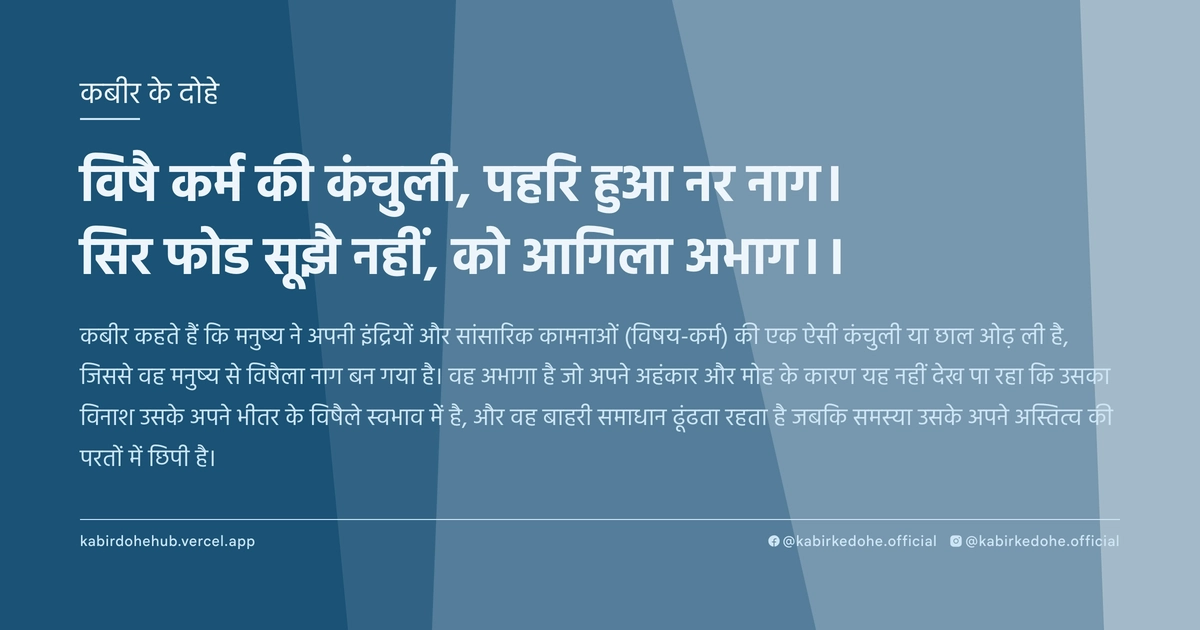
विषै कर्म की कंचुली, पहरि हुआ नर नाग।
सिर फोड सूझै नहीं, को आगिला अभाग।।
Vishai karm ki kanchuli, pahari hua nar naag. Sir phod suzhai nahi, ko aagila abhaag.
इस पृष्ठ पर इस कबीर दोहे का अर्थ (meaning), हिंदी व्याख्या और अंग्रेज़ी अनुवाद, दार्शनिक विश्लेषण और व्यावहारिक जीवन सीख दी गई है। यह दोहा काम (Lust) विषय से जुड़ा है — Kabir doha meaning and explanation in Hindi and English.
अर्थ (Meaning):
कबीर कहते हैं कि मनुष्य ने अपनी इंद्रियों और सांसारिक कामनाओं (विषय-कर्म) की एक ऐसी कंचुली या छाल ओढ़ ली है, जिससे वह मनुष्य से विषैला नाग बन गया है। वह अभागा है जो अपने अहंकार और मोह के कारण यह नहीं देख पा रहा कि उसका विनाश उसके अपने भीतर के विषैले स्वभाव में है, और वह बाहरी समाधान ढूंढता रहता है जबकि समस्या उसके अपने अस्तित्व की परतों में छिपी है।
Kabir asserts that humans have donned a 'slough' or skin of sensory desires and karmic attachments, transforming the human spirit into a venomous serpent. The unfortunate soul remains blind to the fact that the poison resides within their own ego and attachments; they seek external remedies while the root of their suffering is the very identity they cling to, unable to shatter the shell of illusion.
व्याख्या (Interpretation):
यहाँ 'कंचुली' माया और अहंकार का प्रतीक है जिसे मनुष्य सत्य मान बैठता है। जिस प्रकार सांप अपनी केंचुली बदलता है, मनुष्य को भी अपनी पुरानी पहचान और वासनाओं को त्यागना होगा। 'नर नाग' होना इस बात का संकेत है कि जब मनुष्य केवल इंद्रिय सुखों में लिप्त होता है, तो उसकी चेतना विषैली हो जाती है, जो दूसरों और स्वयं को कष्ट देती है। यह निर्गुण भक्ति का मार्ग है जहाँ बाहरी आडंबरों के बजाय आंतरिक शुद्धि पर बल दिया गया है। अद्वैत वेदांत के अनुसार, जब तक यह 'अहंकार की कंचुली' नहीं फटती, तब तक आत्मा और ब्रह्म की एकता का अनुभव असंभव है। यह विरोधाभास है कि जिसे हम अपना 'व्यक्तित्व' कहते हैं, वही वास्तव में हमारी मुक्ति के मार्ग में सबसे बड़ी बाधा है।
The 'kanchuli' (slough) serves as a potent metaphor for Maya and the egoic identity that humans mistake for their true self. Just as a snake sheds its skin, the seeker must shed the layers of conditioned desires. Becoming a 'human-serpent' signifies that when consciousness is consumed by sensory cravings, it becomes toxic, poisoning both the self and the environment. This aligns with Nirgun Bhakti, emphasizing internal purification over external rituals. In the lens of Advaita Vedanta, the realization of Atman-Brahman non-duality is blocked by this illusory shell. The central paradox is that the very identity we strive to protect and polish is the prison we must destroy to be free. The 'unfortunate one' is he who tries to cure the poison without recognizing that he has become the poison.
दार्शनिक विश्लेषण (Philosophical Analysis):
कबीर का यह दोहा उस सामाजिक और धार्मिक जड़ता पर प्रहार है जहाँ लोग केवल बाहरी कर्मकांडों से मोक्ष की आशा करते थे। कबीर के समय में धर्म केवल ऊपरी दिखावा बन गया था, जिसे उन्होंने 'कंचुली' कहा है। वे बताते हैं कि जाति, धर्म और सामाजिक प्रतिष्ठा की पहचान वास्तव में एक कृत्रिम आवरण है जो आत्मा को ढंक लेता है।
दार्शनिक स्तर पर, यह सूफी मत के 'नफ्स' (नकारात्मक अहंकार) के विनाश के समान है। जब तक मनुष्य अपनी वासनाओं के अधीन है, वह आध्यात्मिक रूप से मृत है, भले ही वह जीवित शरीर धारण किए हुए हो। कबीर का तर्क है कि वास्तविक ज्ञान किताबों या गुरुओं के बाहरी उपदेशों से नहीं, बल्कि स्वयं के भीतर के 'विष' को पहचानने और उसे नष्ट करने से आता है।
अद्वैत वेदांत के संदर्भ में, यह 'अविद्या' का वर्णन है। अविद्या वह पर्दा है जो हमें यह विश्वास दिलाता है कि हम शरीर और मन हैं। जब यह भ्रम टूटता है, तभी शुद्ध चेतना का उदय होता है। कबीर यहाँ चेतावनी दे रहे हैं कि जो व्यक्ति अपनी इंद्रियों के सुख को ही सत्य मानता है, वह अनजाने में अपने विनाश का मार्ग प्रशस्त कर रहा है।
यह दोहा मनोवैज्ञानिक रूपांतरण की बात करता है। 'सिर फोड़ना' एक रूपक है उस तीव्र आत्म-विश्लेषण के लिए जहाँ व्यक्ति अपने अहंकार को पूरी तरह नष्ट कर देता है। यह कोई शारीरिक क्रिया नहीं, बल्कि एक मानसिक और आध्यात्मिक विस्फोट है जो अज्ञानता के अंधकार को मिटा देता है।
अंततः, कबीर यह स्पष्ट करते हैं कि मुक्ति किसी बाहरी देवता की कृपा से नहीं, बल्कि अपनी आंतरिक कंचुली को उतार फेंकने से मिलती है। यह एक क्रांतिकारी आह्वान है कि मनुष्य अपनी दासता को पहचाने और उस पहचान को नष्ट करे जो उसे सत्य से दूर रखती है।
Kabir's couplet is a scathing critique of the religious and social inertia of his era, where spirituality had been reduced to superficial rituals. He identifies these outward performances as a 'kanchuli'—a deceptive skin that masks the void within. By challenging the notions of caste and creed, he argues that social identity is merely a synthetic layer obscuring the primordial soul.
Philosophically, this mirrors the Sufi concept of 'Fana'—the annihilation of the lower self (Nafs). Kabir suggests that as long as a human is enslaved by sensory cravings, they are spiritually dormant, effectively a 'serpent' whose only output is toxicity. True gnosis is not found in scriptures but in the courageous act of recognizing and neutralizing this internal poison.
From the perspective of Advaita Vedanta, this 'slough' represents 'Avidya' (ignorance). This ignorance creates the illusion of separation, leading the individual to believe they are the limited ego rather than the infinite Brahman. Kabir warns that clinging to this limited identity is a recipe for existential suffering and spiritual blindness.
Psychologically, the phrase 'breaking the head' is a metaphor for the violent disruption of the ego. It represents a cognitive shift so profound that the old way of perceiving the world is completely shattered. It is not a physical act but a spiritual demolition of the 'I-ness' that prevents the flow of divine consciousness.
Ultimately, Kabir posits that liberation is not a gift from an external deity but a result of shedding the false self. He calls for a radical internal revolution, urging the seeker to stop seeking external cures for an internal disease and to embrace the terrifying yet liberating process of ego-death.
मूल संदेश (Core Message):
- बाहरी पहचान एक भ्रम है जो आत्मा को कैद करती है।
- इंद्रिय सुखों की लालसा मनुष्य को विषैला बना देती है।
- अहंकार का विनाश ही वास्तविक आध्यात्मिक जागृति है।
- पवित्रता का ढोंग सबसे खतरनाक आध्यात्मिक बाधा है।
- सत्य की प्राप्ति के लिए अपनी पुरानी पहचान को त्यागना अनिवार्य है।
- आंतरिक शुद्धि ही एकमात्र वास्तविक मोक्ष का मार्ग है।
- External identity is an illusion that imprisons the soul.
- Cravings for sensory pleasures turn the human spirit toxic.
- The annihilation of ego is the only true spiritual awakening.
- The pretense of purity is the most dangerous spiritual obstacle.
- Shedding the old identity is essential to realize the Truth.
- Internal purification is the sole path to genuine liberation.
व्यावहारिक उदाहरण (Practical Example):
वाराणसी के एक पुराने घाट पर रहने वाली एक वृद्ध विधवा, जानकी, का जीवन केवल दूसरों की सेवा और मंदिर की सफाई में बीत रहा था। वह मानती थी कि वह बहुत पवित्र है क्योंकि वह दिन भर मंत्र जाप करती है और सादा जीवन जीती है।
लेकिन जानकी के भीतर एक गहरा अहंकार था। वह मन ही मन उन लोगों को तुच्छ समझती थी जो मंदिर में आधुनिक कपड़े पहनकर आते थे या जो उसकी तरह कठोर तपस्या नहीं करते थे। उसकी 'पवित्रता' ही उसकी कंचुली बन गई थी।
एक दिन, एक युवा साधु उसके पास आया जिसने कोई वस्त्र नहीं पहने थे और जिसकी भाषा बहुत सरल थी। उसने जानकी से कहा, "माँ, तुम्हारी माला के मनके तो चमक रहे हैं, लेकिन तुम्हारे मन का विष अभी भी बाकी है। तुम दूसरों को छोटा समझकर खुद को बड़ा मान रही हो।"
जानकी को पहले तो बहुत क्रोध आया। उसने सोचा कि यह लड़का उसकी भक्ति का अपमान कर रहा है। उसने उसे डांटा और वहां से जाने को कहा।
लेकिन उस रात, जब वह शांत बैठी थी, कबीर का यह दोहा उसके कानों में गूंजने लगा। उसने महसूस किया कि उसकी 'भक्ति' वास्तव में उसके अहंकार को पालने का एक साधन बन गई थी। वह खुद को एक 'पवित्र नागिन' समझ रही थी, जिसका विष दूसरों के प्रति उसकी श्रेष्ठता की भावना थी।
उसने महसूस किया कि वह जिस पवित्रता का ढोंग कर रही थी, वह वास्तव में उसे सत्य से दूर ले जा रही थी। उसने अपनी उस मानसिक कंचुली को उतारने का निर्णय लिया।
अगले दिन, उसने उन लोगों की मदद करना शुरू किया जिन्हें वह पहले तुच्छ समझती थी, बिना किसी श्रेष्ठता के भाव के। उसने अपनी पहचान एक 'पवित्र विधवा' से बदलकर एक 'साधारण सेवक' की कर ली।
जब उसने अपनी श्रेष्ठता का अहंकार (सिर) फोड़ा, तब उसे समझ आया कि ईश्वर मंदिर की सफाई में नहीं, बल्कि हृदय की सफाई में है। उसका जीवन अब वास्तव में शांत और आनंदमय हो गया था क्योंकि उसने अपनी कंचुली त्याग दी थी।
In the ancient ghats of Varanasi lived an elderly widow named Janaki, whose life revolved around serving others and cleaning the temple. She believed herself to be exceptionally pure because she spent her days chanting mantras and living an ascetic life.
However, beneath this veneer of piety lay a deep-seated ego. Janaki silently looked down upon those who visited the temple in modern attire or those who did not follow her rigorous discipline. Her 'purity' had become her 'kanchuli'—a shell of spiritual pride.
One day, a young wandering monk, wearing nothing but a simple cloth and speaking in a plain dialect, approached her. He said, "Mother, the beads of your rosary are shining, but the poison in your heart remains. You believe yourself superior by deeming others inferior."
Initially, Janaki was enraged. She felt the young man was insulting her lifelong devotion. She scolded him and ordered him to leave her sight.
But that night, in the silence of her room, Kabir's words echoed in her mind. She realized that her devotion had become a tool to nourish her ego. She had become a 'spiritual serpent,' whose venom was the feeling of superiority over others.
She recognized that the very identity she wore as a badge of honor—the 'pure ascetic'—was actually the barrier preventing her from experiencing true divine love.
She decided to consciously shed this mental slough. The next morning, she began helping those she had previously judged, not as a benefactor, but as an equal human being.
She shifted her identity from a 'holy widow' to a 'simple servant.' By 'breaking' the head of her pride, she discovered that God was not in the cleanliness of the temple, but in the cleanliness of the heart.
Her life finally attained a genuine peace and joy, for she had finally stepped out of the restrictive skin of her own ego.
अभ्यास मार्गदर्शन (Practice Guidance):
- दैनिक आत्म-निरीक्षण: प्रतिदिन 15 मिनट मौन बैठें और विचार करें कि आज आपने कितनी बार खुद को दूसरों से श्रेष्ठ या अलग महसूस किया।
- अहंकार की पहचान: जब भी आपको किसी पर क्रोध या उपेक्षा का भाव आए, तो रुककर पूछें, "यह कौन बोल रहा है? मेरी आत्मा या मेरी कंचुली (अहंकार)?"
- सेवा का अभ्यास: किसी ऐसे व्यक्ति की निस्वार्थ मदद करें जिसे आप सामान्यतः नापसंद करते हैं, ताकि आपके भीतर की श्रेष्ठता की भावना नष्ट हो सके।
- डायरी लेखन: उन सामाजिक पहचानों (जैसे पद, जाति, धर्म) की सूची बनाएं जिन्हें आप अपनी असली पहचान मानते हैं, और फिर लिखें कि यदि ये सब छिन जाएं, तो आप वास्तव में कौन हैं।
- निदान चेकलिस्ट: यदि आप दूसरों की गलतियों पर तुरंत प्रतिक्रिया देते हैं या अपनी अच्छाई का बखान करते हैं, तो समझ लें कि आपकी 'कंचुली' अभी भी मौजूद है।
- Daily Self-Inquiry: Spend 15 minutes in silence daily, observing how many times you felt superior or separate from others throughout the day.
- Ego Identification: Whenever anger or contempt arises, pause and ask, "Who is speaking? My true soul or my 'kanchuli' (ego)?"
- Altruistic Practice: Perform a selfless act of service for someone you typically dislike to dismantle the internal feeling of superiority.
- Identity Journaling: List the social identities (rank, caste, religion) you cling to, then write who you are if all these labels were stripped away.
- Diagnostic Checklist: If you react instantly to others' flaws or frequently highlight your own virtues, recognize that your 'slough' is still intact.
चिंतन प्रश्न (Reflection Questions):
- आपकी वह कौन सी 'पवित्र' या 'अच्छी' छवि है जिसे आप दुनिया के सामने बनाए रखने के लिए संघर्ष करते हैं?
- क्या आपकी धार्मिक या नैतिक मान्यताएं आपको दूसरों के प्रति अधिक दयालु बनाती हैं, या अधिक निर्णयात्मक?
- यदि आपकी सारी उपलब्धियां और सामाजिक पद छीन लिए जाएं, तो आपके भीतर क्या बचेगा?
- आपकी डिजिटल पहचान (सोशल मीडिया) आपकी वास्तविक आत्मा का प्रतिबिंब है या केवल एक चमकती हुई कंचुली?
- वह कौन सा 'विष' है जिसे आप अपने भीतर दबाकर रखते हैं और दूसरों में देखते ही प्रतिक्रिया करते हैं?
- क्या आप वास्तव में मुक्त होना चाहते हैं, या आप केवल अपनी कंचुली को और अधिक सुंदर बनाना चाहते हैं?
- What is the 'pure' or 'good' image of yourself that you struggle to maintain in the eyes of the world?
- Do your religious or moral beliefs make you more compassionate toward others, or more judgmental?
- If all your achievements and social statuses were stripped away, what would actually remain within you?
- Is your digital identity a reflection of your true soul or merely a polished 'slough' for public consumption?
- What is the 'poison' you suppress within yourself that triggers an immediate reaction when seen in others?
- Do you truly desire liberation, or do you simply want to make your 'slough' more beautiful?