
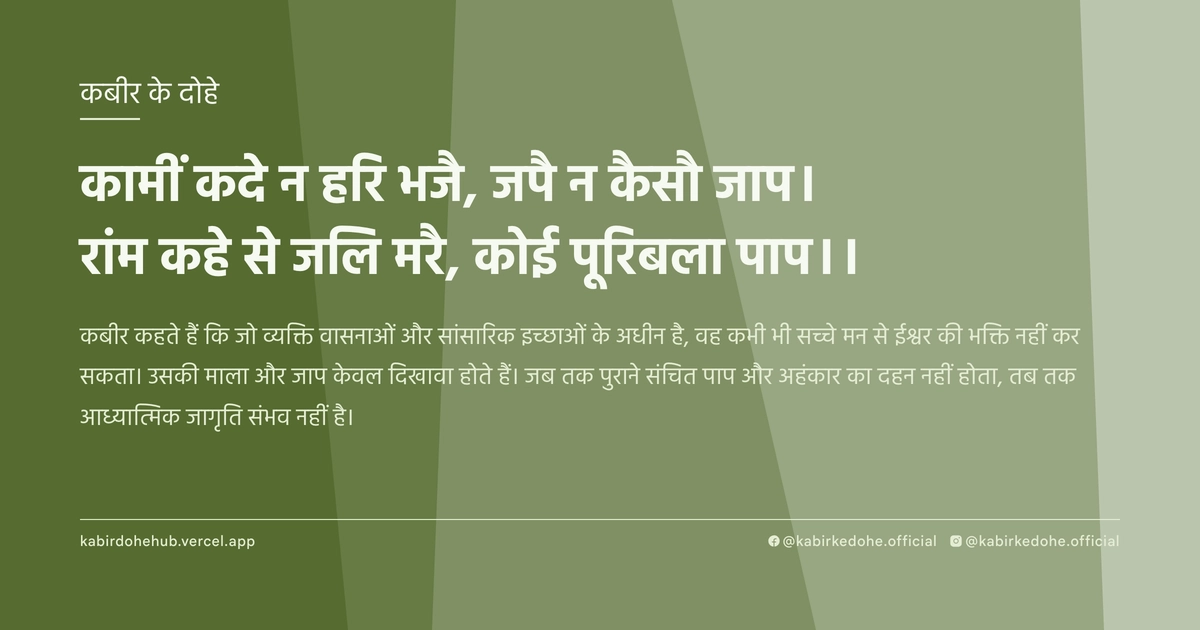
कामीं कदे न हरि भजै, जपै न कैसौ जाप।
रांम कहे से जलि मरै, कोई पूरिबला पाप।।
Kaamin kade na hari bhajai, japai na kaisau jaap. Raam kahe se jali marai, koi puribala paap.
इस पृष्ठ पर इस कबीर दोहे का अर्थ (meaning), हिंदी व्याख्या और अंग्रेज़ी अनुवाद, दार्शनिक विश्लेषण और व्यावहारिक जीवन सीख दी गई है। यह दोहा काम (Lust) विषय से जुड़ा है — Kabir doha meaning and explanation in Hindi and English.
अर्थ (Meaning):
कबीर कहते हैं कि जो व्यक्ति वासनाओं और सांसारिक इच्छाओं के अधीन है, वह कभी भी सच्चे मन से ईश्वर की भक्ति नहीं कर सकता। उसकी माला और जाप केवल दिखावा होते हैं। जब तक पुराने संचित पाप और अहंकार का दहन नहीं होता, तब तक आध्यात्मिक जागृति संभव नहीं है।
Kabir asserts that a person enslaved by lust and worldly desires can never truly devote themselves to the Divine. Their rituals and chants remain superficial. Until the accumulated sins of the past and the fire of ego are incinerated, true spiritual awakening remains an unreachable horizon.
व्याख्या (Interpretation):
इसका शाब्दिक अर्थ है कि कामुक व्यक्ति हरि का भजन नहीं कर पाता। गहरे स्तर पर, 'काम' केवल शारीरिक वासना नहीं, बल्कि किसी भी चीज़ को पाने की तीव्र तृष्णा है। यह तृष्णा 'माया' का एक रूप है जो आत्मा को ब्रह्म से अलग करती है। जब कबीर 'जलि मरै' कहते हैं, तो वे उस आध्यात्मिक अग्नि की बात कर रहे हैं जो अहंकार को जलाती है। यह निरगुण भक्ति का मार्ग है जहाँ बाहरी आडंबरों के बजाय आंतरिक शुद्धि पर बल दिया गया है। यहाँ द्वैत का अंत होता है जब साधक यह समझता है कि उसकी इच्छाएँ ही उसके और परमात्मा के बीच की दीवार हैं।
Literally, the verse claims a lustful person cannot worship Hari. Metaphorically, 'Kama' (lust) represents any intense craving or attachment to the material world, serving as a veil of Maya that obscures the Atman. The phrase 'burning away' refers to the transformative fire of knowledge (Jnana) that incinerates the ego. In the context of Nirgun Bhakti, this highlights the paradox: one cannot reach the formless Divine while clinging to the forms of desire. The struggle is not against the world, but against the internal fragmentation caused by endless wanting, which prevents the realization of non-duality.
दार्शनिक विश्लेषण (Philosophical Analysis):
कबीर का यह दोहा उनके युग के धार्मिक पाखंड और कर्मकांडीय कट्टरता पर एक कड़ा प्रहार है। वे उस समय के उन पंडितों और मुल्लाओं को चुनौती देते हैं जो दिन भर जाप करते थे लेकिन उनके मन वासना और क्रोध से भरे रहते थे। कबीर का दर्शन यहाँ अद्वैत वेदांत से मिलता है, जहाँ अज्ञान (Avidya) को ही बंधन का कारण माना गया है।
सूफी मत के 'नफ्स' (न्यूनतम इच्छाओं का दमन) की अवधारणा यहाँ स्पष्ट दिखती है। कबीर का मानना है कि जब तक 'मैं' (अहंकार) जीवित है, तब तक 'हरि' (परमात्मा) का अनुभव नहीं हो सकता। यह एक मनोवैज्ञानिक रूपांतरण की प्रक्रिया है जहाँ साधक को अपनी वासनाओं को पहचानना और फिर उन्हें विसर्जित करना होता है।
वे जाति और धर्म के ऊपर उठकर एक ऐसी सार्वभौमिक नैतिकता की बात करते हैं जहाँ पवित्रता बाहरी स्नान से नहीं, बल्कि आंतरिक शुद्धता से आती है। ritualism का विरोध करते हुए वे बताते हैं कि बिना चरित्र निर्माण के किया गया जाप केवल शब्दों का दोहराव है।
ऐतिहासिक रूप से, कबीर ने समाज को यह सिखाया कि भक्ति कोई बाहरी क्रिया नहीं बल्कि एक आंतरिक स्थिति है। उन्होंने स्पष्ट किया कि ईश्वर किसी मंदिर या मस्जिद में नहीं, बल्कि उस हृदय में बसता है जो वासनाओं से मुक्त है।
अंततः, यह विश्लेषण हमें बताता है कि 'पाप' का अर्थ यहाँ नैतिक अपराध से अधिक 'अविद्या' या सत्य से विमुख होना है। जब यह अविद्या जलती है, तभी आत्मा का वास्तविक स्वरूप प्रकट होता है।
This Doha is a scathing critique of the religious hypocrisy and ritualistic rigidity prevalent during Kabir's era. He challenges the clergy who performed elaborate chants while remaining prisoners of their own greed and lust. His philosophy aligns with Advaita Vedanta, identifying ignorance (Avidya) as the primary shackle preventing the soul from recognizing its identity with Brahman.
There is a strong resonance with the Sufi concept of 'Nafs' (the lower self), which must be disciplined before the Divine can be encountered. Kabir posits that as long as the 'I' (ego) persists, the 'Hari' (Divine) remains hidden. This is not a call for asceticism but for a psychological transmutation where desires are observed and eventually dissolved.
By rejecting caste and ritualism, Kabir emphasizes that purity is not achieved through external ablutions or the recitation of mantras, but through the alchemy of the heart. He argues that chanting without a corresponding shift in consciousness is merely a linguistic exercise devoid of spiritual potency.
Historically, Kabir shifted the locus of spirituality from the temple and mosque to the internal landscape of the human heart. He democratized the Divine, making liberation accessible to anyone capable of honest self-examination regardless of their social standing.
Ultimately, 'sin' in this context is redefined not as a transgression of a commandment, but as the state of being disconnected from one's true nature. The 'burning' is the process of purification through which the dross of the ego is removed to reveal the gold of the spirit.
मूल संदेश (Core Message):
- बाहरी आडंबर आंतरिक रिक्तता को नहीं भर सकते।
- वासना का त्याग ही वास्तविक भक्ति का प्रवेश द्वार है।
- अहंकार की अग्नि में जलकर ही आत्मा शुद्ध होती है।
- सच्चा जाप वह है जो व्यवहार में करुणा लाए।
- ईश्वर शब्दों में नहीं, बल्कि शुद्ध अंतःकरण में बसता है।
- External rituals cannot fill an internal void of consciousness.
- The surrender of craving is the only gateway to true devotion.
- The soul is purified only when the ego is incinerated by truth.
- Genuine chanting is that which manifests as compassion in action.
- The Divine resides not in words, but in a heart cleansed of desire.
व्यावहारिक उदाहरण (Practical Example):
वाराणसी के एक पुराने घाट पर माधव नाम का एक वृद्ध बुनकर रहता था। वह शहर भर में अपनी ईमानदारी और धर्मपरायणता के लिए जाना जाता था। वह रोज़ सुबह गंगा स्नान करता और घंटों माला जपता था। समाज उसे एक संत मानता था, और वह स्वयं भी इस छवि में खुश था।
लेकिन माधव के भीतर एक गहरा द्वंद्व था। वह अपनी छोटी सी दुकान के मुनाफे को लेकर अत्यंत लालची था। वह अपने प्रतिस्पर्धियों के प्रति ईर्ष्या रखता था और अक्सर अपने सहायकों को मामूली गलतियों पर कठोरता से अपमानित करता था। उसका 'जाप' केवल एक सामाजिक मुखौटा था।
एक दिन उसकी मुलाकात एक घुमक्कड़ फकीर से हुई। फकीर ने माधव की माला देखी और मुस्कुराते हुए कहा, "माधव, तुम्हारी माला के मोती तो चमक रहे हैं, लेकिन तुम्हारे मन के दाग अभी भी गहरे हैं। तुम पत्थर को पूजते हो, पर इंसान से नफरत करते हो।"
माधव को पहले तो गुस्सा आया, लेकिन फकीर की बातों ने उसके भीतर एक हलचल मचा दी। उसने महसूस किया कि उसका पूरा आध्यात्मिक जीवन एक झूठ था। वह ईश्वर को खोज रहा था, लेकिन उसकी वासनाएँ—सत्ता, धन और सम्मान की भूख—उसे जकड़े हुए थीं।
उस रात माधव सो नहीं सका। उसे कबीर की पंक्तियाँ याद आईं कि वासनाओं से भरा व्यक्ति कभी हरि को नहीं पा सकता। उसने महसूस किया कि उसका अहंकार ही वह 'पाप' था जो उसे सत्य से दूर रख रहा था।
अगले दिन से माधव ने अपनी जीवनशैली बदल दी। उसने अपनी दुकान का एक हिस्सा गरीब बच्चों की शिक्षा के लिए समर्पित कर दिया। उसने अपने सहायकों से माफी मांगी और उन्हें सम्मान देना शुरू किया।
उसने माला जपना नहीं छोड़ा, लेकिन अब उसका जाप केवल शब्दों का खेल नहीं था। जब वह 'राम' कहता, तो उसे अपने भीतर के क्रोध और लालच का विसर्जन महसूस होता।
धीरे-धीरे उसका मन शांत होने लगा। अब उसे गंगा के पानी से अधिक पवित्रता अपने भीतर के क्षमाभाव में महसूस होने लगी।
माधव ने सीखा कि वास्तविक भक्ति बाहरी प्रदर्शन में नहीं, बल्कि अपनी वासनाओं को प्रेम और करुणा में बदलने में है।
उसका जीवन अब एक प्रदर्शन नहीं, बल्कि एक जीवंत प्रार्थना बन गया था, जहाँ उसका हर कार्य ईश्वर की सेवा के समान था।
In the ancient alleys of Varanasi, there lived an elderly weaver named Madhav. He was renowned throughout the city for his piety and honesty. Every morning, he bathed in the Ganges and spent hours reciting mantras with his beads. Society viewed him as a saint, and he took great pride in this curated image.
However, beneath this veneer of holiness, Madhav harbored a turbulent interior. He was obsessively greedy regarding the profits of his small loom business. He felt a sharp, biting envy toward his competitors and frequently humiliated his assistants over the slightest mistakes. His 'chanting' was merely a social mask.
One day, he encountered a wandering fakir. The fakir looked at Madhav's prayer beads and smiled cryptically, saying, "Madhav, your beads are shining, but the stains on your heart remain deep. You worship the stone, yet you despise the human."
Initially, Madhav felt a surge of indignation, but the fakir's words planted a seed of doubt. He began to realize that his entire spiritual life was a sophisticated lie. He claimed to seek God, yet he was enslaved by his cravings for power, wealth, and social validation.
That night, Madhav could not sleep. He recalled the essence of Kabir's wisdom: that one consumed by desire can never truly touch the Divine. He recognized that his ego was the very 'sin' that acted as a barrier between him and the Truth.
From the next day, Madhav began a conscious transformation. He dedicated a portion of his earnings to the education of orphaned children in the colony. He apologized to his assistants and began treating them with genuine dignity.
He did not stop his chanting, but the nature of the practice changed. Now, when he uttered the name of 'Ram,' it was not a mechanical repetition but a conscious release of his anger and greed.
Gradually, his mind grew still. He began to feel a purity within his capacity for forgiveness that far exceeded the cleansing power of the river water.
Madhav learned that true devotion is not found in external displays but in the alchemy of converting personal desire into universal compassion.
His life ceased to be a performance and became a living prayer, where every thread he wove was an offering to the formless Divine.
अभ्यास मार्गदर्शन (Practice Guidance):
- दैनिक आत्म-निरीक्षण: प्रतिदिन 15 मिनट मौन बैठें और उन इच्छाओं की सूची बनाएं जो आपको मानसिक अशांति देती हैं।
- साक्षी भाव का अभ्यास: जब भी क्रोध या लालच महसूस हो, तो उसे दबाने के बजाय एक तीसरे व्यक्ति की तरह देखें और पूछें, "यह इच्छा कौन कर रहा है?"
- सेवा का संकल्प: सप्ताह में एक बार बिना किसी प्रशंसा की इच्छा के किसी ऐसे व्यक्ति की मदद करें जिससे आपका कोई निजी स्वार्थ न हो।
- डायरी लेखन: अपने उन व्यवहारों को लिखें जहाँ आपका 'दिखावा' आपकी 'वास्तविकता' से अलग था, और उन्हें स्वीकार करें।
- निदान चेकलिस्ट: क्या मैं दूसरों की आलोचना करते समय स्वयं को श्रेष्ठ महसूस करता हूँ? क्या मेरा जाप केवल तनाव कम करने का साधन है या यह मुझे अधिक विनम्र बना रहा है?
- Daily Self-Inquiry: Spend 15 minutes in silence daily, listing the specific cravings and desires that trigger your mental unrest.
- Practice of the Witness: Whenever anger or greed arises, instead of suppressing it, observe it as a third-party witness and ask, "Who is the one experiencing this desire?"
- Sincere Service: Once a week, perform an act of kindness for someone from whom you expect absolutely no reward or social recognition.
- Shadow Journaling: Document instances where your 'public spiritual persona' contradicted your 'private reality,' and practice radical acceptance of these gaps.
- Diagnostic Checklist: Do I feel superior while criticizing others? Is my spiritual practice a tool for ego-inflation or a path toward genuine humility?
चिंतन प्रश्न (Reflection Questions):
- मेरे जीवन में ऐसा कौन सा 'दिखावा' है जिसे मैं अपनी आध्यात्मिकता समझ बैठा हूँ?
- यदि मेरी सामाजिक प्रतिष्ठा और पद छीन लिए जाएं, तो क्या मेरा ईश्वर के प्रति प्रेम बचेगा?
- मैं किन गुप्त इच्छाओं के कारण दूसरों के प्रति ईर्ष्या या घृणा महसूस करता हूँ?
- क्या मेरा धर्म मुझे अधिक समावेशी बना रहा है या यह मुझे दूसरों से अलग करने का एक साधन बन गया है?
- मेरे भीतर का वह कौन सा 'पाप' या अहंकार है जिसे मैं स्वीकार करने से डरता हूँ?
- क्या मैं वास्तव में शांति चाहता हूँ, या मैं केवल अपनी इच्छाओं की पूर्ति की शांति चाहता हूँ?
- What 'performance' in my life have I mistaken for genuine spiritual progress?
- If my social status and titles were stripped away, would my love for the Divine still exist?
- Which hidden cravings drive my feelings of envy or hatred toward others?
- Is my faith making me more inclusive, or has it become a tool for creating separation?
- What is the specific 'sin' or ego-structure within me that I am most afraid to acknowledge?
- Do I truly seek inner peace, or am I merely seeking the satisfaction of my endless desires?