
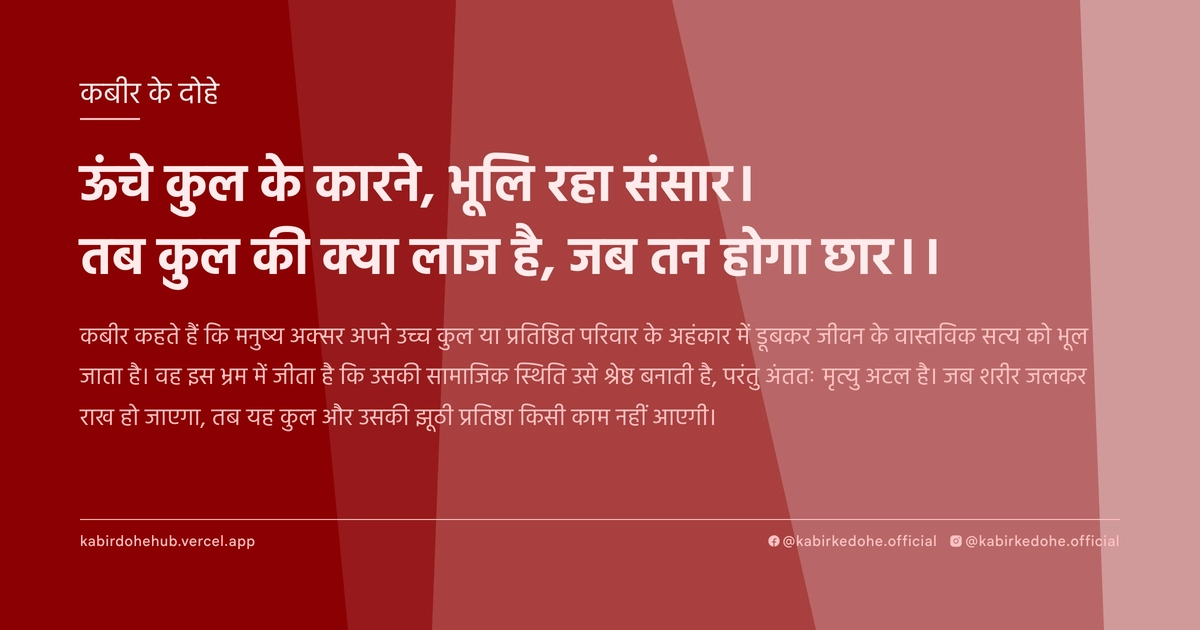
ऊंचे कुल के कारने, भूलि रहा संसार।
तब कुल की क्या लाज है, जब तन होगा छार।।
Unche kul ke kaarane, bhuli raha sansaar. Tab kul ki kya laaj hai, jab tan hoga chhaar.
इस पृष्ठ पर इस कबीर दोहे का अर्थ (meaning), हिंदी व्याख्या और अंग्रेज़ी अनुवाद, दार्शनिक विश्लेषण और व्यावहारिक जीवन सीख दी गई है। यह दोहा मृतुक्यता (Mortality) विषय से जुड़ा है — Kabir doha meaning and explanation in Hindi and English.
अर्थ (Meaning):
कबीर कहते हैं कि मनुष्य अक्सर अपने उच्च कुल या प्रतिष्ठित परिवार के अहंकार में डूबकर जीवन के वास्तविक सत्य को भूल जाता है। वह इस भ्रम में जीता है कि उसकी सामाजिक स्थिति उसे श्रेष्ठ बनाती है, परंतु अंततः मृत्यु अटल है। जब शरीर जलकर राख हो जाएगा, तब यह कुल और उसकी झूठी प्रतिष्ठा किसी काम नहीं आएगी।
Kabir asserts that humans often succumb to the delusion of their high birth or prestigious lineage, forgetting the fundamental truth of existence. One lives under the illusion that social status defines superiority, yet death is inevitable. When the physical body is reduced to ashes, the pride of lineage and social standing becomes utterly meaningless.
व्याख्या (Interpretation):
यह दोहा सामाजिक पहचान और आध्यात्मिक वास्तविकता के बीच के अंतर्विरोध को दर्शाता है। शाब्दिक अर्थ में, यह कुल के अहंकार की व्यर्थता बताता है, लेकिन रूपकात्मक रूप से यह 'माया' के उस जाल की ओर संकेत करता है जहाँ व्यक्ति अपनी बाहरी पहचान (अहंकार) को ही अपनी वास्तविक आत्मा मान लेता है। निर्गुण भक्ति के परिप्रेक्ष्य में, ईश्वर किसी कुल या जाति को नहीं देखता, बल्कि केवल हृदय की शुद्धता को पहचानता है। यहाँ 'छार' (राख) का उल्लेख अद्वैत वेदांत के उस सत्य को उजागर करता है कि शरीर नश्वर है और केवल आत्मा ही शाश्वत है। यह विरोधाभास है कि मनुष्य उसी प्रतिष्ठा को बचाने में जीवन व्यतीत करता है जो मृत्यु के क्षण में पूरी तरह विलुप्त हो जाती है।
This couplet illuminates the contradiction between social identity and spiritual reality. Literally, it addresses the futility of ancestral pride, but metaphorically, it points toward the veil of 'Maya' where an individual mistakes their external persona (ego) for their true essence. In the context of Nirgun Bhakti, the Formless Divine recognizes neither caste nor lineage, but only the purity of the heart. The reference to 'ashes' evokes the Advaita Vedanta truth that the physical vessel is transient, while only the Atman is eternal. It highlights the central paradox of the human condition: spending a lifetime preserving a prestige that vanishes instantly upon the cessation of breath.
दार्शनिक विश्लेषण (Philosophical Analysis):
कबीर का यह प्रहार उस मध्यकालीन सामाजिक संरचना पर है जहाँ जन्म के आधार पर श्रेष्ठता तय की जाती थी। उन्होंने जाति व्यवस्था और कर्मकांडीय श्रेष्ठता को सिरे से खारिज किया, क्योंकि यह मनुष्य को उसके वास्तविक स्वरूप से दूर ले जाती है। यह विचार सूफी मत के 'फना' (अहंकार का विनाश) और अद्वैत वेदांत के 'अहं ब्रह्मास्मि' के करीब है, जहाँ व्यक्ति को यह समझना होता है कि वह शरीर या कुल नहीं, बल्कि शुद्ध चेतना है।
ऐतिहासिक रूप से, कबीर ने समाज के उस वर्ग को चुनौती दी जो धर्म के नाम पर भेदभाव करता था। उनके लिए, 'कुल' एक मानसिक बंधन है जो मनुष्य को दूसरों से अलग करता है और उसमें श्रेष्ठता का भ्रम पैदा करता है। यह भ्रम ही आध्यात्मिक प्रगति में सबसे बड़ी बाधा है।
दार्शनिक स्तर पर, कबीर यहाँ 'अविद्या' (अज्ञान) की बात कर रहे हैं। जब व्यक्ति अपनी पहचान को अपने पूर्वजों या सामाजिक पद से जोड़ता है, तो वह वास्तव में अपनी आत्मा की अनंतता को सीमित कर रहा होता है। यह एक मनोवैज्ञानिक जाल है जहाँ बाहरी प्रशंसा आंतरिक रिक्तता को ढकने का प्रयास करती है।
उनका दृष्टिकोण यह है कि वास्तविक 'कुल' वह है जिसका आधार सत्य, करुणा और प्रेम हो, न कि रक्त संबंध। वे मनुष्य को यह याद दिलाते हैं कि मृत्यु ही अंतिम महान समतावादी (Great Equalizer) है। श्मशान में न कोई राजा होता है और न कोई रंक, केवल राख होती है।
अतः, यह दोहा केवल मृत्यु का भय नहीं दिखाता, बल्कि जीवन जीने का एक नया तरीका सुझाता है। यह अहंकार के विसर्जन और उस सार्वभौमिक सत्य की खोज का आह्वान है जो किसी भी सामाजिक लेबल से परे है।
Kabir’s critique is aimed at the medieval social hierarchy where superiority was determined by birth. He categorically rejected the caste system and ritualistic superiority, arguing that such constructs alienate the individual from their true spiritual nature. This philosophy aligns with the Sufi concept of 'Fana' (annihilation of the ego) and the Advaita Vedanta realization of 'Aham Brahmasmi,' where one recognizes themselves as pure consciousness rather than a social entity.
Historically, Kabir challenged the religious elite who used lineage to justify discrimination. For him, 'Kul' (lineage) is a mental shackle that creates a false sense of separation and superiority. This delusion is the primary obstacle to spiritual evolution, as it anchors the soul to the transient world of forms.
Philosophically, Kabir addresses 'Avidya' (ignorance). When a person ties their identity to ancestors or social rank, they limit the infinity of their soul to a narrow, temporal label. This is a psychological trap where external validation is used to mask internal emptiness.
His perspective suggests that the only true 'lineage' is one founded on truth, compassion, and love, rather than biological descent. He reminds us that death is the ultimate 'Great Equalizer.' In the cremation ground, there is no king or beggar—only ash.
Therefore, this couplet does not merely evoke the fear of death, but proposes a new way of living. It is a call for the dissolution of the ego and a quest for the universal truth that transcends all social labels and artificial boundaries.
मूल संदेश (Core Message):
- सामाजिक प्रतिष्ठा एक अस्थायी मुखौटा है।
- अहंकार आत्मा और परमात्मा के बीच की दीवार है।
- मृत्यु ही अंतिम सत्य और सबसे बड़ा समतावादी है।
- वास्तविक श्रेष्ठता चरित्र और करुणा से आती है, जन्म से नहीं।
- नश्वर शरीर के मोह को त्यागकर शाश्वत आत्मा को पहचानें।
- Social prestige is but a transient mask.
- Ego is the wall separating the soul from the Divine.
- Death is the ultimate truth and the greatest equalizer.
- True superiority stems from character and compassion, not birth.
- Transcend the attachment to the mortal body to realize the eternal soul.
व्यावहारिक उदाहरण (Practical Example):
एक समय की बात है, वाराणसी के घाटों पर माधव नाम का एक वृद्ध मूर्तिकार रहता था। माधव अपने परिवार की महानता पर बहुत गर्व करता था क्योंकि उसके पूर्वज शाही दरबारों के मुख्य कलाकार थे। वह अक्सर अन्य शिल्पकारों को तुच्छ समझता और अपनी कला से अधिक अपने वंश की चर्चा करता था।
एक दिन उसकी मुलाकात एक साधारण से मिट्टी के बर्तन बनाने वाले कुम्हार से हुई, जिसका नाम रामू था। रामू के पास न तो कोई शाही प्रशस्ति पत्र थे और न ही कोई महान कुल, लेकिन उसकी बनाई मिट्टी की कलाकृतियों में एक ऐसी जीवंतता थी जो माधव की पत्थर की मूर्तियों में नहीं थी।
माधव ने अहंकारवश रामू से कहा, 'तुम एक साधारण कुम्हार हो, तुम्हारा कुल मेरी बराबरी नहीं कर सकता। मेरी उंगलियों में सदियों का शाही रक्त और ज्ञान है।' रामू ने मुस्कुराकर केवल एक बात कही, 'माधव भाई, जब हम मिट्टी में मिलते हैं, तो मिट्टी यह नहीं पूछती कि वह किस कुल की है।'
कुछ समय बाद, माधव के शहर में एक भीषण महामारी फैली। माधव ने अपने जीवन के सबसे करीबी मित्र और परिवार के सदस्यों को खो दिया। जब वह अपने प्रियजन के अंतिम संस्कार के लिए श्मशान गया, तो उसने देखा कि वहाँ जलने वाली देहें एक जैसी राख बन रही थीं।
उसने देखा कि उसके 'शाही कुल' के गौरवशाली पूर्वजों की राख और एक साधारण मजदूर की राख में कोई अंतर नहीं था। वह राख हवा में उड़ रही थी, बिना किसी पहचान के, बिना किसी पद के।
उस क्षण माधव को कबीर का वह दोहा याद आया। उसे एहसास हुआ कि उसने अपना पूरा जीवन एक ऐसे मुखौटे को सजाने में बिता दिया, जिसे अंततः अग्नि को निगल जाना था।
उसने अपनी मूर्तियों में वह 'अहंकार' छोड़ दिया और केवल 'प्रेम' को उकेरना शुरू किया। उसने रामू के साथ बैठकर मिट्टी से खेलना सीखा, यह जानकर कि असली कला वह है जो मनुष्य को मनुष्य से जोड़े, न कि वह जो उसे ऊँचा या नीचा दिखाए।
माधव का जीवन बदल गया। अब वह अपनी पहचान अपने कुल से नहीं, बल्कि अपनी करुणा और सेवा से करने लगा। उसने अपनी कार्यशाला को एक मुफ्त विद्यालय बना दिया जहाँ किसी भी जाति या कुल का बच्चा कला सीख सकता था।
उसकी मूर्तियों में अब एक नई चमक थी—एक ऐसी शांति जो केवल अहंकार के विसर्जन के बाद आती है। वह अब वास्तव में एक 'उच्च कुल' का व्यक्ति बन गया था, क्योंकि उसका कुल अब मानवता था।
उसने सीखा कि जीवन की सार्थकता इस बात में नहीं है कि हम कहाँ से आए हैं, बल्कि इस बात में है कि हम अपने पीछे क्या छोड़ कर जाते हैं।
Once, on the ghats of Varanasi, lived an elderly sculptor named Madhav. Madhav took immense pride in his family's prestige, as his ancestors had been the chief artists of royal courts. He often looked down upon other craftsmen, discussing his lineage more than his actual art.
One day, he met a simple potter named Ramu. Ramu possessed no royal commendations nor a noble lineage, yet his clay creations had a vibrancy and soul that Madhav's stone sculptures lacked.
Driven by ego, Madhav told Ramu, 'You are a mere potter; your lineage cannot equal mine. In my fingers flows the royal blood and wisdom of centuries.' Ramu smiled and replied softly, 'Brother Madhav, when we return to the earth, the soil does not ask which lineage the body belongs to.'
Sometime later, a severe plague swept through the city. Madhav lost his closest friends and family members. As he went to the cremation grounds for the final rites, he witnessed bodies of all ranks being reduced to the same grey ash.
He observed that there was no difference between the ashes of his 'noble' ancestors and those of a common laborer. The ash drifted in the wind, devoid of identity, rank, or prestige.
In that moment, Kabir's words resonated within him. He realized he had spent his entire life polishing a mask that was destined to be consumed by fire.
He abandoned the 'ego' in his sculptures and began to carve only 'love.' He sat with Ramu and learned to play with clay, understanding that true art is that which connects human to human, rather than that which elevates one over another.
Madhav's life transformed. He ceased defining himself by his lineage and began defining himself through compassion and service. He turned his workshop into a free school where any child, regardless of caste or birth, could learn art.
His sculptures now possessed a new radiance—a peace that only arrives after the dissolution of the ego. He had finally become a man of 'high lineage,' for his lineage was now humanity itself.
He learned that the meaning of life lies not in where we come from, but in what we leave behind in the hearts of others.
अभ्यास मार्गदर्शन (Practice Guidance):
- दैनिक चिंतन: प्रतिदिन 10 मिनट मौन बैठें और विचार करें कि यदि आपकी सारी सामाजिक पहचान (नाम, पद, परिवार) छीन ली जाए, तो आप वास्तव में कौन हैं?
- आत्म-पूछताछ जर्नल: उन क्षणों को लिखें जब आपने किसी को उसकी सामाजिक स्थिति के कारण कमतर आंका या स्वयं को श्रेष्ठ महसूस किया। विश्लेषण करें कि उस समय आपके भीतर कौन सा 'अहंकार' सक्रिय था।
- व्यवहारिक परिवर्तन: सप्ताह में एक बार ऐसे व्यक्ति की सेवा करें या उससे संवाद करें जिससे आप सामाजिक स्तर पर स्वयं को बहुत अलग मानते हैं। उनके साथ पूर्ण समानता का अनुभव करें।
- निदान चेकलिस्ट: क्या आप अपनी उपलब्धियों का श्रेय अपने कुल/पृष्ठभूमि को देते हैं? क्या आप दूसरों की योग्यता को उनके परिवार के चश्मे से देखते हैं? यदि हाँ, तो आप अभी भी 'माया' के प्रभाव में हैं।
- Daily Contemplation: Spend 10 minutes in silence daily, reflecting on the question: 'If all my social identities (name, rank, family) were stripped away, who would I actually be?'
- Self-Inquiry Journal: Record moments when you judged someone as inferior or felt superior based on social status. Analyze which specific 'ego' was active during that interaction.
- Behavioral Shift: Once a week, serve or engage in a deep conversation with someone you perceive as socially distant from yourself. Practice experiencing absolute equality in their presence.
- Diagnostic Checklist: Do you attribute your successes to your lineage or background? Do you evaluate others' worth through the lens of their family? If yes, you are still under the influence of 'Maya'.
चिंतन प्रश्न (Reflection Questions):
- यदि आज आपकी सारी पारिवारिक और सामाजिक पहचान मिटा दी जाए, तो आपके पास अपनी गरिमा के लिए क्या बचेगा?
- आप अपनी सफलता का कितना हिस्सा अपने 'कुल' या 'संस्कारों' को देते हैं, और कितना अपनी व्यक्तिगत मेहनत को? क्या यह विभाजन वास्तविक है?
- क्या आप अनजाने में उन लोगों को कम सम्मान देते हैं जिनका सामाजिक स्तर आपसे नीचे है, भले ही वे आपसे अधिक ज्ञानी हों?
- मृत्यु के बाद की राख की समानता को जानते हुए भी, आप जीवित रहते हुए इस असमानता को क्यों पालते हैं?
- आपका 'डिजिटल अहंकार' (सोशल मीडिया प्रोफाइल) आपके वास्तविक आंतरिक स्वरूप को कितना ढक चुका है?
- If all your familial and social identities were erased today, what would remain of your dignity?
- How much of your success do you attribute to your 'lineage' versus your own effort? Is this division actually real?
- Do you unconsciously grant less respect to those of a lower social strata, even if they possess greater wisdom than you?
- Knowing the absolute equality of ashes after death, why do you nurture this inequality while alive?
- To what extent has your 'digital ego' (social media profile) obscured your authentic internal self?