
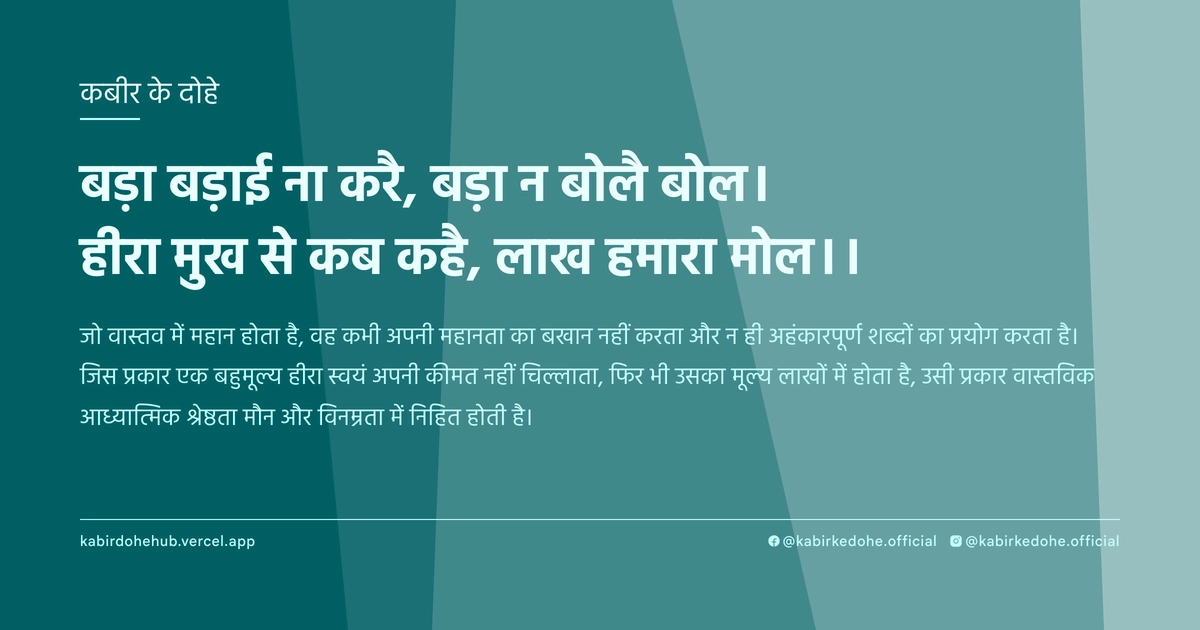
बड़ा बड़ाई ना करै, बड़ा न बोलै बोल।
हीरा मुख से कब कहै, लाख हमारा मोल।।
Bada badai na karai, bada na bolai bol. Heera mukh se kab kahai, laakh hamara mol.
इस पृष्ठ पर इस कबीर दोहे का अर्थ (meaning), हिंदी व्याख्या और अंग्रेज़ी अनुवाद, दार्शनिक विश्लेषण और व्यावहारिक जीवन सीख दी गई है। यह दोहा विनम्रता (Humility) विषय से जुड़ा है — Kabir doha meaning and explanation in Hindi and English.
अर्थ (Meaning):
जो वास्तव में महान होता है, वह कभी अपनी महानता का बखान नहीं करता और न ही अहंकारपूर्ण शब्दों का प्रयोग करता है। जिस प्रकार एक बहुमूल्य हीरा स्वयं अपनी कीमत नहीं चिल्लाता, फिर भी उसका मूल्य लाखों में होता है, उसी प्रकार वास्तविक आध्यात्मिक श्रेष्ठता मौन और विनम्रता में निहित होती है।
One who is truly great never proclaims their own greatness nor speaks words of vanity. Just as a priceless diamond never opens its mouth to announce that its value is worth millions, true spiritual excellence resides in silence and profound humility, remaining unseen yet intrinsically invaluable.
व्याख्या (Interpretation):
यह दोहा बाहरी प्रदर्शन और आंतरिक वास्तविकता के बीच के विरोधाभास को दर्शाता है। शाब्दिक अर्थ यह है कि आत्म-प्रशंसा निम्नता की निशानी है। रूपकात्मक रूप से, 'हीरा' उस शुद्ध आत्मा (Atman) का प्रतीक है जो माया के आवरण के नीचे छिपी होती है। निर्गुण भक्ति के अनुसार, जब साधक अपने अहंकार (Ego) को मिटा देता है, तब वह उस निराकार ब्रह्म के साथ एकाकार हो जाता है। यहाँ 'मौन' केवल शब्दों का अभाव नहीं है, बल्कि वह अवस्था है जहाँ 'मैं' और 'मेरा' का भाव समाप्त हो जाता है। यह अद्वैत वेदांत के उस सिद्धांत की पुष्टि करता है जहाँ सत्य स्वयं-सिद्ध होता है और उसे किसी प्रमाण या शोर की आवश्यकता नहीं होती।
This couplet highlights the paradox between external display and internal reality. Literally, it suggests that self-praise is a mark of inferiority. Metaphorically, the 'diamond' symbolizes the pure Soul (Atman) hidden beneath the veils of Maya. In the context of Nirgun Bhakti, when a seeker annihilates the ego, they merge with the formless Brahman. Here, 'silence' is not merely the absence of speech, but a state where the notions of 'I' and 'mine' vanish. This affirms the Advaita Vedanta principle that Truth is self-evident and requires no external validation or clamor to prove its existence.
दार्शनिक विश्लेषण (Philosophical Analysis):
कबीर का यह विचार उनके युग के धार्मिक पाखंड और सामाजिक स्तरीकरण पर एक सीधा प्रहार है। उस समय, लोग बाहरी वस्त्रों, तिलक, और ऊँची जाति के दावों के माध्यम से अपनी श्रेष्ठता सिद्ध करने का प्रयास करते थे। कबीर ने इस 'प्रदर्शनवाद' को आध्यात्मिक पतन माना। वे तर्क देते हैं कि वास्तविक ज्ञान (Gyan) वह है जो व्यक्ति को विनम्र बनाता है, न कि वह जो उसे दूसरों से ऊपर खड़ा करता है।
दार्शनिक स्तर पर, यह दोहा सूफीवाद के 'फना' (अहंकार का विनाश) और वेदांत के 'अहं ब्रह्मास्मि' के बीच एक सेतु बनाता है। जब व्यक्ति यह अनुभव करता है कि वह संपूर्ण ब्रह्मांड का हिस्सा है, तो 'बड़प्पन' का दावा करना हास्यास्पद हो जाता है क्योंकि अलग होने का बोध ही समाप्त हो जाता है। अहंकार वह पर्दा है जो आत्मा को परमात्मा से अलग करता है।
कबीर यहाँ 'मूल्य' और 'कीमत' के बीच अंतर स्पष्ट करते हैं। कीमत वह है जो बाजार तय करता है (सामाजिक प्रतिष्ठा), जबकि मूल्य वह है जो आंतरिक गुण तय करते हैं (आध्यात्मिक गहराई)। जो व्यक्ति अपनी प्रशंसा स्वयं करता है, वह वास्तव में अपनी आंतरिक रिक्तता को भरने का प्रयास कर रहा होता है।
यह शिक्षण मनोवैज्ञानिक रूपांतरण की बात करता है। जब हम अपनी श्रेष्ठता सिद्ध करने की इच्छा छोड़ देते हैं, तो हम मानसिक तनाव और प्रतिस्पर्धा से मुक्त हो जाते हैं। यह 'अनासक्ति' का मार्ग है, जहाँ व्यक्ति कर्म तो करता है लेकिन फल या प्रशंसा की इच्छा नहीं रखता।
अंततः, कबीर यह संदेश देते हैं कि सत्य मौन में बोलता है। जिस प्रकार सूर्य को अपनी चमक बताने के लिए शब्दों की आवश्यकता नहीं होती, उसी प्रकार एक जागृत आत्मा का प्रभाव उसके आचरण से झलकता है, उसके शब्दों से नहीं। यह ritualism के विरुद्ध एक सशक्त तर्क है, जो बाहरी कर्मकांडों के बजाय आंतरिक शुद्धता पर बल देता है।
Kabir's insight is a direct assault on the religious hypocrisy and social stratification of his era. At the time, individuals attempted to prove their superiority through external attire, religious marks, and claims of high caste. Kabir viewed this 'performative spirituality' as a sign of spiritual decay. He argues that true knowledge (Gyan) is that which renders a person humble, rather than elevating them above others.
On a philosophical level, this couplet bridges the Sufi concept of 'Fana' (annihilation of the ego) and the Vedantic realization of 'Aham Brahmasmi'. When a person experiences their identity as an integral part of the universal consciousness, claiming 'greatness' becomes absurd because the sense of separation has vanished. The ego is the veil that separates the Atman from the Brahman.
Kabir distinguishes between 'price' and 'value'. Price is determined by the market (social prestige), whereas value is determined by intrinsic qualities (spiritual depth). One who praises themselves is merely attempting to fill an internal void of insecurity.
This teaching advocates for a psychological transformation. By relinquishing the desire to prove superiority, one is liberated from mental stress and the cycle of competition. This is the path of 'Anasakti' (non-attachment), where action is performed without craving for validation or reward.
Ultimately, Kabir suggests that Truth speaks in silence. Just as the sun does not need words to announce its brilliance, the influence of an awakened soul radiates through their conduct, not their claims. This is a powerful argument against ritualism, emphasizing internal purity over external ceremony.
मूल संदेश (Core Message):
- अहंकार सत्य का सबसे बड़ा अवरोध है।
- मौन ही आत्मा की सबसे शक्तिशाली भाषा है।
- वास्तविक मूल्य आंतरिक गुणों में निहित होता है।
- विनम्रता कमजोरी नहीं, बल्कि उच्चतम शक्ति है।
- स्वयं की प्रशंसा करना अपनी गरिमा घटाना है।
- ब्रह्म के साथ एकाकार होने के लिए 'मैं' का विसर्जन आवश्यक है।
- Ego is the primary obstacle to realizing Truth.
- Silence is the most potent language of the Soul.
- True value resides in intrinsic spiritual qualities.
- Humility is not weakness, but the highest form of power.
- Self-praise is a subtraction of one's own dignity.
- Dissolution of the 'I' is essential to merge with the Divine.
व्यावहारिक उदाहरण (Practical Example):
वाराणसी के एक पुराने घाट पर रामदीन नाम का एक वृद्ध नाविक रहता था। वह शहर के सबसे कुशल नाविकों में से एक था, लेकिन वह कभी अपनी प्रशंसा नहीं करता था। वह चुपचाप नाव चलाता और यात्रियों को उनके गंतव्य तक पहुँचाता।
उसी घाट पर एक नया नाविक आया, जिसका नाम था सोम। सोम बहुत शोर मचाता था और हर आने वाले यात्री को बताता था कि वह सबसे तेज़ और सबसे सुरक्षित नाव चलाता है। वह अक्सर रामदीन का मज़ाक उड़ाता कि वह कितना 'मौन' और 'साधारण' है।
एक दिन गंगा में भीषण तूफान आया। लहरें इतनी ऊँची थीं कि अधिकांश नाविक डर के मारे किनारे पर रुक गए। सोम ने भी अपनी वीरता का दावा किया, लेकिन जैसे ही वह लहरों के बीच पहुँचा, वह घबरा गया और अपनी नाव का संतुलन खो बैठा।
रामदीन ने देखा कि सोम की नाव डूबने वाली है। बिना किसी शोर के, वह अपनी पुरानी नाव लेकर लहरों के बीच कूद पड़ा। उसने अपनी वर्षों की तपस्या और अनुभव के बल पर सोम और उसके यात्रियों को सुरक्षित किनारे तक पहुँचाया।
जब सभी ने रामदीन की जय-जयकार की और उसे 'महान' कहा, तो रामदीन ने बस एक हल्की मुस्कान दी और चुपचाप अपनी नाव को बांधने चला गया। उसने एक शब्द भी नहीं कहा कि उसने कैसे अपनी जान जोखिम में डाली।
सोम यह देखकर स्तब्ध था। उसे समझ आया कि जिसे वह 'साधारण' समझ रहा था, वह वास्तव में एक हीरा था। रामदीन की महानता उसके शब्दों में नहीं, बल्कि उसके संकट के समय के साहस और उसकी विनम्रता में थी।
सोम ने महसूस किया कि उसकी अपनी 'बड़ाई' केवल एक खोखला खोल था, जबकि रामदीन की 'खामोशी' में एक गहरा सागर छिपा था। उसने उसी दिन से अपनी बड़बोलेपन की आदत छोड़ दी।
रामदीन ने सोम को सिखाया कि असली कौशल वह है जो जरूरत पड़ने पर काम आए, न कि वह जो केवल सुनने वालों को प्रभावित करे। सोम का अहंकार टूट गया और उसने विनम्रता का मार्ग अपनाया।
इस घटना के बाद, सोम ने सीखा कि असली सम्मान माँगा नहीं जाता, बल्कि वह आपके कर्मों के माध्यम से स्वतः प्राप्त होता है। वह अब रामदीन के साथ चुपचाप काम करना सीख रहा था।
यह 'कबीर ट्विस्ट' था—जहाँ बाहरी शोर की हार हुई और आंतरिक गहराई की जीत हुई। सोम अब जान चुका था कि हीरा कभी चिल्लाता नहीं है।
On an ancient ghat in Varanasi lived an elderly boatman named Ramdeen. He was one of the most skilled navigators in the city, yet he never spoke of his prowess. He silently rowed his boat, delivering passengers to their destinations with effortless grace.
Another boatman, Som, arrived at the same ghat. Som was loud and boastful, telling every passenger that he was the fastest and safest rower in the region. He often mocked Ramdeen, calling him 'silent' and 'unremarkable'.
One day, a fierce storm struck the Ganges. The waves rose so high that most boatmen stayed docked in fear. Som, claiming his bravery, ventured into the waters, but as the current intensified, he panicked and lost control of his boat.
Ramdeen saw Som's boat on the verge of capsizing. Without a word or a cry for attention, he launched his old boat into the churning waters. Using years of disciplined experience and calm focus, he rescued Som and his passengers, bringing them safely to shore.
When the crowd cheered and hailed Ramdeen as a 'great man', Ramdeen simply gave a faint smile and quietly went back to tie his boat. He did not utter a single word about the risk he took or the skill he employed.
Som was stunned. He realized that the man he had dismissed as 'ordinary' was actually a diamond. Ramdeen's greatness lay not in his words, but in his courage during crisis and his unwavering humility.
Som understood that his own 'greatness' was merely a hollow shell, while Ramdeen's 'silence' contained a deep, powerful ocean of wisdom.
He realized that true skill is that which serves in the moment of need, not that which merely impresses an audience. Som's ego shattered, and he began to embrace the path of humility.
Through this experience, Som learned that true respect is not demanded; it is naturally earned through one's actions. He began to work beside Ramdeen, learning the art of quiet service.
This was the 'Kabir Twist'—where external noise failed and internal depth triumphed. Som finally understood that a diamond never screams its value.
अभ्यास मार्गदर्शन (Practice Guidance):
- मौन साधना: प्रतिदिन 30 मिनट के लिए पूर्ण मौन रहें। इस दौरान अपने भीतर उठने वाली 'प्रशंसा की इच्छा' को केवल देखें, उसे बढ़ावा न दें।
- अहंकार डायरी: दिन भर में उन क्षणों को लिखें जब आपने अपनी श्रेष्ठता सिद्ध करने के लिए कुछ कहा। विश्लेषण करें कि उस समय आप वास्तव में क्या महसूस कर रहे थे—आत्मविश्वास या असुरक्षा?
- सेवा का गुप्त अभ्यास: किसी की मदद करें लेकिन यह सुनिश्चित करें कि उस व्यक्ति या किसी अन्य को कभी पता न चले कि मदद आपने की है।
- निदान चेकलिस्ट: क्या मैं बातचीत में दूसरों को नीचा दिखाकर खुद को ऊपर महसूस करता हूँ? क्या मुझे अपनी उपलब्धियों के लिए निरंतर बाहरी मान्यता की आवश्यकता होती है? यदि हाँ, तो अहंकार अभी सक्रिय है।
- Silence Practice: Spend 30 minutes in total silence daily. Observe the arising 'desire for praise' without feeding it or reacting to it.
- Ego Journaling: Record moments during the day when you felt the need to prove your superiority. Analyze whether the driver was true confidence or hidden insecurity.
- Anonymous Service: Perform an act of kindness ensuring that neither the recipient nor any third party ever discovers you were the benefactor.
- Diagnostic Checklist: Do I feel superior by subtly belittling others in conversation? Do I crave constant external validation for my achievements? If yes, the ego is still dominant.
चिंतन प्रश्न (Reflection Questions):
- यदि मेरी सभी उपलब्धियां और पद छीन लिए जाएं, तो मेरी पहचान का क्या बचेगा?
- मैं अपनी छवि को दूसरों की नज़रों में बनाए रखने के लिए कितना मानसिक श्रम करता हूँ?
- क्या मेरी विनम्रता वास्तविक है, या यह केवल दूसरों से प्रशंसा पाने की एक रणनीतिक चाल है?
- मेरे जीवन का वह कौन सा हिस्सा है जिसे मैं दुनिया से छिपाता हूँ क्योंकि वह मेरी 'महान' छवि के विपरीत है?
- क्या मैं वास्तव में दूसरों की सफलता से खुश होता हूँ, या मैं गुप्त रूप से अपनी तुलना करता हूँ?
- मौन रहने पर मुझे डर क्यों लगता है? क्या मुझे डर है कि बिना शब्दों के मेरी कोई कीमत नहीं रहेगी?
- If all my achievements and titles were stripped away, what would remain of my identity?
- How much mental energy do I expend maintaining a specific image in the eyes of others?
- Is my humility genuine, or is it a strategic maneuver to elicit praise from others?
- Which part of my life do I hide from the world because it contradicts my 'great' public persona?
- Am I truly happy for others' success, or am I secretly engaged in a comparative struggle?
- Why does silence frighten me? Do I fear that without words, I will have no value?