
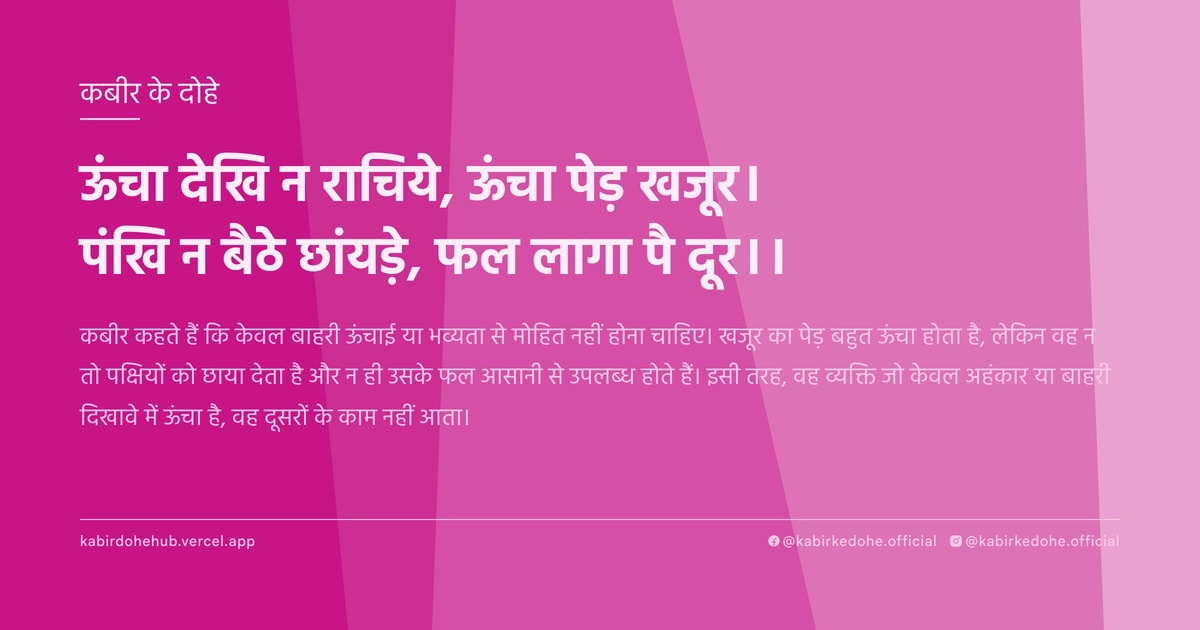
ऊंचा देखि न राचिये, ऊंचा पेड़ खजूर।
पंखि न बैठे छांयड़े, फल लागा पै दूर।।
Uncha dekh na raachiye, uncha ped khajur. Pankhi na baithe chhayde, fal laaga pai door.
इस पृष्ठ पर इस कबीर दोहे का अर्थ (meaning), हिंदी व्याख्या और अंग्रेज़ी अनुवाद, दार्शनिक विश्लेषण और व्यावहारिक जीवन सीख दी गई है। यह दोहा संतोष (Contentment) विषय से जुड़ा है — Kabir doha meaning and explanation in Hindi and English.
अर्थ (Meaning):
कबीर कहते हैं कि केवल बाहरी ऊंचाई या भव्यता से मोहित नहीं होना चाहिए। खजूर का पेड़ बहुत ऊंचा होता है, लेकिन वह न तो पक्षियों को छाया देता है और न ही उसके फल आसानी से उपलब्ध होते हैं। इसी तरह, वह व्यक्ति जो केवल अहंकार या बाहरी दिखावे में ऊंचा है, वह दूसरों के काम नहीं आता।
Kabir warns against being enamored by mere outward height or grandeur. The date palm tree is toweringly tall, yet it offers no shade for birds to rest and its fruits remain distant and inaccessible. Similarly, a person who possesses only the 'height' of ego or superficial status provides no spiritual shelter or genuine benefit to others.
व्याख्या (Interpretation):
इस दोहे में खजूर का पेड़ 'अहंकार' और 'दिखावटी ज्ञान' का प्रतीक है। शाब्दिक अर्थ यह है कि ऊंचाई हमेशा उपयोगिता नहीं लाती। आध्यात्मिक स्तर पर, यह 'माया' के उस भ्रम को दर्शाता है जहाँ साधक बाहरी पद, उपाधियों या कठिन अनुष्ठानों को आध्यात्मिक प्रगति मान लेता है। निर्गुण भक्ति में, वास्तविक ऊंचाई विनम्रता और आंतरिक शुद्धि में है, न कि बाहरी प्रदर्शन में। जब तक आत्मा स्वयं को दूसरों की सेवा के लिए 'झुका' नहीं लेती, वह उस खजूर के पेड़ की तरह अकेली और निष्फल रहती है। यह अद्वैत वेदांत के उस सत्य की ओर इशारा करता है जहाँ 'मैं' का विसर्जन ही वास्तविक मिलन है।
In this couplet, the date palm tree serves as a metaphor for 'ego' and 'superficial knowledge.' Literally, height does not guarantee utility. Spiritually, it illustrates the illusion of Maya, where a seeker mistakes external titles, social status, or rigorous rituals for actual spiritual evolution. In Nirgun Bhakti, true elevation is found in humility and internal purification, not in outward display. Until the Atman bends in service to others, it remains like the palm tree—isolated and fruitless. This points toward the Advaita Vedanta truth that the dissolution of the 'I' is the only path to union with the Brahman, highlighting the paradox that one must descend into humility to ascend spiritually.
दार्शनिक विश्लेषण (Philosophical Analysis):
कबीर का यह दोहा उनके समय के सामाजिक और धार्मिक पाखंड पर एक तीखा प्रहार है। मध्यकालीन भारत में, ब्राह्मणवादी और मौलवी वर्ग अपनी जातिगत और धार्मिक श्रेष्ठता (ऊंचाई) का दावा करते थे, लेकिन उनके पास आम जनता के लिए करुणा या वास्तविक आध्यात्मिक मार्गदर्शन (छाया) नहीं था। कबीर ने यहाँ 'ऊंचाई' को एक मनोवैज्ञानिक जाल के रूप में प्रस्तुत किया है।
दार्शनिक रूप से, यह सूफी मत के 'फना' (अहंकार का विनाश) और वेदांत के 'अहंकार विसर्जन' से मेल खाता है। जब व्यक्ति स्वयं को दूसरों से ऊपर समझने लगता है, तो वह वास्तव में सत्य से दूर हो जाता है। खजूर के फल का 'दूर' होना इस बात का संकेत है कि अहंकार से भरा ज्ञान कभी भी अनुभवजन्य सत्य (Realization) में नहीं बदलता; वह केवल बौद्धिक विलासिता बनकर रह जाता है।
कबीर यहाँ कर्मकांडीय धर्म की निरर्थकता को सिद्ध करते हैं। यदि कोई व्यक्ति कठिन तपस्या करता है लेकिन उसके हृदय में प्रेम नहीं है, तो वह तपस्या उस खजूर के पेड़ की तरह है जो ऊंचा तो है पर किसी काम का नहीं। वास्तविक भक्ति वह है जो सरल हो और जिसमें 'स्व' का अभाव हो।
मनोवैज्ञानिक स्तर पर, यह दोहा हमें 'श्रेष्ठता परिसर' (Superiority Complex) के खतरों से आगाह करता है। जब हम अपनी उपलब्धियों के आधार पर स्वयं को ऊंचा मानते हैं, तो हम अनजाने में अपने चारों ओर एक ऐसी दीवार खड़ी कर लेते हैं जो हमें मानवीय संवेदनाओं से अलग कर देती है।
अंततः, कबीर यह संदेश देते हैं कि ईश्वर या सत्य किसी ऊंचे आसन पर नहीं, बल्कि उस सरलता में बसता है जहाँ कोई छोटा या बड़ा नहीं होता। जो व्यक्ति अपनी ऊंचाई को दूसरों की सेवा में समर्पित कर देता है, वही वास्तव में 'फलदायी' बनता है।
This doha is a sharp critique of the social and religious hypocrisy of Kabir's era. In medieval India, the priestly and clerical classes claimed a spiritual 'height' based on caste and dogma, yet they offered no genuine compassion or accessible guidance (shade) to the masses. Kabir presents this 'height' as a psychological trap.
Philosophically, this aligns with the Sufi concept of 'Fana' (annihilation of the self) and the Vedantic dissolution of the ego. When an individual perceives themselves as superior, they paradoxically distance themselves from the Truth. The 'distant fruit' of the palm tree symbolizes that knowledge steeped in ego never transforms into experiential realization; it remains mere intellectual vanity.
Kabir demonstrates the futility of ritualistic religion here. A person performing rigorous austerities without love in their heart is like the date palm—towering but useless. True devotion is that which is simple and devoid of the 'I'.
On a psychological level, the verse warns against the dangers of a 'Superiority Complex.' By elevating ourselves based on achievements, we unconsciously build a wall that isolates us from human empathy and connection.
Ultimately, Kabir suggests that the Divine or Truth does not reside on a high pedestal but in the simplicity where no distinctions of high or low exist. Only the person who dedicates their 'height' to the service of others becomes truly 'fruitful.'
मूल संदेश (Core Message):
- बाहरी भव्यता अक्सर आंतरिक रिक्तता का मुखौटा होती है।
- अहंकार ज्ञान की ऊंचाई तो देता है, पर करुणा की छाया छीन लेता है।
- सच्ची आध्यात्मिक उन्नति विनम्रता के मार्ग से होकर गुजरती है।
- उपयोगिता और सेवा ही किसी भी ज्ञान का वास्तविक प्रमाण है।
- आत्मा का विस्तार दूसरों के दुख में सहभागी होने से होता है।
- External grandeur is often a mask for internal emptiness.
- Ego grants the height of knowledge but steals the shade of compassion.
- True spiritual evolution passes through the gateway of humility.
- Utility and service are the only authentic proofs of knowledge.
- The expansion of the soul occurs by participating in the suffering of others.
व्यावहारिक उदाहरण (Practical Example):
वाराणसी के एक पुराने मोहल्ले में माधव नाम का एक अत्यंत विद्वान पंडित रहता था। उसने चारों वेदों का अध्ययन किया था और शहर के सबसे बड़े मंदिर का मुख्य पुजारी था। उसकी विद्वत्ता की चर्चा दूर-दूर तक थी, और वह अपनी ज्ञान की 'ऊंचाई' पर बहुत गर्व करता था। वह केवल उन्हीं लोगों से बात करता था जो शास्त्रों के ज्ञाता थे।
उसी गली में एक बूढ़ी विधवा रहती थी, जिसे लोग 'काकी' कहते थे। काकी अनपढ़ थी, लेकिन वह हर किसी की मदद के लिए तत्पर रहती थी। वह अक्सर बीमारों के लिए दवाइयां जुटाती और भूखों को खाना खिलाती। माधव उसे 'अज्ञानी' मानकर अनदेखा करता था।
एक बार शहर में भीषण महामारी फैली। माधव ने अपने घर के दरवाजे बंद कर लिए और केवल मंत्रोच्चार करने लगा, यह सोचकर कि उसकी आध्यात्मिक ऊंचाई उसे बचा लेगी। उसने किसी की मदद नहीं की क्योंकि उसे लगा कि यह सब 'सांसारिक मोह' है।
दूसरी ओर, काकी ने अपनी छोटी सी कुटिया को एक औषधालय बना दिया। वह दिन-रात लोगों की सेवा करती रही, यहाँ तक कि उन लोगों की भी जिन्हें समाज अछूत मानता था। वह स्वयं बीमार पड़ी, लेकिन उसकी करुणा कम नहीं हुई।
एक दिन माधव का छोटा बेटा गंभीर रूप से बीमार हो गया। माधव ने सभी बड़े विद्वानों को बुलाया, लेकिन कोई भी उसकी मदद के लिए आगे नहीं आया, क्योंकि वे सब अपनी-अपनी 'ऊंचाइयों' में व्यस्त थे। माधव की विद्वत्ता उसके बेटे की सांसें वापस नहीं ला पा रही थी।
निराश होकर माधव काकी के पास गया। काकी ने बिना किसी अहंकार के, अपनी साधारण जड़ी-बूटियों और निस्वार्थ सेवा से माधव के बेटे का उपचार किया और उसे जीवनदान दिया।
उस क्षण माधव को कबीर का वह दोहा याद आया। उसे अहसास हुआ कि वह उस खजूर के पेड़ की तरह था—ऊंचा तो था, लेकिन उसकी छाया में कोई पक्षी नहीं बैठ सकता था और उसका ज्ञान किसी के काम नहीं आया।
माधव ने अपनी पोथियां किनारे रखीं और काकी के चरणों में गिरकर रो पड़ा। उसने सीखा कि वास्तविक ज्ञान वह नहीं जो दूसरों को छोटा दिखाए, बल्कि वह है जो दूसरों के दुख को दूर करे।
उस दिन के बाद, माधव ने मंदिर की ऊंचाई से उतरकर गलियों की सेवा करना शुरू किया। उसने अपनी विद्वत्ता का उपयोग लोगों को सरल भाषा में जीवन का सत्य समझाने के लिए किया, न कि उन्हें डराने के लिए।
उसका जीवन अब एक खजूर के पेड़ से बदलकर एक बरगद के पेड़ जैसा हो गया, जिसकी घनी छाया में हर कोई सुकून पा सकता था।
In an old neighborhood of Varanasi lived a highly learned priest named Madhav. He had studied the four Vedas and was the chief priest of the city's largest temple. His scholarship was renowned far and wide, and he took immense pride in the 'height' of his knowledge. He spoke only to those who were well-versed in the scriptures.
In the same lane lived an elderly widow whom people called 'Kaki.' Kaki was illiterate, but she was always ready to help everyone. She often gathered medicines for the sick and fed the hungry. Madhav ignored her, dismissing her as 'ignorant.'
Once, a severe epidemic broke out in the city. Madhav locked his doors and began chanting mantras, believing that his spiritual height would protect him. He helped no one, viewing such acts as 'worldly attachments.'
Conversely, Kaki turned her tiny hut into a makeshift clinic. She served people day and night, including those deemed untouchables by society. She fell ill herself, but her compassion never wavered.
One day, Madhav's young son became critically ill. Madhav summoned all the great scholars, but none stepped forward to help; they were all preoccupied with their own 'heights.' Madhav's scholarship could not bring back his son's breath.
In desperation, Madhav went to Kaki. Without a shred of ego, using her simple herbs and selfless care, Kaki treated Madhav's son and saved his life.
At that moment, Kabir's verse resonated in Madhav's mind. He realized he had been like the date palm—towering, yet providing no shade for any bird, and his knowledge serving no one in their hour of need.
Madhav set aside his heavy scriptures and fell at Kaki's feet, weeping. He learned that true knowledge is not that which makes others feel small, but that which alleviates the suffering of others.
From that day on, Madhav descended from the height of the temple to serve in the lanes. He used his scholarship to explain the truths of life in simple language, rather than using it to intimidate.
His life transformed from a date palm into a banyan tree, whose dense shade provided solace to every living soul.
अभ्यास मार्गदर्शन (Practice Guidance):
- दैनिक आत्म-निरीक्षण: हर रात सोने से पहले यह विश्लेषण करें कि आज आपने कितनी बार अपनी श्रेष्ठता का प्रदर्शन किया या दूसरों को छोटा महसूस कराया।
- सेवा का अभ्यास: सप्ताह में एक बार ऐसे व्यक्ति की मदद करें जिससे आपका कोई सामाजिक या व्यावसायिक संबंध न हो, और यह कार्य पूरी तरह गुप्त रखें।
- मौन चिंतन: प्रतिदिन 20 मिनट मौन बैठें और विचार करें कि यदि आपकी सभी उपाधियाँ और उपलब्धियाँ छीन ली जाएँ, तो आपका 'स्व' क्या बचेगा।
- डायग्नोस्टिक चेकलिस्ट: क्या आप दूसरों की सलाह सुनते समय असहज महसूस करते हैं? क्या आप अपनी उपलब्धियों का जिक्र बातचीत में बार-बार करते हैं? यदि हाँ, तो आप 'खजूर के पेड़' की स्थिति में हैं।
- Daily Self-Audit: Every night before sleep, analyze how many times you displayed superiority or made others feel inferior during the day.
- Practice of Service: Once a week, help someone with whom you have no social or professional connection, and keep this act entirely secret.
- Silent Contemplation: Sit in silence for 20 minutes daily and reflect: if all your titles and achievements were stripped away, what would remain of your 'self'?
- Diagnostic Checklist: Do you feel uncomfortable when listening to others' advice? Do you frequently mention your achievements in conversation? If yes, you are currently in the 'date palm' state.
चिंतन प्रश्न (Reflection Questions):
- मेरी कौन सी उपलब्धियाँ मुझे दूसरों से अलग और श्रेष्ठ महसूस कराती हैं, और क्या यह श्रेष्ठता वास्तव में किसी के काम आ रही है?
- क्या मैं अपनी डिजिटल पहचान (सोशल मीडिया) पर एक 'ऊंचा' व्यक्तित्व बना रहा हूँ, जबकि मेरा वास्तविक जीवन रिक्त है?
- जब मैं किसी की मदद करता हूँ, तो क्या मेरे मन में यह भाव होता है कि मैं 'दाता' हूँ और वह 'याचक'?
- मेरे जीवन का वह कौन सा हिस्सा है जहाँ मैं केवल दिखावे के लिए 'ऊंचा' दिखना चाहता हूँ, भले ही वहां कोई फल न हो?
- यदि मैं अपनी सारी सामाजिक पहचान खो दूँ, तो क्या मुझमें इतनी करुणा बचेगी कि कोई मुझ पर भरोसा कर सके?
- Which of my achievements make me feel separate and superior to others, and is this superiority actually benefiting anyone?
- Am I constructing a 'towering' persona on my digital identity (social media) while my actual inner life remains empty?
- When I help someone, does a subconscious feeling arise that I am the 'giver' and they are the 'beggar'?
- Which part of my life is dedicated solely to appearing 'high' or successful, even though there is no real fruit there?
- If I lost all my social identities, would enough compassion remain in me for someone to trust me?