
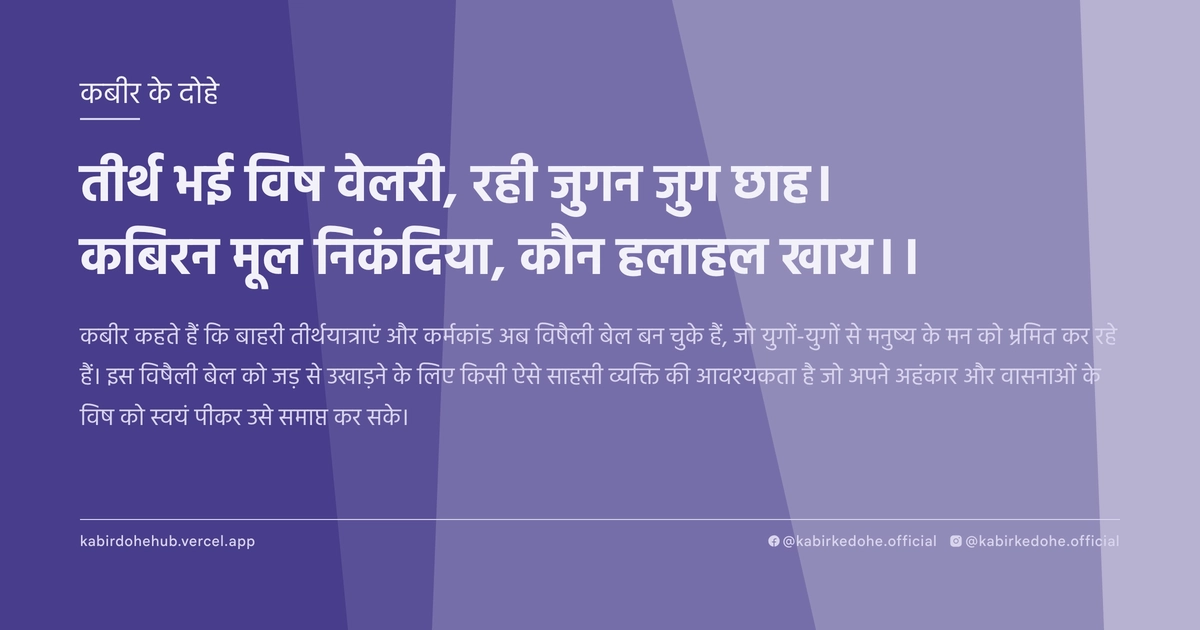
तीर्थ भई विष वेलरी, रही जुगन जुग छाह।
कबिरन मूल निकंदिया, कौन हलाहल खाय।।
Teerth bhai vish velari, rahi jugan jug chhah. Kabiran mool nikandiya, kaun halahal khay.
इस पृष्ठ पर इस कबीर दोहे का अर्थ (meaning), हिंदी व्याख्या और अंग्रेज़ी अनुवाद, दार्शनिक विश्लेषण और व्यावहारिक जीवन सीख दी गई है। यह दोहा मुक्ति (Liberation) विषय से जुड़ा है — Kabir doha meaning and explanation in Hindi and English.
अर्थ (Meaning):
कबीर कहते हैं कि बाहरी तीर्थयात्राएं और कर्मकांड अब विषैली बेल बन चुके हैं, जो युगों-युगों से मनुष्य के मन को भ्रमित कर रहे हैं। इस विषैली बेल को जड़ से उखाड़ने के लिए किसी ऐसे साहसी व्यक्ति की आवश्यकता है जो अपने अहंकार और वासनाओं के विष को स्वयं पीकर उसे समाप्त कर सके।
Kabir asserts that external pilgrimages and ritualistic practices have become like a poisonous vine, entwining the human consciousness for ages. To eradicate this vine from its very root, there must be a seeker courageous enough to consume the poison of ego and desire, neutralizing it through spiritual alchemy.
व्याख्या (Interpretation):
यहाँ 'तीर्थ' केवल भौगोलिक स्थानों का नहीं, बल्कि उन सभी बाहरी आडंबरों का प्रतीक है जिन्हें हम मोक्ष का साधन मानते हैं। 'विष वेलरी' उस मायावी जाल को दर्शाता है जो श्रद्धा के नाम पर मनुष्य को आत्म-साक्षात्कार से दूर ले जाता है। यह दोहा निर्गुण भक्ति की उस धारा को उजागर करता है जहाँ ईश्वर मंदिर या नदी में नहीं, बल्कि अंतरात्मा में स्थित है। 'मूल निकंदिया' का अर्थ है जड़ से उखाड़ना, जो केवल तब संभव है जब साधक अपने भीतर के 'हलाहल' (अहंकार और अज्ञान) को स्वीकार करे और उसे आत्म-ज्ञान की अग्नि में जला दे। यह अद्वैत वेदांत के उस सिद्धांत से जुड़ा है जहाँ द्वैत का अंत ही सत्य की प्राप्ति है।
The term 'Teerth' here symbolizes not just physical shrines, but all external rituals mistaken for paths to liberation. The 'poisonous vine' represents Maya, the cosmic illusion that binds the soul to superficiality under the guise of piety. This verse illuminates the essence of Nirgun Bhakti, where the Divine is not found in stone or water, but within the silent depths of the self. 'Mool Nikandiya' refers to the radical uprooting of ignorance, possible only when the seeker courageously consumes the 'Halahal'—the poison of the ego. It aligns with Advaita Vedanta, suggesting that the annihilation of the perceived separation between the Atman and Brahman is the only true pilgrimage.
दार्शनिक विश्लेषण (Philosophical Analysis):
कबीर का यह दोहा उस सामाजिक और धार्मिक परिवेश की प्रतिक्रिया है जहाँ मोक्ष को बाहरी क्रियाओं से जोड़ा गया था। उन्होंने स्पष्ट किया कि गंगा स्नान या मंदिर जाना तब तक व्यर्थ है जब तक मन का मैल साफ न हो। यह दृष्टिकोण सूफी मत के 'फना' (अहंकार का विनाश) और बौद्ध धर्म के 'शून्यता' के करीब है।
कबीर यहाँ कर्मकांडीय धर्म का खंडन कर रहे हैं। उनके अनुसार, जब धर्म केवल बाहरी प्रदर्शन बन जाता है, तो वह आध्यात्मिक प्रगति के बजाय बाधा बन जाता है। यह 'विष' वास्तव में वह धार्मिक अहंकार है जो व्यक्ति को यह महसूस कराता है कि वह दूसरों से अधिक पवित्र है।
दार्शनिक स्तर पर, यह दोहा अद्वैतवाद की पुष्टि करता है। यदि ब्रह्म सर्वव्यापी है, तो किसी विशेष स्थान की यात्रा करना एक विरोधाभास है। यह खोज बाहर से भीतर की ओर मुड़ने की प्रक्रिया है।
मनोवैज्ञानिक रूप से, 'विष पीना' अपनी कमियों और अंधेरे पक्षों को स्वीकार करने की प्रक्रिया है। जब तक हम अपनी बुराइयों को बाहर नहीं देखते, हम उन्हें बदल नहीं सकते। कबीर हमें अपनी छाया का सामना करने की चुनौती देते हैं।
अंततः, यह दोहा यह संदेश देता है कि वास्तविक मुक्ति किसी तीर्थ में नहीं, बल्कि उस आंतरिक रूपांतरण में है जहाँ 'मैं' मिट जाता है और केवल 'वह' (परमात्मा) शेष रह जाता है। यह एक क्रांतिकारी आह्वान है कि हम परंपराओं के अंधे अनुसरण को छोड़कर विवेक का मार्ग चुनें।
This couplet is a visceral reaction to the socio-religious climate of Kabir's era, where liberation was commodified through external rituals. He argues that bathing in holy rivers or visiting shrines is futile if the internal consciousness remains cluttered with ego. This perspective mirrors the Sufi concept of 'Fana' (annihilation of the self) and the Buddhist notion of 'Sunyata'.
Kabir is dismantling the structure of ritualistic religion. He posits that when spirituality becomes a performance, it transforms into a 'poisonous vine' that stifles genuine growth. This poison is specifically the spiritual pride that convinces a devotee of their superiority over others based on external observances.
Philosophically, this aligns with Advaita Vedanta. If the Brahman is omnipresent, the act of traveling to a specific location to find the Divine is a logical paradox. The true journey is an inward inversion, moving from the periphery of existence to its center.
Psychologically, 'drinking the poison' represents the shadow work of integrating one's flaws. True transformation occurs not by denying the poison of the ego, but by consciously absorbing and neutralizing it through awareness and mindfulness.
Ultimately, the verse suggests that liberation is not a destination but a state of being achieved through the dissolution of the 'I'. It is a revolutionary call to replace blind faith with critical inquiry and internal purity, asserting that the only true pilgrimage is the path from the ego to the soul.
मूल संदेश (Core Message):
- बाहरी आडंबर केवल भ्रम का जाल बुनते हैं।
- सच्ची तीर्थयात्रा स्वयं के भीतर की यात्रा है।
- अहंकार का विष ही मोक्ष के मार्ग की सबसे बड़ी बाधा है।
- अपने अंधेरे पक्षों को स्वीकार करना ही वास्तविक शुद्धि है।
- ईश्वर किसी स्थान में नहीं, बल्कि शुद्ध चेतना में बसता है।
- परंपराओं से ऊपर उठकर विवेक का मार्ग अपनाएं।
- External rituals are often webs of illusion that distract the soul.
- The only authentic pilgrimage is the journey into one's own center.
- The poison of ego is the primary obstacle to liberation.
- Accepting one's inner shadows is the only path to true purification.
- The Divine resides not in locations, but in pure, ego-less consciousness.
- Transcend blind tradition in favor of conscious, spiritual inquiry.
व्यावहारिक उदाहरण (Practical Example):
एक समय की बात है, वाराणसी के घाटों पर रहने वाला एक वृद्ध बुनकर था, जिसका नाम शिवदत्त था। शिवदत्त ने अपना पूरा जीवन तीर्थों की यात्रा करने और दान-पुण्य करने में बिता दिया था। वह खुद को बहुत धार्मिक मानता था और अक्सर अन्य बुनकरों को उपदेश देता था कि वे भी मोक्ष के लिए तीर्थयात्रा करें।
शिवदत्त का एक बेटा था, जो शांत स्वभाव का था और घर पर रहकर ही ध्यान करता था। शिवदत्त अपने बेटे को 'पाखंडी' कहता था क्योंकि वह तीर्थों पर नहीं जाता था। शिवदत्त का मानना था कि केवल बाहरी शुद्धि से ही ईश्वर मिलते हैं।
एक दिन शिवदत्त के जीवन में एक संकट आया। उसके व्यापार में भारी घाटा हुआ और उसके करीबी रिश्तेदारों ने उसे धोखा दिया। वह गहरे अवसाद और क्रोध में डूब गया। उसे लगा कि उसके इतने तीर्थों और पुण्यों के बावजूद उसके साथ ऐसा क्यों हो रहा है।
वह क्रोधित होकर अपने बेटे के पास गया और चिल्लाया, "मैंने इतने तीर्थ किए, फिर भी मेरा जीवन दुखों से भरा है! क्या ईश्वर अंधा है?"
उसका बेटा शांत भाव से मुस्कुराया और बोला, "पिताजी, आपने बाहरी तीर्थों की धूल तो माथे पर लगाई, लेकिन मन के भीतर जो क्रोध और अहंकार का विष था, उसे कभी नहीं पिया। आपने तीर्थों को मोक्ष का साधन बनाया, जबकि वे केवल आपकी अहंकार की बेल को और मजबूत कर रहे थे।"
शिवदत्त को पहली बार महसूस हुआ कि उसकी धार्मिकता वास्तव में उसके अहंकार का एक मुखौटा थी। उसने महसूस किया कि वह तीर्थयात्रा इसलिए करता था ताकि वह खुद को दूसरों से श्रेष्ठ साबित कर सके।
उस रात शिवदत्त ने पहली बार अपनी आँखें बंद कीं और अपने भीतर के उस क्रोध, ईर्ष्या और श्रेष्ठता के भाव को महसूस किया। उसने उन भावनाओं से भागने के बजाय उन्हें स्वीकार किया, जैसे कोई विष पी रहा हो।
धीरे-धीरे उसका क्रोध शांत हुआ और उसके मन में सबके प्रति करुणा जागी। उसने अब तीर्थों की दौड़ छोड़ दी और अपने काम को ही पूजा बना लिया।
शिवदत्त ने पाया कि जिस शांति की तलाश में वह हजारों मील चला था, वह उसके अपने भीतर के विष को समाप्त करने के बाद उसे सहज ही मिल गई।
अब वह एक ऐसा व्यक्ति बन गया था जो दूसरों को उपदेश नहीं देता था, बल्कि अपने शांत आचरण से लोगों के जीवन में बदलाव लाता था।
Once, in the bustling ghats of Varanasi, lived an elderly weaver named Shivdutt. Shivdutt had spent his entire life traveling to various pilgrimage sites and donating wealth to temples. He viewed himself as profoundly pious and frequently lectured fellow weavers on the necessity of pilgrimages for salvation.
Shivdutt had a son who was quiet and spent his time in deep meditation at home. Shivdutt dismissed his son as a 'hypocrite' because he refused to travel to the shrines, believing that only external purification could lead to the Divine.
One day, a crisis struck Shivdutt's life. His business suffered a catastrophic loss, and his closest relatives betrayed him. He sank into a deep abyss of depression and rage, wondering why his numerous pilgrimages and merits had not shielded him from such misery.
In a fit of anger, he confronted his son, screaming, "I have visited every holy site! Why is my life still filled with agony? Is God blind?"
His son smiled serenely and replied, "Father, you applied the dust of holy lands to your forehead, but you never drank the poison of the anger and ego residing within your heart. You treated pilgrimages as a shortcut to salvation, while they only strengthened the vine of your pride."
For the first time, Shivdutt realized that his religiosity was merely a mask for his ego. He acknowledged that he traveled not to find God, but to validate his own sense of superiority over others.
That night, Shivdutt closed his eyes and consciously faced the poison of his resentment and pride. Instead of suppressing these feelings, he observed them with detachment, effectively 'drinking' the poison of his own conditioned mind.
Slowly, his rage dissolved, replaced by a profound sense of compassion for all living beings. He ceased his frantic pursuit of external shrines and began to treat his daily weaving as a form of worship.
Shivdutt discovered that the peace he had sought across thousands of miles was available the moment he neutralized the poison within himself.
He transformed from a man who lectured others into a man whose silent, humble presence inspired a quiet revolution in the hearts of everyone he encountered.
अभ्यास मार्गदर्शन (Practice Guidance):
- प्रतिदिन 20 मिनट मौन बैठें और अपने भीतर उठने वाले क्रोध, ईर्ष्या या श्रेष्ठता के भावों को बिना किसी निर्णय के केवल देखें।
- एक डायरी लिखें जिसमें आप अपनी उन आदतों को दर्ज करें जो आपको दूसरों से 'बेहतर' महसूस कराती हैं, और फिर विश्लेषण करें कि यह आपकी आध्यात्मिक प्रगति में कैसे बाधा हैं।
- जब भी आप किसी धार्मिक अनुष्ठान में शामिल हों, तो स्वयं से पूछें: 'क्या मैं यह वास्तव में समर्पण के लिए कर रहा हूँ, या अपनी छवि को सुधारने के लिए?'
- निदान चेकलिस्ट: यदि आप दूसरों की गलतियों पर तुरंत प्रतिक्रिया देते हैं या अपनी धार्मिकता पर गर्व महसूस करते हैं, तो समझें कि 'विष वेलरी' अभी भी सक्रिय है।
- Practice 20 minutes of daily silence, observing feelings of anger, jealousy, or superiority as they arise, without judgment or resistance.
- Maintain a journal to record habits or thoughts that make you feel 'superior' to others, analyzing how these subtle egos hinder your spiritual evolution.
- Whenever engaging in a religious ritual, ask yourself: 'Am I doing this for genuine surrender, or to polish my public image of piety?'
- Diagnostic Checklist: If you find yourself reacting sharply to others' flaws or feeling a sense of pride in your spiritual practices, recognize that the 'poisonous vine' is still active.
चिंतन प्रश्न (Reflection Questions):
- क्या मेरी धार्मिक पहचान वास्तव में मुझे विनम्र बनाती है, या यह मुझे दूसरों से अलग और श्रेष्ठ महसूस कराने का एक साधन है?
- मेरे जीवन का वह कौन सा 'विष' (क्रोध, मोह, या अहंकार) है जिसे मैं स्वीकार करने से सबसे ज्यादा डरता हूँ?
- यदि मुझसे मेरे सभी बाहरी धार्मिक प्रतीक (कपड़े, माला, रीति-रिवाज) छीन लिए जाएं, तो क्या मेरे भीतर कोई वास्तविक शांति शेष रहेगी?
- मैं अपनी डिजिटल पहचान (सोशल मीडिया) पर अपनी आध्यात्मिकता का प्रदर्शन किस हद तक करता हूँ और यह मेरे वास्तविक अनुभव को कैसे प्रभावित करता है?
- क्या मैं वास्तव में सत्य की खोज कर रहा हूँ, या मैं केवल उन उत्तरों की तलाश में हूँ जो मेरी वर्तमान मान्यताओं की पुष्टि करें?
- Does my religious identity truly make me humble, or is it a tool to feel distinct and superior to others?
- What is the specific 'poison' (anger, attachment, or pride) within me that I am most afraid to acknowledge?
- If all my external religious symbols—clothing, beads, rituals—were stripped away, would any genuine peace remain within me?
- To what extent do I perform my spirituality on digital platforms, and how does this performance distort my actual experience?
- Am I truly seeking the Truth, or am I merely searching for answers that confirm my existing biases and beliefs?