
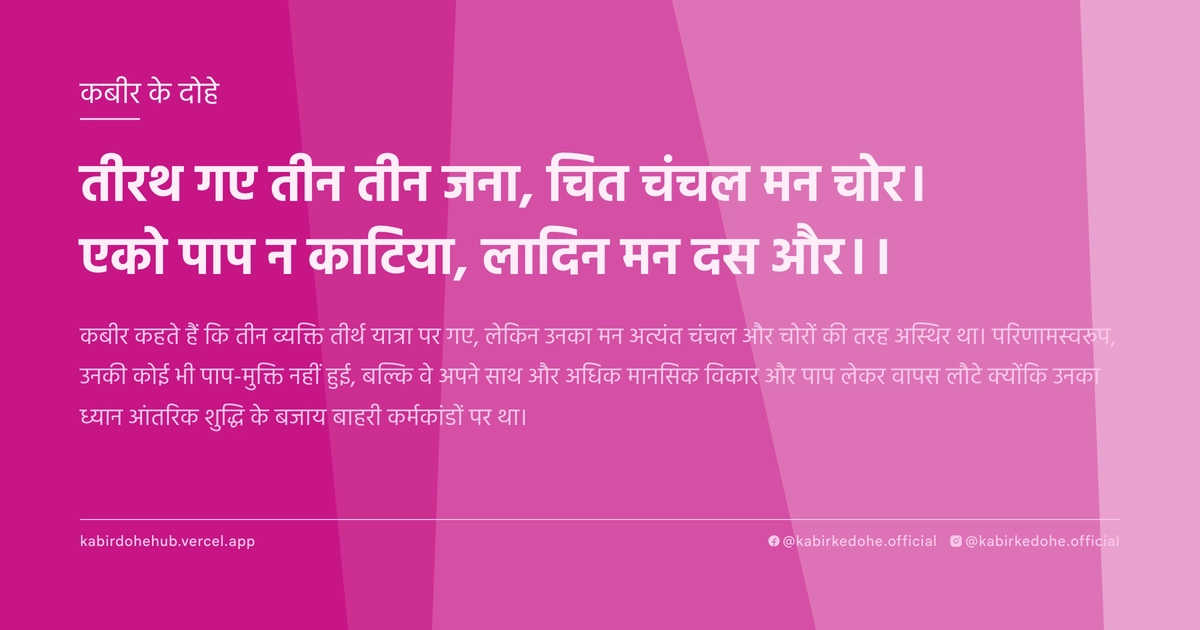
तीरथ गए तीन तीन जना, चित चंचल मन चोर।
एको पाप न काटिया, लादिन मन दस और।।
Teerath gaye teen teen jana, chit chanchal man chor. Eko paap na kaatiya, ladin man das aur.
इस पृष्ठ पर इस कबीर दोहे का अर्थ (meaning), हिंदी व्याख्या और अंग्रेज़ी अनुवाद, दार्शनिक विश्लेषण और व्यावहारिक जीवन सीख दी गई है। यह दोहा धार्मिक पाखंड (Religious Hypocrisy) विषय से जुड़ा है — Kabir doha meaning and explanation in Hindi and English.
अर्थ (Meaning):
कबीर कहते हैं कि तीन व्यक्ति तीर्थ यात्रा पर गए, लेकिन उनका मन अत्यंत चंचल और चोरों की तरह अस्थिर था। परिणामस्वरूप, उनकी कोई भी पाप-मुक्ति नहीं हुई, बल्कि वे अपने साथ और अधिक मानसिक विकार और पाप लेकर वापस लौटे क्योंकि उनका ध्यान आंतरिक शुद्धि के बजाय बाहरी कर्मकांडों पर था।
Kabir observes that three individuals embarked on a pilgrimage to holy sites, yet their minds remained restless and deceptive, like thieves. Consequently, not a single sin was washed away; instead, they returned burdened with ten times more mental impurities because their focus remained on external rituals rather than internal purification.
व्याख्या (Interpretation):
शाब्दिक अर्थ यह है कि केवल पवित्र स्थानों की यात्रा करने से पाप नहीं मिटते। रूपक के स्तर पर, 'तीर्थ' बाहरी दुनिया के प्रतीकों को दर्शाता है और 'चंचल मन' उस मायावी भ्रम को जो हमें सत्य से दूर रखता है। यह दोहा निर्गुण भक्ति के सिद्धांत को पुष्ट करता है कि ईश्वर किसी भौगोलिक स्थान पर नहीं, बल्कि हृदय की पवित्रता में वास करता है। जब साधक अपने अहंकार और वासनाओं को साथ लेकर तीर्थ जाता है, तो वह केवल अपनी इच्छाओं को और अधिक पुष्ट करता है। यह अद्वैत वेदांत के उस सत्य को उजागर करता है जहाँ आत्मा और ब्रह्म की एकता केवल मन के शांत होने पर ही संभव है, न कि शारीरिक विस्थापन से।
Literally, the verse asserts that visiting holy sites does not erase sins. Metaphorically, 'pilgrimage' represents external symbols of faith, while the 'restless mind' signifies the veil of Maya that obscures truth. This Doha reinforces the Nirgun Bhakti principle that the Divine resides not in a geographical location, but within the purity of the heart. When a seeker carries their ego and desires to a shrine, they merely reinforce their attachments. It highlights the Advaita Vedanta truth that the union of Atman and Brahman is achievable only through the stillness of the mind, not through physical displacement.
दार्शनिक विश्लेषण (Philosophical Analysis):
कबीर का यह दोहा उनके युग के गहरे सामाजिक और धार्मिक पाखंड पर एक प्रहार है। मध्यकालीन भारत में, तीर्थयात्रा को मोक्ष का सरल मार्ग माना जाता था, जिससे पुरोहित वर्ग का वर्चस्व बढ़ा। कबीर ने इस यांत्रिक धार्मिकता को चुनौती देते हुए तर्क दिया कि यदि मन 'चोर' है—अर्थात वह सत्य को चुराने वाला और छल करने वाला है—तो बाहरी जल में डुबकी लगाना व्यर्थ है।
दार्शनिक रूप से, यह सूफीवाद के 'नफ्स' (अहंकार) के विचार से मेल खाता है, जहाँ आंतरिक संघर्ष और आत्म-शुद्धि को बाहरी अनुष्ठानों से ऊपर रखा गया है। कबीर यहाँ 'कर्मकांड' बनाम 'साधना' के द्वंद्व को स्पष्ट करते हैं। उनके अनुसार, पाप कोई बाहरी दाग नहीं है जिसे धोया जा सके, बल्कि यह मन की एक अशुद्ध अवस्था है।
अद्वैत वेदांत के परिप्रेक्ष्य में, यह दोहा 'अविद्या' (अज्ञान) की चर्चा करता है। व्यक्ति यह भ्रम पाल लेता है कि स्थान बदलने से उसकी चेतना बदल जाएगी। वास्तव में, चेतना का रूपांतरण केवल आत्म-साक्षात्कार और साक्षी भाव से संभव है।
कबीर का दृष्टिकोण मनोवैज्ञानिक भी है। वे बताते हैं कि जब हम बाहरी समाधान खोजते हैं, तो हम अपनी आंतरिक समस्याओं से भाग रहे होते हैं। यह पलायनवाद अंततः मानसिक बोझ को बढ़ा देता है, जिसे कबीर 'लादिन मन दस और' कहते हैं।
अंततः, यह शिक्षण अहंकार के विलोपन की मांग करता है। जब तक 'मैं' (अहंकार) तीर्थ जा रहा है, तब तक वह केवल अपनी यात्रा का आनंद ले रहा है, ईश्वर का नहीं। वास्तविक तीर्थ वह है जहाँ 'मैं' समाप्त हो जाए और केवल 'वह' (परमात्मा) शेष रहे।
This Doha is a sharp critique of the social and religious hypocrisy of Kabir's era. In medieval India, pilgrimages were viewed as effortless paths to salvation, which bolstered the power of the priestly class. Kabir challenged this mechanical religiosity, arguing that if the mind is a 'thief'—deceptive and elusive—then bathing in external waters is futile.
Philosophically, this aligns with the Sufi concept of 'Nafs' (the ego), where internal struggle and purification are prioritized over external rituals. Kabir clarifies the conflict between 'ritualism' and 'true spiritual practice.' To him, sin is not an external stain to be washed away, but a corrupted state of consciousness.
From the lens of Advaita Vedanta, this verse discusses 'Avidya' (ignorance). The individual harbors the illusion that changing their physical location will alter their consciousness. In reality, the transformation of consciousness is possible only through self-realization and the state of the witness.
Kabir's approach is also psychological. He suggests that seeking external solutions is often a form of escapism from internal turmoil. This avoidance eventually increases the mental burden, which Kabir describes as returning with 'ten times more' impurities.
Ultimately, this teaching demands the annihilation of the ego. As long as the 'I' (ego) is the one visiting the shrine, it is merely indulging in a journey, not experiencing the Divine. The true pilgrimage is where the 'I' dissolves, leaving only the Universal Truth.
मूल संदेश (Core Message):
- बाहरी यात्राएं व्यर्थ हैं यदि आंतरिक यात्रा शुरू नहीं हुई।
- मन की चंचलता ही सबसे बड़ा पाप और अवरोध है।
- शुद्धि जल से नहीं, बल्कि विचार और भाव से आती है।
- ईश्वर भौगोलिक स्थानों में नहीं, शुद्ध चेतना में है।
- अहंकार का विलोपन ही वास्तविक मोक्ष का एकमात्र मार्ग है।
- External journeys are futile if the internal journey has not begun.
- The restlessness of the mind is the greatest sin and obstacle.
- Purification comes from thought and intent, not from water.
- The Divine is not in geographical locations, but in pure consciousness.
- The dissolution of ego is the only true path to liberation.
व्यावहारिक उदाहरण (Practical Example):
वाराणसी के घाटों पर रहने वाले एक वृद्ध विधवा, जानकी, का जीवन इसी द्वंद्व से घिरा था। वह पिछले बीस वर्षों से हर साल काशी, प्रयाग और गया की यात्रा करती थीं। उनका विश्वास था कि इन पवित्र स्थलों के दर्शन से उनके जीवन के सारे दुख और पूर्व जन्मों के पाप मिट जाएंगे।
जानकी का दिन सुबह चार बजे शुरू होता था। वे घंटों मंत्रोच्चार करतीं और दान-पुण्य करतीं, लेकिन उनके मन में हमेशा अपने परिवार के प्रति कड़वाहट और समाज के प्रति शिकायतें बनी रहती थीं। वे दूसरों को धर्म का उपदेश देती थीं, परंतु स्वयं के भीतर क्रोध की अग्नि जलती रहती थी।
एक बार उनकी मुलाकात एक शांत स्वभाव के फकीर से हुई। फकीर ने देखा कि जानकी गंगा में डुबकी लगाकर बाहर निकलीं, लेकिन उनके चेहरे पर शांति के बजाय एक अजीब सी बेचैनी थी। फकीर ने उनसे पूछा, 'माँ, आप इतनी यात्राएं करती हैं, फिर भी आपका मन इतना अशांत क्यों है?'
जानकी ने उत्तर दिया, 'मैं तो सारे तीर्थ कर चुकी हूँ, फिर भी शांति नहीं मिली। शायद मेरी भक्ति में कोई कमी है या मुझे और अधिक कठिन व्रत करने होंगे।'
फकीर मुस्कुराए और बोले, 'आप शरीर को तो तीर्थ ले गईं, लेकिन मन को घर पर ही छोड़ दिया। आपका मन अभी भी उन पुरानी शिकायतों के बाजार में घूम रहा है। जब तक मन चोर है, वह पवित्र जल को भी जहर बना देता है।'
यह बात जानकी के हृदय में बिजली की तरह कौंधी। उन्हें एहसास हुआ कि वे तीर्थ यात्राओं को एक 'लेन-देन' की तरह देख रही थीं—कि इतने पैसे और समय का निवेश करने पर मोक्ष मिलना ही चाहिए। यह विचार स्वयं में एक अहंकार था।
उन्होंने तय किया कि अब वे बाहर नहीं, बल्कि अपने भीतर यात्रा करेंगी। उन्होंने अपनी शिकायतों की सूची बनाई और एक-एक करके उन्हें क्षमा करना शुरू किया। उन्होंने पाया कि जिस शांति को वे हजारों मील दूर खोज रही थीं, वह उनके अपने मौन में छिपी थी।
धीरे-धीरे उनका व्यवहार बदल गया। अब वे केवल पूजा नहीं करती थीं, बल्कि दूसरों की सेवा में आनंद खोजने लगीं। उनके चेहरे की झुर्रियों में अब एक वास्तविक संतोष था, जो किसी तीर्थ के जल से नहीं, बल्कि आंतरिक शुद्धि से आया था।
जानकी ने समझा कि असली तीर्थ वह क्षण है जब मनुष्य अपने अहंकार को त्याग कर दूसरे में ईश्वर को देखता है। उनकी यात्रा अब बाहरी स्थलों से हटकर आंतरिक शांति की ओर मुड़ गई थी।
अंत में, जानकी ने अपनी सारी तीर्थ यात्राओं की सामग्री त्याग दी और केवल एक सरल मंत्र को अपनाया: 'मन को शांत करो, ईश्वर स्वयं प्रकट होगा।'
Janaki, an elderly widow living on the ghats of Varanasi, lived within this very conflict. For twenty years, she traveled annually to Kashi, Prayag, and Gaya, believing that visiting these holy sites would erase her life's sorrows and the sins of past births.
Janaki's day began at 4 AM. She spent hours chanting and donating, yet her heart remained filled with bitterness toward her family and grievances against society. She preached religion to others, while a fire of anger burned within her.
One day, she encountered a serene fakir. He noticed that after Janaki emerged from a dip in the Ganges, her face reflected a strange restlessness rather than peace. The fakir asked, 'Mother, you travel to so many shrines, yet why is your mind so unsettled?'
Janaki replied, 'I have visited every pilgrimage, yet I find no peace. Perhaps my devotion is lacking, or I must undertake more rigorous fasts.'
The fakir smiled and said, 'You took your body to the pilgrimage, but left your mind at home. Your mind is still wandering in the marketplace of old grievances. As long as the mind is a thief, it turns even holy water into poison.'
These words struck Janaki like a bolt of lightning. She realized she had viewed pilgrimages as a 'transaction'—that investing time and money should automatically yield salvation. This thought was, in itself, an act of ego.
She decided that henceforth, she would travel not outward, but inward. She listed her grievances and began the process of forgiveness. She discovered that the peace she sought thousands of miles away was hidden within her own silence.
Gradually, her behavior shifted. She no longer just performed rituals; she found joy in serving others. The wrinkles on her face now held a genuine contentment, born not of holy water, but of internal purification.
Janaki understood that the true pilgrimage is the moment a human discards the ego and sees the Divine in another. Her journey shifted from external landmarks to internal stillness.
Finally, Janaki discarded her pilgrimage gear and adopted a simple mantra: 'Quiet the mind, and the Divine will reveal itself.'
अभ्यास मार्गदर्शन (Practice Guidance):
- दैनिक आत्म-निरीक्षण: प्रतिदिन 20 मिनट मौन बैठें और देखें कि आपका मन किन विचारों की 'चोरी' कर रहा है (पुरानी यादें, भविष्य की चिंताएं)।
- साक्षी भाव का अभ्यास: जब भी क्रोध या ईर्ष्या आए, तो उसे दबाने के बजाय एक तीसरे व्यक्ति की तरह देखें और पूछें, 'यह कौन है जो क्रोध कर रहा है?'
- सेवा आधारित भक्ति: किसी मंदिर जाने के बजाय, किसी ऐसे व्यक्ति की मदद करें जो आपसे सामाजिक या आर्थिक रूप से नीचे हो, बिना किसी फल की इच्छा के।
- डायग्नोस्टिक चेकलिस्ट: क्या मैं शांति के लिए बाहरी साधनों (यात्रा, संगीत, वस्तुएं) पर निर्भर हूँ? क्या मेरी धार्मिकता दूसरों को छोटा महसूस कराती है? यदि हाँ, तो मन अभी भी 'चोर' है।
- Daily Self-Observation: Sit in silence for 20 minutes daily and observe what your mind is 'stealing' (clinging to old memories or worrying about the future).
- Practice of the Witness: Whenever anger or jealousy arises, instead of suppressing it, observe it as a third party and ask, 'Who is it that is feeling this anger?'
- Service-Based Devotion: Instead of visiting a temple, help someone socially or economically disadvantaged without any expectation of reward.
- Diagnostic Checklist: Am I relying on external means (travel, music, objects) for peace? Does my religiosity make others feel inferior? If yes, the mind is still a 'thief'.
चिंतन प्रश्न (Reflection Questions):
- मैं अपनी आध्यात्मिक पहचान को बनाए रखने के लिए किन बाहरी प्रतीकों का सहारा ले रहा हूँ?
- मेरे मन का वह 'चोर' कौन है जो मेरी वर्तमान शांति को भविष्य की चिंताओं में चुरा लेता है?
- क्या मेरी धार्मिक आस्था वास्तव में मुझे विनम्र बना रही है, या यह मेरे अहंकार को एक नया 'पवित्र' रूप दे रही है?
- यदि दुनिया के सारे मंदिर और तीर्थ कल समाप्त हो जाएं, तो क्या मेरे भीतर ईश्वर का निवास बचेगा?
- मैं किन गुप्त पूर्वाग्रहों को अपने साथ लेकर 'पवित्र' स्थानों पर जाता हूँ?
- Which external symbols am I using to sustain my spiritual identity?
- Who is the 'thief' in my mind that steals my present peace for future anxieties?
- Is my religious faith truly making me humble, or is it giving my ego a new 'holy' form?
- If all the temples and shrines in the world vanished tomorrow, would the Divine still reside within me?
- What hidden biases do I carry with me when I visit 'sacred' places?