
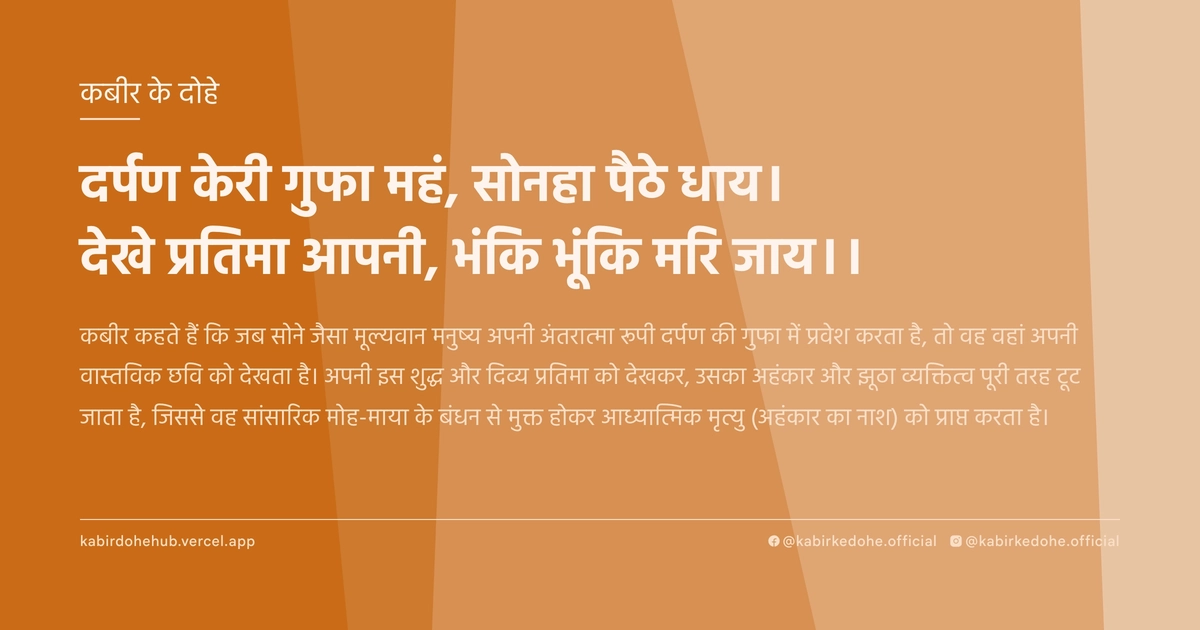
दर्पण केरी गुफा महं, सोनहा पैठे धाय।
देखे प्रतिमा आपनी, भंकि भूंकि मरि जाय।।
Darpan keri gufa mahan, sonha paithay dhay. Dekhe pratima aapni, bhanki bhunki mari jaaye.
इस पृष्ठ पर इस कबीर दोहे का अर्थ (meaning), हिंदी व्याख्या और अंग्रेज़ी अनुवाद, दार्शनिक विश्लेषण और व्यावहारिक जीवन सीख दी गई है। यह दोहा आत्मनिरीक्षण (Self-introspection) विषय से जुड़ा है — Kabir doha meaning and explanation in Hindi and English.
अर्थ (Meaning):
कबीर कहते हैं कि जब सोने जैसा मूल्यवान मनुष्य अपनी अंतरात्मा रूपी दर्पण की गुफा में प्रवेश करता है, तो वह वहां अपनी वास्तविक छवि को देखता है। अपनी इस शुद्ध और दिव्य प्रतिमा को देखकर, उसका अहंकार और झूठा व्यक्तित्व पूरी तरह टूट जाता है, जिससे वह सांसारिक मोह-माया के बंधन से मुक्त होकर आध्यात्मिक मृत्यु (अहंकार का नाश) को प्राप्त करता है।
Kabir suggests that when a precious soul, like gold, enters the cave of the mirror—the inner sanctuary of the self—they encounter their true, divine reflection. Upon seeing this authentic image, the illusory ego and the fabricated social identity shatter completely, leading to the 'death' of the false self and the awakening of the eternal spirit.
व्याख्या (Interpretation):
यहाँ 'दर्पण की गुफा' मन की उस गहराई का प्रतीक है जहाँ बाहरी शोर शांत हो जाता है। 'सोना' उस शुद्ध चेतना का प्रतीक है जो माया के आवरण में छिपी है। जब साधक आत्म-साक्षात्कार करता है, तो वह पाता है कि जिसे वह 'मैं' समझता था, वह केवल एक प्रतिबिंब था। यह अनुभव निर्गुण भक्ति के उस शिखर को दर्शाता है जहाँ आत्मा और परमात्मा का द्वैत समाप्त हो जाता है। 'भंकि भूंकि मरि जाय' का अर्थ शारीरिक मृत्यु नहीं, बल्कि अहंकार का पूर्ण विलोपन है। यह अद्वैत वेदांत के उस सत्य को उजागर करता है कि ब्रह्म ही एकमात्र सत्य है और शेष सब मिथ्या है। इस विरोधाभास में ही मुक्ति निहित है कि स्वयं को खोकर ही स्वयं को पाया जा सकता है।
The 'cave of the mirror' symbolizes the deepest recesses of the subconscious where external noise ceases. 'Gold' represents the pure, latent consciousness obscured by the veil of Maya. When the seeker achieves self-realization, they discover that the 'I' they clung to was merely a distorted reflection. This experience mirrors the peak of Nirgun Bhakti, where the duality between the soul and the Formless Divine dissolves. 'Bhanki bhunki mari jaay' does not signify physical death, but the total annihilation of the ego. It highlights the Advaita Vedanta truth that Brahman is the only reality and all else is an illusion. The central paradox is that only by losing the fabricated identity can one find the authentic Self.
दार्शनिक विश्लेषण (Philosophical Analysis):
कबीर का यह दोहा मध्यकालीन भारत के उस सामाजिक और धार्मिक संक्रमण काल की उपज है जहाँ कर्मकांड और बाहरी आडंबर चरम पर थे। कबीर ने मंदिर, मस्जिद और तीर्थों की बाहरी यात्रा के बजाय 'भीतर की यात्रा' पर बल दिया। उनका दर्शन सूफी मत के 'फना' (अहंकार का मिटना) और वेदांत के 'अहं ब्रह्मास्मि' का एक अनूठा संगम है। वे तर्क देते हैं कि जब तक मनुष्य बाहरी पहचानों—जाति, धर्म, पद—से चिपका रहता है, वह सत्य से दूर रहता है।
यहाँ 'दर्पण' का उपयोग मनोवैज्ञानिक रूपांतरण को दर्शाने के लिए किया गया है। दर्पण सत्य नहीं होता, वह केवल सत्य को दिखाता है। जब आत्मा अपने वास्तविक स्वरूप को देखती है, तो वह महसूस करती है कि उसने जीवन भर एक मुखौटे को ओढ़े रखा था। यह बोध एक तीव्र मानसिक आघात की तरह होता है, जो पुराने व्यक्तित्व को नष्ट कर देता है।
कबीर की अस्वीकृति केवल रीति-रिवाजों की नहीं, बल्कि उस 'अहंकार' की है जो रीति-रिवाजों से पुष्ट होता है। वे बताते हैं कि ईश्वर किसी बाहरी स्थान पर नहीं, बल्कि चेतना की उस गुफा में है जहाँ कोई दूसरा नहीं बचता। यह 'शून्य' की अवस्था है, जहाँ पहुँचकर साधक स्वयं को ईश्वर में विलीन पाता है।
इस विश्लेषण में यह समझना आवश्यक है कि 'मृत्यु' यहाँ एक सकारात्मक परिवर्तन है। यह उस बीज की मृत्यु है जो वृक्ष बनने के लिए अनिवार्य है। यदि अहंकार नहीं मरता, तो सत्य का उदय नहीं हो सकता। कबीर यहाँ एक आध्यात्मिक शल्य चिकित्सा (spiritual surgery) की बात कर रहे हैं जहाँ अज्ञान का ट्यूमर काटकर अलग किया जाता है।
अंततः, यह दोहा हमें सिखाता है कि आत्म-ज्ञान कोई बौद्धिक उपलब्धि नहीं है, बल्कि एक अनुभवजन्य विखंडन है। यह वह क्षण है जब व्यक्ति यह जान लेता है कि वह शरीर नहीं, बल्कि वह अनंत प्रकाश है जो शरीर के माध्यम से स्वयं को देख रहा है।
This couplet emerges from the socio-religious turbulence of medieval India, a time dominated by rigid rituals and external piety. Kabir emphasizes the 'inward journey' over the outward pilgrimage to temples, mosques, or shrines. His philosophy is a sophisticated synthesis of the Sufi concept of 'Fana' (annihilation of the self) and the Vedantic realization of 'Aham Brahmasmi' (I am Brahman).
He argues that as long as a human clings to external identities—caste, creed, or status—they remain estranged from the Truth. The 'mirror' serves as a psychological tool for transformation. A mirror is not the truth itself, but a medium that reveals it. When the soul perceives its authentic nature, it realizes that it has spent a lifetime wearing a mask.
Kabir's rejection is not merely of rituals, but of the ego that these rituals often reinforce. He posits that the Divine resides not in a distant heaven, but in the cave of consciousness where the 'other' ceases to exist. This is the state of 'Shunya' (Void), where the seeker merges into the Formless.
It is crucial to understand that 'death' in this context is a positive transmutation. It is the death of the seed, which is prerequisite for the growth of the tree. Without the annihilation of the ego, the dawn of truth is impossible. Kabir describes a form of spiritual surgery where the tumor of ignorance is excised.
Ultimately, this Doha teaches that self-knowledge is not an intellectual achievement but an experiential fragmentation. It is the precise moment when the individual realizes they are not the physical vessel, but the infinite light observing itself through that vessel.
मूल संदेश (Core Message):
- बाहरी पहचान एक भ्रम है, आंतरिक सत्य ही एकमात्र वास्तविकता है।
- अहंकार का विनाश ही वास्तविक आध्यात्मिक जन्म है।
- सत्य को जानने के लिए पहले झूठ (झूठे मैं) को मरना होगा।
- ईश्वर कोई व्यक्ति नहीं, बल्कि स्वयं की शुद्धतम छवि है।
- मौन और आत्म-निरीक्षण ही वह द्वार है जो दर्पण की गुफा तक ले जाता है।
- जब 'मैं' मिटता है, तब 'सब' प्रकट होते हैं।
- External identity is an illusion; inner truth is the only reality.
- The annihilation of the ego is the only true spiritual birth.
- To know the Truth, the lie (the false self) must first perish.
- The Divine is not a person, but the purest reflection of one's own self.
- Silence and introspection are the only gateways to the cave of the mirror.
- When the 'I' vanishes, the 'All' manifests.
व्यावहारिक उदाहरण (Practical Example):
वाराणसी के घाटों पर रहने वाला एक वृद्ध विधवा, जिसे समाज ने 'अशुभ' मानकर हाशिए पर धकेल दिया था, अपना पूरा जीवन दूसरों की सेवा और मौन प्रार्थनाओं में बिताती थी। वह स्वयं को तुच्छ और पापमय मानती थी क्योंकि उसे बचपन से यही सिखाया गया था कि उसकी स्थिति उसकी नियति है।
एक दिन, वह एक शांत कोने में बैठकर गंगा की लहरों को देख रही थी। उसने महसूस किया कि उसकी पीड़ा और उसका अकेलापन वास्तव में उसे एक ऐसी शांति की ओर ले जा रहे हैं जहाँ दुनिया की कोई भी परिभाषा उसे छू नहीं सकती।
उसने अपनी आँखें बंद कीं और अपने भीतर झाँका। उसने पाया कि वह 'विधवा' नहीं है, न ही वह 'अशुभ' है; वह केवल एक शुद्ध चेतना है जो इस शरीर और इस सामाजिक पहचान के पीछे छिपी है।
यह अनुभव उसके लिए उस 'दर्पण की गुफा' में प्रवेश करने जैसा था। उसने देखा कि जिस दुख को वह अपना अस्तित्व मानती थी, वह केवल एक बाहरी आवरण था।
अचानक, उसके भीतर का वह डर, जो समाज द्वारा थोपा गया था, पूरी तरह टूट गया। वह 'भंकि भूंकि' हो गई—उसका वह पुराना व्यक्तित्व, जो खुद को पीड़ित मानता था, मर गया।
अब वह घाटों पर चलती तो थी, लेकिन उसके चेहरे पर एक ऐसी मुस्कान थी जिसे दुनिया समझ नहीं पाती थी। वह अब दूसरों की सेवा इसलिए नहीं करती थी क्योंकि वह 'बेचारी' थी, बल्कि इसलिए क्योंकि वह सबको अपना ही विस्तार मानती थी।
उसने पाया कि जब उसने अपनी सामाजिक पहचान की मृत्यु को स्वीकार किया, तो वह वास्तव में जीवित हो गई।
उसका जीवन अब एक जीवित उदाहरण था कि कैसे आंतरिक सत्य बाहरी दुनिया के सारे लेबल और अपमानों को अर्थहीन कर देता है।
वह अब किसी मंदिर की शरण नहीं खोजती थी, क्योंकि उसने अपने भीतर ही उस अनंत दर्पण को पा लिया था।
उसकी यह रूपांतरण यात्रा यह सिद्ध करती है कि मुक्ति किसी बाहरी स्थिति के बदलने से नहीं, बल्कि आंतरिक पहचान के विखंडन से आती है।
An elderly widow living on the ghats of Varanasi, marginalized by society as 'inauspicious,' spent her entire life in silent prayer and service to others. She viewed herself as insignificant and tainted, having been taught since childhood that her social status was her destiny.
One day, while sitting in a quiet corner watching the ripples of the Ganges, she realized that her grief and loneliness were actually leading her toward a peace that no worldly definition could touch.
Closing her eyes, she peered deep within. She discovered that she was not a 'widow,' nor was she 'inauspicious'; she was simply a pure consciousness hiding behind this body and social label.
This experience was like entering the 'cave of the mirror.' She saw that the suffering she had mistaken for her identity was merely an outer shell.
Suddenly, the fear imposed upon her by society shattered completely. She underwent that 'bhanki bhunki'—the old personality that saw itself as a victim died.
She continued to walk the ghats, but with a smile that the world could not comprehend. She no longer served others because she felt 'pitiful,' but because she saw everyone as an extension of herself.
She found that by accepting the death of her social identity, she had truly come alive for the first time.
Her life became a living testament to how inner truth renders all external labels and insults meaningless.
She no longer sought refuge in any temple, for she had found the infinite mirror within her own heart.
Her journey of transformation proves that liberation comes not from changing external circumstances, but from the fragmentation of the internal false identity.
अभ्यास मार्गदर्शन (Practice Guidance):
- प्रतिदिन 20 मिनट 'साक्षी भाव' का अभ्यास करें: अपने विचारों को ऐसे देखें जैसे आप किसी दर्पण में किसी अजनबी को देख रहे हों।
- आत्म-पूछताछ जर्नल: प्रतिदिन लिखें—'मैं कौन हूँ?' और हर उस उत्तर को काट दें जो आपकी सामाजिक, पारिवारिक या शारीरिक पहचान से जुड़ा हो।
- मौन व्रत: सप्ताह में एक बार कुछ घंटों के लिए पूर्ण मौन धारण करें ताकि बाहरी शोर कम हो और 'भीतर की गुफा' सुनाई दे।
- निदान चेकलिस्ट: क्या मैं अभी भी अपनी गलतियों या उपलब्धियों पर गर्व/दुख कर रहा हूँ? यदि हाँ, तो मेरा अहंकार अभी जीवित है। क्या मैं दूसरों को उनकी पहचान से देख रहा हूँ? यदि हाँ, तो मैं अभी भी दर्पण के बाहर हूँ।
- Practice 'Witness Consciousness' for 20 minutes daily: Observe your thoughts as if you are watching a stranger in a mirror.
- Self-Inquiry Journaling: Write 'Who am I?' daily, and cross out every answer linked to social, familial, or physical identity.
- Vow of Silence: Observe complete silence for a few hours once a week to quiet the external noise and hear the 'inner cave.'
- Diagnostic Checklist: Am I still feeling pride or grief over my achievements/failures? If yes, the ego is still alive. Am I seeing others through their labels? If yes, I am still outside the mirror.
चिंतन प्रश्न (Reflection Questions):
- यदि आपकी सारी डिग्रियां, पद और पारिवारिक रिश्ते छीन लिए जाएं, तो आपके पास क्या बचेगा?
- आप दुनिया को जो चेहरा दिखाते हैं, वह आपके वास्तविक स्वरूप से कितना अलग है?
- क्या आप अपनी 'छवि' (Image) को बचाने के लिए अपने 'सत्य' (Truth) की बलि दे रहे हैं?
- वह कौन सा डर है जो आपको अपने भीतर की गुफा में उतरने से रोकता है?
- क्या आप वास्तव में मुक्त होना चाहते हैं, या आप केवल अपनी वर्तमान पहचान के भीतर एक 'बेहतर' संस्करण बनना चाहते हैं?
- जब आप अकेले होते हैं, तब आप वास्तव में कौन होते हैं, बिना किसी दर्शक के?
- If all your degrees, titles, and family ties were stripped away, what would remain of you?
- How different is the face you show the world from your actual internal nature?
- Are you sacrificing your 'Truth' to protect your 'Image'?
- What is the specific fear that prevents you from descending into your inner cave?
- Do you truly desire liberation, or do you simply want to become a 'better' version of your current identity?
- Who are you truly when you are alone, with no audience to perform for?