
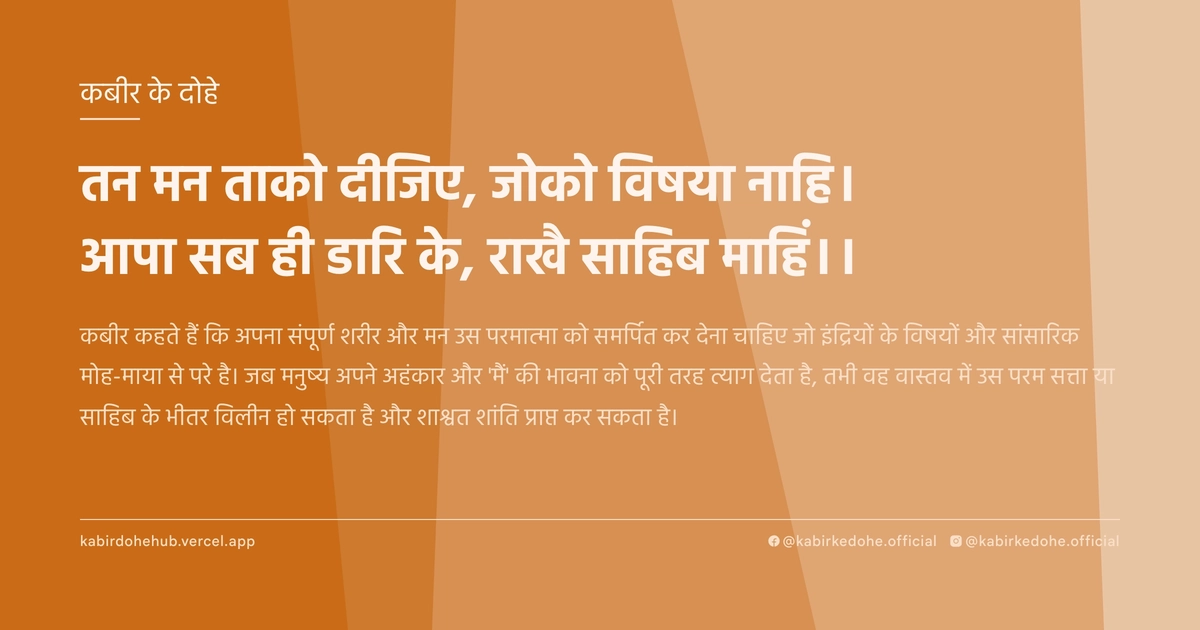
तन मन ताको दीजिए, जोको विषया नाहि।
आपा सब ही डारि के, राखै साहिब माहिं।।
Tan man taako deeje, joko vishaya nahi. Aapa sab hi daari ke, raakhe sahib mahin.
इस पृष्ठ पर इस कबीर दोहे का अर्थ (meaning), हिंदी व्याख्या और अंग्रेज़ी अनुवाद, दार्शनिक विश्लेषण और व्यावहारिक जीवन सीख दी गई है। यह दोहा प्रपत्ति (Surrender) विषय से जुड़ा है — Kabir doha meaning and explanation in Hindi and English.
अर्थ (Meaning):
कबीर कहते हैं कि अपना संपूर्ण शरीर और मन उस परमात्मा को समर्पित कर देना चाहिए जो इंद्रियों के विषयों और सांसारिक मोह-माया से परे है। जब मनुष्य अपने अहंकार और 'मैं' की भावना को पूरी तरह त्याग देता है, तभी वह वास्तव में उस परम सत्ता या साहिब के भीतर विलीन हो सकता है और शाश्वत शांति प्राप्त कर सकता है।
Kabir exhorts the seeker to surrender their entire physical existence and mental faculty to the Divine, who exists beyond the reach of sensory desires and worldly attachments. Only by completely discarding the 'I-ness' or the ego can one truly merge into the presence of the Master (Sahib), achieving a state of eternal union and liberation from the cycle of suffering.
व्याख्या (Interpretation):
इस दोहे का शाब्दिक अर्थ समर्पण है, लेकिन इसका गहरा आध्यात्मिक अर्थ 'अद्वैत' की स्थिति है। 'विषया नाहि' का अर्थ है कि ईश्वर किसी भौतिक वस्तु या मानवीय इच्छा का विषय नहीं है, बल्कि वह शुद्ध चेतना है। जब कबीर 'आपा' (अहंकार) को डारने की बात करते हैं, तो वे उस सूक्ष्म पर्दे की बात कर रहे हैं जो आत्मा को ब्रह्म से अलग दिखाता है। यह निरगुण भक्ति का सार है, जहाँ ईश्वर किसी मूर्ति में नहीं बल्कि स्वयं के भीतर शून्य होकर खोजा जाता है। यहाँ विरोधाभास यह है कि स्वयं को पूरी तरह खोकर ही वास्तव में स्वयं को पाया जा सकता है। यह प्रक्रिया माया के भ्रम को नष्ट करने की है, जहाँ व्यक्ति यह समझता है कि शरीर नश्वर है और केवल आत्मा ही शाश्वत है। अंततः, यह आत्मा का परमात्मा में विलीनीकरण है।
Literally, this couplet speaks of surrender, but metaphorically, it describes the state of Advaita (non-duality). The phrase 'joko vishaya naahi' signifies that the Divine is not an object of sensory perception or desire, but is Pure Consciousness itself. When Kabir speaks of discarding 'Aapa' (the ego), he refers to the subtle veil of separation that creates the illusion of a distinct self apart from the Brahman. This is the essence of Nirgun Bhakti, where the formless Divine is found not in external idols, but within the void created by the absence of ego. The central paradox here is that only by completely losing the self can one truly find the Self. This process involves dismantling the constructs of Maya, recognizing that the physical body is transient while the Atman is eternal. Ultimately, it is the dissolution of the drop into the ocean of existence.
दार्शनिक विश्लेषण (Philosophical Analysis):
कबीर का यह दर्शन 15वीं शताब्दी के सामाजिक और धार्मिक परिवेश में एक क्रांतिकारी कदम था। उस समय धर्म कर्मकांडों, बाहरी दिखावे और जातिगत श्रेष्ठता में जकड़ा हुआ था। कबीर ने इन सबको नकारते हुए 'सहज' मार्ग की बात की। उनका यह दोहा सीधे तौर पर इस विचार पर प्रहार करता है कि ईश्वर को बाहरी पूजा या तीर्थयात्रा से पाया जा सकता है। वे बताते हैं कि असली बाधा 'आपा' यानी अहंकार है, जो मनुष्य को उसकी वास्तविक प्रकृति से दूर रखता है।
दार्शनिक रूप से, यह अद्वैत वेदांत के करीब है, जहाँ जीव और ब्रह्म की एकता पर बल दिया गया है। कबीर का 'साहिब' कोई बाहरी व्यक्ति नहीं, बल्कि वह सार्वभौमिक चेतना है जो हर कण में व्याप्त है। सूफी मत के 'फना' (स्वयं का विनाश) की अवधारणा यहाँ स्पष्ट दिखती है, जहाँ साधक अपनी व्यक्तिगत पहचान को ईश्वर की इच्छा में विलीन कर देता है। यह केवल धार्मिक समर्पण नहीं, बल्कि एक मनोवैज्ञानिक रूपांतरण है।
यहाँ 'विषय' का त्याग केवल इंद्रियों के दमन के बारे में नहीं है, बल्कि उनके प्रति आसक्ति के अंत के बारे में है। जब हम किसी वस्तु को चाहते हैं, तो हम एक विभाजन पैदा करते हैं—'मैं' और 'वह'। यह विभाजन ही दुख का मूल कारण है। कबीर का सुझाव है कि इस विभाजन को मिटाकर ही पूर्णता प्राप्त की जा सकती है।
कबीर की दृष्टि में, जाति और धर्म के बंधन भी 'आपा' के ही विस्तार हैं। जब कोई व्यक्ति कहता है कि 'मैं इस जाति का हूँ' या 'मैं इस धर्म का हूँ', तो वह वास्तव में अपने अहंकार को एक नया लेबल दे रहा होता है। इस लेबल को हटाना ही वास्तविक मुक्ति है।
अंततः, यह दोहा हमें सिखाता है कि आध्यात्मिक यात्रा बाहर से भीतर की ओर है। यह बाहरी दुनिया के शोर को शांत कर उस आंतरिक मौन को सुनने की प्रक्रिया है जहाँ केवल 'साहिब' का वास है। यह एक ऐसी स्थिति है जहाँ कर्ता (doer) समाप्त हो जाता है और केवल क्रिया (action) शेष रहती है, जो दैवीय इच्छा द्वारा संचालित होती है।
Kabir's philosophy was a revolutionary intervention in the 15th-century socio-religious landscape, a time when spirituality was stifled by rigid rituals, outward displays of piety, and caste hierarchies. This couplet directly challenges the notion that the Divine can be accessed through external rites or pilgrimages. Instead, Kabir identifies the primary obstacle as 'Aapa'—the ego—which creates a perceived distance between the seeker and the Truth.
Philosophically, this aligns closely with Advaita Vedanta, emphasizing the fundamental oneness of the Jiva (individual soul) and Brahman (universal soul). Kabir's 'Sahib' is not a distant deity but the omnipresent consciousness residing within every atom. The Sufi concept of 'Fana' (annihilation of the self) is vividly present here, where the practitioner dissolves their individual identity into the Divine Will. This is not merely religious submission but a profound psychological transformation.
The rejection of 'Vishaya' (sensory objects) is not an advocacy for ascetic suppression, but for the cessation of attachment. When we desire, we create a duality—the 'I' and the 'Other.' This duality is the root of all human suffering. Kabir suggests that by erasing this boundary, one attains wholeness.
In Kabir's vision, caste and religious identities are merely extensions of the ego. When a person claims a specific caste or creed, they are simply labeling their ego. Removing these labels is the only path to true liberation. The struggle is not against the world, but against the illusion of being a separate entity from the whole.
Ultimately, this teaching directs the spiritual journey from the periphery to the center. It is a process of silencing the external noise to hear the internal silence where the 'Sahib' resides. It describes a state where the 'doer' vanishes, and only the Divine Action remains, flowing through the instrument of the human body without the interference of personal pride.
मूल संदेश (Core Message):
- अहंकार वह पर्दा है जो ईश्वर और आत्मा के बीच खड़ा है।
- सच्ची भक्ति बाहरी अनुष्ठानों में नहीं, बल्कि आंतरिक शून्य में है।
- जब 'मैं' मिटता है, तभी 'वह' प्रकट होता है।
- इंद्रियों के विषयों से परे जाना ही वास्तविक स्वतंत्रता है।
- समर्पण का अर्थ है स्वयं को परमात्मा के उपकरण के रूप में देखना।
- The ego is the only veil separating the soul from the Divine.
- True devotion lies not in rituals, but in the internal void of the self.
- When the 'I' vanishes, the 'He' (Universal Truth) manifests.
- Transcending sensory attachments is the only path to absolute freedom.
- Surrender means viewing oneself as a mere instrument of the Divine.
व्यावहारिक उदाहरण (Practical Example):
एक समय की बात है, वाराणसी के एक पुराने मोहल्ले में माधव नाम का एक बुनकर रहता था। माधव अपने काम में निपुण था, लेकिन उसका अहंकार उससे भी बड़ा था। वह मानता था कि उसके द्वारा बुने गए वस्त्र पूरे शहर में सबसे श्रेष्ठ हैं और वह अपनी कला के कारण स्वयं को दूसरों से ऊपर समझता था। वह अक्सर अन्य बुनकरों का उपहास करता और अपनी श्रेष्ठता का प्रदर्शन करता था।
एक दिन, उसके जीवन में एक वृद्ध सन्यासी आए। सन्यासी ने माधव के वस्त्रों की प्रशंसा की, लेकिन फिर एक प्रश्न पूछा, 'माधव, इस सुंदर कपड़े को बुनने वाला कौन है—तुम, या वह कौशल जो तुम्हारे भीतर है?' माधव ने गर्व से कहा, 'मैं हूँ, मेरी मेहनत और मेरी बुद्धि है।' सन्यासी मुस्कुराए और बोले, 'तुम तो केवल एक माध्यम हो। जिस तरह धागा खुद नहीं जानता कि वह क्या बनेगा, वैसे ही तुम भी उस महान बुनकर के हाथ की एक कठपुतली हो। तुम्हारा 'मैं' ही तुम्हारी सबसे बड़ी बाधा है।'
माधव को पहले तो यह बात चुभी, लेकिन सन्यासी के शब्दों ने उसके भीतर एक हलचल पैदा कर दी। उसने गौर किया कि उसकी श्रेष्ठता की भावना ने उसे अकेला कर दिया था। उसके साथी उससे दूर हो गए थे और उसके मन में हमेशा एक अनजाना तनाव रहता था। उसने महसूस किया कि वह अपनी कला से प्रेम नहीं करता था, बल्कि उस प्रशंसा से प्रेम करता था जो उसे उस कला के कारण मिलती थी।
अगले कुछ महीनों तक, माधव ने एक प्रयोग किया। उसने तय किया कि वह हर वस्त्र को इस भाव से बुनेगा कि वह उसे किसी महान शक्ति के लिए बना रहा है, न कि अपने नाम के लिए। जब भी उसके मन में यह विचार आता कि 'देखो मैं कितना कुशल हूँ', वह तुरंत अपनी आँखें बंद करता और मन ही मन कहता, 'यह मैं नहीं, वह साहिब है जो मेरे हाथों से काम करवा रहा है।'
धीरे-धीरे, उसका व्यवहार बदलने लगा। उसने अपनी कला का उपयोग गरीबों को मुफ्त कपड़े देने के लिए करना शुरू किया। अब वह अपनी श्रेष्ठता का ढिंढोरा नहीं पीटता था, बल्कि विनम्रता से दूसरों की मदद करता था। उसके चेहरे पर एक ऐसी शांति आ गई जो पहले कभी नहीं थी।
एक दिन, एक बहुत बड़े व्यापारी ने उसके काम की भारी कीमत देने की पेशकश की। पुराने माधव ने इसे अपनी जीत माना होता, लेकिन नए माधव ने उस धन का एक बड़ा हिस्सा सामुदायिक कुएं की मरम्मत में लगा दिया। उसने महसूस किया कि जब उसने 'आपा' (अहंकार) को छोड़ा, तो उसे एक ऐसी खुशी मिली जो किसी भी प्रशंसा या धन से कहीं अधिक थी।
उसके साथी बुनकर, जो कभी उससे नफरत करते थे, अब उसके पास सलाह और प्रेम के लिए आने लगे। माधव ने पाया कि जब उसने खुद को 'बड़ा' समझना बंद किया, तो वह वास्तव में सबके साथ जुड़ गया।
माधव की कहानी हमें सिखाती है कि समर्पण का अर्थ अपनी क्षमता को खोना नहीं है, बल्कि उस क्षमता के साथ जुड़े अहंकार को मिटाना है। जब हम स्वयं को एक माध्यम मान लेते हैं, तो हमारा जीवन एक साधना बन जाता है और हम उस 'साहिब' के साथ एकाकार हो जाते हैं।
Once, in an old neighborhood of Varanasi, lived a weaver named Madhav. Madhav was exceptionally skilled in his craft, but his ego was even larger than his talent. He believed the fabrics he wove were the finest in the city and viewed himself as superior to all other artisans. He often mocked his peers, basking in the admiration of his clients.
One day, an elderly monk visited his workshop. The monk praised the beauty of the fabric but asked a piercing question: 'Madhav, who is the true weaver of this cloth—you, or the skill that flows through you?' Madhav replied with pride, 'It is I; it is my hard work and my intellect.' The monk smiled and said, 'You are merely an instrument. Just as the thread does not know what it will become, you are but a puppet in the hands of the Great Weaver. Your "I" is your greatest obstacle.'
Initially, Madhav felt offended, but the monk's words sparked a restlessness within him. He realized that his sense of superiority had isolated him. His colleagues avoided him, and he lived in a state of constant, underlying tension. He understood that he didn't actually love the art of weaving; he loved the praise he received for it.
For the next few months, Madhav conducted an experiment. He decided to weave every piece of cloth with the feeling that he was creating it for a higher power, not for his own fame. Whenever the thought 'Look how skilled I am' surfaced, he would close his eyes and whisper, 'This is not me; it is the Sahib working through my hands.'
Slowly, his behavior transformed. He began using his skill to provide free clothing to the poor. He stopped boasting and started helping others with genuine humility. A profound peace settled over his countenance, a serenity he had never known before.
One day, a wealthy merchant offered him a staggering sum for his work. The old Madhav would have seen this as a personal victory, but the new Madhav donated a large portion of the money to repair the community well. He discovered that by letting go of 'Aapa' (ego), he found a joy far deeper than any monetary gain or public acclaim.
His fellow weavers, who once resented him, began to seek his guidance and friendship. Madhav realized that when he stopped trying to be 'big,' he finally became connected to everyone.
Madhav's story teaches us that surrender is not about losing one's capability, but about erasing the ego attached to that capability. When we view ourselves as a medium, our life becomes a spiritual practice, and we merge with the 'Sahib' in every action.
अभ्यास मार्गदर्शन (Practice Guidance):
- दैनिक अभ्यास: प्रतिदिन 20 मिनट मौन बैठें और अपने भीतर उठने वाले 'मैं' (अहंकार) के विचारों को केवल एक साक्षी की तरह देखें, बिना किसी निर्णय के।
- आत्म-पूछताछ जर्नल: हर रात लिखें कि आज दिन भर में कितनी बार आपने 'मैं' या 'मेरा' शब्द का प्रयोग किया और वह किस भावना (गर्व, क्रोध या असुरक्षा) से प्रेरित था।
- व्यवहार परिवर्तन: दिन में कम से कम एक ऐसा कार्य करें जिसका श्रेय आप किसी और को दें या जिसे पूरी तरह गुप्त रखें, ताकि प्रशंसा की भूख समाप्त हो सके।
- डायग्नोस्टिक चेकलिस्ट: यदि आप किसी की आलोचना पर क्रोधित होते हैं या अपनी उपलब्धि पर अत्यधिक गर्व महसूस करते हैं, तो समझें कि 'आपा' अभी भी हावी है। यदि आप दूसरों की सफलता में अपनी खुशी पाते हैं, तो आप समर्पण के मार्ग पर हैं।
- Daily Practice: Spend 20 minutes in silence daily, observing the thoughts of 'I' (ego) as a witness, without judgment or attachment.
- Self-Inquiry Journal: Every night, record the instances where you used the words 'I' or 'Mine' and analyze the underlying emotion—whether it was pride, anger, or insecurity.
- Behavioral Shift: Perform at least one act of kindness daily that you keep completely secret or attribute to someone else, specifically to starve the hunger for validation.
- Diagnostic Checklist: If you feel anger at criticism or excessive pride in achievement, recognize that 'Aapa' is still dominant. If you find genuine joy in others' success, you are aligning with the path of surrender.
चिंतन प्रश्न (Reflection Questions):
- मेरी वह कौन सी पहचान है जिसे मैं सबसे अधिक सहेज कर रखता हूँ, और यदि वह छीन ली जाए, तो क्या मैं वास्तव में 'मैं' रहूँगा?
- क्या मेरी धार्मिक या आध्यात्मिक मान्यताएँ मुझे दूसरों से बेहतर महसूस कराने का एक सूक्ष्म तरीका हैं?
- डिजिटल युग में, मेरी सोशल मीडिया प्रोफाइल मेरे 'आपा' (अहंकार) को कैसे पोषित कर रही है?
- क्या मैं वास्तव में ईश्वर की इच्छा चाहता हूँ, या मैं चाहता हूँ कि ईश्वर मेरी इच्छाओं को पूरा करे?
- मेरे जीवन का वह कौन सा क्षेत्र है जहाँ मैं अभी भी पूरी तरह नियंत्रण चाहता हूँ और समर्पण से डरता हूँ?
- Which identity do I cling to most fiercely, and if it were stripped away, would any 'I' actually remain?
- Are my religious or spiritual beliefs merely a subtle tool to make me feel superior to others?
- In this digital age, how does my social media persona nourish and amplify my 'Aapa' (ego)?
- Do I truly desire the Will of the Divine, or do I simply want the Divine to fulfill my personal desires?
- In which area of my life am I still desperately clinging to control, fearing the vulnerability of total surrender?