
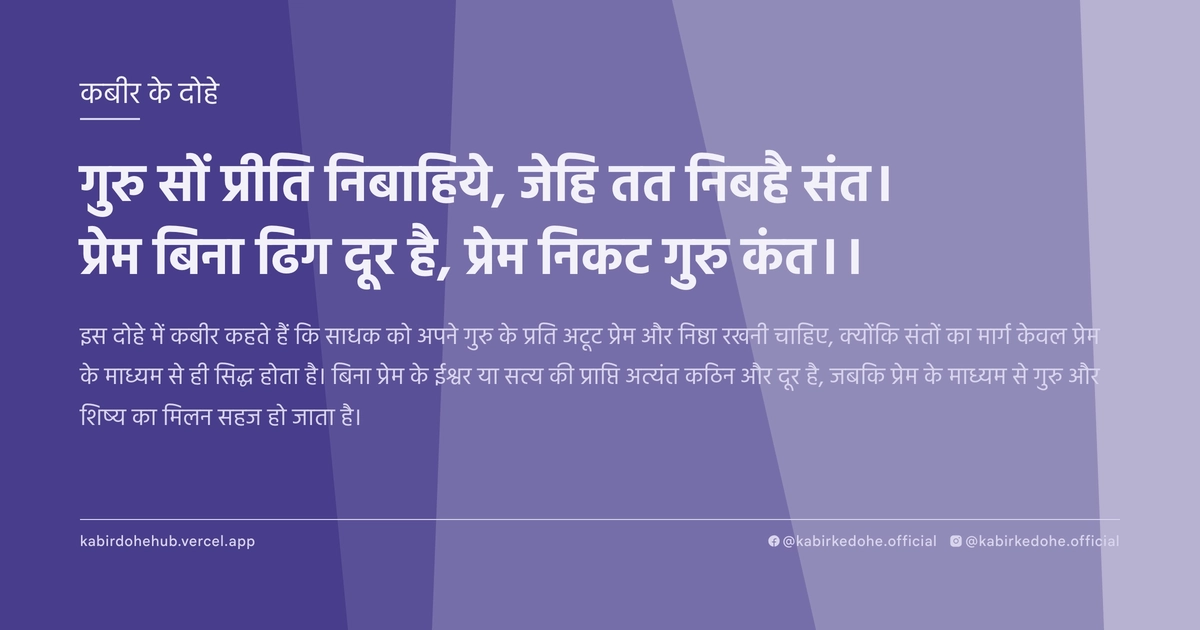
गुरु सों प्रीति निबाहिये, जेहि तत निबहै संत।
प्रेम बिना ढिग दूर है, प्रेम निकट गुरु कंत।।
Guru son preeti nibahiye, jehi tat nibahai sant. Prem bina dhig door hai, prem nikat guru kant.
इस पृष्ठ पर इस कबीर दोहे का अर्थ (meaning), हिंदी व्याख्या और अंग्रेज़ी अनुवाद, दार्शनिक विश्लेषण और व्यावहारिक जीवन सीख दी गई है। यह दोहा गुरु महत्व (The Guru's Importance) विषय से जुड़ा है — Kabir doha meaning and explanation in Hindi and English.
अर्थ (Meaning):
इस दोहे में कबीर कहते हैं कि साधक को अपने गुरु के प्रति अटूट प्रेम और निष्ठा रखनी चाहिए, क्योंकि संतों का मार्ग केवल प्रेम के माध्यम से ही सिद्ध होता है। बिना प्रेम के ईश्वर या सत्य की प्राप्ति अत्यंत कठिन और दूर है, जबकि प्रेम के माध्यम से गुरु और शिष्य का मिलन सहज हो जाता है।
In this couplet, Kabir emphasizes that a seeker must maintain an unwavering bond of love and devotion toward their Guru, as the path of the saints is navigated solely through love. Without love, the ultimate truth remains distant and unattainable, but through love, the union between the disciple and the enlightened master becomes immediate and effortless.
व्याख्या (Interpretation):
शाब्दिक अर्थ यह है कि गुरु के साथ प्रेम का संबंध बनाए रखें। आध्यात्मिक स्तर पर, यहाँ 'गुरु' केवल एक व्यक्ति नहीं, बल्कि वह चेतना है जो अज्ञान के अंधकार को मिटाती है। यह दोहा निर्गुण भक्ति की उस धारा को दर्शाता है जहाँ बाहरी कर्मकांडों के बजाय आंतरिक भाव को प्रधानता दी गई है। माया हमें भ्रमित करती है कि ज्ञान केवल ग्रंथों से आता है, परंतु कबीर स्पष्ट करते हैं कि ज्ञान का वास्तविक हस्तांतरण केवल प्रेम के माध्यम से होता है। यह अद्वैत वेदांत के उस सिद्धांत से जुड़ा है जहाँ गुरु और शिष्य के बीच का द्वैत समाप्त हो जाता है। जब अहंकार मिटता है, तब केवल प्रेम शेष रहता है, जो आत्मा को परमात्मा से जोड़ता है।
Literally, the verse urges the maintenance of a loving relationship with the Guru. On a spiritual plane, the 'Guru' is not merely a physical person but the awakened consciousness that dispels the darkness of ignorance. This doha reflects the essence of Nirgun Bhakti, prioritizing internal devotion over external rituals. Maya creates the illusion that enlightenment is a product of intellectual study, but Kabir asserts that true wisdom is transmitted only through the medium of love. This aligns with Advaita Vedanta, where the duality between the teacher and the taught dissolves. When the ego is annihilated, only love remains, serving as the bridge connecting the Atman to the Brahman.
दार्शनिक विश्लेषण (Philosophical Analysis):
कबीर का यह दृष्टिकोण उनके युग के कट्टरपंथ और शुष्क बौद्धिकवाद के विरुद्ध एक विद्रोह था। उस समय धर्म केवल नियमों, जातियों और बाहरी दिखावे तक सीमित था। कबीर ने 'प्रेम' को सर्वोच्च साधन मानकर धर्म का लोकतंत्रीकरण किया। उनके लिए प्रेम कोई सांसारिक भावना नहीं, बल्कि एक आध्यात्मिक अग्नि है जो शिष्य के अहंकार को जलाकर राख कर देती है।
यह दर्शन सूफीवाद के 'इश्क-ए-हकीकी' (ईश्वरीय प्रेम) से गहराई से मेल खाता है, जहाँ प्रेमी और प्रियतम का भेद मिट जाता है। कबीर का तर्क है कि बिना प्रेम के ज्ञान केवल अहंकार को बढ़ाता है; एक विद्वान व्यक्ति यदि अहंकारी है, तो वह सत्य से और दूर हो जाता है। प्रेम ही वह कुंजी है जो हृदय के कपाट खोलती है।
अद्वैत वेदांत के संदर्भ में, गुरु वह दर्पण है जिसमें शिष्य अपनी वास्तविक स्वरूप को देखता है। यदि शिष्य के मन में प्रेम नहीं है, तो वह दर्पण में केवल अपनी त्रुटियाँ देखेगा, सत्य नहीं। प्रेम यहाँ समर्पण का पर्याय है, जो 'मैं' को 'तू' में विलीन कर देता है।
कबीर ritualism (कर्मकांड) का विरोध करते हुए कहते हैं कि मंदिर, मस्जिद या तीर्थयात्राएँ तब तक व्यर्थ हैं जब तक हृदय में प्रेम का वास न हो। उनके लिए गुरु की प्रीति का अर्थ है—गुरु के शब्दों को केवल सुनना नहीं, बल्कि उन्हें अपने जीवन में उतारना।
अंततः, यह विश्लेषण हमें बताता है कि आध्यात्मिक प्रगति का पैमाना ज्ञान की मात्रा नहीं, बल्कि प्रेम की गहराई है। जब प्रेम परिपक्व होता है, तो साधक को अनुभव होता है कि जिसे वह बाहर खोज रहा था, वह उसके भीतर ही है, और गुरु केवल उस मार्ग का संकेत मात्र थे।
Kabir's perspective was a profound rebellion against the rigid orthodoxy and dry intellectualism of his era. During his time, religion was confined to rules, caste hierarchies, and outward displays of piety. By establishing 'Love' as the supreme instrument of liberation, Kabir democratized spirituality, making it accessible to all regardless of social standing.
This philosophy resonates deeply with the Sufi concept of 'Ishq-e-Haqiqi' (Divine Love), where the distinction between the lover and the Beloved vanishes. Kabir argues that knowledge without love only fuels the ego; a scholar devoid of love becomes further distanced from the Truth. Love is the only key capable of unlocking the chambers of the heart.
In the context of Advaita Vedanta, the Guru acts as a mirror reflecting the disciple's true nature. If the disciple lacks love, they see only their flaws and distortions in that mirror, rather than the Absolute Truth. Here, love is synonymous with surrender, the process of dissolving the 'I' into the 'Thou'.
Opposing ritualism, Kabir suggests that temples, mosques, and pilgrimages are futile if the heart is void of love. For him, devotion to the Guru means not just listening to words, but embodying those teachings in every breath and action.
Ultimately, this analysis reveals that the metric of spiritual progress is not the volume of one's knowledge, but the depth of one's love. When love matures, the seeker realizes that the Truth they sought externally was always within, and the Guru was simply the catalyst for this internal awakening.
मूल संदेश (Core Message):
- ज्ञान का मार्ग कठिन है, प्रेम का मार्ग सरल और सीधा है।
- अहंकार वह पर्दा है जो गुरु और शिष्य के बीच खड़ा रहता है।
- बिना प्रेम के की गई भक्ति केवल एक मानसिक व्यायाम है।
- सच्चा गुरु वह है जो आपको स्वयं के भीतर के प्रेम से मिला दे।
- समर्पण ही वह एकमात्र द्वार है जिससे सत्य का साक्षात्कार होता है।
- The path of knowledge is arduous; the path of love is simple and direct.
- Ego is the veil that stands between the seeker and the enlightened master.
- Devotion without love is merely a mental exercise in ritualism.
- A true Guru is one who connects you to the love residing within yourself.
- Surrender is the only gateway through which the Absolute Truth is realized.
व्यावहारिक उदाहरण (Practical Example):
वाराणसी के एक पुराने घाट पर माधव नाम का एक वृद्ध बुनकर रहता था। माधव ने अपना पूरा जीवन सूत कातने और कपड़े बुनने में बिता दिया था, लेकिन उसका मन हमेशा अशांत रहता था। वह स्वयं को बहुत धार्मिक मानता था और प्रतिदिन घंटों कठिन तपस्या करता था, फिर भी उसके भीतर क्रोध और अहंकार भरा था।
उसी घाट के पास एक फकीर रहता था, जिसे लोग 'गुरु' कहते थे। माधव उनके पास गया और अपनी समस्या बताई। उसने कहा, 'मैं सभी नियमों का पालन करता हूँ, फिर भी मुझे शांति क्यों नहीं मिलती?' गुरु ने मुस्कुराकर कहा, 'तुम नियमों को तो पकड़कर बैठे हो, लेकिन प्रेम को भूल गए हो।'
माधव को यह बात समझ नहीं आई। वह अपनी तपस्या को ही प्रेम समझ रहा था। गुरु ने उसे एक कार्य दिया—उसे प्रतिदिन घाट पर आने वाले सबसे गरीब और उपेक्षित लोगों की चुपचाप मदद करनी थी, बिना यह सोचे कि वह कोई महान कार्य कर रहा है।
शुरुआत में माधव को यह बहुत छोटा और तुच्छ काम लगा। उसे लगा कि उसकी तपस्या का स्तर बहुत ऊँचा है और यह सेवा उसके लिए नीचे गिरने जैसा है। लेकिन जैसे-जैसे दिन बीते, उसने देखा कि जब वह एक भूखे बच्चे को रोटी देता या किसी बीमार वृद्ध का हाथ थामता, तो उसके भीतर का क्रोध धीरे-धीरे शांत होने लगा।
एक दिन उसने देखा कि एक व्यक्ति उसकी मदद के बदले उसे केवल एक मुस्कान दे रहा है। उस एक मुस्कान ने माधव के भीतर के अहंकार के उस किले को ढहा दिया जिसे उसने वर्षों की तपस्या से बनाया था। उसे अहसास हुआ कि वह अब तक केवल 'स्वयं की शुद्धि' के लिए तप कर रहा था, जो वास्तव में एक सूक्ष्म अहंकार था।
उसने महसूस किया कि गुरु ने उसे नियमों से हटाकर प्रेम के मार्ग पर डाल दिया था। अब वह गुरु के प्रति केवल सम्मान नहीं, बल्कि एक गहरा प्रेम महसूस करने लगा, क्योंकि गुरु ने उसे स्वयं से मिलवाया था।
माधव का जीवन बदल गया। अब वह केवल कपड़े नहीं बुनता था, बल्कि प्रेम के धागों से लोगों के दिलों को जोड़ता था। उसकी तपस्या अब बाहरी नहीं, बल्कि आंतरिक हो गई थी।
अंत में, माधव ने समझा कि गुरु के प्रति प्रीति का अर्थ उनके चरणों में गिरना नहीं, बल्कि उनके द्वारा दिखाए गए प्रेम के मार्ग पर चलना है। यही वह 'कबीर ट्विस्ट' था जिसने एक अहंकारी तपस्वी को एक प्रेमपूर्ण संत में बदल दिया।
On an ancient ghat in Varanasi lived an elderly weaver named Madhav. Madhav had spent his entire life spinning yarn and weaving cloth, yet his mind remained perpetually restless. He considered himself deeply religious, spending hours in rigorous penance, but his heart was filled with hidden anger and pride.
Near the ghat lived a wandering dervish whom people called 'Guru'. Madhav approached him and asked, 'I follow every religious rule meticulously, yet why do I find no peace?' The Guru smiled and replied, 'You are clinging to the rules, but you have forgotten Love.'
Madhav did not understand. He believed his austerity was a form of love. The Guru gave him a task: he was to silently help the poorest and most neglected people on the ghat every day, without the thought that he was performing a great deed.
Initially, Madhav found this task trivial. He felt his spiritual standing was far superior and that such service was beneath him. However, as days passed, he noticed that whenever he fed a hungry child or held the hand of a sick elder, the anger within him began to subside.
One day, a man he helped gave him nothing but a simple, sincere smile in return. That single smile demolished the fortress of ego that Madhav had built through years of rigid penance. He realized he had been practicing austerity only for 'self-purification,' which was actually a subtle form of narcissism.
He felt that the Guru had shifted him from the path of rules to the path of love. He began to feel a profound love for the Guru, not out of obligation, but because the Guru had introduced him to his own true self.
Madhav's life transformed. He no longer just wove cloth; he wove connections between hearts using threads of compassion. His penance was no longer external; it became internal and effortless.
Finally, Madhav understood that love for the Guru does not mean blindly bowing at their feet, but walking the path of love they illuminate. This was the 'Kabir Twist' that transformed an arrogant ascetic into a loving saint.
अभ्यास मार्गदर्शन (Practice Guidance):
- प्रतिदिन 20 मिनट मौन रहकर यह चिंतन करें कि आपके जीवन में 'प्रेम' और 'अहंकार' के बीच क्या संघर्ष है।
- एक 'प्रेम पत्रिका' (Journal) बनाएँ जिसमें आप उन क्षणों को लिखें जब आपने बिना किसी स्वार्थ या अपेक्षा के किसी की सहायता की।
- व्यवहार परिवर्तन: दिन में कम से कम एक बार किसी ऐसे व्यक्ति के प्रति दया दिखाएं जिससे आपका वैचारिक मतभेद हो।
- निदान चेकलिस्ट: क्या मैं ज्ञान का उपयोग दूसरों को नीचा दिखाने के लिए कर रहा हूँ? क्या मेरा धर्म मुझे विनम्र बना रहा है या अहंकारी? क्या मैं केवल नियमों का पालन कर रहा हूँ या हृदय से जुड़ा हूँ?
- Spend 20 minutes daily in silence, contemplating the conflict between 'Love' and 'Ego' within your life.
- Maintain a 'Love Journal' recording moments where you helped others without any selfish motive or expectation of reward.
- Behavioral Shift: At least once a day, show genuine kindness to someone with whom you have a fundamental ideological disagreement.
- Diagnostic Checklist: Am I using my knowledge to belittle others? Is my spirituality making me humble or arrogant? Am I merely following rules, or am I connected from the heart?
चिंतन प्रश्न (Reflection Questions):
- क्या मेरी भक्ति वास्तव में प्रेम है, या यह केवल मेरी अपनी छवि को 'पवित्र' बनाने का एक प्रयास है?
- मैं अपने गुरु या आदर्शों के प्रति कितना समर्पित हूँ, और वह समर्पण मेरे अहंकार को बढ़ा रहा है या घटा रहा है?
- यदि मेरे जीवन से सभी धार्मिक पहचान और पदवी हटा दी जाए, तो क्या मेरे भीतर केवल प्रेम बचेगा?
- मैं उन लोगों के साथ कैसा व्यवहार करता हूँ जो मेरे आध्यात्मिक स्तर से 'नीचे' प्रतीत होते हैं?
- क्या मैं सत्य को खोजने के लिए अपने सबसे प्रिय मानसिक विश्वासों का त्याग करने को तैयार हूँ?
- Is my devotion truly love, or is it merely an attempt to construct a 'holy' image of myself?
- How devoted am I to my mentors or ideals, and is that devotion inflating or dissolving my ego?
- If all religious identities and titles were stripped from me, would only love remain within?
- How do I treat those who appear to be 'spiritually inferior' to me in my eyes?
- Am I prepared to sacrifice my most cherished mental beliefs to encounter the Absolute Truth?