
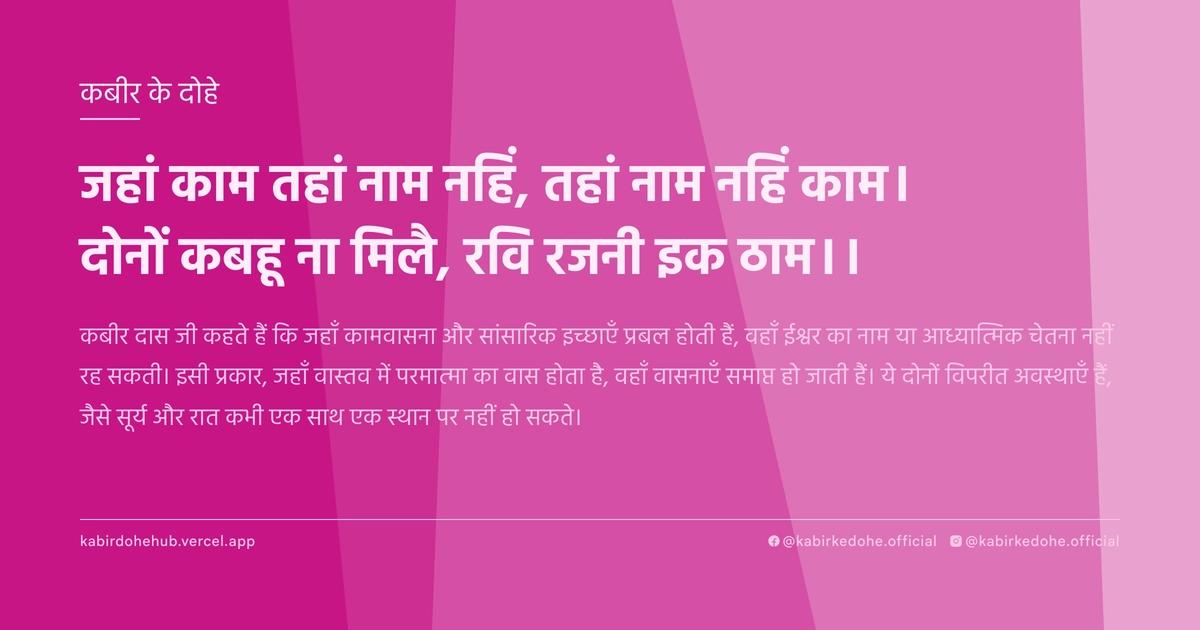
जहां काम तहां नाम नहिं, तहां नाम नहिं काम।
दोनों कबहू ना मिलै, रवि रजनी इक ठाम।।
Jahan kaam tahan naam nahin, tahan naam nahin kaam. Donon kabahu na milai, ravi rajni ik thaam.
इस पृष्ठ पर इस कबीर दोहे का अर्थ (meaning), हिंदी व्याख्या और अंग्रेज़ी अनुवाद, दार्शनिक विश्लेषण और व्यावहारिक जीवन सीख दी गई है। यह दोहा मन नियंत्रण (Mind Control) विषय से जुड़ा है — Kabir doha meaning and explanation in Hindi and English.
अर्थ (Meaning):
कबीर दास जी कहते हैं कि जहाँ कामवासना और सांसारिक इच्छाएँ प्रबल होती हैं, वहाँ ईश्वर का नाम या आध्यात्मिक चेतना नहीं रह सकती। इसी प्रकार, जहाँ वास्तव में परमात्मा का वास होता है, वहाँ वासनाएँ समाप्त हो जाती हैं। ये दोनों विपरीत अवस्थाएँ हैं, जैसे सूर्य और रात कभी एक साथ एक स्थान पर नहीं हो सकते।
Kabir asserts that where lust and worldly desires dominate, the Divine Name or spiritual consciousness cannot reside. Conversely, where the presence of the Divine is truly established, desires vanish. These two states are fundamentally antithetical, much like the sun and the night, which can never occupy the same space at the same time.
व्याख्या (Interpretation):
यह दोहा द्वैत और अद्वैत के बीच के संघर्ष को दर्शाता है। 'काम' यहाँ केवल शारीरिक इच्छा नहीं, बल्कि अहंकार और आसक्ति का प्रतीक है, जबकि 'नाम' उस निराकार ब्रह्म की उपस्थिति है। जब मन बाहरी दुनिया के आकर्षणों में उलझा होता है, तो वह आंतरिक शून्य को नहीं देख पाता। यह एक आध्यात्मिक विरोधाभास है: हम चाहते हैं कि हम संसार में रहकर भी मुक्त रहें, लेकिन कबीर चेतावनी देते हैं कि वासना और ज्ञान एक साथ नहीं रह सकते। यह माया के प्रभाव को दर्शाता है जहाँ इंद्रिय सुख आत्मा के प्रकाश को ढक लेते हैं। जैसे सूर्य के उदय होते ही अंधकार मिट जाता है, वैसे ही 'नाम' के उदय से 'काम' का विनाश होता है। अंततः, यह आत्मा और परमात्मा के मिलन के लिए आवश्यक शुद्धि की प्रक्रिया है।
This couplet illustrates the conflict between duality and non-duality. 'Kaam' here represents not just physical lust, but the broader spectrum of ego and attachment, while 'Naam' symbolizes the presence of the Formless Brahman. When the mind is entangled in external attractions, it fails to perceive the internal void. It presents a spiritual paradox: the human desire to remain worldly yet liberated, which Kabir warns is impossible because desire and gnosis cannot coexist. This reflects the influence of Maya, where sensory pleasures veil the light of the Atman. Just as the sunrise inevitably eradicates the night, the awakening of the Divine Name annihilates the grip of desire. Ultimately, it describes the essential purification process required for the union of the individual soul with the Universal Consciousness.
दार्शनिक विश्लेषण (Philosophical Analysis):
कबीर का यह दर्शन निर्गुण भक्ति और सूफी मत के संगम पर आधारित है। उन्होंने अपने समय के कर्मकांडों और बाहरी दिखावे का विरोध किया, यह तर्क देते हुए कि मोक्ष किसी मंदिर या मस्जिद में नहीं, बल्कि मन की शुद्धि में है। यहाँ 'काम' का अर्थ केवल कामुकता नहीं, बल्कि वह 'मैं' है जो दुनिया को अपनी इच्छा के अनुसार मोड़ना चाहता है। यह अद्वैत वेदांत के उस सिद्धांत से मेल खाता है जहाँ अविद्या (अज्ञान) ही बंधन का कारण है। जब तक साधक अपनी पहचान शरीर और उसकी इच्छाओं से जोड़ता है, वह सत्य से दूर रहता है।
सूफीवाद के संदर्भ में, यह 'नफ्स' (अहंकार/इच्छा) के दमन की बात है। जब तक नफ्स जीवित है, तब तक 'फना' (ईश्वर में विलीन होना) संभव नहीं है। कबीर का तर्क है कि आध्यात्मिक यात्रा एक 'सबट्रैक्शन' (घटाने) की प्रक्रिया है, न कि जोड़ने की। हम ज्ञान इकट्ठा नहीं करते, बल्कि उस अज्ञान को हटाते हैं जो हमें सत्य से अलग करता है।
ऐतिहासिक रूप से, कबीर ने जाति और धर्म के भेदों को नकारते हुए एक सार्वभौमिक सत्य की स्थापना की। उन्होंने बताया कि ईश्वर किसी विशेष वर्ग का नहीं है, बल्कि वह शुद्ध चेतना है। ritualism (कर्मकांड) अक्सर अहंकार को पुष्ट करता है, जबकि वास्तविक भक्ति अहंकार को मिटाती है।
मनोवैज्ञानिक स्तर पर, यह दोहा संज्ञानात्मक विसंगति (cognitive dissonance) को संबोधित करता है। मनुष्य अक्सर आध्यात्मिक होने का ढोंग करता है जबकि उसके भीतर लालच और ईर्ष्या भरी होती है। कबीर इस पाखंड पर प्रहार करते हैं।
अंततः, यह संदेश है कि सत्य की प्राप्ति के लिए विपरीत दिशा में चलने वाली प्रवृत्तियों का त्याग अनिवार्य है। यदि आप प्रकाश चाहते हैं, तो आपको अंधकार को पकड़ना छोड़ना होगा। यह एक पूर्ण समर्पण की मांग है, जहाँ व्यक्ति अपनी सीमित पहचान को अनंत में विलीन कर देता है।
Kabir's philosophy is rooted in the confluence of Nirgun Bhakti and Sufism. He opposed the rituals and outward displays of his era, arguing that liberation is found not in temples or mosques, but in the purification of the mind. Here, 'Kaam' does not merely denote sexuality, but the 'I-ness'—the ego that seeks to bend the world to its will. This aligns with the Advaita Vedanta principle where Avidya (ignorance) is the primary cause of bondage. As long as the seeker identifies with the body and its cravings, they remain distant from the Truth.
In the context of Sufism, this refers to the struggle against the 'Nafs' (the lower self/ego). Until the Nafs is subdued, 'Fana' (annihilation of the self in the Divine) is impossible. Kabir posits that the spiritual journey is a process of subtraction rather than addition. We do not accumulate knowledge; rather, we remove the ignorance that separates us from the Absolute.
Historically, Kabir dismantled caste and religious hierarchies to establish a universal truth. He asserted that God is not the property of a specific class but is Pure Consciousness. Ritualism often reinforces the ego, whereas genuine devotion dissolves it.
Psychologically, this couplet addresses cognitive dissonance. Humans often perform the theater of spirituality while harboring greed and jealousy. Kabir strikes at this hypocrisy, demanding an honest alignment between internal state and external practice.
Ultimately, the message is that the abandonment of contradictory tendencies is mandatory for the realization of Truth. To seek the light, one must stop clinging to the darkness. It demands a total surrender, where the individual merges their limited identity into the Infinite.
मूल संदेश (Core Message):
- इच्छा और ईश्वर का मिलन असंभव है।
- अहंकार का त्याग ही वास्तविक प्रार्थना है।
- बाहरी कर्मकांड आंतरिक शुद्धि का विकल्प नहीं हैं।
- शांति तब आती है जब 'मैं' समाप्त होता है।
- सत्य का अनुभव केवल शून्य में संभव है।
- Desire and Divinity cannot coexist in one heart.
- The surrender of ego is the only true prayer.
- External rituals are not substitutes for internal purity.
- Peace arrives only when the 'I' vanishes.
- Truth is experienced only in the state of emptiness.
व्यावहारिक उदाहरण (Practical Example):
वाराणसी के एक पुराने घाट पर रहने वाली एक वृद्ध विधवा, जानकी, का जीवन केवल एक ही उद्देश्य के इर्द-गिर्द घूमता था—अपने मृत पुत्र की यादों को सहेजना और उसके लिए निरंतर पूजा-पाठ करना। वह दिन भर मंदिर जाती, घंटों मंत्र जाप करती और खुद को एक महान भक्त मानती थी। लेकिन उसके भीतर एक गहरा क्रोध था। वह अपने पड़ोसियों से ईर्ष्या करती थी, उनके बच्चों की सफलता पर उसे जलन होती थी, और वह अक्सर अपने छोटे से घर में आने वाले किसी भी व्यक्ति को नीचा दिखाती थी।
वह मानती थी कि उसकी पूजा उसे ईश्वर के करीब ले जा रही है, लेकिन उसका मन अभी भी 'काम' (इच्छा और अहंकार) के जाल में था। वह चाहती थी कि दुनिया उसे एक 'पवित्र विधवा' के रूप में देखे, जो वास्तव में उसकी सामाजिक छवि की भूख थी।
एक दिन, एक घुमक्कड़ साधु उसके पास आया। उसने जानकी की लंबी पूजा और उसके तीखे शब्दों के बीच के विरोधाभास को देख लिया। साधु ने उससे कहा, 'माँ, तुम सूर्य और रात को एक ही कमरे में रखने की कोशिश कर रही हो। तुम्हारी पूजा 'नाम' है, लेकिन तुम्हारा अहंकार 'काम' है। जब तक तुम इस श्रेष्ठता के भाव को नहीं छोड़ोगी, तुम्हारी प्रार्थनाएं केवल शोर हैं।'
जानकी को पहले तो यह बात चुभी, लेकिन उस रात वह सो नहीं सकी। उसने महसूस किया कि वह ईश्वर को नहीं, बल्कि अपनी 'छवि' को पूज रही थी। उसने अपनी पूजा की लंबी सूची को छोटा किया और अपना समय दूसरों की सेवा में लगाने का निर्णय लिया।
उसने अपने पड़ोस की उस महिला की मदद करना शुरू किया जिसे वह नापसंद करती थी। उसने महसूस किया कि जब वह दूसरों के प्रति करुणा महसूस करती है, तो उसका आंतरिक क्रोध शांत होने लगता है।
धीरे-धीरे, उसकी पूजा का स्वरूप बदल गया। अब वह मंत्रों को केवल दोहराती नहीं थी, बल्कि उन्हें महसूस करती थी। उसका अहंकार, जो उसे दूसरों से अलग करता था, धीरे-धीरे पिघलने लगा।
एक दिन उसने पाया कि अब उसे अपनी 'पवित्रता' के प्रमाण की आवश्यकता नहीं थी। वह बस शांत थी। उसके भीतर का द्वंद्व समाप्त हो गया था।
उसने अनुभव किया कि जब उसने अपनी इच्छाओं (काम) को त्याग दिया, तब वास्तव में ईश्वर का नाम (नाम) उसके हृदय में गूंजने लगा। वह अब केवल एक 'विधवा' नहीं थी, वह एक मुक्त आत्मा बन गई थी।
In the ancient ghats of Varanasi lived an elderly widow named Janaki, whose life revolved around a single purpose—preserving the memory of her deceased son through endless rituals and prayers. She spent her days in temples, chanting mantras for hours, believing herself to be a paragon of devotion. However, deep within her lay a simmering rage. She envied her neighbors, felt a sting of jealousy at the success of their children, and frequently belittled anyone who entered her small home.
She believed her rituals were bringing her closer to God, but her mind was still trapped in 'Kaam' (desire and ego). She craved the world to perceive her as a 'holy widow,' which was essentially a hunger for social validation.
One day, a wandering monk visited her. He observed the stark contradiction between Janaki's elaborate worship and her caustic words. The monk told her, 'Mother, you are trying to keep the sun and the night in the same room. Your prayers are the Name, but your ego is the Desire. Until you relinquish this sense of superiority, your prayers are merely noise.'
Janaki was initially offended, but she could not sleep that night. She realized she wasn't worshipping God, but rather her own 'image.' She decided to shorten her long list of rituals and instead dedicate her time to serving others.
She began helping the very neighbor she had spent years disliking. She discovered that as she felt genuine compassion for others, her internal anger began to subside.
Gradually, the nature of her worship changed. She no longer just repeated mantras; she felt them. The ego that had separated her from the world began to melt away.
One day, she realized she no longer needed proof of her 'holiness.' She was simply at peace. The internal conflict had ceased.
She experienced that once she let go of her desires and attachments (Kaam), the Divine Name (Naam) truly began to resonate within her heart. She was no longer just a 'widow'; she had become a liberated soul.
अभ्यास मार्गदर्शन (Practice Guidance):
- प्रतिदिन 20 मिनट मौन अभ्यास करें, जहाँ आप केवल अपनी सांसों और मन में उठने वाली इच्छाओं का अवलोकन करें, बिना किसी निर्णय के।
- एक 'इच्छा डायरी' बनाएँ। जब भी आप किसी के प्रति ईर्ष्या या क्रोध महसूस करें, तो लिखें कि वह किस 'अहंकार' से उपजा है।
- व्यवहार परिवर्तन: दिन में कम से कम एक कार्य ऐसा करें जिसमें आपको कोई श्रेय (credit) न मिले और जिसे आप गुप्त रखें।
- निदान चेकलिस्ट: क्या मैं प्रार्थना करते समय भी दूसरों से बेहतर महसूस कर रहा हूँ? क्या मेरी शांति बाहरी परिस्थितियों पर निर्भर है? यदि हाँ, तो 'काम' अभी भी प्रभावी है।
- Practice 20 minutes of daily silence, observing your breath and the desires arising in your mind without judgment.
- Maintain a 'Desire Journal.' Whenever you feel envy or anger, write down which specific 'ego-trigger' caused that emotion.
- Behavioral Shift: Perform at least one act of kindness daily that brings you no credit and keep it strictly secret.
- Diagnostic Checklist: Am I feeling superior to others while praying? Is my peace dependent on external circumstances? If yes, 'Kaam' is still dominant.
चिंतन प्रश्न (Reflection Questions):
- मेरी आध्यात्मिक साधना वास्तव में ईश्वर के लिए है, या मेरी अपनी एक 'पवित्र' छवि बनाने के लिए?
- वे कौन सी गुप्त इच्छाएँ हैं जिन्हें मैं 'भक्ति' के नाम पर छिपा रहा हूँ?
- क्या मैं वास्तव में दूसरों की प्रगति से खुश हूँ, या मेरी खुशी उनकी विफलता में छिपी है?
- यदि मेरी सभी सामाजिक पहचान (पद, प्रतिष्ठा, धर्म) छीन ली जाएँ, तो मेरे भीतर क्या बचेगा?
- मेरे जीवन में 'सूर्य' (ज्ञान) और 'रात' (अज्ञान) का संघर्ष कहाँ सबसे अधिक है?
- Is my spiritual practice truly for the Divine, or is it for constructing a 'holy' image of myself?
- What secret desires am I masking under the guise of 'devotion'?
- Am I genuinely happy for the progress of others, or is my satisfaction hidden in their failure?
- If all my social identities (rank, prestige, religion) were stripped away, what would remain within me?
- Where in my life is the conflict between the 'Sun' (knowledge) and the 'Night' (ignorance) most intense?