
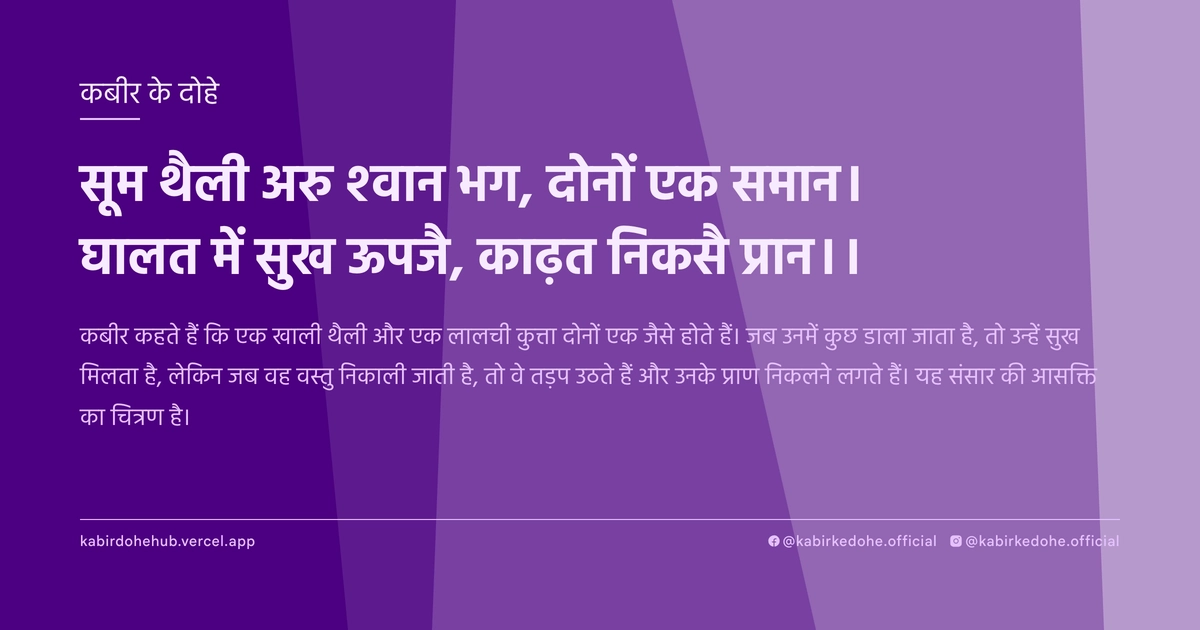
सूम थैली अरु श्वान भग, दोनों एक समान।
घालत में सुख ऊपजै, काढ़त निकसै प्रान।।
Soom thaili aru shwan bhag, dono ek samaan. Ghaalat mein sukh upjai, kaadhat niksai praan.
इस पृष्ठ पर इस कबीर दोहे का अर्थ (meaning), हिंदी व्याख्या और अंग्रेज़ी अनुवाद, दार्शनिक विश्लेषण और व्यावहारिक जीवन सीख दी गई है। यह दोहा मृतुक्यता (Mortality) विषय से जुड़ा है — Kabir doha meaning and explanation in Hindi and English.
अर्थ (Meaning):
कबीर कहते हैं कि एक खाली थैली और एक लालची कुत्ता दोनों एक जैसे होते हैं। जब उनमें कुछ डाला जाता है, तो उन्हें सुख मिलता है, लेकिन जब वह वस्तु निकाली जाती है, तो वे तड़प उठते हैं और उनके प्राण निकलने लगते हैं। यह संसार की आसक्ति का चित्रण है।
Kabir posits that an empty bag and a greedy dog are identical in their nature. Both experience a fleeting sense of joy when something is put into them, but suffer agonizing distress when that object is removed. This serves as a metaphor for the human soul's attachment to transient material possessions.
व्याख्या (Interpretation):
शाब्दिक अर्थ में, यह दोहा बाहरी वस्तुओं के प्रति हमारी निर्भरता को दर्शाता है। रूपक के स्तर पर, 'सूम थैली' और 'श्वान' मानव अहंकार और वासना का प्रतीक हैं। निर्गुण भक्ति के अनुसार, जब मनुष्य अपनी पहचान बाहरी उपाधियों या भौतिक सुखों से जोड़ता है, तो वह उस खाली थैली की तरह हो जाता है जो केवल बाहरी भराव से संतुष्ट होती है। यह माया का जाल है जहाँ सुख केवल 'प्राप्ति' में है, 'होने' में नहीं। अद्वैत वेदांत के नजरिए से, यह द्वैत की स्थिति है जहाँ आत्मा स्वयं को अधूरा मानकर बाहरी वस्तुओं में पूर्णता खोजती है। अंततः, यह विरोधाभास है कि जिस वस्तु को हम अपना सुख मानते हैं, वही हमारे दुख का कारण बनती है क्योंकि उसका विछोह अनिवार्य है।
Literally, the couplet describes the dependency on external objects. Metaphorically, the 'empty bag' and the 'dog' symbolize the human ego and craving. In the context of Nirgun Bhakti, when a human ties their identity to external titles or material pleasures, they become like that empty bag, satisfied only by external filling. This is the veil of Maya, where happiness is found in 'acquisition' rather than 'being'. From the perspective of Advaita Vedanta, this represents the state of duality where the Atman perceives itself as incomplete and seeks wholeness in the external world. The central paradox lies in the fact that the very object we perceive as our source of joy becomes the source of our agony because separation is inevitable.
दार्शनिक विश्लेषण (Philosophical Analysis):
कबीर का यह दोहा उनके युग के उस सामाजिक और धार्मिक पाखंड पर प्रहार है जहाँ लोग बाहरी कर्मकांडों और संचय को ही मोक्ष का मार्ग मानते थे। कबीर ने स्पष्ट किया कि चाहे वह धर्म के नाम पर किया गया संचय हो या सांसारिक धन, दोनों ही मनुष्य को बंधन में डालते हैं। यह विश्लेषण सूफी मत के 'नफ्स' (अहंकार) के विचार से मेल खाता है, जहाँ इच्छाओं का अंत ही ईश्वर तक पहुँचने का एकमात्र मार्ग है।
यहाँ कबीर 'शून्यता' की बात कर रहे हैं। जब तक मनुष्य स्वयं को 'खाली' (अहंकार रहित) नहीं करता, वह बाहरी वस्तुओं का गुलाम बना रहता है। यह अद्वैत वेदांत के उस सिद्धांत की पुष्टि करता है कि ब्रह्म ही एकमात्र सत्य है और बाकी सब माया है। जो व्यक्ति माया को सत्य मानकर उससे चिपकता है, वह उस कुत्ते की तरह है जो हड्डी खोने पर विलाप करता है।
कबीर का दृष्टिकोण मनोवैज्ञानिक है; वे बताते हैं कि सुख वस्तु में नहीं, बल्कि उसे पाने की 'तृष्णा' में है। यह तृष्णा ही जन्म और मृत्यु के चक्र का कारण है। जब तक हम 'पाने' की मानसिकता में रहते हैं, हम वास्तव में रिक्त रहते हैं।
इस दोहे में जाति और वर्ग का कोई उल्लेख नहीं है क्योंकि लालच और आसक्ति सार्वभौमिक हैं। एक राजा और एक भिखारी, दोनों ही अपनी-अपनी 'थैलियों' को भरने की होड़ में लगे हैं। कबीर इस मानसिक दासता से मुक्ति का आह्वान करते हैं।
अंततः, यह दोहा हमें 'साक्षी भाव' की ओर ले जाता है। जब हम यह देख पाते हैं कि हमारी खुशी बाहरी वस्तुओं पर टिकी है, तब हम उस बंधन को तोड़ने का प्रयास करते हैं। यह अहंकार का विलोपन (annihilation of ego) है, जहाँ 'मैं' और 'मेरा' का भाव समाप्त होकर केवल शुद्ध चेतना शेष रहती है।
This couplet is a scathing critique of the social and religious hypocrisy of Kabir's era, where people viewed external rituals and accumulation as the path to salvation. Kabir clarifies that whether it is accumulation in the name of religion or worldly wealth, both bind the human soul. This analysis aligns with the Sufi concept of 'Nafs' (the lower self/ego), where the extinction of desires is the only path to the Divine.
Kabir speaks here of 'emptiness'. Until a human makes themselves truly empty (ego-less), they remain a slave to external objects. This validates the Advaita Vedanta principle that Brahman is the only reality and everything else is Maya. One who clings to Maya as truth is like the dog lamenting the loss of a bone.
Kabir's approach is deeply psychological; he posits that happiness resides not in the object, but in the 'craving' (Trishna) for it. This craving is the root cause of the cycle of birth and death. As long as we operate from a mindset of 'acquisition', we remain fundamentally empty.
There is no mention of caste or class here because greed and attachment are universal. A king and a beggar are both racing to fill their respective 'bags'. Kabir calls for liberation from this mental servitude.
Ultimately, the couplet guides us toward the 'Witness Consciousness' (Sakshi Bhava). When we realize that our happiness is contingent upon external variables, we begin the process of breaking those chains. This is the annihilation of the ego, where the notions of 'I' and 'Mine' dissolve, leaving only pure consciousness.
मूल संदेश (Core Message):
- बाहरी वस्तुओं में सुख खोजना एक अंतहीन और दुखद चक्र है।
- अहंकार एक खाली थैली की तरह है जिसे कभी भरा नहीं जा सकता।
- असली पूर्णता बाहरी संचय में नहीं, बल्कि आंतरिक शून्यता में है।
- आसक्ति ही वह बंधन है जो आत्मा को तड़पाता है।
- स्वयं को जानना ही एकमात्र स्थायी सुख का स्रोत है।
- Seeking happiness in external objects is an endless and tragic cycle.
- The ego is like an empty bag that can never be truly filled.
- True wholeness lies not in external accumulation, but in internal emptiness.
- Attachment is the very bond that causes the soul to suffer.
- Self-realization is the only source of permanent and abiding joy.
व्यावहारिक उदाहरण (Practical Example):
एक समय की बात है, वाराणसी के घाटों पर रहने वाला एक वृद्ध बुनकर था जिसका नाम माधव था। माधव अपनी कला में निपुण था, लेकिन उसका मन हमेशा इस चिंता में रहता था कि उसके पास पर्याप्त रेशम और सोने के धागे नहीं हैं। वह मानता था कि यदि उसके पास सबसे कीमती सामग्री होगी, तो वह शहर का सबसे सम्मानित व्यक्ति बन जाएगा।
सालों की मेहनत के बाद, माधव ने एक ऐसा अद्भुत वस्त्र बनाया जिसे देखकर राजा मंत्रमुग्ध हो गया। राजा ने उसे भारी मात्रा में स्वर्ण मुद्राएं और कीमती रत्न दिए। अचानक, माधव की 'थैली' भर गई। वह अब गर्व से चलता था और खुद को दूसरों से श्रेष्ठ समझने लगा। उसकी खुशी अब उन रत्नों और उसकी प्रसिद्धि से जुड़ी थी।
कुछ समय बाद, शहर में एक भीषण बाढ़ आई। माधव का घर बह गया और उसके सारे रत्न और स्वर्ण मुद्राएं नदी की लहरों में खो गईं। जिस क्षण उसे एहसास हुआ कि उसकी संपत्ति चली गई है, वह बुरी तरह टूट गया। वह घंटों नदी के किनारे बैठकर रोता रहा, जैसे उसके प्राण निकल रहे हों। वह उस 'सूम थैली' की तरह था जिसे भरने के बाद खाली होने पर असहनीय पीड़ा हुई।
एक दिन, एक फकीर ने उसे रोते देखा और पूछा, "बेटा, तू उस सोने के लिए रो रहा है जो कभी तेरा था ही नहीं, या उस शांति के लिए जो तूने सोने के चक्कर में खो दी?"
माधव चुप रहा। फकीर ने आगे कहा, "तूने अपनी खुशी को उन पत्थरों में डाल दिया था जिन्हें तू रत्न कहता था। जब पत्थर गए, तो तूने सोचा कि तू भी चला गया। तूने खुद को उस थैली जैसा बना लिया था जिसमें केवल बाहरी चीजें भरी जा सकती थीं।"
यह बात माधव के हृदय में गहरे तक उतर गई। उसने महसूस किया कि वह वर्षों से केवल 'संग्रह' कर रहा था, 'अनुभव' नहीं। उसने देखा कि उसके पास अभी भी उसकी कला थी, उसकी सांसें थीं और वह बहती नदी थी, लेकिन उसने इन सबको नजरअंदाज कर दिया था।
माधव ने तय किया कि वह अब अपनी खुशी को किसी बाहरी वस्तु का मोहताज नहीं होने देगा। उसने फिर से बुनना शुरू किया, लेकिन इस बार वह केवल धन के लिए नहीं, बल्कि आनंद के लिए बुनने लगा। उसने अपनी कला को गरीबों के साथ साझा करना शुरू किया।
अब, जब वह किसी को मुफ्त में वस्त्र देता, तो उसे वह सुख मिलता जो पहले उसे स्वर्ण मुद्राएं पाकर मिलता था। उसने अपनी 'थैली' को बाहरी वस्तुओं से नहीं, बल्कि आंतरिक संतोष और करुणा से भरना सीख लिया था।
उसका जीवन अब उस कुत्ते की तरह नहीं था जो हड्डी के लिए तड़पता है, बल्कि उस सागर की तरह था जो स्वयं में पूर्ण है। उसने जान लिया कि असली सुख 'पाने' में नहीं, बल्कि 'होने' और 'देने' में है।
Once, in the ghats of Varanasi, lived an elderly weaver named Madhav. Madhav was skilled in his craft, but his mind was always plagued by the worry that he lacked enough silk and gold threads. He believed that if he possessed the most precious materials, he would become the most respected man in the city.
After years of toil, Madhav created a magnificent garment that left the King spellbound. The King rewarded him with a vast amount of gold coins and precious gems. Suddenly, Madhav's 'bag' was full. He began to walk with pride and considered himself superior to others. His happiness was now inextricably linked to those gems and his fame.
Some time later, a devastating flood hit the city. Madhav's house was swept away, and all his gems and gold coins were lost in the river's currents. The moment he realized his wealth was gone, he broke down completely. He spent hours weeping by the riverbank, as if his very life force were escaping him. He was like that 'empty bag' which, after being filled, felt unbearable agony upon being emptied.
One day, a wandering ascetic saw him weeping and asked, "Son, are you mourning the gold that was never truly yours, or the peace that you lost in the pursuit of gold?"
Madhav remained silent. The ascetic continued, "You placed your happiness in those stones you called gems. When the stones left, you felt that you had ceased to exist. You turned yourself into a bag that could only be filled with external things."
These words pierced Madhav's heart. He realized that for years he had been merely 'accumulating' rather than 'experiencing'. He noticed that he still had his art, his breath, and the flowing river, yet he had ignored them all.
Madhav decided that he would no longer make his happiness dependent on any external object. He began weaving again, but this time not for wealth, but for joy. He started sharing his art with the poor.
Now, whenever he gave a garment for free, he felt the same joy he once felt upon receiving gold coins. He learned to fill his 'bag' not with external possessions, but with internal contentment and compassion.
His life was no longer like the dog yearning for a bone, but like the ocean, complete within itself. He understood that true happiness lies not in 'acquiring', but in 'being' and 'giving'.
अभ्यास मार्गदर्शन (Practice Guidance):
- दैनिक चिंतन: हर सुबह 10 मिनट यह विचार करें कि आपकी कौन सी खुशियाँ बाहरी वस्तुओं पर निर्भर हैं और उन्हें आंतरिक संतोष में कैसे बदला जाए।
- आत्म-पूछताछ जर्नल: एक सूची बनाएं उन चीजों की जिन्हें खोने का डर आपको सबसे ज्यादा सताता है। पूछें, 'यदि यह सब चला जाए, तो मेरे भीतर क्या शेष रहेगा?'
- व्यवहार परिवर्तन: सप्ताह में एक बार ऐसी वस्तु का दान करें जिससे आप भावनात्मक रूप से जुड़े हों, ताकि आप 'मोह' के बंधन को तोड़ सकें।
- निदान चेकलिस्ट: क्या आप किसी की प्रशंसा पर अत्यधिक खुश और आलोचना पर गहरे दुखी होते हैं? क्या आप नई वस्तुएं खरीदने के बाद भी जल्द ही खालीपन महसूस करते हैं? यदि हाँ, तो आप 'सूम थैली' की स्थिति में हैं।
- Daily Contemplation: Spend 10 minutes every morning reflecting on which of your joys depend on external objects and how to transform them into internal contentment.
- Self-Inquiry Journal: List the things you fear losing the most. Ask yourself, 'If all of this were gone, what would remain within me?'
- Behavioral Change: Once a week, donate an object you are emotionally attached to, in order to break the bonds of 'Moha' (attachment).
- Diagnostic Checklist: Do you feel excessively elated by praise and deeply devastated by criticism? Do you feel a sense of emptiness shortly after acquiring new possessions? If yes, you are in the state of the 'empty bag'.
चिंतन प्रश्न (Reflection Questions):
- मेरी वह कौन सी 'डिजिटल पहचान' या सोशल मीडिया इमेज है जिसे खोने का डर मुझे वास्तव में परेशान करता है?
- क्या मैं अपनी योग्यता को अपनी उपलब्धियों से मापता हूँ, या अपने आंतरिक मूल्यों से?
- जब मैं कहता हूँ 'यह मेरा है', तो क्या मैं वास्तव में उस वस्तु का स्वामी हूँ, या वह वस्तु मेरी स्वामी बन गई है?
- मेरे जीवन का वह कौन सा हिस्सा है जहाँ मैं केवल 'दिखावे' की थैली भर रहा हूँ?
- यदि मेरी सारी सामाजिक प्रतिष्ठा आज छीन ली जाए, तो क्या मेरे पास प्रेम करने और जीने का कोई कारण बचेगा?
- What is that 'digital identity' or social media image of mine that I am most terrified of losing?
- Do I measure my worth by my achievements, or by my internal values?
- When I say 'this is mine', am I truly the master of that object, or has the object become my master?
- Which part of my life is spent merely filling a 'bag of appearances'?
- If all my social prestige were stripped away today, would I still have a reason to love and live?