
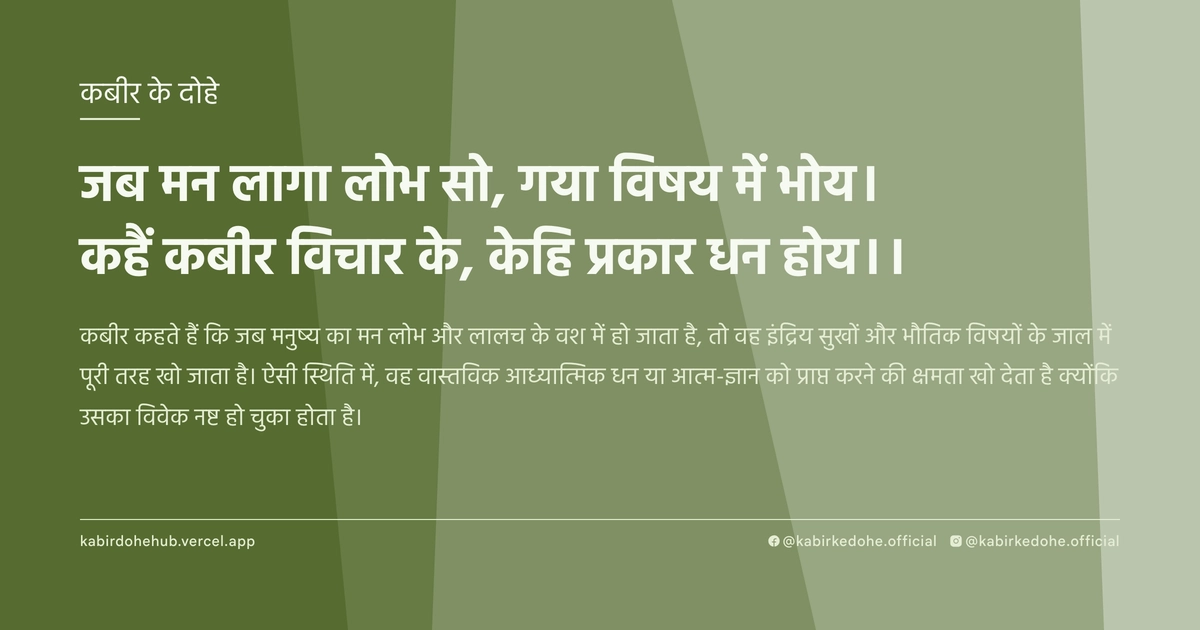
जब मन लागा लोभ सो, गया विषय में भोय।
कहैं कबीर विचार के, केहि प्रकार धन होय।।
Jab man laaga lobh so, gaya vishay mein bhoy. Kahein Kabir vichaar ke, kehi prakar dhan hoye.
इस पृष्ठ पर इस कबीर दोहे का अर्थ (meaning), हिंदी व्याख्या और अंग्रेज़ी अनुवाद, दार्शनिक विश्लेषण और व्यावहारिक जीवन सीख दी गई है। यह दोहा लोभ (Greed) विषय से जुड़ा है — Kabir doha meaning and explanation in Hindi and English.
अर्थ (Meaning):
कबीर कहते हैं कि जब मनुष्य का मन लोभ और लालच के वश में हो जाता है, तो वह इंद्रिय सुखों और भौतिक विषयों के जाल में पूरी तरह खो जाता है। ऐसी स्थिति में, वह वास्तविक आध्यात्मिक धन या आत्म-ज्ञान को प्राप्त करने की क्षमता खो देता है क्योंकि उसका विवेक नष्ट हो चुका होता है।
Kabir explains that when the mind is consumed by greed and avarice, it becomes utterly lost in the pursuit of sensory pleasures and material attachments. In such a state, the individual loses the capacity to attain true spiritual wealth or self-realization, as their discernment is clouded by worldly desires.
व्याख्या (Interpretation):
इस दोहे का शाब्दिक अर्थ है कि लोभ मन को भौतिक विषयों में उलझा देता है। गहरे स्तर पर, 'लोभ' केवल धन की इच्छा नहीं, बल्कि 'अपूर्णता' की भावना है जो व्यक्ति को बाहरी वस्तुओं में सुख खोजने पर मजबूर करती है। यह 'माया' का प्रभाव है जो आत्मा को उसके वास्तविक स्वरूप (ब्रह्म) से अलग कर एक कृत्रिम अहंकार का निर्माण करता है। निर्गुण भक्ति के अनुसार, जब तक मन बाहरी विषयों में 'भोय' (विलीन) है, तब तक वह आंतरिक शून्य का अनुभव नहीं कर सकता। यहाँ 'धन' का अर्थ भौतिक मुद्रा नहीं, बल्कि 'चित्त की शुद्धि' और 'आत्म-बोध' है। यह विरोधाभास है कि हम जिसे पाने के लिए भागते हैं, वही हमें वास्तविक संपदा से दूर ले जाता है।
Literally, the verse suggests that greed entangles the mind in material pursuits. On a deeper level, 'greed' is not merely the desire for money, but a profound sense of 'incompleteness' that drives a person to seek fulfillment in external objects. This is the operation of 'Maya' (illusion), which separates the Atman from its essence (Brahman) by constructing a false ego. In the tradition of Nirgun Bhakti, as long as the mind is 'lost' in sensory objects, it cannot experience the internal void or the fullness of the Divine. Here, 'wealth' does not refer to currency, but to 'purity of consciousness' and 'self-realization.' The central paradox is that the very pursuit of perceived gain leads to the loss of the only true treasure: the Self.
दार्शनिक विश्लेषण (Philosophical Analysis):
कबीर का यह दोहा उस सामाजिक और धार्मिक परिवेश में लिखा गया था जहाँ कर्मकांड और बाहरी दिखावे का बोलबाला था। कबीर ने स्पष्ट किया कि मोक्ष किसी मंदिर या मस्जिद में नहीं, बल्कि मन की आंतरिक शुद्धि में है। वे लोभ को एक मानसिक बीमारी मानते हैं जो मनुष्य को उसकी मूल प्रकृति से विमुख करती है।
अद्वैत वेदांत के परिप्रेक्ष्य में, लोभ 'अविद्या' (अज्ञान) का परिणाम है। जब हम स्वयं को शरीर और मन मानते हैं, तो हम बाहरी वस्तुओं के माध्यम से अपनी कमी को भरने की कोशिश करते हैं। कबीर का तर्क है कि यह एक अंतहीन चक्र है क्योंकि बाहरी वस्तुएं कभी भी आंतरिक शून्यता को नहीं भर सकती हैं।
सूफी मत के 'फना' (अहंकार का विनाश) के सिद्धांत से जोड़कर देखें तो, लोभ वह पर्दा है जो साधक और सत्य के बीच खड़ा है। जब तक 'मैं' और 'मेरा' का भाव रहता है, तब तक ईश्वर का अनुभव असंभव है। कबीर यहाँ भौतिकवाद की उस संस्कृति पर प्रहार कर रहे हैं जो मनुष्य को केवल एक उपभोक्ता बना देती है।
मनोवैज्ञानिक रूप से, लोभ एक रक्षा तंत्र है जो हमें हमारे अस्तित्वगत भय से दूर रखता है। हम वस्तुओं का संग्रह करते हैं ताकि हम सुरक्षित महसूस कर सकें, लेकिन वास्तव में हम अपनी स्वतंत्रता को खो देते हैं। कबीर 'विचार' (चिंतन) पर जोर देते हैं, जिसका अर्थ है कि केवल बौद्धिक ज्ञान पर्याप्त नहीं है, बल्कि गहन आत्म-निरीक्षण आवश्यक है।
अंततः, कबीर यह समझाते हैं कि वास्तविक 'धन' वह है जो नष्ट नहीं होता। यह वह अवस्था है जहाँ व्यक्ति को किसी बाहरी वस्तु की आवश्यकता नहीं रहती क्योंकि वह स्वयं में पूर्ण हो जाता है। यह भौतिक गरीबी और आध्यात्मिक समृद्धि के बीच का एक सूक्ष्म संतुलन है, जहाँ त्याग का अर्थ वस्तुओं को छोड़ना नहीं, बल्कि वस्तुओं के प्रति मोह को छोड़ना है।
This Doha was composed in a socio-religious climate dominated by rigid rituals and outward displays of piety. Kabir asserts that liberation is found not in temples or mosques, but in the internal purification of the mind. He views greed as a psychic ailment that alienates a human being from their primordial nature.
From the lens of Advaita Vedanta, greed is a manifestation of 'Avidya' (ignorance). When we mistakenly identify ourselves with the body and mind, we attempt to fill an existential void through external acquisitions. Kabir argues that this is a futile cycle, as material objects can never satisfy a spiritual hunger.
Connecting this to the Sufi concept of 'Fana' (annihilation of the ego), greed is the veil that stands between the seeker and the Truth. As long as the notions of 'I' and 'Mine' persist, the experience of the Divine remains inaccessible. Kabir attacks the culture of materialism that reduces a human being to a mere consumer.
Psychologically, greed serves as a defense mechanism against the fear of non-existence. We accumulate possessions to create a facade of security, but in doing so, we surrender our inner freedom. Kabir emphasizes 'Vichaar' (contemplation), suggesting that intellectual knowledge is insufficient; only rigorous self-inquiry can break the chains of desire.
Ultimately, Kabir defines true 'wealth' as that which is imperishable. It is the state of being where one no longer requires external validation or possession because they have realized their own wholeness. This is the subtle balance between material poverty and spiritual opulence, where renunciation does not mean the absence of things, but the absence of attachment to them.
मूल संदेश (Core Message):
- लोभ आत्मा की वह प्यास है जो कभी नहीं बुझती।
- बाहरी संपदा केवल एक भ्रम है; आंतरिक शांति ही वास्तविक धन है।
- इच्छाओं का त्याग ही वास्तविक स्वतंत्रता का द्वार है।
- जब 'मैं' मिटता है, तभी 'सत्य' प्रकट होता है।
- संतोष वह संपदा है जिसे कोई चोर चुरा नहीं सकता।
- Greed is a thirst of the soul that can never be quenched.
- External wealth is a mere illusion; inner peace is the only true treasure.
- The renunciation of craving is the gateway to absolute freedom.
- Only when the 'I' dissolves does the 'Truth' reveal itself.
- Contentment is the only wealth that no thief can steal.
व्यावहारिक उदाहरण (Practical Example):
एक समय की बात है, वाराणसी के घाटों पर रहने वाला एक वृद्ध बुनकर था जिसका नाम माधव था। माधव अपनी कला में निपुण था, लेकिन उसके मन में हमेशा एक टीस रहती थी कि वह और अधिक धन कमा सके ताकि वह शहर के सबसे बड़े सेठ की तरह सम्मान पा सके।
वह दिन-रात मेहनत करता, लेकिन उसका मन कभी संतुष्ट नहीं होता था। वह अपनी साड़ियों की गुणवत्ता घटाने लगा ताकि वह अधिक माल जल्दी बेच सके और अधिक मुनाफा कमा सके। उसके मन में लोभ का बीज ऐसा पनपा कि वह अपने परिवार और स्वास्थ्य को भी भूल गया।
एक दिन, माधव ने एक बहुत महंगी रेशमी साड़ी बनाई जिसे उसने एक शाही ग्राहक को बेचने का सपना देखा। उसने उस साड़ी में सोने के तार डाले, लेकिन लालच में आकर उसने धागों की मजबूती की अनदेखी की ताकि वह कम समय में काम पूरा कर सके।
जब वह साड़ी बाजार ले गया, तो एक बड़े व्यापारी ने उसे देखा। व्यापारी ने उसे बहुत बड़ी रकम देने का वादा किया, लेकिन जैसे ही उसने साड़ी को छुआ, वह कमजोर धागे टूट गए और साड़ी बिखर गई। माधव की सारी मेहनत और उसका अहंकार एक पल में चूर हो गया।
माधव टूटकर घाट की सीढ़ियों पर बैठ गया। तभी वहां से एक फकीर गुजरा जिसने माधव की आंखों में वह खालीपन देखा। फकीर ने उससे पूछा, 'तूने सोने के तार तो डाले, लेकिन क्या तूने अपनी नीयत में ईमानदारी डाली?'
माधव को अचानक कबीर की पंक्तियाँ याद आईं कि जब मन लोभ में होता है, तो वह विषय-भोगों में खो जाता है। उसे अहसास हुआ कि वह जिस 'धन' के पीछे भाग रहा था, उसने उससे उसका मानसिक सुकून, उसकी कला की पवित्रता और उसका आत्म-सम्मान छीन लिया था।
उसने महसूस किया कि वह अब तक केवल बाहरी चमक देख रहा था, जबकि उसके भीतर का प्रकाश बुझ चुका था। उसने तय किया कि वह अब मात्रा (Quantity) के बजाय गुणवत्ता (Quality) और संतोष (Contentment) पर ध्यान देगा।
माधव ने फिर से बुनना शुरू किया, लेकिन अब उसकी प्रेरणा लालच नहीं, बल्कि सृजन का आनंद था। उसने पाया कि जब उसने 'अधिक' की इच्छा छोड़ी, तो उसे वह शांति मिली जो करोड़ों रुपयों से भी नहीं खरीदी जा सकती थी।
उसका जीवन बदल गया। वह अब भी एक साधारण बुनकर था, लेकिन उसके चेहरे पर एक ऐसी चमक थी जिसे देखकर लोग उससे शांति का मार्ग पूछने लगे। उसने जान लिया था कि वास्तविक धन 'संतोष' है।
इस प्रकार, माधव ने लोभ के जाल से निकलकर आत्म-बोध के मार्ग को चुना, और उसकी कला अब केवल कपड़ा नहीं, बल्कि एक साधना बन गई थी।
Once, in the bustling ghats of Varanasi, lived an elderly weaver named Madhav. Madhav was a master of his craft, yet he harbored a persistent ache in his heart—a desire to accumulate vast wealth so he could command the same respect as the city's wealthiest merchants.
He worked day and night, but his mind was never at peace. Driven by an insatiable hunger for more, he began to compromise the quality of his sarees, producing them faster and cheaper to maximize his profit. The seed of greed grew so wildly that he neglected his health and his family.
One day, Madhav crafted an exquisite silk saree, imagining it would be sold to a royal client for a fortune. He wove gold threads into the fabric, but in his haste to finish quickly and earn more, he ignored the structural integrity of the weave.
When he took the saree to the market, a prominent trader noticed it. The trader promised a staggering sum, but the moment he touched the fabric, the weak threads snapped, and the saree unraveled before their eyes. Madhav's effort and his ego collapsed in an instant.
Devastated, Madhav sat on the stone steps of the ghat. A wandering fakir passed by and noticed the void in Madhav's eyes. The fakir asked him, 'You wove gold into the cloth, but did you weave honesty into your intention?'
Suddenly, Kabir's words resonated within Madhav: when the mind is gripped by greed, it is lost in the illusions of the world. He realized that the 'wealth' he had chased had robbed him of his mental peace, the purity of his art, and his self-respect.
He understood that he had been chasing an external shimmer while the internal light of his soul had dimmed. He decided that from then on, he would prioritize quality over quantity and contentment over accumulation.
Madhav returned to his loom, but his inspiration was no longer greed; it was the joy of creation. He discovered that by letting go of the desire for 'more,' he attained a tranquility that no amount of money could purchase.
His life transformed. He remained a simple weaver, but a radiance emerged on his face that drew people to him, seeking the path to peace. He had finally learned that the only true wealth is 'Santosh' (contentment).
Thus, Madhav escaped the trap of avarice and embraced self-realization, turning his craft from a mere trade into a spiritual discipline.
अभ्यास मार्गदर्शन (Practice Guidance):
- प्रतिदिन 20 मिनट 'साक्षी भाव' का अभ्यास करें: अपने भीतर उठने वाली इच्छाओं को बिना किसी निर्णय के केवल देखें।
- आत्म-पूछताछ जर्नल: हर शाम लिखें कि आज किस क्षण में 'लोभ' ने आपके निर्णय को प्रभावित किया और उस समय आपकी आंतरिक स्थिति क्या थी।
- व्यवहार परिवर्तन: सप्ताह में एक बार ऐसी वस्तु या सेवा का दान करें जिसे आप बहुत संभाल कर रखते हैं, ताकि 'मोह' का बंधन टूटे।
- निदान चेकलिस्ट: क्या आप किसी वस्तु को पाने के बाद भी अधूरा महसूस करते हैं? क्या आपकी खुशी दूसरों की तुलना पर निर्भर है? यदि हाँ, तो आप लोभ के प्रभाव में हैं।
- Practice 'Witness Consciousness' for 20 minutes daily: Observe the desires arising within you without judgment or attachment.
- Self-Inquiry Journaling: Every evening, record the moments where 'greed' influenced your decisions and describe your internal state during those moments.
- Behavioral Shift: Once a week, donate an object or service that you hold dear, specifically to break the bond of 'attachment' (Moha).
- Diagnostic Checklist: Do you still feel incomplete after acquiring a desired object? Is your happiness dependent on comparison with others? If yes, you are operating under the influence of greed.
चिंतन प्रश्न (Reflection Questions):
- यदि आज आपकी सारी भौतिक उपलब्धियां छीन ली जाएं, तो आपके व्यक्तित्व में क्या शेष बचेगा?
- आपकी 'डिजिटल पहचान' (सोशल मीडिया) किस प्रकार आपके भीतर एक कृत्रिम लोभ को जन्म दे रही है?
- क्या आप वास्तव में वह चाहते हैं जो आप चाहते हैं, या आप केवल दूसरों की इच्छाओं की नकल कर रहे हैं?
- आपके जीवन का वह कौन सा 'गुप्त लोभ' है जिसे आप दुनिया से छिपाते हैं लेकिन वह आपको अंदर से नियंत्रित करता है?
- क्या आपकी करुणा वास्तव में निस्वार्थ है, या इसमें भी प्रशंसा पाने का एक सूक्ष्म लोभ छिपा है?
- If all your material achievements were stripped away today, what would remain of your identity?
- In what ways is your 'digital persona' fueling a synthetic greed within you?
- Do you truly desire what you are chasing, or are you merely mimicking the desires of others?
- What is that 'hidden greed' in your life that you conceal from the world but which secretly controls you?
- Is your compassion truly selfless, or is there a subtle greed for validation hidden within it?