
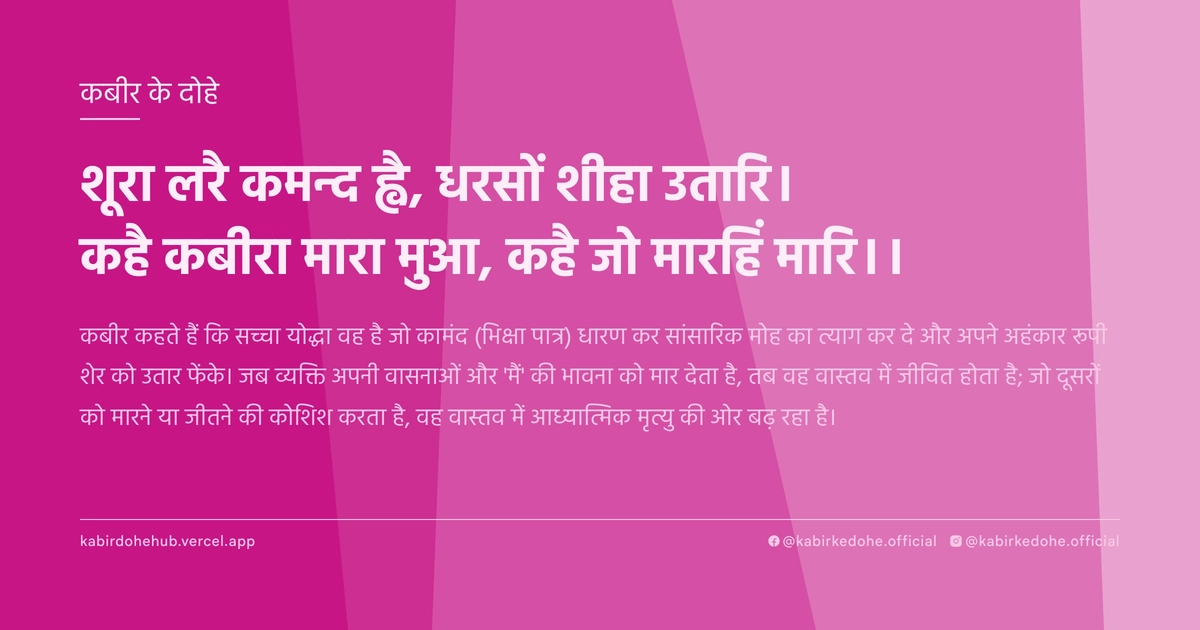
शूरा लरै कमन्द ह्वै, धरसों शीहा उतारि।
कहै कबीरा मारा मुआ, कहै जो मारहिं मारि।।
Shoora larai kamand hvai, dharson sheeha utari. Kahai Kabira maara mua, kahai jo maarahin maari.
इस पृष्ठ पर इस कबीर दोहे का अर्थ (meaning), हिंदी व्याख्या और अंग्रेज़ी अनुवाद, दार्शनिक विश्लेषण और व्यावहारिक जीवन सीख दी गई है। यह दोहा निष्ठा (Integrity) विषय से जुड़ा है — Kabir doha meaning and explanation in Hindi and English.
अर्थ (Meaning):
कबीर कहते हैं कि सच्चा योद्धा वह है जो कामंद (भिक्षा पात्र) धारण कर सांसारिक मोह का त्याग कर दे और अपने अहंकार रूपी शेर को उतार फेंके। जब व्यक्ति अपनी वासनाओं और 'मैं' की भावना को मार देता है, तब वह वास्तव में जीवित होता है; जो दूसरों को मारने या जीतने की कोशिश करता है, वह वास्तव में आध्यात्मिक मृत्यु की ओर बढ़ रहा है।
Kabir asserts that the true warrior is not one who conquers others, but one who adopts the bowl of a mendicant, renouncing worldly attachments and casting off the predatory ego. He suggests that the one who 'dies' to their own ego is the only one who truly awakens, while those who seek to destroy or dominate others are merely accelerating their own spiritual demise.
व्याख्या (Interpretation):
इस दोहे में कबीर 'शूरवीर' की पारंपरिक परिभाषा को उलट देते हैं। यहाँ युद्ध बाहरी नहीं, बल्कि आंतरिक है। 'कमन्द' वैराग्य का प्रतीक है, जो यह दर्शाता है कि असली जीत बाहरी दुनिया को जीतने में नहीं, बल्कि अपनी इंद्रियों पर विजय पाने में है। 'शीहा' (शेर) यहाँ अदम्य अहंकार और क्रोध का प्रतीक है। जब साधक अपने भीतर के इस हिंसक अहंकार को उतार देता है, तब वह 'मारा मुआ' यानी अहंकार-विहीन हो जाता है। यह स्थिति अद्वैत वेदांत के उस सत्य को दर्शाती है जहाँ 'मैं' का विलोपन ही ब्रह्म के साथ मिलन है। निर्गुण भक्ति में, ईश्वर को पाने का मार्ग स्वयं के मिथ्या स्वरूप को मिटाना है। यह एक विरोधाभास है: स्वयं को मिटाकर ही स्वयं को पाना संभव है।
In this couplet, Kabir subverts the traditional definition of a 'warrior.' The battle described is not external but internal. The 'kamand' (mendicant's bowl) symbolizes renunciation, suggesting that true victory lies not in conquering the world, but in mastering one's own senses. The 'sheeha' (lion) represents the untamed ego and aggressive pride. When the seeker casts off this predatory identity, they become 'mara mua'—dead to the ego. This aligns with Advaita Vedanta, where the dissolution of the individual 'I' is the only path to realizing the universal Brahman. In Nirgun Bhakti, the formless Divine is realized only when the veil of the ego is torn. It presents a spiritual paradox: only by 'dying' to the false self can one truly be born into the eternal truth.
दार्शनिक विश्लेषण (Philosophical Analysis):
कबीर का यह दृष्टिकोण उनके समय के सामाजिक और धार्मिक परिवेश के प्रति एक तीखी प्रतिक्रिया है, जहाँ वीरता को युद्ध और रक्तपात से जोड़ा जाता था। वे वीरता का पुनर्गठन करते हैं, इसे शारीरिक शक्ति से हटाकर मानसिक और आध्यात्मिक अनुशासन की ओर ले जाते हैं। यह सूफी मत के 'फना' (अहंकार का विनाश) के सिद्धांत से गहराई से मेल खाता है, जहाँ साधक ईश्वर में विलीन होने के लिए अपनी व्यक्तिगत पहचान को मिटा देता है।
यहाँ कबीर कर्मकांडीय धर्म की आलोचना करते हैं जो बाहरी प्रतीकों और शक्ति प्रदर्शन पर जोर देता है। वे तर्क देते हैं कि यदि कोई व्यक्ति दूसरों को नीचा दिखाकर या मारकर जीतना चाहता है, तो वह वास्तव में माया के जाल में और अधिक फंस रहा है। यह अद्वैत दर्शन का प्रतिबिंब है, जहाँ द्वैत (मैं और तुम) का अंत ही मोक्ष है। जब तक 'मारने वाला' और 'मरने वाला' का भाव है, तब तक अज्ञानता बनी रहती है।
मनोवैज्ञानिक स्तर पर, यह दोहा 'छाया' (shadow) के साथ संघर्ष की बात करता है। मनुष्य अक्सर अपने भीतर के क्रोध और ईर्ष्या को बाहरी शत्रुओं पर आरोपित करता है। कबीर कहते हैं कि असली शत्रु वह 'शेर' है जो हमारे भीतर दहाड़ रहा है। इस आंतरिक पशु को शांत करना ही वास्तविक वीरता है।
भक्ति आंदोलन के संदर्भ में, यह संदेश स्पष्ट है कि ईश्वर की प्राप्ति के लिए किसी बाहरी तीर्थ या कठिन अनुष्ठान की आवश्यकता नहीं है, बल्कि आत्म-साक्षात्कार और अहंकार के विसर्जन की आवश्यकता है। यह एक क्रांतिकारी विचार था जिसने जाति और वर्ग की सीमाओं को तोड़कर मनुष्य को उसकी आंतरिक चेतना से जोड़ा।
अंततः, कबीर यह समझाते हैं कि आध्यात्मिक मृत्यु (ego death) ही वास्तविक जीवन की शुरुआत है। जो व्यक्ति अपनी इच्छाओं और अहंकार की बलि दे देता है, वह उस शांति को प्राप्त करता है जो जन्म और मृत्यु के चक्र से परे है। यह भौतिक विजय की निरर्थकता और आंतरिक शांति की सर्वोच्चता का उद्घोष है।
Kabir's perspective is a sharp reaction to the socio-religious climate of his era, where valor was equated with warfare and bloodshed. He redefines bravery, shifting it from physical dominance to mental and spiritual discipline. This resonates deeply with the Sufi concept of 'Fana' (annihilation of the self), where the seeker dissolves their individual identity to merge with the Divine.
Here, Kabir critiques ritualistic religion that emphasizes external symbols and displays of power. He argues that anyone seeking victory by belittling or destroying others is merely becoming more entangled in Maya (illusion). This reflects Advaita Vedanta, where the cessation of duality—the distinction between 'I' and 'Thou'—is the only path to liberation. As long as the concepts of the 'slayer' and the 'slain' exist, ignorance persists.
Psychologically, this doha addresses the struggle with the 'shadow.' Humans often project their internal anger and jealousy onto external enemies. Kabir asserts that the real enemy is the 'lion' roaring within. Taming this internal beast is the ultimate act of courage.
Within the context of the Bhakti movement, the message is clear: attaining the Divine requires neither external pilgrimages nor rigorous rituals, but self-realization and the surrender of the ego. This was a revolutionary idea that bypassed caste and class hierarchies, connecting the individual directly to universal consciousness.
Ultimately, Kabir explains that spiritual death (the death of the ego) is the beginning of true life. The person who sacrifices their desires and pride attains a peace that transcends the cycle of birth and death. It is a proclamation of the futility of material conquest and the supremacy of inner stillness.
मूल संदेश (Core Message):
- बाहरी विजय एक भ्रम है; आंतरिक विजय ही सत्य है।
- अहंकार का त्याग ही वास्तविक आध्यात्मिक वीरता है।
- जब 'मैं' मिटता है, तब 'ब्रह्म' प्रकट होता है।
- दूसरों को जीतने की इच्छा स्वयं के विनाश का मार्ग है।
- वैराग्य केवल वस्त्र बदलना नहीं, बल्कि चेतना बदलना है।
- External conquest is an illusion; inner victory is the only truth.
- The renunciation of ego is the highest form of spiritual valor.
- When the 'I' dissolves, the Universal Truth manifests.
- The desire to conquer others is a path to one's own demise.
- Renunciation is not changing clothes, but transforming consciousness.
व्यावहारिक उदाहरण (Practical Example):
एक समय की बात है, वाराणसी के घाटों पर माधव नाम का एक अत्यंत अभिमानी विद्वान रहता था। वह वेदों का ज्ञाता था और अपनी बुद्धि के बल पर सबको नीचा दिखाने में गर्व महसूस करता था। वह मानता था कि ज्ञान ही उसकी सबसे बड़ी शक्ति है और जो उससे असहमत थे, उन्हें वह मानसिक रूप से 'मार' देता था।
एक दिन उसकी मुलाकात एक साधारण से बुनकर से हुई, जो शांत भाव से अपना काम कर रहा था। माधव ने उसे शास्त्रार्थ के लिए चुनौती दी और अपनी विद्वत्ता का प्रदर्शन कर उसे अपमानित करना शुरू किया। बुनकर ने केवल मुस्कुराते हुए कहा, "पंडित जी, आप शब्दों के शेर बने हुए हैं, लेकिन क्या आपने कभी अपने भीतर के उस शेर को देखा है जो आपको दूसरों को छोटा दिखाने के लिए उकसाता है?"
माधव को यह बात चुभी। उसने क्रोध में आकर बुनकर को मूर्ख कहा। लेकिन बुनकर की आँखों में एक ऐसी करुणा और शांति थी जिसने माधव को अंदर तक हिला दिया। बुनकर ने कहा, "सच्ची जीत वह नहीं जो दूसरों को हरा कर मिले, बल्कि वह है जब आप स्वयं को हरा दें।"
माधव उस रात सो नहीं सका। उसे एहसास हुआ कि उसकी सारी विद्वत्ता केवल उसके अहंकार को पालने का एक साधन थी। वह जिसे 'ज्ञान' समझ रहा था, वह वास्तव में एक मानसिक हथियार था जिससे वह दूसरों को चोट पहुँचाता था।
अगले कुछ महीनों तक माधव ने मौन का अभ्यास किया। उसने अपनी पहचान एक 'विद्वान' के रूप में त्याग दी और लोगों की सेवा करना शुरू किया। उसने महसूस किया कि जब उसने अपनी श्रेष्ठता का दावा छोड़ दिया, तो उसका मन हल्का हो गया।
उसने देखा कि अब वह लोगों की गलतियों पर क्रोध करने के बजाय उनके प्रति सहानुभूति महसूस करता है। उसका 'शेर' अब शांत हो चुका था।
एक दिन, वही बुनकर फिर मिला। माधव ने उसके चरणों में सिर झुका दिया। अब वह शब्दों से नहीं, बल्कि अपने आचरण से जीत रहा था।
माधव ने समझा कि जिस दिन वह 'विद्वान' के रूप में मरा, उसी दिन वह वास्तव में एक इंसान के रूप में जीवित हुआ।
उसका जीवन अब दूसरों को नीचा दिखाने का युद्धक्षेत्र नहीं, बल्कि प्रेम और सेवा का मंदिर बन गया था।
यही कबीर का वह 'ट्विस्ट' था—अहंकार की मृत्यु ही वास्तविक जीवन का उदय है।
Once, on the ghats of Varanasi, lived a profoundly arrogant scholar named Madhav. He was a master of the Vedas and took immense pride in using his intellect to belittle others. He believed knowledge was his greatest weapon, and he took pleasure in 'slaying' the arguments of those who disagreed with him.
One day, he encountered a simple weaver who was calmly tending to his loom. Madhav challenged him to a scholarly debate and began to humiliate him with his vast erudition. The weaver merely smiled and said, "Pandit ji, you have become a lion of words, but have you ever seen the lion within you that urges you to make others feel small?"
Madhav was stung by this. In a fit of rage, he called the weaver a fool. However, the weaver's eyes held a compassion and stillness that shook Madhav to his core. The weaver added, "True victory is not in defeating others, but in defeating oneself."
Madhav could not sleep that night. He realized that all his scholarship was merely a tool to feed his ego. What he perceived as 'knowledge' was actually a mental weapon used to wound others.
For the next few months, Madhav practiced silence. He renounced his identity as a 'great scholar' and began serving the poor and the sick. He discovered that once he stopped claiming superiority, his mind became light.
He noticed that instead of reacting with anger to people's mistakes, he felt a deep empathy for them. His internal 'lion' had finally been tamed.
One day, he met the weaver again. Madhav bowed at his feet. He was no longer winning through words, but through his conduct.
Madhav understood that the day he 'died' as a scholar, he was truly born as a human being.
His life was no longer a battlefield of intellectual dominance, but a temple of love and service.
This was the 'Kabir Twist'—the death of the ego is the birth of authentic existence.
अभ्यास मार्गदर्शन (Practice Guidance):
- प्रतिदिन 20 मिनट 'साक्षी भाव' का अभ्यास करें: अपने क्रोध और अहंकार के विचारों को एक बाहरी दर्शक की तरह देखें, उनसे जुड़ें नहीं।
- आत्म-पूछताछ जर्नल: हर रात लिखें कि आज किस क्षण में आपने अपनी श्रेष्ठता सिद्ध करने की कोशिश की और उस समय आपके भीतर का 'शेर' कैसे जागा।
- व्यवहारिक परिवर्तन: दिन में कम से कम एक बार किसी ऐसे व्यक्ति की बात सुनें जिसे आप 'अज्ञानी' मानते हैं, और बिना सुधारने की कोशिश किए उनकी बात को स्वीकार करें।
- डायग्नोस्टिक चेकलिस्ट: क्या मैं दूसरों की गलती पर तुरंत प्रतिक्रिया देता हूँ? क्या मुझे अपनी प्रशंसा सुनने की तीव्र इच्छा होती है? यदि हाँ, तो अहंकार अभी जीवित है।
- Practice 'Witness Consciousness' for 20 minutes daily: Observe your thoughts of anger and pride as an external spectator without attaching to them.
- Self-Inquiry Journaling: Every night, record the moments where you tried to prove your superiority and how the internal 'lion' was triggered.
- Behavioral Shift: At least once a day, listen to someone you perceive as 'ignorant' and accept their perspective without trying to correct them.
- Diagnostic Checklist: Do I react instantly to others' mistakes? Do I have an intense craving for praise? If yes, the ego is still alive.
चिंतन प्रश्न (Reflection Questions):
- मेरी वह कौन सी 'बौद्धिक पहचान' है जिसका उपयोग मैं दूसरों को छोटा महसूस कराने के लिए करता हूँ?
- यदि मेरी सारी उपलब्धियाँ और पद छीन लिए जाएँ, तो मेरे भीतर क्या बचेगा?
- क्या मेरा 'परोपकार' वास्तव में निस्वार्थ है, या यह मेरे अहंकार को संतुष्ट करने का एक सूक्ष्म तरीका है?
- मैं किन लोगों को अपना 'शत्रु' मानता हूँ, और वे मेरे भीतर के किस डर या क्रोध का प्रतिबिंब हैं?
- क्या मैं वास्तव में सत्य की खोज में हूँ, या मैं केवल 'सत्य जानने वाले' की छवि बनाना चाहता हूँ?
- What 'intellectual identity' do I use as a tool to make others feel inferior?
- If all my achievements and titles were stripped away, what would remain of me?
- Is my 'altruism' truly selfless, or is it a subtle way to feed my ego?
- Whom do I consider my 'enemies,' and which internal fear or anger do they reflect?
- Am I truly seeking the Truth, or am I merely trying to build the image of 'one who knows the Truth'?