
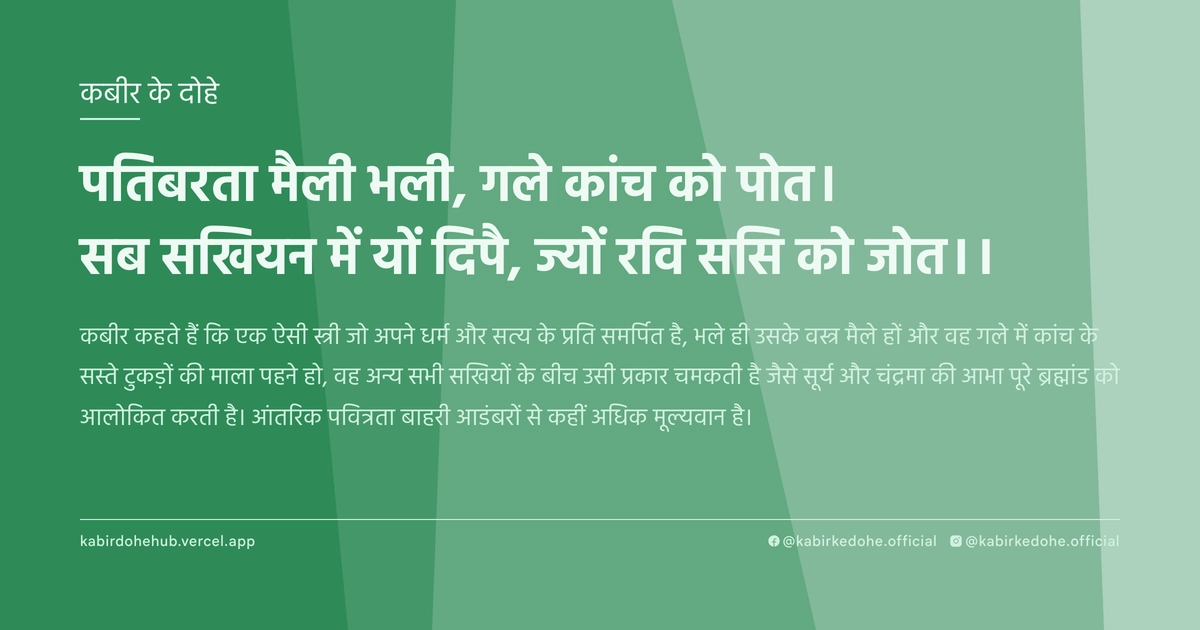
पतिबरता मैली भली, गले कांच को पोत।
सब सखियन में यों दिपै, ज्यों रवि ससि को जोत।।
Patibarta maili bhali, gale kaanch ko pot. Sab sakhiyan mein yon dipai, jyon ravi sasi ko jot.
इस पृष्ठ पर इस कबीर दोहे का अर्थ (meaning), हिंदी व्याख्या और अंग्रेज़ी अनुवाद, दार्शनिक विश्लेषण और व्यावहारिक जीवन सीख दी गई है। यह दोहा निष्ठा (Integrity) विषय से जुड़ा है — Kabir doha meaning and explanation in Hindi and English.
अर्थ (Meaning):
कबीर कहते हैं कि एक ऐसी स्त्री जो अपने धर्म और सत्य के प्रति समर्पित है, भले ही उसके वस्त्र मैले हों और वह गले में कांच के सस्ते टुकड़ों की माला पहने हो, वह अन्य सभी सखियों के बीच उसी प्रकार चमकती है जैसे सूर्य और चंद्रमा की आभा पूरे ब्रह्मांड को आलोकित करती है। आंतरिक पवित्रता बाहरी आडंबरों से कहीं अधिक मूल्यवान है।
Kabir asserts that a woman devoted to her truth and spiritual duty, even if her clothes are soiled and she wears a necklace of cheap glass beads, radiates a brilliance that surpasses all others. Her inner purity makes her shine among her peers just as the sun and moon illuminate the entire cosmos, proving that internal virtue outweighs external ornamentation.
व्याख्या (Interpretation):
यहाँ 'पति' शब्द केवल सांसारिक पति के लिए नहीं, बल्कि 'परमात्मा' या 'स्वयं के सत्य' के प्रतीक के रूप में प्रयुक्त हुआ है। मैला वस्त्र और कांच का पोत सांसारिक दरिद्रता और भौतिक अभाव को दर्शाते हैं, जबकि 'दीपना' आत्मा की जागृति का संकेत है। यह दोहा निर्गुण भक्ति के उस सिद्धांत को पुष्ट करता है जहाँ ईश्वर बाहरी चमक-धमक में नहीं, बल्कि शुद्ध अंतःकरण में वास करता है। माया हमें बाहरी आवरणों में उलझाती है, लेकिन जब साधक अपनी आत्मा (Atman) को ब्रह्म (Brahman) के साथ एकाकार कर लेता है, तो वह द्वैत से मुक्त हो जाता है। यह विरोधाभास है कि जो दुनिया की नजर में 'मैला' या 'तुच्छ' है, वह आध्यात्मिक दृष्टि से सबसे अधिक प्रकाशमान है।
In this context, 'Pati' (husband) is not merely a domestic partner but a metaphor for the 'Paramatma' (Supreme Soul) or one's own ultimate Truth. The soiled garments and glass beads symbolize material poverty and the absence of worldly luxury, while 'shining' signifies the awakening of the soul. This doha reinforces the principle of Nirgun Bhakti, where the Divine resides not in external pomp but in a pure heart. Maya lures us with superficial appearances, but when a seeker aligns their Atman with Brahman, they transcend duality. It presents a profound paradox: that which the world deems 'soiled' or 'insignificant' is, in spiritual reality, the most luminous.
दार्शनिक विश्लेषण (Philosophical Analysis):
कबीर का यह कथन उनके युग के सामाजिक और धार्मिक पाखंडों पर एक तीखा प्रहार है। उस समय समाज में बाहरी प्रतीकों—जैसे महंगे आभूषण, विशेष वस्त्र और जातिगत पहचान—को पवित्रता का पैमाना माना जाता था। कबीर इस धारणा को पूरी तरह नकारते हैं। वे तर्क देते हैं कि सच्ची भक्ति और नैतिकता किसी भौतिक वस्तु की मोहताज नहीं होती। यह दृष्टिकोण अद्वैत वेदांत के करीब है, जहाँ यह माना जाता है कि आत्मा का स्वरूप शुद्ध है और वह शरीर या बाहरी परिस्थितियों से प्रभावित नहीं होता।
सूफी मत के 'इश्क-ए-हकीकी' (ईश्वरीय प्रेम) के समान, यहाँ भी समर्पण की बात की गई है। जब एक व्यक्ति अपने अहंकार (Ego) को मिटाकर पूर्णतः समर्पित हो जाता है, तो वह 'फना' हो जाता है और उसमें ईश्वरीय नूर प्रकट होता है। कबीर यहाँ यह समझा रहे हैं कि सामाजिक प्रतिष्ठा और आध्यात्मिक गरिमा दो अलग चीजें हैं। एक व्यक्ति समाज में निम्न स्तर का हो सकता है, लेकिन उसकी चेतना का स्तर उच्चतम हो सकता है।
यह दोहा कर्मकांडों की निरर्थकता को भी उजागर करता है। यदि मन मैला है, तो सोने के आभूषण भी उसे पवित्र नहीं बना सकते। इसके विपरीत, यदि मन सत्यनिष्ठ है, तो कांच के टुकड़े भी हीरे की तरह चमकते हैं। यह मनोवैज्ञानिक रूपांतरण की प्रक्रिया है जहाँ व्यक्ति बाहरी मान्यता (External Validation) की भूख को छोड़कर आंतरिक संतोष (Internal Fulfillment) की ओर बढ़ता है।
कबीर का उद्देश्य यह स्पष्ट करना है कि 'पवित्रता' कोई ऐसी वस्तु नहीं है जिसे बाजार से खरीदा जा सके या किसी विशेष कुल में जन्म लेने से प्राप्त हो। यह निरंतर आत्म-संयम और सत्य के प्रति निष्ठा का परिणाम है। वे हमें सिखाते हैं कि हम अपनी पहचान को बाहरी वस्तुओं से न जोड़ें, क्योंकि वस्तुएं नश्वर हैं, जबकि आत्मा का प्रकाश शाश्वत है।
अंततः, यह विश्लेषण हमें इस निष्कर्ष पर ले जाता है कि वास्तविक सौंदर्य 'सत्य' का सौंदर्य है। जब हम दिखावे के मुखौटों को उतार फेंकते हैं, तभी हम उस सार्वभौमिक प्रकाश का अनुभव कर पाते हैं जो सूर्य और चंद्रमा की तरह सबको समान रूप से आलोकित करता है। यह अहंकार के विसर्जन और सत्य के स्वीकार की यात्रा है।
Kabir's statement is a sharp critique of the social and religious hypocrisies of his era. During his time, external symbols—such as expensive jewelry, specific attire, and caste markers—were regarded as the benchmarks of purity. Kabir completely rejects this notion, arguing that true devotion and morality are not dependent on any material object. This perspective aligns closely with Advaita Vedanta, which posits that the soul's essence is pure and remains unaffected by the body or external circumstances.
Similar to the Sufi concept of 'Ishq-e-Haqiqi' (Divine Love), there is an emphasis on total surrender. When an individual annihilates their ego and surrenders completely, they undergo 'Fana' (extinction of self), allowing the Divine Light to manifest. Kabir illustrates that social prestige and spiritual dignity are two distinct entities; a person may be low in the eyes of society but possess the highest level of consciousness.
This doha also exposes the futility of ritualism. If the mind is corrupted, gold ornaments cannot purify it. Conversely, if the mind is steadfast in truth, even pieces of glass shine like diamonds. This is a process of psychological transformation where the individual shifts from seeking external validation to achieving internal fulfillment.
Kabir intends to clarify that 'purity' is not a commodity to be purchased from a market or an inheritance of a specific lineage. It is the result of constant self-discipline and loyalty to Truth. He teaches us not to tether our identity to external objects, as objects are ephemeral, while the light of the soul is eternal.
Ultimately, this analysis leads to the conclusion that real beauty is the beauty of Truth. Only when we strip away the masks of pretense can we experience the universal light that illuminates everyone equally, like the sun and the moon. It is a journey of dissolving the ego and embracing the Absolute.
मूल संदेश (Core Message):
- बाहरी चमक अक्सर आंतरिक अंधकार को छिपाने का मुखौटा होती है।
- सत्यनिष्ठा और पवित्रता ही आत्मा के वास्तविक आभूषण हैं।
- भौतिक अभाव आध्यात्मिक प्रचुरता का मार्ग प्रशस्त कर सकता है।
- अहंकार का विसर्जन ही ईश्वरीय प्रकाश के प्रकटीकरण की शर्त है।
- सच्ची सुंदरता वह है जो बिना किसी साधन के स्वयं प्रकाशित हो।
- External glitter is often a mask hiding internal darkness.
- Integrity and purity are the true ornaments of the soul.
- Material scarcity can pave the way for spiritual abundance.
- The dissolution of ego is the prerequisite for the manifestation of Divine Light.
- True beauty is that which radiates spontaneously without any external aid.
व्यावहारिक उदाहरण (Practical Example):
वाराणसी के एक पुराने मोहल्ले में सरस्वती नाम की एक वृद्ध विधवा रहती थी। उसके पास न तो रहने के लिए कोई आलीशान घर था और न ही पहनने के लिए रेशमी साड़ियाँ। वह फटे-पुराने सूती वस्त्र पहनती और गले में कांच के मोतियों की एक पुरानी माला पहनती थी, जो उसे उसकी शादी के समय मिली थी। मोहल्ले की अन्य समृद्ध महिलाएँ, जो सोने के भारी गहनों से लदी रहती थीं, अक्सर सरस्वती की दरिद्रता का मज़ाक उड़ाती थीं और उसे 'मैली' कहकर पुकारती थीं।
सरस्वती इन बातों पर कभी ध्यान नहीं देती थी। उसका पूरा दिन दूसरों की सेवा करने, बीमारों की देखभाल करने और ईश्वर के नाम के जाप में बीतता था। उसकी आँखों में एक ऐसी शांति थी जो किसी भी महंगे इत्र या आभूषण से अधिक आकर्षक थी। वह बिना किसी भेदभाव के हर किसी की मदद करती, चाहे वह व्यक्ति अमीर हो या गरीब।
एक दिन शहर में एक बहुत बड़ा धार्मिक आयोजन हुआ, जहाँ शहर की सबसे अमीर महिलाएँ अपनी संपत्ति और गहनों का प्रदर्शन कर रही थीं। वहाँ एक प्रसिद्ध संत आए थे। जब वे महिलाएँ उनके सामने अपनी धन-संपदा का बखान कर रही थीं, तब संत की नज़र दूर खड़ी सरस्वती पर पड़ी। सरस्वती साधारण कपड़ों में थी, लेकिन उसका चेहरा एक अलौकिक तेज से चमक रहा था।
संत ने उन अमीर महिलाओं को अनदेखा किया और सीधे सरस्वती के पास जाकर उसे प्रणाम किया। यह देखकर पूरी भीड़ दंग रह गई। महिलाओं ने पूछा, 'महाराज, इस मैली और गरीब औरत में ऐसा क्या है जो आप इसे प्रणाम कर रहे हैं?'
संत ने मुस्कुराते हुए कहा, 'तुमने केवल शरीर को सजाया है, लेकिन इस माँ ने अपनी आत्मा को सजाया है। तुम्हारे गहने केवल धातु हैं, लेकिन इसकी सादगी और सत्यनिष्ठा वह प्रकाश है जो सूर्य और चंद्रमा की तरह सबको रास्ता दिखाता है। असली चमक सोने में नहीं, बल्कि चरित्र की पवित्रता में होती है।'
यह सुनकर उन महिलाओं का अहंकार टूट गया। उन्हें एहसास हुआ कि वे अब तक केवल बाहरी आवरण की पूजा कर रही थीं और असली सुंदरता को पहचानना भूल गई थीं। उन्होंने महसूस किया कि उनकी महंगी साड़ियाँ उनके भीतर के खालीपन को नहीं भर सकती थीं।
सरस्वती के प्रति उनका नजरिया बदल गया। उन्होंने सीखा कि विनम्रता और सेवा ही सबसे बड़े आभूषण हैं। उन्होंने अपनी संपत्ति का उपयोग दिखावे के बजाय गरीबों की सेवा में करना शुरू किया।
सरस्वती की सादगी ने पूरे मोहल्ले के वातावरण को बदल दिया। अब लोग कपड़ों से नहीं, बल्कि व्यवहार से इंसान की पहचान करने लगे थे। यह 'कबीर ट्विस्ट' था जिसने भौतिकता के अंधेपन को हटाकर सत्य के प्रकाश को स्थापित किया।
In an old neighborhood of Varanasi lived an elderly widow named Saraswati. She possessed neither a lavish home nor silk sarees. She wore torn, old cotton clothes and a necklace of glass beads given to her during her wedding. The other wealthy women of the neighborhood, adorned in heavy gold jewelry, often mocked Saraswati's poverty, calling her 'soiled' and 'shabby.'
Saraswati paid no heed to these remarks. Her entire day was spent serving others, caring for the sick, and chanting the name of the Divine. There was a peace in her eyes more attractive than any expensive perfume or ornament. She helped everyone without discrimination, regardless of their social status.
One day, a grand religious event took place in the city, where the wealthiest women showcased their riches and jewelry. A renowned saint visited the event. As the women boasted about their wealth, the saint's gaze fell upon Saraswati, standing at a distance. She was in simple clothes, but her face radiated a transcendental glow.
To the shock of the crowd, the saint ignored the wealthy women and walked straight to Saraswati, bowing before her. The women asked in bewilderment, 'Maharaj, what is so special about this soiled, poor woman that you are bowing to her?'
The saint smiled and replied, 'You have only decorated the body, but this mother has decorated her soul. Your jewelry is merely metal, but her simplicity and integrity are the light that guides everyone, like the sun and the moon. True brilliance lies not in gold, but in the purity of character.'
Hearing this, the ego of those women shattered. They realized they had been worshipping external shells and had forgotten to recognize true beauty. They understood that their expensive sarees could not fill the void within them.
Their perspective toward Saraswati changed completely. They learned that humility and service are the greatest ornaments. They began using their wealth for the service of the poor instead of ostentatious display.
Saraswati's simplicity transformed the atmosphere of the entire neighborhood. People stopped judging others by their clothes and started recognizing them by their conduct. This was the 'Kabir Twist' that removed the blindness of materialism and established the light of Truth.
अभ्यास मार्गदर्शन (Practice Guidance):
- दैनिक आत्म-निरीक्षण: प्रतिदिन 15 मिनट मौन बैठें और विचार करें कि आप अपनी पहचान के लिए किन बाहरी वस्तुओं (पद, प्रतिष्ठा, ब्रांड) पर निर्भर हैं।
- सादगी का अभ्यास: सप्ताह में एक दिन जानबूझकर सबसे साधारण वस्त्र पहनें और देखें कि क्या इससे आपके आत्मविश्वास या आत्म-सम्मान में कोई कमी आती है।
- सेवा भाव: किसी ऐसे व्यक्ति की निस्वार्थ मदद करें जिसे समाज 'तुच्छ' या 'अदृश्य' मानता है, और उनके भीतर की मानवता को खोजें।
- डायग्नोस्टिक चेकलिस्ट: क्या मैं दूसरों को उनके कपड़ों या स्थिति से आंकता हूँ? क्या मुझे अपनी प्रशंसा के लिए बाहरी दिखावे की आवश्यकता है? यदि हाँ, तो आप अभी भी माया के प्रभाव में हैं।
- Daily Self-Inquiry: Sit in silence for 15 minutes daily and contemplate which external objects (status, prestige, brands) you rely on for your identity.
- Practice of Simplicity: Once a week, intentionally wear the simplest clothes and observe if this diminishes your confidence or self-esteem.
- Spirit of Service: Selflessly help someone whom society considers 'insignificant' or 'invisible,' and seek the humanity within them.
- Diagnostic Checklist: Do I judge others by their clothes or status? Do I need external display for my validation? If yes, you are still under the influence of Maya.
चिंतन प्रश्न (Reflection Questions):
- यदि आपसे आपकी सारी भौतिक उपलब्धियाँ और सामाजिक पद छीन लिए जाएँ, तो आपके पास ऐसा क्या बचेगा जो आपको 'प्रकाशमान' बनाता है?
- आप अपनी सार्वजनिक छवि (Public Image) को बनाए रखने के लिए अपने भीतर के किन हिस्सों को दबा रहे हैं?
- क्या आपकी 'पवित्रता' केवल दूसरों की नज़रों में है, या वह आपके एकांत में भी मौजूद है?
- आप किन लोगों को 'मैला' या 'निम्न' मानते हैं, और यह धारणा आपके अपने किस डर या पूर्वाग्रह से उपजी है?
- क्या आप कांच के टुकड़ों (सांसारिक सुखों) को हीरा मानकर अपना जीवन व्यतीत कर रहे हैं?
- If all your material achievements and social titles were stripped away, what would remain in you that makes you 'luminous'?
- Which parts of your inner self are you suppressing to maintain your public image?
- Is your 'purity' only for the eyes of others, or does it exist in your solitude as well?
- Whom do you consider 'soiled' or 'inferior,' and from which of your own fears or biases does this perception arise?
- Are you spending your life mistaking pieces of glass (worldly pleasures) for diamonds?