
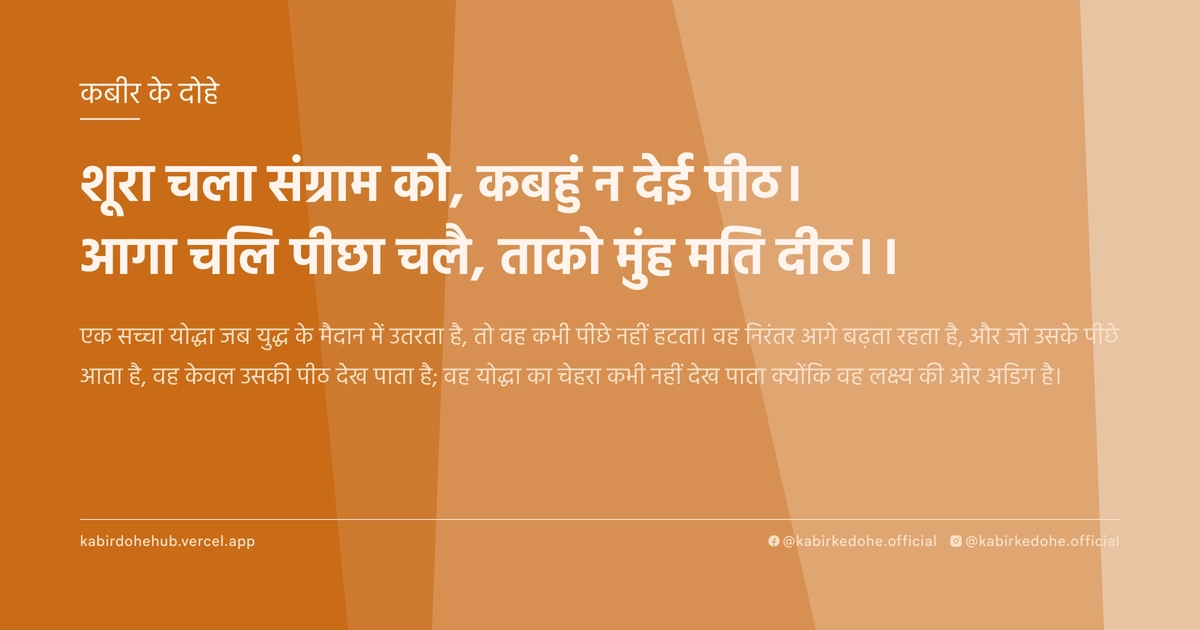
शूरा चला संग्राम को, कबहुं न देई पीठ।
आगा चलि पीछा चलै, ताको मुंह मति दीठ।।
Shura chala sangram ko, kabhun na dei peeth. Aaga chali peechha chalai, taako munh mati deeth.
इस पृष्ठ पर इस कबीर दोहे का अर्थ (meaning), हिंदी व्याख्या और अंग्रेज़ी अनुवाद, दार्शनिक विश्लेषण और व्यावहारिक जीवन सीख दी गई है। यह दोहा निष्ठा (Integrity) विषय से जुड़ा है — Kabir doha meaning and explanation in Hindi and English.
अर्थ (Meaning):
एक सच्चा योद्धा जब युद्ध के मैदान में उतरता है, तो वह कभी पीछे नहीं हटता। वह निरंतर आगे बढ़ता रहता है, और जो उसके पीछे आता है, वह केवल उसकी पीठ देख पाता है; वह योद्धा का चेहरा कभी नहीं देख पाता क्योंकि वह लक्ष्य की ओर अडिग है।
A true warrior, upon entering the battlefield of life, never retreats nor turns back. He advances with unwavering resolve; those who follow behind see only his back, for the warrior's face is forever fixed upon the ultimate goal, invisible to those who hesitate.
व्याख्या (Interpretation):
यहाँ 'संग्राम' बाहरी युद्ध नहीं, बल्कि अंतर्मन का संघर्ष है। 'शूरा' वह साधक है जिसने अपनी इंद्रियों और अहंकार पर विजय प्राप्त कर ली है। 'पीठ न देना' का अर्थ है कि एक बार सत्य के मार्ग पर चलने के बाद, संशय या मोह के कारण पीछे मुड़कर न देखना। यह निरगुण भक्ति का प्रतीक है जहाँ साधक माया के प्रलोभनों को त्यागकर शून्य की ओर बढ़ता है। जब हम अपनी वासनाओं के पीछे भागते हैं, तो हम वास्तव में अपने ही अहंकार की पीठ देख रहे होते हैं। आत्म-साक्षात्कार की प्रक्रिया में, जब साधक पूरी तरह समर्पित होता है, तो वह द्वैत से परे चला जाता है, जिससे वह सांसारिक दृष्टि से ओझल हो जाता है।
The 'battlefield' here is not a physical war but the internal struggle between the lower self and the higher consciousness. The 'warrior' represents the seeker who has mastered their senses and ego. 'Never turning one's back' signifies the absolute resolve of a practitioner who, once set on the path of Truth, refuses to succumb to doubt or worldly attachment. This is a metaphor for Nirgun Bhakti, where the seeker transcends the illusions of Maya to merge with the formless Divine. When we chase desires, we are merely following the shadow of our own ego. In the process of self-realization, the seeker becomes so absorbed in the Absolute that they vanish from the perception of those still trapped in duality.
दार्शनिक विश्लेषण (Philosophical Analysis):
कबीर का यह दोहा उस समय के सामाजिक और धार्मिक परिवेश में रचा गया था जहाँ बाहरी कर्मकांडों और जातिगत श्रेष्ठता का बोलबाला था। कबीर ने 'योद्धा' की परिभाषा को बदलकर उसे एक आंतरिक आध्यात्मिक योद्धा बना दिया। यह दृष्टिकोण अद्वैत वेदांत के उस सिद्धांत से मेल खाता है जहाँ जीव और ब्रह्म की एकता को प्राप्त करने के लिए अज्ञानता के अंधकार से लड़ना पड़ता है।
यहाँ कबीर सूफी मत के 'नफ्स' (अहंकार) के विनाश की बात करते हैं। जिस प्रकार एक सैनिक युद्ध में अपनी जान की परवाह नहीं करता, उसी प्रकार एक साधक को अपने 'मैं' (ego) की आहुति देनी पड़ती है। ritualism का विरोध करते हुए कबीर समझाते हैं कि मोक्ष मंदिर या मस्जिद में नहीं, बल्कि उस दृढ़ संकल्प में है जो मनुष्य को अपनी वासनाओं से लड़ने के लिए प्रेरित करता है।
मनोवैज्ञानिक स्तर पर, यह दोहा 'संज्ञानात्मक स्थिरता' की बात करता है। जब मन विचलित होता है, तो वह अतीत की यादों या भविष्य के डर में 'पीछे' मुड़ता है। सच्चा योद्धा वर्तमान क्षण में स्थित रहता है। यह 'स्थितप्रज्ञ' होने की अवस्था है, जहाँ बाहरी शोर और आंतरिक उथल-पुथल का प्रभाव समाप्त हो जाता है।
कबीर यह स्पष्ट करते हैं कि आध्यात्मिक मार्ग कोई सरल सैर नहीं है, बल्कि एक भीषण संग्राम है। इसमें सबसे बड़ा शत्रु स्वयं का अहंकार है। जो व्यक्ति अपनी कमजोरियों को पहचानकर उन्हें नष्ट करने का साहस रखता है, वही वास्तव में 'शूरा' है।
अंततः, यह दोहा हमें सिखाता है कि सत्य की खोज में कोई समझौता नहीं होता। या तो आप पूरी तरह समर्पित होते हैं, या आप केवल दूसरों की विजय को देखते रह जाते हैं। यह पूर्ण समर्पण (Prapatti) और आत्म-साक्षात्कार की अनिवार्य शर्त है।
Kabir composed this couplet during an era dominated by rigid ritualism and caste hierarchies. He redefined the concept of a 'warrior,' shifting it from a physical combatant to an internal spiritual seeker. This perspective aligns with Advaita Vedanta, where the realization of the oneness of Atman and Brahman requires a fierce battle against the darkness of ignorance.
Kabir draws upon the Sufi concept of 'Fana'—the annihilation of the lower self or 'Nafs.' Just as a soldier disregards their own life in battle, a seeker must sacrifice the 'I' (ego) to achieve union with the Divine. By rejecting ritualism, Kabir asserts that liberation is not found in temples or mosques, but in the unwavering resolve to fight one's own baser instincts.
Psychologically, this verse addresses the need for cognitive stability. A distracted mind constantly 'turns back' toward past regrets or future anxieties. The true warrior remains anchored in the present moment. This is the state of being 'Sthitaprajna' (steadfast in wisdom), where external noise and internal turmoil no longer disrupt the soul's equilibrium.
Kabir emphasizes that the spiritual path is not a leisurely stroll but a rigorous war. The primary adversary is the ego. Only the individual who possesses the courage to confront and dismantle their own psychological shadows can be termed a 'Shoora.'
Ultimately, the poem teaches that there is no compromise in the pursuit of Truth. One must either be entirely committed to the journey or remain a mere spectator of another's victory. This absolute surrender is the prerequisite for spiritual awakening.
मूल संदेश (Core Message):
- आंतरिक संघर्ष ही वास्तविक युद्ध है।
- अहंकार का त्याग ही सच्ची वीरता है।
- सत्य के मार्ग पर संशय का कोई स्थान नहीं।
- बाहरी शोर को अनदेखा कर अंतर्मन की सुनें।
- लक्ष्य के प्रति अडिगता ही मोक्ष का द्वार है।
- The internal struggle is the only real war.
- True bravery lies in the annihilation of the ego.
- There is no room for doubt on the path of Truth.
- Ignore the external noise and listen to the inner soul.
- Unwavering focus on the Goal is the gateway to liberation.
व्यावहारिक उदाहरण (Practical Example):
एक समय की बात है, वाराणसी के घाटों पर रहने वाला एक वृद्ध बुनकर था, जिसका नाम माधव था। माधव अपने जीवन के साठ साल केवल कपड़े बुनने और समाज की नजरों में एक 'साधारण' व्यक्ति बने रहने में बिता चुका था। वह हमेशा दूसरों की प्रशंसा और आलोचनाओं के बीच झूलता रहता था।
एक दिन उसने कबीर के इस दोहे को सुना। उसे महसूस हुआ कि वह अब तक केवल दूसरों की उम्मीदों के पीछे भाग रहा था, जैसे कोई डरपोक सैनिक युद्ध में पीछे हटता है। उसने तय किया कि वह अब अपनी आंतरिक शांति के लिए 'संग्राम' करेगा।
माधव ने सबसे पहले अपनी उस आदत को छोड़ा जहाँ वह हर छोटी बात पर दूसरों से अपनी श्रेष्ठता सिद्ध करना चाहता था। उसके पड़ोसी उसका मजाक उड़ाने लगे कि वह अब 'अहंकारी' नहीं रहा, बल्कि 'बेवकूफ' हो गया है।
लेकिन माधव ने पीछे मुड़कर नहीं देखा। उसने अपनी बुनाई को ही अपनी साधना बना लिया। वह धागों के बीच अपनी सांसों को गिनने लगा और हर ताने-बाने में ईश्वर का नाम जपने लगा।
शुरुआत में उसे बहुत कठिनाई हुई। उसका मन उसे बार-बार याद दिलाता कि लोग क्या कहेंगे, उसकी प्रतिष्ठा क्या होगी। यह उसका आंतरिक युद्ध था।
धीरे-धीरे, माधव का चेहरा बदल गया। उसकी आँखों में एक ऐसी स्थिरता आई जो पहले कभी नहीं थी। वह अब बाहरी प्रशंसा का भूखा नहीं था।
एक दिन शहर का एक बड़ा सेठ उसके पास आया और उसे बहुत अधिक धन का लालच देकर अपने यहाँ काम करने को कहा, लेकिन शर्त यह थी कि वह सेठ की चापलूसी करे।
माधव ने विनम्रता से मना कर दिया। उसने महसूस किया कि यदि वह अब वापस उस चापलूसी के मार्ग पर गया, तो वह फिर से 'पीठ' दिखाएगा।
उसने अपनी गरीबी को स्वीकार किया लेकिन अपनी शांति को नहीं खोया। वह अब एक सच्चा योद्धा बन चुका था, जिसने अपनी वासनाओं को जीत लिया था।
अंत में, माधव की शांति देखकर वही लोग जो उसका मजाक उड़ाते थे, उसके पास मार्गदर्शन के लिए आने लगे। उन्होंने देखा कि माधव अब उस लक्ष्य की ओर बढ़ चुका है जहाँ दुनिया की कोई भी चीज उसे विचलित नहीं कर सकती थी।
Once, in the ghats of Varanasi, lived an elderly weaver named Madhav. For sixty years, Madhav had spent his life weaving cloth and remaining a 'common' man in the eyes of society, constantly swinging between the praise and criticism of others.
One day, he heard this specific Doha of Kabir. He realized that he had spent his entire life chasing the expectations of others, much like a cowardly soldier retreating from a battlefield.
Madhav decided that he would now wage a 'war' for his own internal peace. He began by abandoning the habit of trying to prove his superiority to others in every small conversation.
His neighbors began to mock him, saying he was no longer 'proud' but had simply become 'foolish.' However, Madhav did not look back. He turned his weaving into a spiritual practice.
He started counting his breaths between the threads and chanting the name of the Divine with every weave of the loom. Initially, it was incredibly difficult. His mind constantly reminded him of his social standing and what people would say.
This was his internal battle. Slowly, Madhav's countenance changed. A stillness appeared in his eyes that had never been there before. He was no longer hungry for external validation.
One day, a wealthy merchant came to him and offered a vast sum of money to work for him, on the condition that Madhav would flatter the merchant's ego.
Madhav politely declined. He realized that if he returned to the path of flattery, he would once again be 'turning his back' on the Truth.
He accepted his poverty but refused to surrender his peace. He had finally become a true warrior who had conquered his own desires.
Eventually, those who had mocked him began to seek his guidance. They saw that Madhav had advanced toward a goal where nothing in the material world could disturb his resolve.
अभ्यास मार्गदर्शन (Practice Guidance):
- प्रतिदिन 20 मिनट मौन ध्यान करें, जहाँ आप अपने मन में उठने वाले द्वंद्वों को एक योद्धा की तरह देखें, उनसे डरें नहीं बल्कि उन्हें साक्षी भाव से देखें।
- एक 'अहंकार डायरी' लिखें: दिन भर में जब भी आपने किसी की प्रशंसा पाने के लिए झूठ बोला या अपनी श्रेष्ठता सिद्ध की, उसे लिखें और विश्लेषण करें कि वह कौन सा 'डर' था जिसने आपको पीछे मोड़ा।
- व्यवहार परिवर्तन: किसी भी कार्य को शुरू करने के बाद, परिणाम की चिंता में या दूसरों की राय के कारण उसे बीच में न छोड़ें। पूर्णता तक पहुँचने का अभ्यास करें।
- डायग्नोस्टिक चेकलिस्ट: क्या मैं अभी भी दूसरों की राय से विचलित होता हूँ? क्या मैं अपनी गलतियों को स्वीकार करने के बजाय बहाने बनाता हूँ? क्या मेरा ध्यान लक्ष्य से ज्यादा इस बात पर है कि लोग मुझे कैसे देख रहे हैं?
- Practice 20 minutes of silent meditation daily, observing the conflicts arising in your mind like a warrior—not with fear, but with the detachment of a witness.
- Maintain an 'Ego Journal': Record every instance during the day where you lied for praise or tried to prove your superiority, and analyze the fear that made you 'turn back.'
- Behavioral Shift: Once you commit to a task, do not abandon it due to anxiety over the result or others' opinions. Practice completing the action with absolute resolve.
- Diagnostic Checklist: Am I still swayed by others' opinions? Do I make excuses instead of owning my mistakes? Is my focus more on how I am perceived than on the goal itself?
चिंतन प्रश्न (Reflection Questions):
- मेरी वह कौन सी 'पीठ' है जिसे मैं दुनिया से छिपाता हूँ, लेकिन वह मुझे आगे बढ़ने से रोकती है?
- क्या मेरी आध्यात्मिक खोज वास्तव में सत्य के लिए है, या यह केवल मेरी 'आध्यात्मिक श्रेष्ठता' का एक नया मुखौटा है?
- जब मैं अकेले होता हूँ, तो क्या मैं वही योद्धा हूँ जो मैं समाज के सामने होने का दावा करता हूँ?
- मेरे जीवन का वह कौन सा 'संग्राम' है जिससे मैं अब तक भागता रहा हूँ?
- यदि मेरी सारी सामाजिक पहचान छीन ली जाए, तो क्या मेरे भीतर कोई ऐसा योद्धा बचेगा जो शून्य में भी अडिग रहे?
- What is the 'back' that I hide from the world, yet prevents me from moving forward?
- Is my spiritual quest truly for Truth, or is it merely a new mask for my 'spiritual superiority'?
- When I am alone, am I the same warrior I claim to be in front of society?
- What is the specific 'battle' in my life that I have been avoiding until now?
- If all my social identities were stripped away, would there be a warrior left within me who remains steadfast even in the void?