
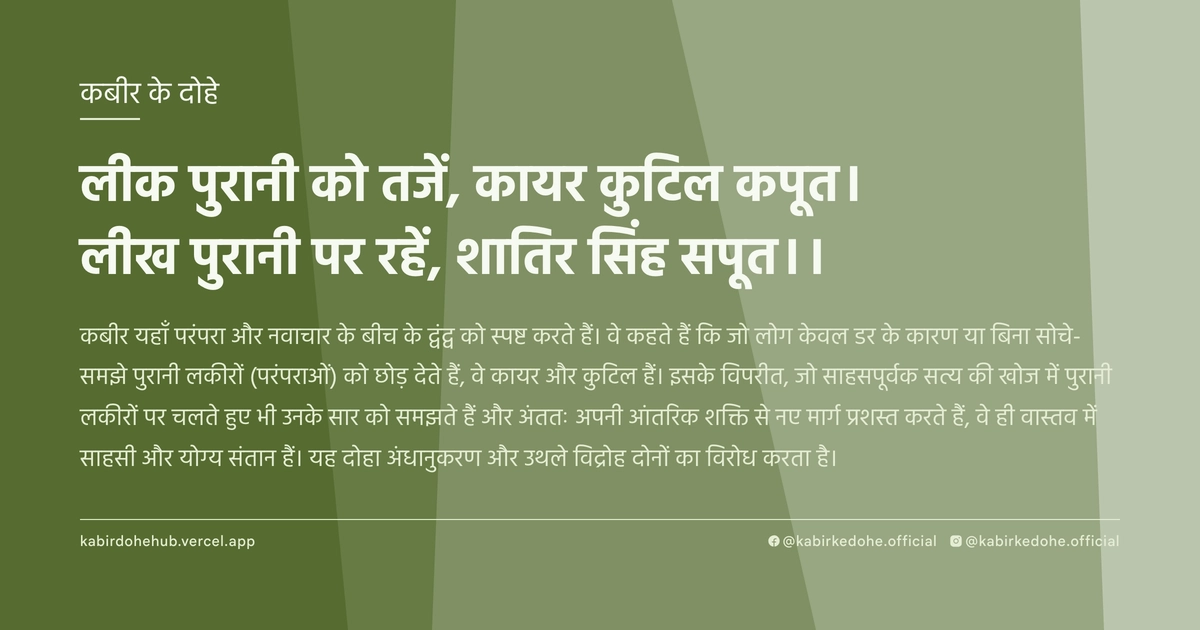
लीक पुरानी को तजें, कायर कुटिल कपूत।
लीख पुरानी पर रहें, शातिर सिंह सपूत।।
Leek purani ko taje, kayar kutil kapoot. Leekh purani par rahein, shatir singh sapoot.
इस पृष्ठ पर इस कबीर दोहे का अर्थ (meaning), हिंदी व्याख्या और अंग्रेज़ी अनुवाद, दार्शनिक विश्लेषण और व्यावहारिक जीवन सीख दी गई है। यह दोहा निष्ठा (Integrity) विषय से जुड़ा है — Kabir doha meaning and explanation in Hindi and English.
अर्थ (Meaning):
कबीर यहाँ परंपरा और नवाचार के बीच के द्वंद्व को स्पष्ट करते हैं। वे कहते हैं कि जो लोग केवल डर के कारण या बिना सोचे-समझे पुरानी लकीरों (परंपराओं) को छोड़ देते हैं, वे कायर और कुटिल हैं। इसके विपरीत, जो साहसपूर्वक सत्य की खोज में पुरानी लकीरों पर चलते हुए भी उनके सार को समझते हैं और अंततः अपनी आंतरिक शक्ति से नए मार्ग प्रशस्त करते हैं, वे ही वास्तव में साहसी और योग्य संतान हैं। यह दोहा अंधानुकरण और उथले विद्रोह दोनों का विरोध करता है।
Kabir addresses the tension between tradition and innovation. He suggests that those who abandon ancestral paths out of cowardice or malice are misguided. Conversely, those who have the courage to walk the established path—not out of blind faith, but to master it and eventually transcend it—are the truly brave and worthy. He warns against both the mindless following of rituals and the superficial rebellion that lacks spiritual grounding, urging a conscious engagement with truth.
व्याख्या (Interpretation):
शाब्दिक अर्थ में, यह दोहा पुरानी राहों को छोड़ने या अपनाने की बात करता है, लेकिन आध्यात्मिक स्तर पर यह 'साधना' और 'अहंकार' के बीच का अंतर है। 'लीक पुरानी' यहाँ केवल सामाजिक रीति-रिवाजों का नहीं, बल्कि उन आध्यात्मिक अनुशासनों का प्रतीक है जो सदियों से चले आ रहे हैं। कायर वह है जो चुनौती से डरकर मार्ग बदल लेता है, जबकि 'सिंह सपूत' वह है जो परंपरा की गहराई में उतरकर उसके वास्तविक सत्य को खोजता है। यह निर्गुण भक्ति का वह पहलू है जहाँ साधक बाहरी आडंबरों को त्यागता है, लेकिन आंतरिक अनुशासन को नहीं। यहाँ माया का खेल यह है कि मनुष्य अक्सर विद्रोह को ही प्रगति मान लेता है, जबकि वास्तविक प्रगति आत्म-साक्षात्कार (Atman-Brahman non-duality) में है। जब तक साधक अपनी जड़ों को नहीं समझता, वह शून्य में भटकता रहता है। अंततः, यह दोहा इस विरोधाभास को दर्शाता है कि सत्य तक पहुँचने के लिए कभी-कभी सबसे पुराने रास्तों पर चलना पड़ता है, बशर्ते चलने वाला जागरूक हो।
Literally, the couplet discusses abandoning or following old paths, but metaphorically, it distinguishes between spiritual discipline and ego-driven rebellion. The 'old path' (leek purani) symbolizes not just social customs, but the rigorous spiritual frameworks established by sages. The 'coward' is one who deviates from the path due to fear or intellectual arrogance, whereas the 'lion-hearted son' is the one who engages deeply with tradition to extract its essence. This aligns with Nirgun Bhakti, where the seeker rejects external ritualism but embraces internal discipline. Maya creates the illusion that mere rebellion is equivalent to enlightenment; however, true liberation occurs through the realization of non-duality (Advaita). The paradox presented is that to innovate spiritually, one must first master the foundational truths of the past. Only by walking the path with full consciousness can one eventually transcend the path itself, moving from the relative truth to the absolute truth of Brahman.
दार्शनिक विश्लेषण (Philosophical Analysis):
कबीर का यह दोहा उनके युग के सामाजिक और धार्मिक संक्रमण काल का प्रतिबिंब है। उस समय समाज दो चरम सीमाओं में बंटा था: एक तरफ वे थे जो कट्टरता के साथ मृत परंपराओं को पकड़े हुए थे, और दूसरी तरफ वे जो बिना किसी आधार के धर्म का त्याग कर रहे थे। कबीर ने यहाँ 'मध्यम मार्ग' की वकालत की है, जो बौद्ध धर्म और सूफीवाद के करीब है। वे जातिवाद और कर्मकांडों का विरोध करते थे, लेकिन वे 'गुरु' और 'अनुशासन' के महत्व को कभी नहीं भूले। उनके लिए, परंपरा का त्याग तब तक व्यर्थ है जब तक कि वह आंतरिक रूपांतरण से प्रेरित न हो।
अद्वैत वेदांत के परिप्रेक्ष्य में, यह दोहा 'अविद्या' (अज्ञान) और 'विद्या' (ज्ञान) के बीच के संघर्ष को दर्शाता है। जब कोई व्यक्ति केवल अहंकारवश परंपरा छोड़ता है, तो वह वास्तव में एक अज्ञान से दूसरे अज्ञान की ओर जाता है। वास्तविक साहस वह है जो सत्य की खोज में स्वयं को तपाता है। सूफी मत में इसे 'फना' (अहंकार का विनाश) कहा गया है। जब तक साधक का 'मैं' जीवित है, वह चाहे परंपरा का पालन करे या उसका विरोध, वह बंधन में ही है।
कबीर का दर्शन यह है कि सत्य किसी विशेष धर्म या संप्रदाय की जागीर नहीं है। उन्होंने यह स्पष्ट किया कि केवल बाहरी बदलाव (जैसे कपड़े बदलना या नाम बदलना) आध्यात्मिक प्रगति नहीं है। वास्तविक प्रगति तब होती है जब व्यक्ति अपनी चेतना को विस्तृत करता है। वे उन लोगों पर प्रहार करते हैं जो 'आधुनिक' दिखने के लिए अपनी जड़ों को काट देते हैं, क्योंकि बिना जड़ के पेड़ कभी फल नहीं दे सकता।
मनोवैज्ञानिक स्तर पर, यह दोहा संज्ञानात्मक विसंगति (cognitive dissonance) को संबोधित करता है। मनुष्य अक्सर अपनी असफलताओं को छिपाने के लिए परंपराओं को दोष देता है। कबीर कहते हैं कि अपनी कमजोरियों को परंपरा के नाम पर छिपाना कायरता है। साहस का अर्थ है अपनी कमियों को स्वीकार करना और फिर भी सत्य के मार्ग पर अडिग रहना।
अंततः, यह शिक्षण हमें सिखाता है कि परंपरा एक मानचित्र की तरह है। मानचित्र को जला देने से मंजिल नहीं मिलती; बल्कि मानचित्र को समझकर, उस पर चलकर, और अंत में जब मंजिल मिल जाए, तब मानचित्र की आवश्यकता समाप्त हो जाती है। यही वह बिंदु है जहाँ 'सिंह सपूत' अपनी स्वयं की नई लीक बनाता है, जो वास्तव में सार्वभौमिक सत्य की लीक होती है।
This couplet reflects the socio-religious transition of Kabir's era, where society was polarized between rigid traditionalists and superficial rebels. Kabir advocates for a 'Middle Path,' echoing Buddhist and Sufi sensibilities. While he vehemently rejected caste hierarchies and empty rituals, he never dismissed the necessity of a Guru or spiritual discipline. For Kabir, abandoning tradition is futile if the motivation is merely ego or avoidance of effort, rather than a genuine internal transformation.
From the lens of Advaita Vedanta, the verse highlights the struggle between Avidya (ignorance) and Vidya (knowledge). When a person rejects tradition out of arrogance, they are simply moving from one form of ignorance to another. True courage lies in the willingness to undergo the rigorous process of self-purification. In Sufism, this mirrors the concept of 'Fana'—the annihilation of the ego. As long as the 'I' persists, whether in conformity or rebellion, the seeker remains bound by the illusion of duality.
Kabir's philosophy posits that Truth is not the monopoly of any specific religion or sect. He argues that external changes—such as changing one's attire or nomenclature—do not constitute spiritual progress. Real evolution occurs when the consciousness expands. He critiques those who sever their roots to appear 'modern' or 'enlightened,' noting that a tree without roots can never bear fruit.
Psychologically, the verse addresses cognitive dissonance. Humans often blame tradition to mask their own failures or lack of discipline. Kabir asserts that using tradition as a scapegoat for one's shortcomings is an act of cowardice. Courage is the ability to confront one's shadows while remaining steadfast on the path of Truth.
Ultimately, this teaching suggests that tradition is like a map. Burning the map does not bring one closer to the destination; rather, one must study the map, walk the terrain, and only upon reaching the destination does the map become obsolete. This is the moment the 'lion-hearted son' creates a new path, which is actually the universal path of Eternal Truth.
मूल संदेश (Core Message):
- अंधानुकरण और उथले विद्रोह दोनों ही आध्यात्मिक बंधन हैं।
- सच्चा साहस अनुशासन के माध्यम से आत्म-विजय में निहित है।
- परंपरा एक आधार है, मंजिल नहीं; इसे समझें फिर पार करें।
- अहंकारवश किया गया त्याग वास्तव में एक मानसिक पलायन है।
- आंतरिक रूपांतरण ही पुरानी लकीरों को सार्थक बनाता है।
- Both blind conformity and superficial rebellion are spiritual shackles.
- True courage lies in achieving self-mastery through rigorous discipline.
- Tradition is a foundation, not the destination; understand it, then transcend it.
- Renunciation driven by ego is actually a psychological escape.
- Internal transformation is what gives meaning to the old paths.
व्यावहारिक उदाहरण (Practical Example):
एक समय की बात है, वाराणसी के एक पुराने मोहल्ले में माधव नाम का एक बुनकर रहता था। माधव के पूर्वज पीढ़ियों से एक विशेष प्रकार की जटिल बुनाई करते थे, जिसे 'शाश्वत ताना-बाना' कहा जाता था। यह कला कठिन थी और इसमें वर्षों का धैर्य चाहिए था। माधव के समय में, शहर में नए और सस्ते कपड़े आने लगे थे। माधव के साथी बुनकर कहने लगे, 'यह पुरानी पद्धति बेकार है, समय बर्बाद करती है। हमें नई मशीनों और सरल डिजाइनों को अपनाना चाहिए।'
माधव ने देखा कि उसके साथी अपनी परंपरा को छोड़कर जल्दी पैसा कमाने की दौड़ में लग गए। उन्होंने पुरानी लकीर को 'कायरता' और 'पिछड़ापन' कहकर त्याग दिया। लेकिन कुछ समय बाद, वे सभी एक जैसे साधारण कपड़े बनाने लगे और उनकी कला की मौलिकता समाप्त हो गई। वे बाजार की माँग के गुलाम बन गए, उनकी अपनी कोई पहचान नहीं रही।
माधव ने एक अलग रास्ता चुना। उसने पुरानी पद्धति को छोड़ा नहीं, बल्कि उसे पूरी गहराई से सीखा। उसने अपने पिता और दादा के पुराने नुस्खों को समझा, उनकी गलतियों को पहचाना और उस कठिन बुनाई में रात-दिन एक कर दिया। शुरुआत में लोग उसका मजाक उड़ाते थे कि वह एक 'पुरानी लीक' पर चल रहा है।
लेकिन माधव का उद्देश्य केवल नकल करना नहीं था। वह उस परंपरा के सार को समझना चाहता था। जब उसने उस कला में महारत हासिल कर ली, तो उसे एहसास हुआ कि पुरानी पद्धति में एक विशेष प्रकार का आध्यात्मिक संतुलन था। उसने उस प्राचीन ज्ञान को आधुनिक रंगों और नए डिजाइनों के साथ जोड़ा।
एक दिन, एक विदेशी कला पारखी उसकी दुकान पर आया। उसने माधव के कपड़ों में वह गहराई और आत्मा देखी जो मशीनी कपड़ों में नहीं थी। उसने कहा, 'तुमने परंपरा को केवल निभाया नहीं, बल्कि उसे पुनर्जीवित किया है।'
माधव की सफलता का राज यह था कि उसने परंपरा को 'बोझ' नहीं, बल्कि 'सीढ़ी' माना। उसने पहले उस लीक पर चलना सीखा, फिर उस लीक की सीमाओं को समझा, और अंत में अपनी रचनात्मकता से एक नई लीक बनाई।
उसके साथी, जिन्होंने परंपरा को केवल इसलिए छोड़ा क्योंकि वह कठिन थी, अब माधव के पास काम माँगने आते थे। वे समझ गए थे कि बिना आधार के किया गया विद्रोह केवल पलायन है, प्रगति नहीं।
माधव अब केवल एक बुनकर नहीं था, वह एक गुरु बन चुका था। उसने सिखाया कि साहस पुरानी लकीर को मिटाने में नहीं, बल्कि उसे पार करने की क्षमता विकसित करने में है।
Once in an ancient neighborhood of Varanasi, there lived a weaver named Madhav. For generations, his ancestors had practiced a complex weaving style known as the 'Eternal Warp and Weft.' This art was grueling and required years of immense patience. In Madhav's time, cheap, mass-produced fabrics began flooding the city. His fellow weavers argued, 'This old method is useless; it wastes time. We must embrace new machines and simpler designs.'
Madhav observed his peers abandoning their heritage in a rush for quick profit. They dismissed the old path as 'cowardice' and 'backwardness.' However, after some time, they all began producing identical, soulless fabrics. Their originality vanished, and they became slaves to market demands, losing their unique identity.
Madhav chose a different path. He did not abandon the old method; instead, he immersed himself in it. He studied the ancient techniques of his father and grandfather, identified their flaws, and dedicated his nights and days to mastering that difficult weave. Initially, people mocked him for clinging to an 'old track.'
But Madhav's goal was not mere imitation. He wanted to understand the essence of the tradition. Once he achieved mastery, he realized that the old method possessed a specific spiritual balance. He then integrated that ancient wisdom with modern colors and contemporary designs.
One day, a foreign art connoisseur visited his shop. He saw a depth and soul in Madhav's work that was absent in machine-made clothes. He remarked, 'You haven't just followed tradition; you have revitalized it.'
The secret to Madhav's success was that he viewed tradition not as a burden, but as a ladder. He first learned to walk the old path, then understood its limitations, and finally used his creativity to carve a new path.
His peers, who had abandoned tradition simply because it was difficult, now came to Madhav seeking work. They realized that rebellion without a foundation is merely escape, not progress.
Madhav was no longer just a weaver; he had become a master. He taught that courage does not lie in erasing the old track, but in developing the capacity to transcend it.
अभ्यास मार्गदर्शन (Practice Guidance):
- प्रतिदिन 15 मिनट मौन रहकर विचार करें कि आपके जीवन में कौन सी आदतें 'अंधानुकरण' हैं और कौन सी 'सचेत चुनाव'।
- एक 'स्व-पूछताछ जर्नल' बनाएँ: जब भी आप किसी परंपरा का विरोध करें, खुद से पूछें—'क्या मैं इसे सत्य की खोज के लिए छोड़ रहा हूँ, या केवल कठिनाई से बचने के लिए?'
- व्यवहार परिवर्तन: किसी भी पुरानी पद्धति को छोड़ने से पहले, उसे उसकी पूर्णता में एक बार निष्ठापूर्वक निभाने का प्रयास करें।
- निदान चेकलिस्ट: यदि आप दूसरों की आलोचना करते हैं लेकिन स्वयं के अनुशासन में विफल हैं, तो आप 'कायर' श्रेणी में हैं। यदि आप अनुशासन का पालन करते हुए उसमें सुधार लाते हैं, तो आप 'सिंह सपूत' हैं।
- Spend 15 minutes in daily silence contemplating which of your habits are 'blind imitations' and which are 'conscious choices.'
- Maintain a 'Self-Inquiry Journal': Whenever you rebel against a tradition, ask yourself—'Am I abandoning this in search of Truth, or simply to avoid the hardship of discipline?'
- Behavioral Shift: Before discarding any old method or tradition, attempt to practice it with absolute sincerity and completeness at least once.
- Diagnostic Checklist: If you criticize others' traditions while failing in your own self-discipline, you are in the 'coward' category. If you follow a discipline while consciously evolving it, you are the 'lion-hearted son.'
चिंतन प्रश्न (Reflection Questions):
- क्या मेरा 'आधुनिक' होना वास्तव में प्रगति है, या यह केवल पुरानी जिम्मेदारियों से भागने का एक तरीका है?
- मेरे व्यक्तित्व का वह कौन सा हिस्सा है जो केवल इसलिए दूसरों से अलग दिखना चाहता है क्योंकि वह अंदर से कमजोर है?
- क्या मैं उन परंपराओं का सम्मान कर सकता हूँ जिन्हें मैं गलत मानता हूँ, ताकि मैं उनके मूल सत्य को समझ सकूँ?
- मेरी डिजिटल पहचान (Social Media Ego) मुझे किस प्रकार की 'नई लीक' बनाने के लिए उकसा रही है, और क्या वह सत्य पर आधारित है?
- यदि मैं आज अपनी सभी मान्यताओं को छोड़ दूँ, तो क्या मेरे पास कोई आंतरिक धुरी (Inner Axis) बचेगी?
- Is my 'modernity' actually progress, or is it merely a way to escape old responsibilities?
- Which part of my personality seeks to appear different from others simply because it is internally fragile?
- Can I respect the traditions I deem incorrect in order to understand the core truth they were meant to protect?
- How is my digital identity (Social Media Ego) pushing me to create a 'new path,' and is that path based on Truth?
- If I were to strip away all my inherited beliefs today, would there be any inner axis remaining within me?