
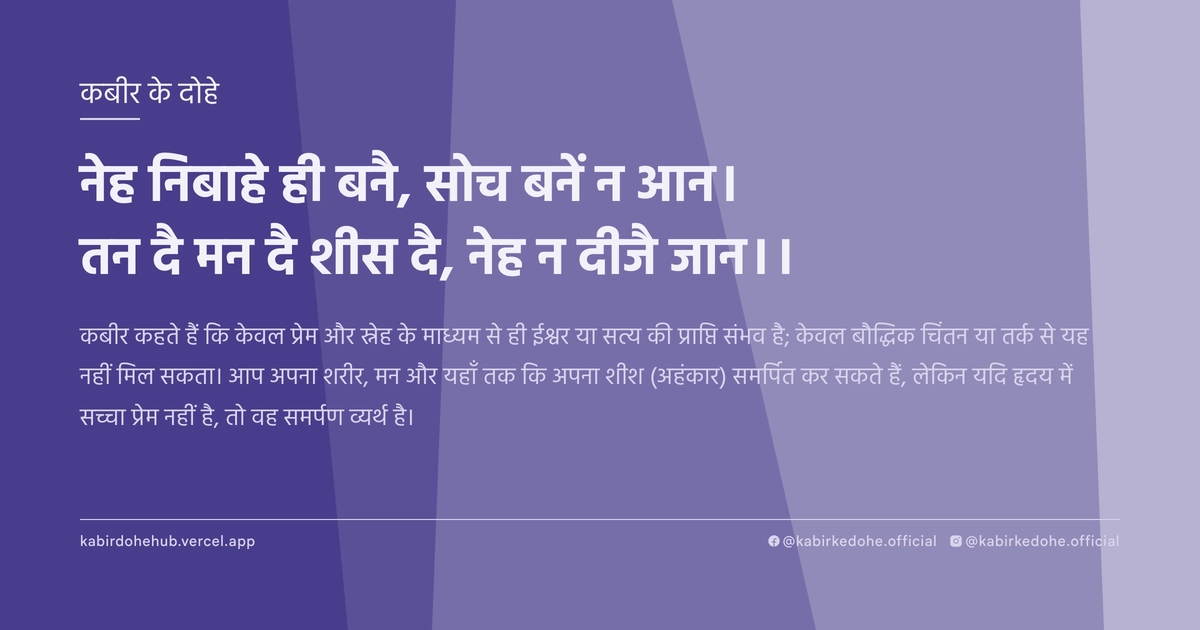
नेह निबाहे ही बनै, सोच बनें न आन।
तन दै मन दै शीस दै, नेह न दीजै जान।।
Neh nibahe hi banai, soch banain na aan. Tan dai man dai shees dai, neh na deeje jaan.
इस पृष्ठ पर इस कबीर दोहे का अर्थ (meaning), हिंदी व्याख्या और अंग्रेज़ी अनुवाद, दार्शनिक विश्लेषण और व्यावहारिक जीवन सीख दी गई है। यह दोहा भक्ति (Bhakti) विषय से जुड़ा है — Kabir doha meaning and explanation in Hindi and English.
अर्थ (Meaning):
कबीर कहते हैं कि केवल प्रेम और स्नेह के माध्यम से ही ईश्वर या सत्य की प्राप्ति संभव है; केवल बौद्धिक चिंतन या तर्क से यह नहीं मिल सकता। आप अपना शरीर, मन और यहाँ तक कि अपना शीश (अहंकार) समर्पित कर सकते हैं, लेकिन यदि हृदय में सच्चा प्रेम नहीं है, तो वह समर्पण व्यर्थ है।
Kabir asserts that only through the cultivation of selfless love and devotion can one attain the Divine or ultimate Truth; intellectual reasoning and mere contemplation are insufficient. One may offer their body, their mind, and even their head in sacrifice, but if the essence of true love is missing, such offerings remain devoid of spiritual value.
व्याख्या (Interpretation):
यह दोहा प्रेम की सर्वोच्चता को स्थापित करता है। यहाँ 'सोच' का अर्थ केवल विचार नहीं, बल्कि वह बौद्धिक अहंकार है जो तर्क के माध्यम से ईश्वर को खोजने का प्रयास करता है। कबीर निरगुण भक्ति के प्रणेता हैं, जहाँ ईश्वर किसी मूर्ति में नहीं बल्कि हृदय के प्रेम में बसता है। 'तन, मन और शीश' का समर्पण बाहरी कर्मकांडों और शारीरिक तपस्या का प्रतीक है, जो अक्सर अहंकार को बढ़ाते हैं। जब तक 'नेह' यानी निस्वार्थ प्रेम नहीं आता, तब तक साधक माया के जाल में फंसा रहता है। यह अद्वैत वेदांत के उस सत्य को दर्शाता है जहाँ ज्ञाता और ज्ञेय के बीच का अंतर केवल प्रेम के सेतु से मिटाया जा सकता है। अंततः, यह दोहा सिखाता है कि ज्ञान मार्ग (Jnana Marga) अधूरा है यदि वह भक्ति मार्ग (Bhakti Marga) के बिना है।
This couplet establishes the absolute supremacy of love over intellect. Here, 'soch' refers not merely to thought, but to the intellectual ego that attempts to capture the Divine through logic and categorization. As a proponent of Nirgun Bhakti, Kabir suggests that the Formless Absolute resides not in idols, but in the purity of the heart's affection. The offering of 'body, mind, and head' symbolizes external rituals and physical austerities, which often inadvertently inflate the ego. Until 'neh'—unconditional, selfless love—is awakened, the seeker remains imprisoned by Maya, the cosmic illusion. This aligns with Advaita Vedanta, where the perceived duality between the seeker and the Sought is dissolved only through the alchemy of love. Ultimately, the verse teaches that the path of knowledge (Jnana) is incomplete if it is not infused with the essence of devotion (Bhakti).
दार्शनिक विश्लेषण (Philosophical Analysis):
कबीर का यह विचार उनके युग के धार्मिक पाखंड और कट्टरता के विरुद्ध एक सशक्त प्रहार था। उस समय धर्म को केवल नियमों, अनुष्ठानों और जातिगत श्रेष्ठता के रूप में देखा जाता था। कबीर ने इस व्यवस्था को चुनौती देते हुए यह स्पष्ट किया कि ईश्वर तक पहुँचने का एकमात्र मार्ग 'प्रेम' है, जो किसी जाति, धर्म या शास्त्र का मोहताज नहीं है। यह दृष्टिकोण सूफी मत के 'इश्क-ए-हकीकी' (ईश्वरीय प्रेम) से गहराई से मेल खाता है, जहाँ प्रेमी और प्रियतम का विलीनीकरण ही अंतिम लक्ष्य है।
दार्शनिक स्तर पर, कबीर यहाँ 'अहंकार' और 'समर्पण' के बीच के सूक्ष्म अंतर को समझा रहे हैं। जब कोई कहता है कि "मैंने अपना सब कुछ त्याग दिया", तो वह 'त्याग' ही एक नया अहंकार बन जाता है। शरीर और मन का दान यदि इस भाव से किया जाए कि "मैं यह कर रहा हूँ", तो वह केवल एक सौदा है। वास्तविक समर्पण वह है जहाँ 'मैं' पूरी तरह मिट जाए और केवल 'प्रेम' शेष रहे। यह शून्य की अवस्था है, जहाँ द्वैत समाप्त हो जाता है।
अद्वैत वेदांत के संदर्भ में, यह दोहा आत्मा और ब्रह्म की एकता की बात करता है। जब तक मनुष्य अपनी पहचान को शरीर या मन से जोड़ता है, वह अलग महसूस करता है। प्रेम वह अग्नि है जो इस झूठे अलगाव को जला देती है। कबीर का तर्क है कि बौद्धिक विश्लेषण (सोच) केवल शब्दों का जाल बुनता है, जबकि प्रेम सीधे अनुभव (Anubhava) की ओर ले जाता है।
मनोवैज्ञानिक रूप से, यह दोहा व्यक्ति को अपनी बौद्धिक सुरक्षा (Intellectual Defense) को छोड़ने के लिए प्रेरित करता है। हम अक्सर कठिन प्रश्नों के उत्तर तर्क से खोजने की कोशिश करते हैं ताकि हमें अपनी भावनाओं का सामना न करना पड़े। कबीर कहते हैं कि सत्य तर्क की परिधि से बाहर है; इसे केवल महसूस किया जा सकता है।
अंततः, यह संदेश ritualism (कर्मकांड) की निरर्थकता को सिद्ध करता है। मंदिर, मस्जिद या तीर्थयात्राएं केवल बाहरी आवरण हैं। यदि हृदय में करुणा और प्रेम नहीं है, तो ये सभी क्रियाएं केवल मानसिक व्यायाम हैं। वास्तविक धर्म वह है जो मनुष्य को दूसरे मनुष्य से और अंततः परमात्मा से प्रेम करना सिखाए।
Kabir's insight serves as a potent critique of the religious hypocrisy and rigid orthodoxy of his era. During his time, spirituality was often reduced to a set of rules, rituals, and caste-based hierarchies. Kabir challenged this structure, asserting that the only authentic gateway to the Divine is 'Love'—a force that transcends caste, creed, and scriptural boundaries. This perspective resonates deeply with the Sufi concept of 'Ishq-e-Haqiqi' (Divine Love), where the ultimate goal is the annihilation of the self into the Beloved.
On a philosophical level, Kabir distinguishes between 'egoic sacrifice' and 'true surrender'. When a practitioner claims, "I have renounced everything," the act of renunciation itself becomes a new form of ego. Offering the body and mind, if done with the consciousness of "I am the giver," is merely a spiritual transaction. True surrender occurs only when the 'I' is completely obliterated, leaving only Love behind. This is the state of Shunya (Void), where all duality ceases to exist.
In the context of Advaita Vedanta, this verse speaks to the non-duality of Atman and Brahman. As long as a human identifies themselves with the physical body or the fluctuating mind, they experience separation. Love is the alchemical fire that burns away this illusion of separation. Kabir argues that intellectual analysis (soch) merely weaves a web of words, whereas love leads directly to experiential realization (Anubhava).
Psychologically, the couplet urges the individual to drop their 'intellectual defenses'. We often attempt to solve spiritual mysteries through logic to avoid the vulnerability of emotional openness. Kabir suggests that Truth lies beyond the perimeter of logic; it can only be felt, not calculated.
Ultimately, this message exposes the futility of ritualism. Temples, mosques, and pilgrimages are mere external shells. If the heart lacks compassion and love, these actions are nothing more than mental gymnastics. True religion is that which teaches a human to love another human, and through that, to love the Universal Soul.
मूल संदेश (Core Message):
- बौद्धिक अहंकार सत्य की प्राप्ति में सबसे बड़ी बाधा है।
- तर्क मस्तिष्क को संतुष्ट करता है, लेकिन प्रेम आत्मा को तृप्त करता है।
- बाहरी त्याग व्यर्थ है यदि हृदय में करुणा का अभाव हो।
- सच्चा समर्पण 'मैं' के विलीनीकरण में निहित है।
- प्रेम ही वह एकमात्र सेतु है जो मनुष्य को परमात्मा से जोड़ता है।
- Intellectual pride is the greatest obstacle to realizing the Truth.
- Logic satisfies the mind, but love nourishes the soul.
- External sacrifice is futile if the heart lacks compassion.
- True surrender lies in the complete dissolution of the 'I'.
- Love is the only bridge that connects the human to the Divine.
व्यावहारिक उदाहरण (Practical Example):
एक समय की बात है, वाराणसी के घाटों पर माधव नाम का एक वृद्ध बुनकर रहता था। माधव अपने जीवन के चालीस वर्ष केवल शास्त्रों के अध्ययन और कठिन तपस्या में बिता चुका था। वह शहर का सबसे बड़ा विद्वान माना जाता था और उसका मानना था कि ईश्वर को केवल गहन चिंतन और कठोर अनुशासन से पाया जा सकता है। वह हर दिन घंटों ध्यान लगाता और जटिल ग्रंथों की व्याख्या करता, लेकिन उसके हृदय में एक अजीब सी रिक्तता और अशांति बनी रहती थी।
उसी घाट के पास एक छोटी सी झोपड़ी में एक वृद्ध विधवा रहती थी, जिसे लोग 'काकी' कहते थे। काकी अनपढ़ थी, उसने कभी कोई शास्त्र नहीं पढ़ा था, लेकिन वह पूरे मोहल्ले की सेवा करती थी। वह बीमारों को दवा खिलाती, भूखों को रोटी देती और हर किसी के दुख में उनके साथ खड़ी रहती थी। माधव उसे अक्सर देखता और मन ही मन सोचता कि यह अनपढ़ स्त्री कैसे समय बर्बाद कर रही है, जबकि उसे एकांत में बैठकर मोक्ष का चिंतन करना चाहिए।
एक दिन माधव बहुत बीमार पड़ गया। उसकी तबीयत इतनी बिगड़ गई कि वह बिस्तर से उठ भी नहीं पा रहा था। उसके वे सभी शिष्य, जिन्हें उसने तर्क और शास्त्र पढ़ाए थे, उसकी बीमारी के डर से या अपने व्यस्त समय का हवाला देकर दूर हो गए। माधव ने महसूस किया कि उसके पास ज्ञान का पहाड़ तो था, लेकिन उस ज्ञान को साझा करने वाला या उसकी सेवा करने वाला कोई नहीं था।
तभी काकी उसके घर आई। उसने बिना किसी सवाल के माधव की सेवा शुरू कर दी। वह उसके माथे पर ठंडी पट्टियाँ रखती, उसे समय पर दवा देती और रात-भर जागकर उसकी देखभाल करती। माधव ने देखा कि काकी की आँखों में उसके लिए कोई स्वार्थ नहीं था, केवल एक निस्वार्थ प्रेम था। वह माधव को केवल एक 'विद्वान' के रूप में नहीं, बल्कि एक 'दुखी मनुष्य' के रूप में देख रही थी।
एक रात, जब माधव की चेतना धीरे-धीरे लौट रही थी, उसने काकी को अपने पैरों के पास सोए हुए देखा। अचानक उसे कबीर का वह दोहा याद आया—"तन दै मन दै शीस दै, नेह न दीजै जान"। उसे एहसास हुआ कि उसने अपना पूरा जीवन 'सोच' (बौद्धिक चिंतन) में बिता दिया, लेकिन उसने कभी 'नेह' (प्रेम) का अभ्यास नहीं किया।
उसने महसूस किया कि उसकी सारी तपस्या और शास्त्र-ज्ञान उसके अहंकार की दीवारें बन गए थे, जिन्होंने उसे मानवता से अलग कर दिया था। जबकि काकी, जिसने कभी कोई किताब नहीं छुई थी, अपने प्रेम के कारण ईश्वर के सबसे करीब थी। काकी की सेवा में माधव को वह शांति मिली जो उसे चालीस साल के ध्यान में नहीं मिली थी।
माधव की आँखों से आँसू बहने लगे। उसने पहली बार अपने बौद्धिक अहंकार को पूरी तरह समर्पित कर दिया। उसने समझा कि ईश्वर किसी ग्रंथ के पन्नों में नहीं, बल्कि उस निस्वार्थ प्रेम में है जो एक इंसान दूसरे इंसान के लिए महसूस करता है।
ठीक होने के बाद, माधव ने अपनी सारी पुस्तकें एक कोने में रख दीं। उसने विद्वान होने का मुखौटा उतार फेंका और काकी के साथ मिलकर गरीबों की सेवा करने लगा। अब वह केवल 'सोच' नहीं रहा था, वह 'जी' रहा था। उसके जीवन का असली मोक्ष तब शुरू हुआ जब उसने तर्क को छोड़कर प्रेम को अपना लिया।
Once, on the ghats of Varanasi, lived an elderly weaver named Madhav. Madhav had spent forty years of his life in the study of scriptures and rigorous asceticism. He was regarded as the city's greatest scholar, believing that the Divine could only be attained through profound contemplation and strict discipline. He spent hours in meditation and interpreted complex texts, yet a strange void and restlessness persisted in his heart.
Near his dwelling lived an elderly widow known to everyone as 'Kaki'. Kaki was illiterate; she had never read a single scripture. However, she spent her days serving the entire neighborhood. She fed the hungry, tended to the sick, and stood by everyone in their grief. Madhav often watched her and thought, "How this illiterate woman wastes her time, when she should be in solitude contemplating liberation."
One day, Madhav fell gravely ill. His condition deteriorated to the point where he could not leave his bed. All the disciples to whom he had taught logic and scripture either avoided him out of fear of contagion or cited their busy schedules. Madhav realized that while he possessed a mountain of knowledge, there was no one to share that knowledge with or care for him in his vulnerability.
Then, Kaki arrived. Without a single question, she began tending to Madhav. She placed cold compresses on his forehead, ensured he took his medicine, and stayed awake through the nights to watch over him. Madhav noticed that there was no ulterior motive in Kaki's eyes—only a pure, selfless love. She did not see him as a 'scholar', but simply as a 'suffering human being'.
One night, as Madhav's consciousness began to return, he saw Kaki asleep at his feet. Suddenly, Kabir's couplet flashed through his mind: "Tan dai man dai shees dai, neh na dijai jaan". He realized he had spent his entire life in 'soch' (intellectual contemplation) but had never practiced 'neh' (love).
He understood that all his austerities and scriptural knowledge had become walls of ego, separating him from humanity. Meanwhile, Kaki, who had never touched a book, was closest to the Divine because of her love. In Kaki's service, Madhav found a peace that forty years of meditation had failed to provide.
Tears streamed down Madhav's face. For the first time, he completely surrendered his intellectual pride. He understood that God does not reside in the pages of a book, but in the selfless love one human feels for another.
After recovering, Madhav set aside his books in a corner. He cast off the mask of the 'learned man' and began serving the poor alongside Kaki. He was no longer merely 'thinking'; he was finally 'living'. His true liberation began the moment he traded logic for love.
अभ्यास मार्गदर्शन (Practice Guidance):
- प्रतिदिन 15 मिनट मौन बैठें और यह विचार करें कि आपके जीवन में 'प्रेम' और 'तर्क' का अनुपात क्या है। क्या आप रिश्तों को सुलझाने के लिए प्रेम का उपयोग करते हैं या केवल सही साबित होने के लिए तर्क का?
- एक 'अहंकार डायरी' (Ego Journal) बनाएँ। जब भी आप किसी को अपनी बौद्धिक श्रेष्ठता का अहसास कराएं, उसे लिखें और फिर विचार करें कि उस क्षण में प्रेम कहाँ गायब था।
- सप्ताह में एक बार किसी ऐसे व्यक्ति की निस्वार्थ सेवा करें जिससे आपका कोई व्यक्तिगत संबंध न हो और जिससे आपको बदले में किसी प्रशंसा की उम्मीद न हो।
- निदान चेकलिस्ट: यदि आप अभी भी दूसरों की गलतियों में तर्क ढूंढ रहे हैं, तो आप 'सोच' में हैं। यदि आप उनकी गलतियों के पीछे के दर्द को महसूस कर रहे हैं, तो आप 'नेह' (प्रेम) के मार्ग पर हैं।
- Spend 15 minutes in daily silence contemplating the ratio of 'Love' versus 'Logic' in your life. Do you use love to heal relationships, or logic merely to prove yourself right?
- Maintain an 'Ego Journal'. Whenever you assert intellectual superiority over someone, record it and reflect on where love was missing in that specific moment.
- Once a week, perform a selfless act of service for someone with whom you have no personal connection and from whom you expect no recognition or reward.
- Diagnostic Checklist: If you are still searching for logical flaws in others' mistakes, you are trapped in 'soch'. If you are feeling the pain behind their mistakes, you are walking the path of 'neh' (love).
चिंतन प्रश्न (Reflection Questions):
- क्या मेरी आध्यात्मिक खोज वास्तव में सत्य की प्यास है, या यह केवल मेरी बौद्धिक क्षमता को सिद्ध करने का एक तरीका है?
- जब मैं दूसरों की मदद करता हूँ, तो क्या मैं वास्तव में उन्हें देख रहा हूँ, या मैं अपनी 'परोपकारी' छवि को देख रहा हूँ?
- मेरे जीवन का वह कौन सा हिस्सा है जहाँ मैं तर्क का उपयोग केवल अपने डर और असुरक्षाओं को छिपाने के लिए करता हूँ?
- यदि मुझसे मेरी सारी डिग्रियाँ, पद और ज्ञान छीन लिया जाए, तो क्या मेरे पास देने के लिए केवल प्रेम बचेगा?
- क्या मैं प्रेम करने के योग्य हूँ, या मैं केवल प्रेम की मांग करने वाला एक अहंकारी मन हूँ?
- Is my spiritual quest truly a thirst for Truth, or is it merely a way to validate my intellectual capabilities?
- When I help others, am I truly seeing them, or am I seeing my own image as a 'philanthropist'?
- In which areas of my life do I use logic simply to mask my fears and insecurities?
- If all my degrees, titles, and knowledge were stripped away, would I have anything left to give but love?
- Am I actually capable of loving, or am I merely an egoistic mind demanding to be loved?