
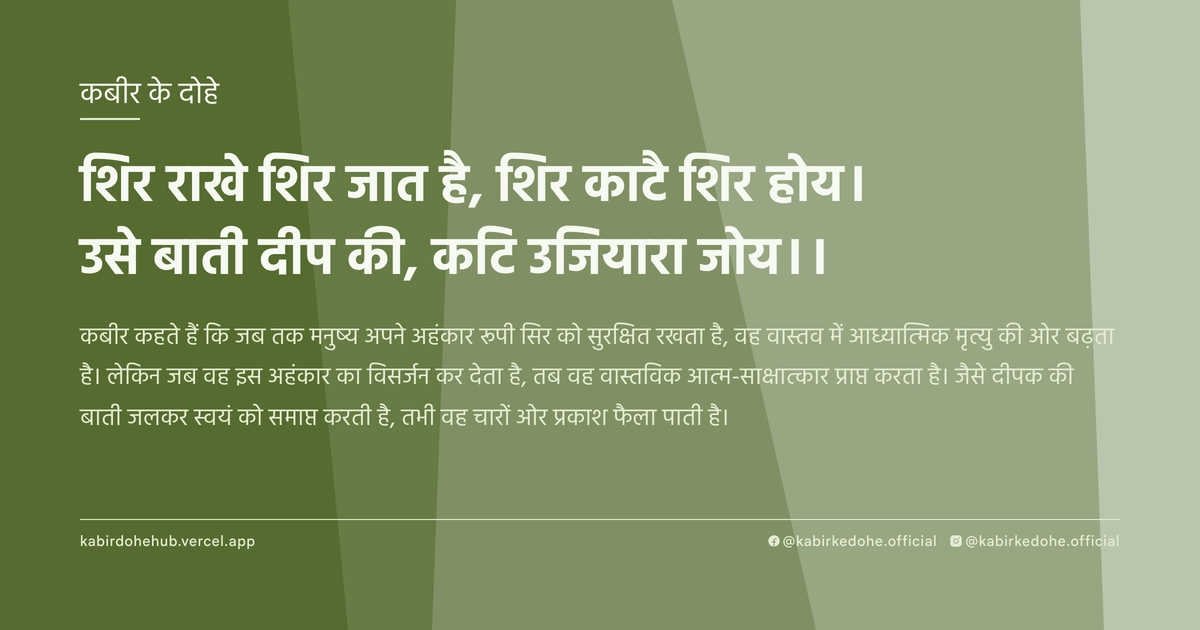
शिर राखे शिर जात है, शिर काटै शिर होय।
उसे बाती दीप की, कटि उजियारा जोय।।
Shir rakhe shir jaat hai, shir kaatai shir hoye. Use baati deep ki, kati ujiyara joye.
इस पृष्ठ पर इस कबीर दोहे का अर्थ (meaning), हिंदी व्याख्या और अंग्रेज़ी अनुवाद, दार्शनिक विश्लेषण और व्यावहारिक जीवन सीख दी गई है। यह दोहा प्रपत्ति (Surrender) विषय से जुड़ा है — Kabir doha meaning and explanation in Hindi and English.
अर्थ (Meaning):
कबीर कहते हैं कि जब तक मनुष्य अपने अहंकार रूपी सिर को सुरक्षित रखता है, वह वास्तव में आध्यात्मिक मृत्यु की ओर बढ़ता है। लेकिन जब वह इस अहंकार का विसर्जन कर देता है, तब वह वास्तविक आत्म-साक्षात्कार प्राप्त करता है। जैसे दीपक की बाती जलकर स्वयं को समाप्त करती है, तभी वह चारों ओर प्रकाश फैला पाती है।
Kabir asserts that as long as a person clings to the 'head' of ego, they are drifting toward spiritual oblivion. Only by 'beheading' or annihilating this ego can one truly exist in the divine presence. Much like the wick of a lamp must be consumed by fire to illuminate the darkness, the self must be sacrificed to reveal the inner light.
व्याख्या (Interpretation):
यहाँ 'शिर' (सिर) केवल शारीरिक अंग नहीं, बल्कि 'अहंकार' और 'मैं' की भावना का प्रतीक है। जब तक व्यक्ति अपनी पहचान, पद और प्रतिष्ठा को पकड़े रहता है, वह सत्य से दूर जाता है। 'शिर काटै' का अर्थ है आत्म-समर्पण और अहंकार का पूर्ण विनाश। यह निर्गुण भक्ति का सार है जहाँ भक्त स्वयं को शून्य कर देता है ताकि परमात्मा उसमें समा सके। यह अद्वैत वेदांत के उस सिद्धांत को दर्शाता है जहाँ जीव और ब्रह्म के बीच का पर्दा केवल अहंकार है। जब यह पर्दा हटता है, तो केवल शुद्ध चेतना शेष रहती है। यह एक विरोधाभास है: स्वयं को खोकर ही स्वयं को पाना संभव है।
In this verse, 'Shir' (head) is not a physical anatomical reference but a potent metaphor for the 'Ahamkara' or the egoic identity. To 'keep the head' signifies clinging to the illusion of a separate self, which leads to spiritual decay. 'Cutting the head' symbolizes the radical act of ego-death and total surrender. This aligns with Nirgun Bhakti, where the devotee seeks the formless Divine by erasing the boundaries of the individual personality. It mirrors the Advaita Vedanta concept of non-duality, suggesting that the perceived separation between Atman and Brahman is merely a veil of pride. The central paradox is presented: only through the annihilation of the perceived 'I' can the universal 'I' be realized. The lamp's wick serves as the ultimate symbol of transformative sacrifice.
दार्शनिक विश्लेषण (Philosophical Analysis):
कबीर का यह दोहा मध्यकालीन भारत के धार्मिक पाखंड और कर्मकांडीय कठोरता के विरुद्ध एक सशक्त प्रहार है। उस समय समाज जाति और बाहरी प्रतीकों (जैसे तिलक, जटा या विशेष वस्त्र) के आधार पर श्रेष्ठता का दावा करता था। कबीर ने स्पष्ट किया कि मोक्ष बाहरी क्रियाओं से नहीं, बल्कि आंतरिक रूपांतरण से मिलता है।
दार्शनिक स्तर पर, यह सूफी मत के 'फना' (Fana) के सिद्धांत से गहराई से जुड़ा है, जहाँ साधक ईश्वर में विलीन होने के लिए अपने अस्तित्व को मिटा देता है। यह केवल शारीरिक मृत्यु नहीं, बल्कि मानसिक और भावनात्मक स्तर पर 'मैं' का अंत है। जब तक 'मैं' जीवित है, तब तक 'वह' (परमात्मा) प्रकट नहीं हो सकता।
अद्वैत वेदांत के परिप्रेक्ष्य में, यह माया के आवरण को हटाने की प्रक्रिया है। माया हमें यह विश्वास दिलाती है कि हम शरीर और मन हैं। कबीर इस भ्रम को 'सिर' कहते हैं। इस भ्रम का कटना ही वास्तविक ज्ञान (Jnana) है।
कबीर यहाँ यह चेतावनी देते हैं कि जो लोग अपनी विद्वत्ता या धार्मिक पहचान पर गर्व करते हैं, वे वास्तव में अंधेरे में हैं। उनका 'सिर' (अहंकार) उन्हें सत्य देखने से रोक रहा है। वास्तविक ज्ञान वह है जो विनम्रता और शून्यता से आता है।
मनोवैज्ञानिक रूप से, यह प्रक्रिया 'ईगो-डेथ' (Ego Death) की है। जब व्यक्ति अपनी सामाजिक छवि और अपेक्षाओं के बोझ को छोड़ देता है, तो वह एक ऐसी शांति का अनुभव करता है जो शब्दों से परे है। यह रूपांतरण ही 'उजियारा' या दिव्य प्रकाश है।
Kabir's verse is a profound critique of the ritualistic rigidity and social hierarchies prevalent in medieval India. During his era, spiritual superiority was often claimed through external markers—caste, attire, or religious symbols. Kabir dismantles this by asserting that liberation is an internal alchemy, not a result of external performance.
Philosophically, this resonates with the Sufi concept of 'Fana' (annihilation), where the seeker dissolves their individual identity into the Divine Will. This is not a physical death but a psychological transcendence of the 'I'. The core premise is that the presence of the ego acts as a barrier; as long as the 'small self' exists, the 'Universal Self' cannot be experienced.
From the lens of Advaita Vedanta, the 'head' represents the veil of Maya (illusion). Maya convinces the individual that they are a separate entity, limited by the body and mind. The act of 'cutting the head' is the realization of the illusory nature of the ego, leading to the recognition of the non-dual reality of Brahman.
Kabir warns that those who pride themselves on their scholarship or religious piety are actually deepening their ignorance. Their intellectual pride is the very 'head' that prevents them from seeing the light. True enlightenment is born from humility and the state of 'Shunya' (emptiness).
Psychologically, this describes the process of 'Ego Death'. When a person releases the burden of their social persona and the need for validation, they enter a state of primordial peace. This shift from the ego-centric to the soul-centric perspective is the 'Ujiyara' or the divine illumination mentioned in the text.
मूल संदेश (Core Message):
- अहंकार वह पर्दा है जो आत्मा को परमात्मा से अलग करता है।
- विनाश ही सृजन का मार्ग है; पुराने 'मैं' का अंत ही नए 'स्व' का जन्म है।
- ज्ञान तब तक बोझ है जब तक वह विनम्रता में नहीं बदलता।
- समर्पण कोई कमजोरी नहीं, बल्कि सर्वोच्च आध्यात्मिक शक्ति है।
- स्वयं को मिटाकर ही ब्रह्मांडीय चेतना में विलीन होना संभव है।
- The ego is the only veil separating the individual soul from the Universal Divine.
- Destruction is the path to creation; the end of the 'small I' is the birth of the 'True Self'.
- Knowledge remains a burden until it is transmuted into profound humility.
- Surrender is not a sign of weakness, but the ultimate act of spiritual strength.
- Only by erasing the self can one merge with the cosmic consciousness.
व्यावहारिक उदाहरण (Practical Example):
एक समय की बात है, वाराणसी के घाटों पर माधव नाम का एक अत्यंत विद्वान पंडित रहता था। माधव को अपनी शास्त्र-विद्या पर बहुत गर्व था। वह घंटों तक दूसरों को उपदेश देता और अपनी श्रेष्ठता सिद्ध करने के लिए कठिन तर्कों का प्रयोग करता था। उसके लिए धर्म का अर्थ था—शुद्धता, नियम और दूसरों से श्रेष्ठ होना।
एक दिन उसकी मुलाकात एक साधारण से बुनकर से हुई, जो शांत भाव से अपना काम कर रहा था। माधव ने उसे शास्त्र ज्ञान की जटिलताओं के बारे में बताना शुरू किया। बुनकर ने मुस्कुराते हुए केवल एक बात कही, "पंडित जी, आपका ज्ञान बहुत बड़ा है, लेकिन क्या वह आपके अहंकार को छोटा कर पाया?"
माधव को यह बात चुभी। उसने तर्क दिया कि ज्ञान तो अहंकार को मिटाने का साधन है। बुनकर ने जवाब दिया, "यदि ज्ञान आपको यह महसूस करा रहा है कि आप दूसरों से बेहतर हैं, तो वह ज्ञान नहीं, बल्कि आपका नया अहंकार है। आप उस दीपक की तरह हैं जिसने बाती तो लगाई है, पर उसे जलने नहीं दिया।"
माधव को पहले तो क्रोध आया, लेकिन रात भर वह इस बात पर विचार करता रहा। उसने महसूस किया कि उसकी पूरी पहचान उसकी 'विद्वत्ता' के इर्द-गिर्द घूमती थी। वह वास्तव में ज्ञान का प्रेमी नहीं, बल्कि 'ज्ञानी कहलाने' का प्रेमी था।
अगले कुछ महीनों तक माधव ने उपदेश देना बंद कर दिया। उसने चुपचाप घाटों पर बीमारों की सेवा करना शुरू किया, जहाँ उसे कोई सम्मान नहीं मिलता था। उसने अपनी पहचान को एक 'महान पंडित' से बदलकर एक 'साधारण सेवक' के रूप में ढालना शुरू किया।
शुरुआत में उसका मन विद्रोह करता था। उसे लगता था कि वह अपनी गरिमा खो रहा है। लेकिन धीरे-धीरे उसे अनुभव हुआ कि जैसे-जैसे उसकी 'पंडित' वाली छवि (उसका सिर) टूट रही थी, उसके भीतर एक असीम शांति और करुणा का जन्म हो रहा था।
एक दिन, एक अत्यंत गरीब व्यक्ति ने उससे मदद मांगी। माधव ने बिना किसी अहंकार के, बिना यह सोचे कि वह कौन है, उसकी सेवा की। उस क्षण माधव को महसूस हुआ कि वह अब तक जिस प्रकाश की तलाश शास्त्रों में कर रहा था, वह तो इस निस्वार्थ समर्पण में था।
माधव का 'सिर' अब कट चुका था। वह अब एक विद्वान नहीं था, वह केवल एक प्रेममय आत्मा था। उसकी आँखों में अब दूसरों के लिए निर्णय नहीं, बल्कि केवल करुणा थी। वह वास्तव में 'उजियारा' बन गया था।
Once in the sacred city of Varanasi, there lived a scholar named Madhav. Madhav was profoundly learned in the scriptures, but his knowledge had become a fortress of pride. He spent his days lecturing others, using complex logic to establish his intellectual superiority. To him, spirituality was a matter of purity, strict adherence to rules, and being 'better' than others.
One day, he encountered a humble weaver who was quietly working at his loom. Madhav began to impress him with the intricacies of Vedic philosophy. The weaver smiled and asked a single question: "Pandit ji, your knowledge is vast, but has it succeeded in making your ego small?"
Madhav was stung. He argued that knowledge is the very tool used to destroy the ego. The weaver replied, "If your knowledge makes you feel superior to others, then it is not enlightenment; it is merely a new, more sophisticated form of ego. You are like a lamp that has a wick, but refuses to let it burn."
Initially, Madhav felt insulted, but the words haunted him throughout the night. He realized that his entire identity was constructed around being 'the learned one.' He wasn't in love with Truth; he was in love with the image of being a scholar.
For the next few months, Madhav stopped preaching. He began volunteering to care for the sick and destitute on the ghats, in roles where he received no recognition or respect. He consciously shifted his identity from a 'great scholar' to a 'simple servant.'
At first, his mind rebelled. He felt he was losing his dignity. However, he gradually noticed that as the image of the 'scholar' (his metaphorical head) was being dismantled, a profound sense of peace and compassion was emerging within him.
One afternoon, a destitute man asked him for help. Madhav served him without a shred of judgment or a sense of charity. In that moment of pure, selfless action, Madhav realized that the light he had sought in books was actually found in the act of surrender.
Madhav's 'head' had finally been severed. He was no longer a scholar; he was simply a loving soul. The judgment in his eyes had been replaced by unconditional compassion. He had finally become the 'Ujiyara'—the light.
अभ्यास मार्गदर्शन (Practice Guidance):
- प्रतिदिन 20 मिनट 'शून्य ध्यान' का अभ्यास करें, जहाँ आप अपनी सभी उपाधियों (नाम, पद, रिश्ता) को मानसिक रूप से त्याग दें और केवल एक साक्षी बनें।
- एक 'अहंकार डायरी' लिखें: दिन भर में उन क्षणों को नोट करें जब आपको लगा कि आप दूसरों से श्रेष्ठ हैं या जब आपको अपनी प्रशंसा की इच्छा हुई।
- सचेत सेवा: सप्ताह में एक बार ऐसा कार्य करें जिसमें आपको कोई श्रेय न मिले और आपकी पहचान गुप्त रहे।
- निदान चेकलिस्ट: क्या मैं दूसरों की गलती पर तुरंत प्रतिक्रिया देता हूँ? क्या मुझे अपनी बात मनवाने की तीव्र इच्छा होती है? यदि हाँ, तो 'सिर' अभी भी सुरक्षित है।
- Practice 20 minutes of 'Shunya Meditation' daily, mentally stripping away all your labels (name, profession, status) and remaining only as a silent witness.
- Maintain an 'Ego Journal': Record moments throughout the day when you felt superior to others or experienced a strong craving for validation.
- Anonymous Service: Perform one act of service per week where you receive no credit and your identity remains hidden.
- Diagnostic Checklist: Do I react instantly to others' mistakes? Do I feel an intense need to be right in every argument? If yes, the 'head' of ego is still intact.
चिंतन प्रश्न (Reflection Questions):
- यदि मेरी सभी सामाजिक उपलब्धियाँ और उपाधियाँ छीन ली जाएँ, तो मेरे पास क्या बचेगा?
- मैं अपनी 'छवि' को बचाने के लिए कितनी बार सत्य का त्याग करता हूँ?
- क्या मेरा आध्यात्मिक अभ्यास मुझे वास्तव में विनम्र बना रहा है, या यह मेरे 'आध्यात्मिक अहंकार' को बढ़ा रहा है?
- मेरे जीवन का वह कौन सा हिस्सा है जहाँ मैं अभी भी 'सही' होने की जिद पकड़ कर बैठा हूँ?
- क्या मैं वास्तव में दूसरों की सेवा करता हूँ, या मैं सेवा के माध्यम से अपनी श्रेष्ठता का अनुभव करना चाहता हूँ?
- If all my social achievements and titles were stripped away, what would actually remain of me?
- How often do I sacrifice the truth just to protect my public image?
- Is my spiritual practice making me genuinely humble, or is it fueling a 'spiritual ego'?
- In which area of my life am I still stubbornly clinging to the need to be 'right'?
- Do I truly serve others, or am I using service as a tool to experience a sense of superiority?