
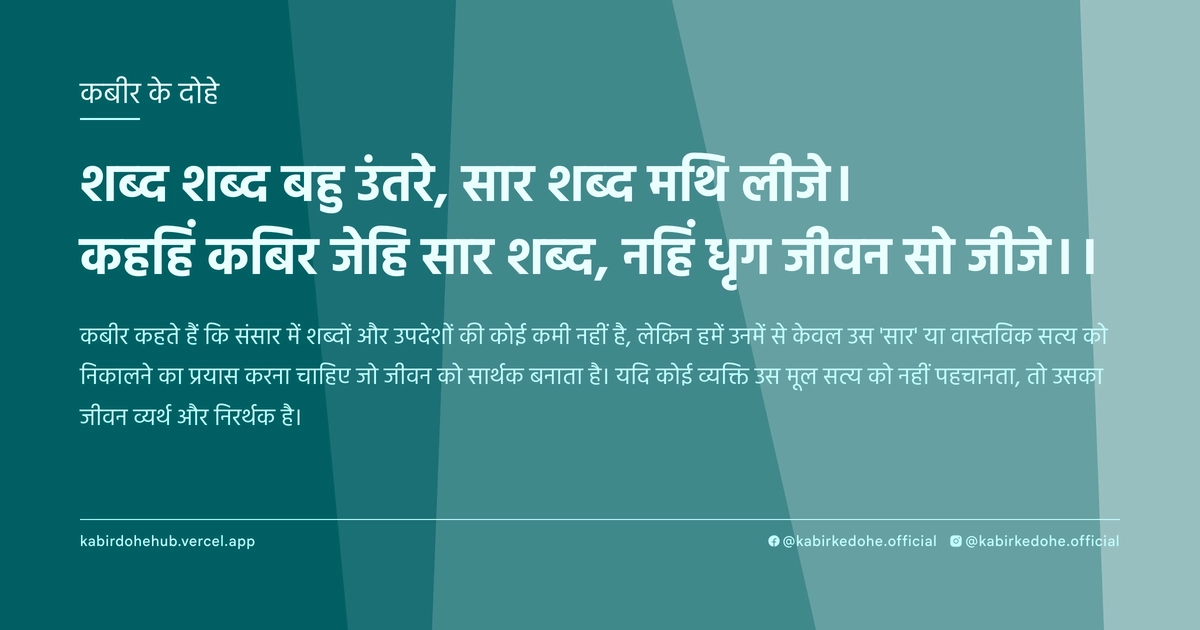
शब्द शब्द बहु उंतरे, सार शब्द मथि लीजे।
कहहिं कबिर जेहि सार शब्द, नहिं धृग जीवन सो जीजे।।
Shabd shabd bahu untare, saar shabd mathi leeje. Kahahin Kabir jehi saar shabd, nahin dhrig jeevan so jeeje.
इस पृष्ठ पर इस कबीर दोहे का अर्थ (meaning), हिंदी व्याख्या और अंग्रेज़ी अनुवाद, दार्शनिक विश्लेषण और व्यावहारिक जीवन सीख दी गई है। यह दोहा सत्य (Truth) विषय से जुड़ा है — Kabir doha meaning and explanation in Hindi and English.
अर्थ (Meaning):
कबीर कहते हैं कि संसार में शब्दों और उपदेशों की कोई कमी नहीं है, लेकिन हमें उनमें से केवल उस 'सार' या वास्तविक सत्य को निकालने का प्रयास करना चाहिए जो जीवन को सार्थक बनाता है। यदि कोई व्यक्ति उस मूल सत्य को नहीं पहचानता, तो उसका जीवन व्यर्थ और निरर्थक है।
Kabir asserts that while the world is flooded with countless words, scriptures, and discourses, one must churn through them to extract the 'essence' or the ultimate truth. He warns that a life spent without realizing this core spiritual essence is a life wasted, devoid of true purpose.
व्याख्या (Interpretation):
यह दोहा शब्दों के बाहरी आवरण और उनके आंतरिक सत्य के बीच के अंतर को स्पष्ट करता है। 'मथना' शब्द यहाँ मानसिक मंथन और गहन आत्म-चिंतन का प्रतीक है, जैसे मक्खन निकालने के लिए दूध को मथा जाता है। कबीर यहाँ निरगुण भक्ति की ओर संकेत कर रहे हैं, जहाँ ईश्वर किसी लिखित शब्द में नहीं, बल्कि उस मौन सत्य में है जो शब्दों के पार है। यह माया के उस जाल की ओर इशारा करता है जहाँ मनुष्य केवल धार्मिक शब्दावलियों में उलझकर रह जाता है और वास्तविक अनुभव (Anubhava) को भूल जाता है। आत्मा और ब्रह्म की एकता केवल पढ़ने से नहीं, बल्कि सार को आत्मसात करने से प्राप्त होती है। अंततः, यह दोहा हमें बौद्धिक संचय के बजाय आध्यात्मिक रूपांतरण की चुनौती देता है।
This couplet illuminates the chasm between the external shell of language and the internal core of Truth. The act of 'churning' (mathi) serves as a metaphor for rigorous self-inquiry and meditative contemplation, akin to extracting butter from milk. Kabir points toward Nirgun Bhakti, suggesting that the Divine is not found in the ink of scriptures but in the silent essence that transcends all vocabulary. He critiques the illusion of Maya, where seekers often mistake religious terminology for spiritual realization, confusing the map for the territory. The non-duality of Atman and Brahman is realized not through academic accumulation, but through the experiential distillation of truth. Ultimately, the verse challenges the seeker to move from intellectual hoarding to a profound ontological transformation.
दार्शनिक विश्लेषण (Philosophical Analysis):
कबीर का यह दृष्टिकोण उनके समय के कट्टरपंथ और केवल किताबी ज्ञान पर आधारित धर्म के विरुद्ध एक सशक्त प्रहार था। उन्होंने देखा कि पंडित और मौलवी शब्दों के जाल में फंसे थे, जबकि वास्तविक ईश्वर उनके भीतर ही था। यह दर्शन अद्वैत वेदांत के करीब है, जहाँ 'नेति नेति' (यह नहीं, वह नहीं) के माध्यम से सत्य तक पहुँचा जाता है।
सूफीवाद के प्रभाव में, कबीर 'हक़' या सत्य की बात करते हैं, जो किसी भाषा या धर्म की सीमा में नहीं बंधा है। उनके लिए शब्द केवल सीढ़ियाँ हैं; एक बार मंजिल मिल जाने पर सीढ़ियों को छोड़ देना अनिवार्य है। वे ritualism (कर्मकांड) का विरोध करते हैं क्योंकि कर्मकांड अक्सर शब्दों के बाहरी प्रदर्शन तक सीमित रह जाते हैं।
मनोवैज्ञानिक स्तर पर, यह दोहा संज्ञानात्मक अधिभार (cognitive overload) की बात करता है। हम सूचनाओं के युग में रहते हैं, लेकिन ज्ञान (Wisdom) का अभाव है। कबीर का 'सार' वह बिंदु है जहाँ विचार समाप्त होते हैं और अनुभव शुरू होता है।
अहंकार अक्सर शब्दों के माध्यम से खुद को श्रेष्ठ सिद्ध करने का प्रयास करता है। जब हम कहते हैं कि "मैं यह शास्त्र जानता हूँ", तो हम सत्य को नहीं, बल्कि अपने अहंकार को बढ़ा रहे होते हैं। सार को मथने का अर्थ है अहंकार को मिटाकर विनम्रता प्राप्त करना।
अंततः, कबीर यह समझाते हैं कि जीवन की सार्थकता इस बात में नहीं है कि आपने कितने ग्रंथ पढ़े, बल्कि इस बात में है कि उस ज्ञान ने आपके व्यवहार और चेतना को कितना बदला। बिना अनुभव के शब्द केवल शोर हैं।
Kabir's perspective is a potent critique of the dogmatism and scriptural literalism prevalent during his era. He observed that the religious elite were trapped in a linguistic labyrinth, chasing the shadows of words while ignoring the living Presence within. This philosophy aligns closely with Advaita Vedanta, utilizing the process of 'Neti Neti' (not this, not that) to strip away the superficial and arrive at the Absolute.
Influenced by Sufi mysticism, Kabir speaks of 'Haq' or Truth, which transcends the boundaries of language and organized religion. For him, words are merely scaffolding; once the structure of realization is complete, the scaffolding must be discarded. He vehemently rejects ritualism because rituals often become performative exercises in vocabulary rather than internal shifts in consciousness.
On a psychological plane, this verse addresses the phenomenon of cognitive overload. We exist in an age of infinite information, yet we suffer from a famine of wisdom. Kabir's 'essence' is the singular point where conceptual thought ceases and direct experience (Anubhava) begins.
The ego frequently uses intellectual mastery of texts to establish a sense of superiority. When one claims, "I have mastered this scripture," they are inflating the ego, not expanding the soul. Churning for the essence requires the annihilation of this intellectual pride in favor of radical humility.
Ultimately, Kabir posits that the validity of a human life is not measured by the volume of texts consumed, but by the degree of transformation in one's character and consciousness. Without experiential realization, words are nothing more than spiritual noise.
मूल संदेश (Core Message):
- शब्द केवल संकेत हैं, गंतव्य नहीं।
- बौद्धिक संचय आध्यात्मिक प्रगति का अवरोध है।
- सत्य को पढ़ा नहीं, अनुभव किया जाता है।
- मौन ही सबसे गहरा और सारगर्भित शब्द है।
- जीवन की सार्थकता आचरण के रूपांतरण में है।
- Words are mere signposts, not the destination.
- Intellectual accumulation is an obstacle to spiritual growth.
- Truth is not read; it is experienced directly.
- Silence is the deepest and most essential word.
- Life's meaning lies in the transformation of conduct.
व्यावहारिक उदाहरण (Practical Example):
वाराणसी के एक पुराने घाट पर रामदीन नाम का एक वृद्ध बुनकर रहता था। वह जीवन भर धर्मग्रंथों को सुनने और उनके बारे में चर्चा करने में बिता चुका था। वह शहर के सबसे बड़े विद्वान माने जाते थे क्योंकि उन्हें हज़ारों श्लोकों का अर्थ याद था।
रामदीन का अहंकार उनके ज्ञान के साथ बढ़ता गया। वे अक्सर अन्य बुनकरों को नीचा दिखाते थे कि वे शास्त्रों को नहीं जानते। उनके घर में शांति नहीं थी, और उनके बच्चे उनसे दूर हो गए थे क्योंकि रामदीन केवल उपदेश देते थे, प्रेम नहीं।
एक दिन, एक साधारण सा फकीर उनके पास आया। फकीर ने रामदीन से पूछा, "तुम्हारे पास शब्दों का भंडार है, लेकिन क्या तुम्हारे पास एक भी ऐसा शब्द है जो तुम्हारे क्रोध को शांत कर सके या तुम्हारे बेटे की आँखों में आँसू पोंछ सके?"
रामदीन ने गर्व से एक कठिन श्लोक सुनाया जो क्षमा के बारे में था। फकीर मुस्कुराया और बोला, "तुमने श्लोक सुनाया, लेकिन क्या तुमने क्षमा को जिया? शब्द तो केवल बर्तन हैं, रस तो अनुभव में है।"
यह बात रामदीन के हृदय में गहरे तक चुभ गई। उन्हें अहसास हुआ कि उन्होंने जीवन भर केवल 'बर्तन' इकट्ठे किए, लेकिन उनके भीतर का 'रस' सूख चुका था।
अगले कुछ महीनों तक, रामदीन ने शास्त्रों को पढ़ना बंद कर दिया। उन्होंने मौन का अभ्यास किया और अपने भीतर के क्रोध को देखना शुरू किया। उन्होंने शब्दों के बजाय कर्मों से प्रेम करना सीखा।
उन्होंने अपने बेटे के पास जाकर बिना किसी उपदेश के, केवल एक स्पर्श से अपनी गलती मांगी। उन्होंने महसूस किया कि एक छोटा सा सच्चा आँसू हज़ारों ग्रंथों के ज्ञान से अधिक शक्तिशाली होता है।
रामदीन अब भी बुनते थे, लेकिन अब उनके कपड़ों में एक अलग चमक थी। लोग अब उनकी विद्वत्ता के कारण नहीं, बल्कि उनकी करुणा के कारण उनके पास आने लगे।
उन्होंने जान लिया था कि 'सार शब्द' वह नहीं है जिसे पढ़ा जाए, बल्कि वह है जिसे जिया जाए। उनका जीवन अब शब्दों का बोझ नहीं, बल्कि सत्य का संगीत बन गया था।
इस प्रकार, रामदीन ने शब्दों के ढेर से निकलकर उस एक सार को पा लिया जिसने उनके मृतप्राय जीवन में प्राण फूँक दिए।
On an ancient ghat in Varanasi lived an elderly weaver named Ramdeen. He had spent his entire life listening to scriptures and engaging in theological debates. He was regarded as one of the city's greatest scholars because he could recite thousands of verses with precision.
Ramdeen's ego grew in tandem with his knowledge. He often belittled other weavers, mocking their ignorance of the texts. There was no peace in his home, and his children had drifted away from him because Ramdeen offered only sermons, never love.
One day, a simple wandering dervish approached him. The dervish asked, "You possess a treasury of words, but do you possess a single word that can quiet your anger or wipe the tears from your son's eyes?"
Ramdeen proudly recited a complex verse on the virtue of forgiveness. The dervish smiled and replied, "You have recited the verse, but have you lived the forgiveness? Words are merely vessels; the nectar lies in the experience."
These words pierced Ramdeen's heart. He realized that he had spent his life collecting 'vessels' while the 'nectar' within him had completely dried up.
For the next few months, Ramdeen stopped reading scriptures. He practiced silence and began to observe the roots of his own anger. He learned to love through actions rather than adjectives.
He approached his son and, without a single lecture, asked for forgiveness with a simple, honest touch. He realized that one genuine tear is more powerful than the knowledge of a thousand texts.
Ramdeen continued to weave, but there was now a different radiance in his fabrics. People began visiting him not for his scholarship, but for his profound compassion.
He had finally understood that the 'essence word' is not something to be read, but something to be lived. His life was no longer a burden of words, but a melody of truth.
Thus, Ramdeen emerged from the heap of vocabulary to find that one singular essence that breathed life back into his withered existence.
अभ्यास मार्गदर्शन (Practice Guidance):
- दैनिक मौन अभ्यास: प्रतिदिन 30 मिनट पूर्ण मौन रहें। शब्दों के बिना केवल अपनी श्वास और आंतरिक संवेदनाओं को देखें।
- ज्ञान का विसर्जन: किसी एक आध्यात्मिक विचार को चुनें और उसे पढ़ने के बजाय, पूरे दिन उसे अपने व्यवहार में उतारने का प्रयास करें।
- आत्म-पूछताछ जर्नल: लिखें कि आज आपने कितनी बार 'सही' दिखने के लिए शब्दों का सहारा लिया और कितनी बार 'सत्य' होने के लिए मौन रहे।
- निदान चेकलिस्ट: क्या मैं दूसरों को उपदेश दे रहा हूँ? क्या मेरा ज्ञान मुझे विनम्र बना रहा है या अहंकारी? क्या मेरी शांति बाहरी परिस्थितियों पर निर्भर है?
- Daily Silence Practice: Spend 30 minutes in absolute silence daily. Observe your breath and internal sensations without labeling them with words.
- Dissolution of Knowledge: Select one spiritual concept and, instead of reading about it, attempt to embody it through your actions throughout the day.
- Self-Inquiry Journaling: Record instances where you used words to 'appear right' versus moments where you remained silent to 'be true'.
- Diagnostic Checklist: Am I lecturing others? Is my knowledge making me humble or arrogant? Is my peace dependent on external validation or internal essence?
चिंतन प्रश्न (Reflection Questions):
- क्या मेरी आध्यात्मिक पहचान केवल उन शब्दों और शब्दावलियों पर टिकी है जिन्हें मैं उपयोग करता हूँ?
- यदि मुझसे मेरी सारी धार्मिक और दार्शनिक शब्दावली छीन ली जाए, तो मेरे भीतर क्या बचेगा?
- मैं सत्य की खोज कर रहा हूँ या केवल सत्य के बारे में बात करने की कला सीख रहा हूँ?
- मेरे जीवन का कौन सा हिस्सा अभी भी केवल 'शब्दों' में जी रहा है और 'अनुभव' से कटा हुआ है?
- क्या मेरा ज्ञान मुझे दूसरों से जोड़ता है या उनके प्रति मेरी श्रेष्ठता की भावना को बढ़ाता है?
- Is my spiritual identity merely anchored in the vocabulary and terminology I employ?
- If all my religious and philosophical terminology were stripped away, what would remain within me?
- Am I seeking the Truth, or am I merely mastering the art of talking about the Truth?
- Which part of my life is still lived through 'words' and remains disconnected from direct 'experience'?
- Does my knowledge connect me to others, or does it fuel a sense of superiority over them?