
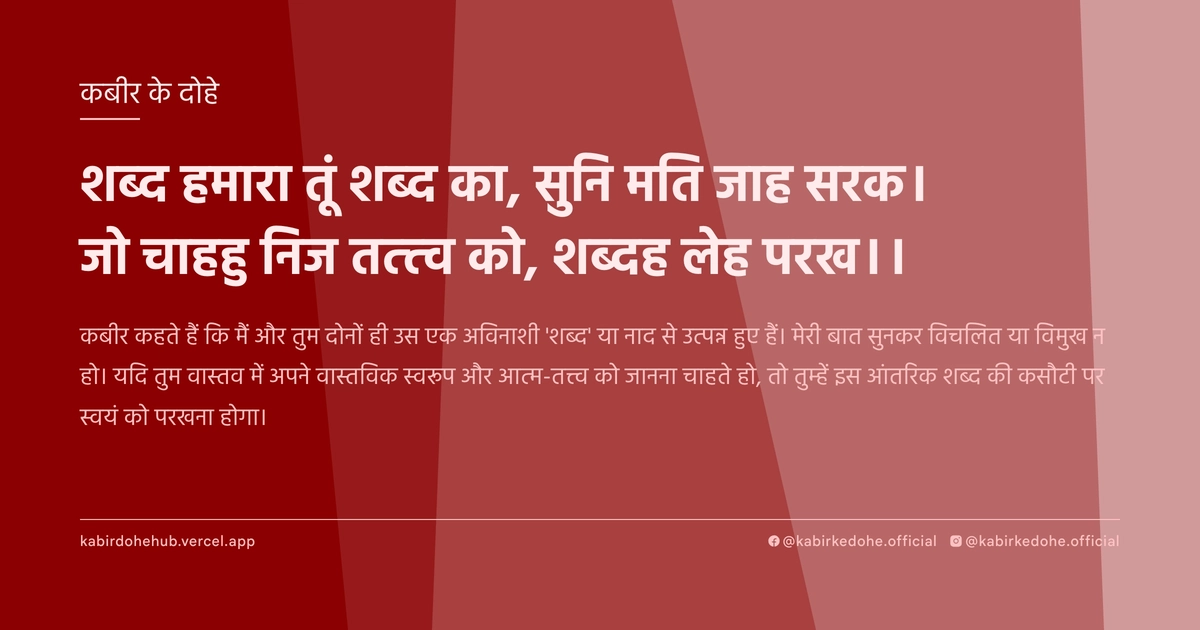
शब्द हमारा तूं शब्द का, सुनि मति जाह सरक।
जो चाहहु निज तत्त्व को, शब्दह लेह परख।।
Shabd hamara tun shabd ka, suni mati jaah sarak. Jo chahahu nij tattva ko, shabdah leh parakh.
इस पृष्ठ पर इस कबीर दोहे का अर्थ (meaning), हिंदी व्याख्या और अंग्रेज़ी अनुवाद, दार्शनिक विश्लेषण और व्यावहारिक जीवन सीख दी गई है। यह दोहा आत्मनिरीक्षण (Self-introspection) विषय से जुड़ा है — Kabir doha meaning and explanation in Hindi and English.
अर्थ (Meaning):
कबीर कहते हैं कि मैं और तुम दोनों ही उस एक अविनाशी 'शब्द' या नाद से उत्पन्न हुए हैं। मेरी बात सुनकर विचलित या विमुख न हो। यदि तुम वास्तव में अपने वास्तविक स्वरूप और आत्म-तत्त्व को जानना चाहते हो, तो तुम्हें इस आंतरिक शब्द की कसौटी पर स्वयं को परखना होगा।
Kabir asserts that both the speaker and the listener are manifestations of the same primordial 'Shabd' or Cosmic Sound. He urges the seeker not to recoil or be deterred by his words. If one truly desires to realize their own essential nature and ultimate truth, they must test their consciousness through the lens of this divine vibration.
व्याख्या (Interpretation):
इस दोहे में 'शब्द' केवल बोला गया वचन नहीं, बल्कि 'अनहद नाद' या उस आदि-ध्वनि का प्रतीक है जिससे सृष्टि का सृजन हुआ। कबीर पहले यह स्थापित करते हैं कि गुरु और शिष्य के बीच कोई द्वैत नहीं है; दोनों एक ही चैतन्य ऊर्जा के अंश हैं। 'सरक' जाने का अर्थ है अहंकारवश सत्य से दूर हटना। यहाँ 'निज तत्त्व' का अर्थ है वह शुद्ध आत्मा जो माया के आवरण से मुक्त है। यह विश्लेषण निरगुण भक्ति की उस अवस्था को दर्शाता है जहाँ साधक बाहरी कर्मकांडों को छोड़कर आंतरिक ध्वनि में लीन हो जाता है। यह अद्वैत वेदांत के उस सिद्धांत से जुड़ा है जहाँ ज्ञाता, ज्ञान और ज्ञेय का भेद समाप्त हो जाता है। अंततः, यह दोहा यह संदेश देता है कि आत्म-साक्षात्कार केवल बौद्धिक चर्चा से नहीं, बल्कि अनुभवजन्य परख से संभव है।
In this verse, 'Shabd' does not refer to mere spoken language, but to the 'Anhad Naad' or the primordial cosmic vibration from which all existence emanates. Kabir begins by dismantling the duality between the teacher and the student, suggesting they are both expressions of the same singular consciousness. To 'recoil' (sarak) signifies the ego's tendency to flee from a truth that threatens its perceived autonomy. 'Nij Tattva' refers to the essential soul, stripped of the illusory veils of Maya. This analysis aligns with Nirgun Bhakti, where the seeker transcends ritualistic forms to merge with the formless sound. It mirrors the Advaita Vedanta principle of non-duality, where the distinction between the knower and the known dissolves. Ultimately, the verse posits that self-realization is not an intellectual achievement but an experiential verification through the internal vibration of truth.
दार्शनिक विश्लेषण (Philosophical Analysis):
कबीर का यह दृष्टिकोण उनके समय के कट्टरपंथी धार्मिक वातावरण के विरुद्ध एक सशक्त प्रतिक्रिया था। उन्होंने देखा कि लोग केवल ग्रंथों के शब्दों को रट रहे थे, जबकि वास्तविक अनुभव से कोसों दूर थे। यहाँ 'शब्द' का प्रयोग सूफी मत के 'कलाम' और योग परंपरा के 'नाद' के संगम के रूप में किया गया है। कबीर ritualism (कर्मकांड) का खंडन करते हुए यह समझाते हैं कि ईश्वर किसी मंदिर या मस्जिद में नहीं, बल्कि शरीर के भीतर गूंजने वाले उस सूक्ष्म शब्द में है।
दार्शनिक स्तर पर, यह दोहा अहंकार के विसर्जन की बात करता है। जब कबीर कहते हैं 'तूं शब्द का', तो वे व्यक्ति की व्यक्तिगत पहचान (Identity) को मिटाकर उसे ब्रह्मांडीय चेतना का हिस्सा बना देते हैं। यह सूफीवाद के 'फना' (अहंकार का विनाश) के समान है, जहाँ बूंद समुद्र में मिलकर समुद्र बन जाती है।
अद्वैत वेदांत के अनुसार, ब्रह्म ही एकमात्र सत्य है और जगत मिथ्या है। कबीर इस 'मिथ्या' को पार करने के लिए 'परख' (परीक्षण) की बात करते हैं। यह परख बाहरी दुनिया की नहीं, बल्कि अंतर्मुखी होकर अपनी चेतना की गहराई में उतरने की प्रक्रिया है।
मनोवैज्ञानिक रूप से, यह दोहा साधक को अपनी मानसिक बाधाओं को पहचानने के लिए प्रेरित करता है। अक्सर सत्य कड़वा होता है, इसलिए मनुष्य 'सरक' जाता है। कबीर इस मनोवैज्ञानिक प्रतिरोध को चुनौती देते हैं और साहस के साथ आत्म-विश्लेषण का आह्वान करते हैं।
अंततः, यह शिक्षण यह स्पष्ट करता है कि आध्यात्मिक प्रगति केवल सुनने से नहीं, बल्कि उस सुने हुए सत्य को अपने जीवन और श्वास में उतारने से होती है। यह बौद्धिक ज्ञान और वास्तविक बोध के बीच के अंतर को स्पष्ट करता है, जहाँ 'शब्द' एक सेतु बन जाता है जो जीव को शिव से जोड़ता है।
Kabir's perspective serves as a potent reaction to the dogmatic religious atmosphere of his era. He observed that people were merely reciting scriptures without experiencing the living truth. Here, 'Shabd' is employed as a synthesis of the Sufi 'Kalam' and the Yogic 'Naad', emphasizing a vibration that transcends linguistic boundaries.
On a philosophical level, this verse advocates for the annihilation of the ego. By stating 'you are of the Shabd', Kabir strips away the individual identity and integrates the seeker into the cosmic consciousness. This is analogous to the Sufi concept of 'Fana', where the drop vanishes into the ocean to realize it was always the ocean.
According to Advaita Vedanta, Brahman is the only reality, and the perceived world is Maya. Kabir suggests that to pierce through this illusion, one needs 'Parakh' (verification). This is not an empirical test of the external world, but an introspective audit of one's own consciousness.
Psychologically, the verse addresses the human tendency to avoid uncomfortable truths. The act of 'recoiling' represents the ego's defense mechanism against the dissolution of the self. Kabir challenges this resistance, urging the seeker to face the internal void with courage.
Ultimately, this teaching clarifies that spiritual evolution does not occur through passive listening, but through the active integration of truth into one's breath and being. It distinguishes between intellectual accumulation and actual realization, positioning the 'Shabd' as the bridge between the finite human and the infinite divine.
मूल संदेश (Core Message):
- अहंकार वह पर्दा है जो हमें हमारी वास्तविक एकता से अलग करता है।
- सत्य को सुनने के बाद उससे विमुख होना आध्यात्मिक पतन का संकेत है।
- आत्म-साक्षात्कार के लिए आंतरिक ध्वनि और मौन का सहारा लें।
- बाहरी पहचान एक भ्रम है; वास्तविक तत्त्व केवल शुद्ध चेतना है।
- अनुभव ही एकमात्र कसौटी है, बौद्धिक ज्ञान केवल एक दिशा-निर्देश है।
- जब व्यक्ति 'मैं' को खो देता है, तब वह 'सब' को पा लेता है।
- The ego is the veil that separates us from our fundamental unity.
- Recoiling from the truth after hearing it is a sign of spiritual regression.
- Utilize internal sound and profound silence as tools for self-realization.
- External identity is an illusion; the only reality is pure consciousness.
- Direct experience is the only valid test; intellectual knowledge is merely a map.
- When the individual 'I' vanishes, the universal 'All' is revealed.
व्यावहारिक उदाहरण (Practical Example):
वाराणसी के एक पुराने घाट पर रहने वाले माधव नाम के एक वृद्ध बुनकर थे। माधव अपनी कला में निपुण थे, लेकिन उनका मन हमेशा इस बात से अशांत रहता था कि वे समाज में अपनी क्या पहचान रखते हैं। वे खुद को केवल एक 'गरीब बुनकर' मानते थे और अक्सर अपनी नियति को कोसते थे।
एक दिन उनकी मुलाकात एक घुमक्कड़ संत से हुई, जिन्होंने माधव को कबीर का यह दोहा सुनाया। संत ने कहा, "माधव, तुम धागों को जोड़कर कपड़ा बनाते हो, लेकिन क्या तुमने उस धागे को देखा है जो पूरे ब्रह्मांड को जोड़कर रखता है?"
माधव ने पहले तो इस बात को अनसुना कर दिया, वे 'सरक' गए। उन्हें लगा कि यह केवल दार्शनिक बातें हैं जिनका उनके दैनिक संघर्ष से कोई लेना-देना नहीं है। लेकिन संत की बातों ने उनके भीतर एक जिज्ञासा जगा दी।
अगले कुछ हफ्तों तक, माधव ने एक प्रयोग किया। जब भी वे करघे पर काम करते, वे बाहरी शोर को भूलकर अपनी सांसों की लय पर ध्यान देने लगे। उन्होंने महसूस किया कि करघे की 'खट-खट' की ध्वनि उनके हृदय की धड़कन के साथ तालमेल बिठा रही है।
धीरे-धीरे, उन्हें अनुभव हुआ कि वे केवल एक बुनकर नहीं हैं, बल्कि वह चेतना हैं जो इस पूरी प्रक्रिया को देख रही है। उनका 'बुनकर' होने का अहंकार मिटने लगा और वे उस 'शब्द' या लय में लीन होने लगे।
एक दिन, जब उनके जीवन में एक बड़ी आर्थिक तंगी आई, तो वे विचलित नहीं हुए। उन्होंने महसूस किया कि जैसे धागा टूटकर फिर जुड़ जाता है, वैसे ही जीवन के उतार-चढ़ाव भी उसी एक महान लय का हिस्सा हैं।
उनकी इस आंतरिक शांति का प्रभाव उनके काम पर भी पड़ा। उनके द्वारा बुने गए वस्त्रों में अब एक ऐसी दिव्यता और शांति थी जिसे लोग महसूस कर सकते थे। वे अब केवल कपड़ा नहीं, बल्कि शांति बुन रहे थे।
माधव ने जान लिया कि 'निज तत्त्व' को पहचानना किसी तीर्थयात्रा में नहीं, बल्कि अपने वर्तमान कर्म को उस ईश्वरीय लय (शब्द) के साथ जोड़ देने में है। उनका जीवन अब एक निरंतर साधना बन गया था।
In the ancient ghats of Varanasi lived an elderly weaver named Madhav. Madhav was a master of his craft, yet his mind was perpetually clouded by a sense of inadequacy. He identified himself solely as a 'poor weaver' and often lamented his social standing and destiny.
One day, he encountered a wandering mystic who recited this specific Doha of Kabir to him. The mystic asked, "Madhav, you join threads to make a cloth, but have you seen the invisible thread that binds the entire universe together?"
Initially, Madhav dismissed the idea; he 'recoiled' from the truth. He believed these were mere philosophical musings that had no place in his struggle for survival. However, the seed of curiosity had been planted.
Over the following weeks, Madhav began an experiment. Whenever he worked at his loom, he consciously ignored the external noise and focused on the rhythm of his breath. He noticed the rhythmic 'clack-clack' of the loom synchronizing with his own heartbeat.
Gradually, he realized that he was not merely a weaver, but the consciousness observing the act of weaving. The egoic identity of being a 'struggling artisan' began to dissolve, and he started merging with that singular cosmic rhythm—the Shabd.
When a severe financial crisis hit his household later that year, Madhav remained unshaken. He realized that just as a broken thread can be tied back together, the ups and downs of life are merely fluctuations in a greater, unchanging melody.
This internal stillness transformed his art. The fabrics he wove began to possess a quality of serenity and divinity that customers could feel. He was no longer just weaving cloth; he was weaving peace.
Madhav discovered that realizing one's 'Nij Tattva' (essential nature) does not require a pilgrimage, but rather the alignment of one's current action with the divine vibration. His life became a living meditation.
अभ्यास मार्गदर्शन (Practice Guidance):
- प्रतिदिन 20 मिनट 'अजपा जाप' या मौन ध्यान करें, जहाँ आप केवल अपनी सांसों की स्वाभाविक ध्वनि को सुनें और उसे ब्रह्मांडीय शब्द के रूप में अनुभव करें।
- एक डायरी लिखें जिसमें आप उन क्षणों को दर्ज करें जब आपका अहंकार (Ego) आपको सत्य को स्वीकार करने से रोकता है या आपको 'सरकने' पर मजबूर करता है।
- व्यवहार परिवर्तन: दिन में तीन बार रुकें और स्वयं से पूछें, "क्या मैं अभी अपनी सामाजिक पहचान (नाम, पद, जाति) से बोल रहा हूँ, या अपनी आत्मा से?"
- डायग्नोस्टिक चेकलिस्ट: यदि आप छोटी बातों पर विचलित होते हैं, दूसरों के विचारों से आहत होते हैं, या केवल बाहरी पूजा-पाठ में शांति ढूंढ रहे हैं, तो इसका अर्थ है कि आप अभी भी 'शब्द' की परख से दूर हैं।
- Practice 20 minutes of 'Ajapa Jap' or silent meditation daily, focusing solely on the natural sound of your breath, perceiving it as the cosmic vibration (Shabd).
- Maintain a reflective journal to document moments where your ego prevents you from accepting a truth or compels you to 'recoil' from a challenging insight.
- Behavioral Shift: Three times a day, pause and ask yourself, "Am I speaking right now from my social identity (name, rank, caste), or from my essential soul?"
- Diagnostic Checklist: If you find yourself easily agitated by trivialities, wounded by others' opinions, or seeking peace exclusively through external rituals, you are currently disconnected from the 'Parakh' of the Shabd.
चिंतन प्रश्न (Reflection Questions):
- वह कौन सा सत्य है जिसे सुनकर आप अक्सर 'सरक' जाते हैं क्योंकि वह आपके अहंकार को चोट पहुँचाता है?
- यदि आपकी सभी सामाजिक पहचान (पेशा, रिश्ता, नाम) छीन ली जाएं, तो आपके भीतर क्या शेष बचेगा?
- क्या आप अपनी डिजिटल पहचान (सोशल मीडिया इमेज) को ही अपना वास्तविक तत्त्व मान बैठे हैं?
- आपकी आंतरिक शांति बाहरी परिस्थितियों पर निर्भर है या आपके भीतर की गूँज पर?
- क्या आप वास्तव में सत्य की खोज कर रहे हैं, या केवल अपनी पूर्व-धारणाओं की पुष्टि करना चाहते हैं?
- आपके जीवन का वह कौन सा 'शब्द' या लय है जो आपको वर्तमान क्षण में स्थिर रखता है?
- What is the specific truth that makes you 'recoil' because it threatens the stability of your ego?
- If all your social identifiers (profession, relationships, name) were stripped away, what would remain within you?
- Have you mistaken your digital persona for your essential nature?
- Is your inner peace dependent on external circumstances or on the internal vibration of your being?
- Are you truly seeking the truth, or are you merely seeking confirmation of your existing biases?
- What is the 'Shabd' or rhythm in your life that anchors you to the present moment?