
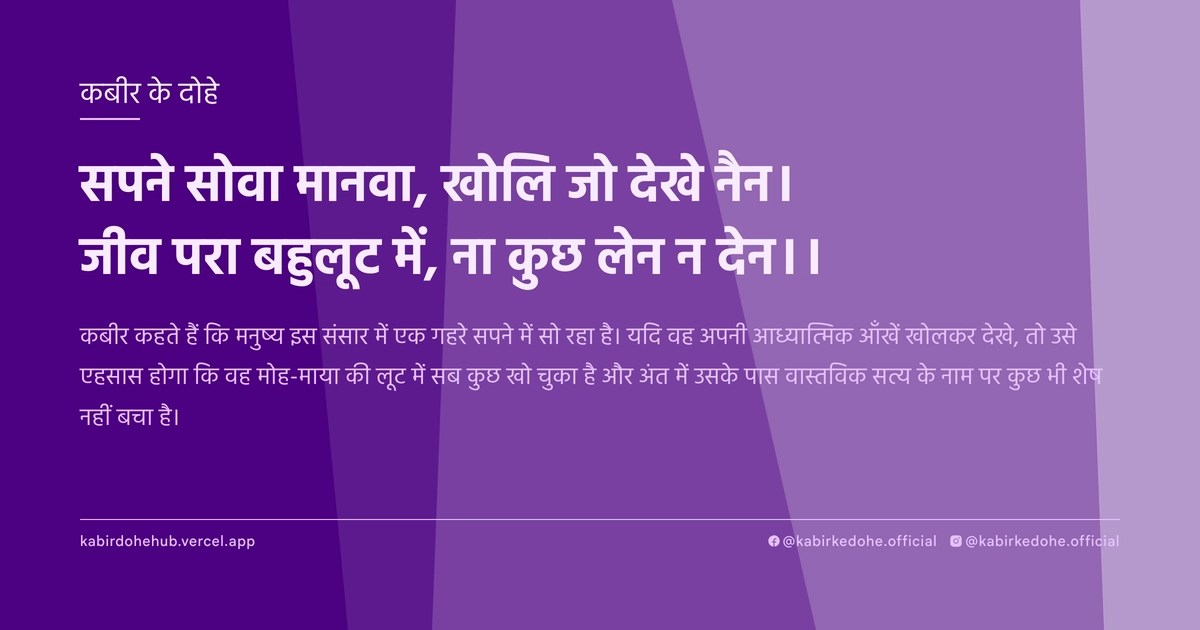
सपने सोवा मानवा, खोलि जो देखे नैन।
जीव परा बहुलूट में, ना कुछ लेन न देन।।
Sapne sowa manva, kholi jo dekhe nain. Jeev para bahuloot me, na kuch len na den.
इस पृष्ठ पर इस कबीर दोहे का अर्थ (meaning), हिंदी व्याख्या और अंग्रेज़ी अनुवाद, दार्शनिक विश्लेषण और व्यावहारिक जीवन सीख दी गई है। यह दोहा जागृति (The Wake-up Call) विषय से जुड़ा है — Kabir doha meaning and explanation in Hindi and English.
अर्थ (Meaning):
कबीर कहते हैं कि मनुष्य इस संसार में एक गहरे सपने में सो रहा है। यदि वह अपनी आध्यात्मिक आँखें खोलकर देखे, तो उसे एहसास होगा कि वह मोह-माया की लूट में सब कुछ खो चुका है और अंत में उसके पास वास्तविक सत्य के नाम पर कुछ भी शेष नहीं बचा है।
Kabir asserts that humanity exists in a state of profound slumber, dreaming a dream of worldly existence. If one were to open their spiritual eyes, they would realize that the soul has been plundered by the illusions of Maya, leaving the seeker with nothing of eternal value at the end of the journey.
व्याख्या (Interpretation):
यहाँ 'सपना' भौतिक संसार का प्रतीक है जिसे हम सत्य मान बैठे हैं। 'नैन खोलना' केवल शारीरिक जागृति नहीं, बल्कि बोध (Enlightenment) की प्राप्ति है। कबीर समझाते हैं कि जीव माया के जाल में इस कदर फँसा है कि वह अपनी वास्तविक पहचान (आत्मा) को भूल चुका है। यह स्थिति निर्गुण भक्ति के उस सिद्धांत को दर्शाती है जहाँ संसार को मिथ्या माना गया है। जब तक अहंकार जीवित है, मनुष्य इस 'लूट' का शिकार रहता है। अंततः, यह दोहा अद्वैत वेदांत के उस सत्य की ओर इशारा करता है जहाँ केवल ब्रह्म सत्य है और बाकी सब एक स्वप्न मात्र है।
The 'dream' serves as a potent metaphor for the empirical world, which we mistakenly perceive as the ultimate reality. 'Opening the eyes' signifies the transition from ignorance (Avidya) to spiritual awakening (Bodhi). Kabir illustrates that the soul is caught in a cosmic heist, where the ego steals the essence of the self to feed the illusion of separation. This aligns with Nirgun Bhakti, emphasizing that the formless Divine is the only truth, while the material world is a transient projection. The paradox lies in the fact that we fight to possess things in a dream, unaware that the dreamer himself is the only reality. It mirrors the Advaita Vedanta concept where the individual soul (Atman) realizes its non-duality with the Absolute (Brahman) only after the dream of duality dissolves.
दार्शनिक विश्लेषण (Philosophical Analysis):
कबीर का यह दोहा मध्यकालीन भारत के उस सामाजिक और धार्मिक परिवेश में रचा गया था जहाँ कर्मकांड और बाहरी आडंबर चरम पर थे। कबीर ने स्पष्ट किया कि मंदिर, मस्जिद या तीर्थयात्रा से अधिक महत्वपूर्ण 'भीतरी जागृति' है। वे यहाँ 'माया' की अवधारणा को एक लुटेरे के रूप में प्रस्तुत करते हैं, जो मनुष्य के समय और चेतना को चुरा लेती है।
दार्शनिक स्तर पर, यह सूफी मत के 'फना' (अहंकार का विनाश) और वेदांत के 'माया' सिद्धांत का संगम है। कबीर तर्क देते हैं कि जब तक मनुष्य स्वयं को शरीर और सामाजिक पहचान (जाति, धर्म) से जोड़कर देखता है, वह सो रहा है। यह 'नींद' वास्तव में अज्ञानता की वह परत है जो हमें हमारी दिव्य प्रकृति से अलग करती है।
वे ritualism का विरोध करते हुए कहते हैं कि बाहरी पूजा केवल सपने को और गहरा करती है। वास्तविक मुक्ति तब आती है जब साधक यह समझ जाता है कि वह इस संसार का हिस्सा नहीं, बल्कि वह चेतना है जिसमें यह संसार प्रतिबिंबित हो रहा है।
मनोवैज्ञानिक रूप से, यह दोहा 'संज्ञानात्मक विसंगति' (Cognitive Dissonance) की बात करता है—हम जानते हैं कि मृत्यु निश्चित है, फिर भी हम ऐसे व्यवहार करते हैं जैसे हम अमर हों। यह विरोधाभास ही वह 'लूट' है जिसका कबीर जिक्र कर रहे हैं।
अंततः, कबीर का संदेश यह है कि जागृति का मार्ग आत्म-निरीक्षण और अहंकार के विसर्जन से होकर जाता है। जब 'मैं' मिटता है, तब 'सत्य' प्रकट होता है, और तब यह लूट समाप्त हो जाती है क्योंकि अब लेने या देने के लिए कोई अलग व्यक्तित्व शेष नहीं रहता।
This Doha emerges from the socio-religious crucible of medieval India, a time dominated by rigid caste hierarchies and empty ritualism. Kabir strips away the veneer of organized religion, suggesting that spiritual liberation is not found in the pilgrimage to a physical site, but in the awakening of the internal witness. He personifies 'Maya' (illusion) as a cosmic thief, highlighting the tragedy of a soul that spends its entire existence accumulating shadows.
Philosophically, Kabir bridges the gap between the Sufi concept of 'Fana' (the annihilation of the self) and the Vedantic doctrine of 'Maya'. He posits that the human condition is one of spiritual somnambulism; we move, act, and suffer, yet we are unconscious of our true nature. The 'sleep' is the veil of ignorance (Avidya) that obscures the non-dual reality of the Atman and Brahman.
His rejection of ritualism is central here. He argues that performing rites without internal realization is like rearranging furniture within a dream—it does not wake the dreamer. The only path to liberation is the direct experience of the Formless (Nirgun), which requires the total collapse of the egoic identity.
From a psychological perspective, Kabir addresses the human tendency toward denial. We live in a state of collective hypnosis, ignoring the transience of life to cling to temporary identities. This denial is the 'looting' process, where the essence of life is traded for the triviality of social status and material possession.
Ultimately, the teaching focuses on the transformation of consciousness. By recognizing the dream-like nature of the world, the seeker ceases to be a victim of circumstance. The resolution of the paradox is found in the realization that there is no 'other' to loot and no 'self' to be robbed—only the eternal, unchanging consciousness remains.
मूल संदेश (Core Message):
- संसार एक मायावी स्वप्न है, जिसे सत्य मानना ही सबसे बड़ी भूल है।
- जागृति का अर्थ बाहरी दुनिया को बदलना नहीं, बल्कि देखने के नजरिए को बदलना है।
- अहंकार वह लुटेरा है जो हमारी आत्मिक शांति और वास्तविक पहचान को चुरा लेता है।
- जब तक हम 'मैं' और 'मेरा' में फंसे हैं, हम आध्यात्मिक रूप से सो रहे हैं।
- मुक्ति का एकमात्र मार्ग वर्तमान क्षण में पूर्ण जागरूकता के साथ जीना है।
- सत्य वह है जो समय और परिस्थिति के बदलने पर भी अपरिवर्तित रहे।
- The world is a phantasmagoric dream; mistaking it for ultimate truth is the primal error.
- Awakening is not about changing the external world, but transforming the lens of perception.
- The ego is the cosmic thief that plunders our spiritual peace and authentic identity.
- As long as we are imprisoned by 'I' and 'Mine', we remain in a state of spiritual slumber.
- The only path to liberation is living with absolute awareness in the present moment.
- Truth is that which remains immutable regardless of the shifting tides of time and circumstance.
व्यावहारिक उदाहरण (Practical Example):
वाराणसी के घाटों पर रहने वाले एक वृद्ध विधवा, जानकी, की कहानी है। जानकी ने अपना पूरा जीवन केवल इस उम्मीद में बिता दिया कि उनके बेटे विदेश से लौटकर उन्हें एक आलीशान घर देंगे और उनकी सेवा करेंगे। उन्होंने अपनी सारी जमापूंजी और अपनी खुशियाँ उस भविष्य के सपने में निवेश कर दीं जो कभी सच नहीं हुआ।
वे हर दिन घाट पर बैठकर दूसरों की सुख-सुविधाओं को देखतीं और अपनी किस्मत को कोसतीं। उनके लिए जीवन का अर्थ केवल उस 'वापसी' में था। वे वर्तमान की शांति, गंगा की लहरों और अपने आस-पास के लोगों के प्रेम को पूरी तरह अनदेखा कर रही थीं।
एक दिन उनकी मुलाकात एक मौन साधु से हुई। साधु ने उन्हें एक छोटा सा दर्पण दिखाया और कहा, "तुम उस चेहरे को ढूंढ रही हो जो अब बदल चुका है, जबकि वह चेहरा जो वास्तव में तुम्हारा है, इस दर्पण में अभी भी मौजूद है।"
जानकी को अचानक एहसास हुआ कि उन्होंने अपना पूरा जीवन एक 'इंतजार' के सपने में गुजार दिया। उन्होंने अपनी वर्तमान चेतना को भविष्य की एक कल्पना के लिए गिरवी रख दिया था। यह वही 'लूट' थी जिसका जिक्र कबीर ने किया था—समय की लूट, शांति की लूट।
उस क्षण जानकी की 'आंखें खुल गईं'। उन्होंने महसूस किया कि उनके बेटे की अनुपस्थिति उनके दुख का कारण नहीं थी, बल्कि उनकी अपनी आसक्ति (Attachment) थी जिसने उन्हें कैद कर रखा था।
उन्होंने तय किया कि वे अब अपनी बची हुई सांसों को किसी और के इंतजार में नहीं गँवाएंगी। उन्होंने घाट पर आने वाले अनाथ बच्चों को पढ़ाना शुरू किया और अपनी छोटी सी कुटिया को ही अपना मंदिर बना लिया।
उनकी व्यवहारिक स्थिति नहीं बदली—वे अभी भी एक छोटी कुटिया में रहती थीं—लेकिन उनकी आंतरिक स्थिति पूरी तरह बदल गई। अब वे शिकायत नहीं करती थीं, बल्कि हर पल का आनंद लेती थीं।
यह 'कबीर ट्विस्ट' था: जब उन्होंने बाहरी दुनिया के सपने को छोड़कर आंतरिक सत्य को अपनाया, तो उन्हें वह शांति मिली जिसे वे विदेश से आने वाले धन में ढूंढ रही थीं। अब उनके पास खोने के लिए कुछ नहीं था, और इसीलिए वे वास्तव में समृद्ध हो गईं।
Consider the story of Janaki, an elderly widow living on the ghats of Varanasi. Janaki spent decades of her life anchored to a single dream: that her son, who had migrated abroad years ago, would return with immense wealth to provide her with a luxurious home and a life of comfort.
She invested every emotional resource, every prayer, and all her meager savings into this imagined future. She spent her days watching the affluent pilgrims on the ghats, feeling a deep sense of deprivation and resentment toward her own fate.
For Janaki, the present moment was merely a waiting room. She ignored the rhythmic peace of the Ganges, the kinship of fellow widows, and the simple joy of the morning sun, seeing them all as distractions from her ultimate goal of 'return'.
One afternoon, she encountered a silent monk. Without speaking, the monk held up a small mirror to her face and whispered a single thought through his gaze: "You are searching for a face that has long since changed, while the face that truly belongs to you is staring back right now."
In that instant, a bolt of clarity struck Janaki. She realized she had been living in a spiritual slumber. She had traded the tangible reality of her existence for a phantom projection of a 'better' life. This was the 'looting' Kabir spoke of—the theft of the present by the illusion of the future.
Janaki understood that her suffering was not caused by her son's absence, but by her own attachment to a dream. She had been a victim of her own mind, plundered of her peace by the promise of material security.
With this awakening, Janaki's behavior shifted radically. She stopped waiting for a savior and decided to become a source of light for others. She began teaching orphaned children on the ghats and found profound contentment in her humble hut.
Her external circumstances remained unchanged—she was still poor and alone—but her internal landscape was transformed. The 'Kabir Twist' occurred when she stopped trying to 'get' something from the dream and started 'being' the truth.
By relinquishing the desire for the imagined, she reclaimed the reality of the now. She discovered that the wealth she sought was not in a foreign land, but in the stillness of her own awakened heart.
अभ्यास मार्गदर्शन (Practice Guidance):
- प्रतिदिन 20 मिनट 'साक्षी भाव' का अभ्यास करें: अपने विचारों को ऐसे देखें जैसे आप किसी और का सपना देख रहे हों, उनमें उलझें नहीं।
- स्व-पूछताछ जर्नल: हर रात लिखें कि आज मैंने किन ऐसी चीजों के पीछे समय व्यर्थ किया जो वास्तव में स्थायी नहीं हैं (जैसे सोशल मीडिया की प्रशंसा या दूसरों की राय)।
- मौन व्रत: सप्ताह में एक दिन या दिन में कुछ घंटे पूर्ण मौन रहें ताकि बाहरी शोर कम हो और आंतरिक जागृति शुरू हो सके।
- डायग्नोस्टिक चेकलिस्ट: क्या मैं वर्तमान क्षण में उपस्थित हूँ? क्या मेरी खुशी बाहरी परिस्थितियों पर निर्भर है? क्या मैं अपनी पहचान केवल अपने पद या रिश्तों से जोड़ रहा हूँ? (यदि हाँ, तो आप अभी भी 'सपने' में हैं)।
- Practice 'Witness Consciousness' for 20 minutes daily: Observe your thoughts as if you are watching someone else's dream, without becoming entangled in them.
- Self-Inquiry Journaling: Every night, record the instances where you chased transient validations—such as social media approval or the opinions of others—realizing these are the 'looters' of your time.
- Vow of Silence: Dedicate one day a week or a few hours daily to complete silence to diminish external noise and facilitate internal awakening.
- Diagnostic Checklist: Am I fully present in this moment? Is my happiness contingent on external circumstances? Do I define myself solely by my titles or relationships? (If yes, you are still residing in the 'dream').
चिंतन प्रश्न (Reflection Questions):
- यदि आज आपका सारा सामाजिक पद, धन और रिश्ते छीन लिए जाएं, तो आपके भीतर क्या बचेगा?
- आपकी वह कौन सी 'डिजिटल पहचान' है जिसे आप सच मानते हैं, जबकि वह केवल एक छलावा है?
- आप किन ऐसी उम्मीदों को पकड़कर बैठे हैं जो वास्तव में आपके वर्तमान की शांति को लूट रही हैं?
- क्या आप वास्तव में जाग रहे हैं, या आप केवल एक सपने से दूसरे सपने में जा रहे हैं?
- आपके जीवन का वह कौन सा हिस्सा है जहाँ आप जानते हैं कि आप झूठ जी रहे हैं, फिर भी उसे नहीं छोड़ते?
- यदि यह जीवन एक सपना है, तो आप इस सपने के भीतर किस 'सत्य' की खोज कर रहे हैं?
- If all your social status, wealth, and relationships were stripped away today, what would remain within you?
- Which part of your 'digital identity' do you perceive as real, while it is merely a curated illusion?
- What expectations are you clinging to that are actively plundering the peace of your present moment?
- Are you truly awake, or are you simply transitioning from one dream to another?
- In which area of your life are you consciously living a lie, yet refusing to let it go?
- If this entire existence is a dream, what 'Truth' are you attempting to find within the dream itself?