
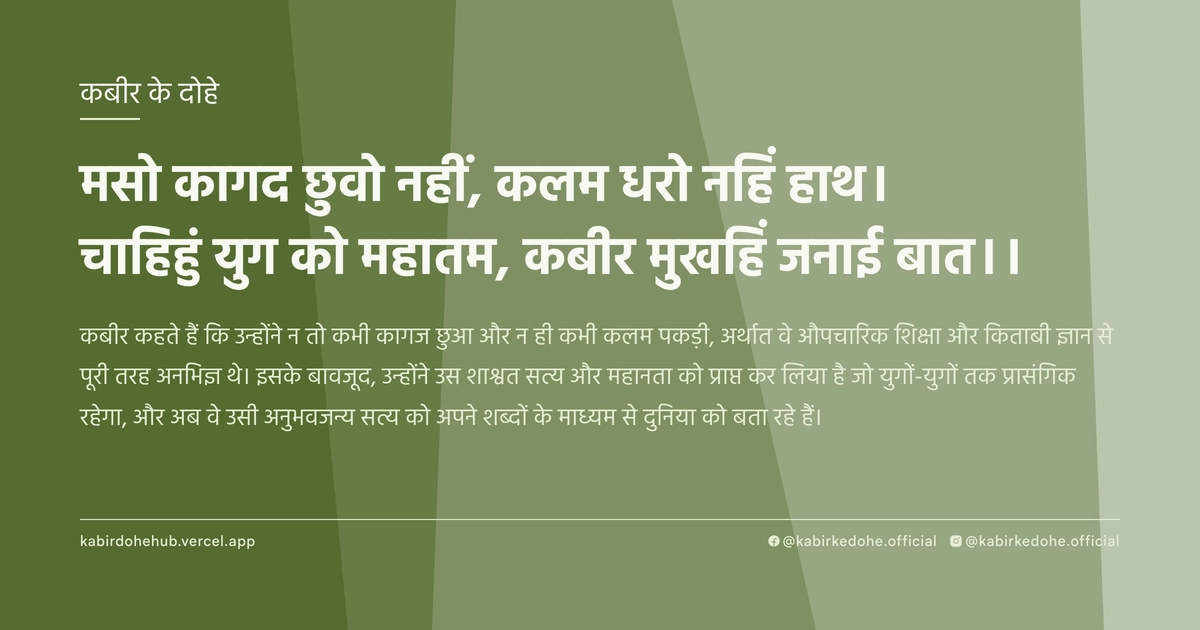
मसो कागद छुवो नहीं, कलम धरो नहिं हाथ।
चाहिहुं युग को महातम, कबीर मुखहिं जनाई बात।।
Maso kagad chhuvo nahi, kalam dharo nahin haath. Chahihun yug ko mahatam, kabir mukhahin janai baat.
इस पृष्ठ पर इस कबीर दोहे का अर्थ (meaning), हिंदी व्याख्या और अंग्रेज़ी अनुवाद, दार्शनिक विश्लेषण और व्यावहारिक जीवन सीख दी गई है। यह दोहा सहज योग (Sahaja Yoga) विषय से जुड़ा है — Kabir doha meaning and explanation in Hindi and English.
अर्थ (Meaning):
कबीर कहते हैं कि उन्होंने न तो कभी कागज छुआ और न ही कभी कलम पकड़ी, अर्थात वे औपचारिक शिक्षा और किताबी ज्ञान से पूरी तरह अनभिज्ञ थे। इसके बावजूद, उन्होंने उस शाश्वत सत्य और महानता को प्राप्त कर लिया है जो युगों-युगों तक प्रासंगिक रहेगा, और अब वे उसी अनुभवजन्य सत्य को अपने शब्दों के माध्यम से दुनिया को बता रहे हैं।
Kabir declares that he has never touched paper nor held a pen, signifying his complete lack of formal schooling or scriptural erudition. Despite this absence of academic learning, he has realized the supreme truth and greatness that transcends eras, and he now shares this direct, experiential wisdom through his spoken words.
व्याख्या (Interpretation):
यह दोहा साक्षरता और वास्तविक ज्ञान के बीच के गहरे अंतर को स्पष्ट करता है। कबीर यहाँ 'कागज' और 'कलम' को केवल लेखन सामग्री नहीं, बल्कि उस संस्थागत धर्म और रूढ़िवादी शिक्षा के प्रतीकों के रूप में देखते हैं जो अक्सर सत्य को शब्दों के जाल में उलझा देते हैं। वे निरगुण भक्ति के उस मार्ग पर चलते हैं जहाँ ईश्वर किसी पुस्तक में नहीं, बल्कि स्वयं के भीतर स्थित है। यह अद्वैत वेदांत के उस सिद्धांत की पुष्टि करता है जहाँ आत्मा और ब्रह्म की एकता का अनुभव किताबी ज्ञान से नहीं, बल्कि अंतःकरण की शुद्धि और सहज बोध से होता है। माया यहाँ वह भ्रम है जो हमें विश्वास दिलाता है कि सत्य केवल विद्वानों या शास्त्रों के पास है। कबीर इस विरोधाभास को उजागर करते हैं कि एक अनपढ़ व्यक्ति भी उस परम सत्य का साक्षात्कार कर सकता है जिसे बड़े-बड़े पंडित अपनी पूरी उम्र किताबों में ढूँढते रह जाते हैं।
This couplet elucidates the profound chasm between literacy and true enlightenment. Kabir views 'paper' and 'pen' not merely as tools for writing, but as symbols of institutionalized religion and orthodox education that often entrap truth within a web of words. He adheres to the path of Nirgun Bhakti, where the Divine resides not in a book, but within the self. This validates the Advaita Vedanta principle that the unity of Atman and Brahman is realized not through academic study, but through the purification of the heart and intuitive awareness. Maya, in this context, is the illusion that suggests truth is the exclusive domain of scholars or scriptures. Kabir highlights the central paradox of the human condition: that an unlettered soul can attain the supreme realization that lifelong scholars fail to find within the pages of their texts.
दार्शनिक विश्लेषण (Philosophical Analysis):
कबीर का यह कथन उनके युग के सामाजिक और धार्मिक ढांचे पर एक तीखा प्रहार है। मध्यकालीन भारत में, ज्ञान पर केवल उच्च जातियों और ब्राह्मणों का एकाधिकार था, और शास्त्रों की भाषा (संस्कृत) आम जनमानस की पहुँच से बाहर थी। कबीर ने इस 'ज्ञान के अभिजात्य' को चुनौती दी और यह स्थापित किया कि सत्य का मार्ग किसी विशेष जाति, भाषा या औपचारिक शिक्षा का मोहताज नहीं है। उनका दृष्टिकोण सूफी मत के 'मारिफत' (अनुभवात्मक ज्ञान) से मेल खाता है, जहाँ ईश्वर के साथ सीधा संबंध किसी मध्यस्थ या पुस्तक के बिना स्थापित किया जाता है।
दार्शनिक स्तर पर, कबीर यहाँ 'श्रुति' (सुना हुआ) और 'अनुभव' को 'शास्त्र' (लिखा हुआ) से ऊपर रखते हैं। वे तर्क देते हैं कि लिखित शब्द स्थिर और मृत होते हैं, जबकि जीवित अनुभव निरंतर प्रवाहित और गतिशील होता है। जब कोई व्यक्ति अहंकार का त्याग करता है, तो वह उस 'अक्षर' (अविनाशी) को पा लेता है जिसे कलम से नहीं लिखा जा सकता। यह अहंकार का विलोपन ही वह कुंजी है जो व्यक्ति को माया के आवरण से मुक्त करती है।
वे ritualism (कर्मकांड) का विरोध करते हुए यह समझाते हैं कि बाहरी दिखावे, जैसे कि माला जपना या तिलक लगाना, या केवल ग्रंथों का पाठ करना, आध्यात्मिक प्रगति के प्रमाण नहीं हैं। वास्तविक भक्ति वह है जो हृदय की गहराई से उपजे और व्यवहार में उतरे। कबीर का 'अनपढ़' होना उनकी सबसे बड़ी शक्ति बन गया, क्योंकि उन्होंने दुनिया को बिना किसी पूर्वग्रह के देखा और सीधे सत्य से संवाद किया।
यह दोहा हमें यह सोचने पर मजबूर करता है कि हम अक्सर सूचना (Information) को ज्ञान (Knowledge) और ज्ञान को बोध (Wisdom) समझने की गलती करते हैं। सूचना कागज पर होती है, ज्ञान मस्तिष्क में, लेकिन बोध आत्मा में होता है। कबीर का दावा है कि उन्होंने बोध प्राप्त किया है, जो कि किसी भी शैक्षणिक डिग्री से कहीं अधिक मूल्यवान है।
अंततः, कबीर का संदेश यह है कि सत्य सार्वभौमिक है। वह किसी एक धर्म, संप्रदाय या भाषा की बपौती नहीं है। जब व्यक्ति अपनी सीमित पहचान (ego) को मिटा देता है, तो वह उस सार्वभौमिक चेतना का हिस्सा बन जाता है, जहाँ शब्द समाप्त हो जाते हैं और केवल मौन सत्य शेष रह जाता है।
Kabir's assertion is a sharp critique of the social and religious structures of his era. In medieval India, knowledge was monopolized by the upper castes and Brahmins, and the language of the scriptures (Sanskrit) was inaccessible to the common masses. Kabir challenged this 'aristocracy of knowledge,' establishing that the path to truth is not dependent on a specific caste, language, or formal education.
Philosophically, Kabir elevates 'experience' and 'intuitive hearing' above 'scripture.' He argues that written words are static and dead, whereas living experience is fluid and dynamic. When an individual renounces the ego, they attain the 'Akshara' (the Imperishable), which cannot be captured by a pen. This annihilation of the ego is the key that liberates one from the veil of Maya.
He opposes ritualism, explaining that external displays—such as chanting beads, wearing tilaks, or merely reciting texts—are not evidence of spiritual progress. True devotion is that which arises from the depths of the heart and manifests in one's behavior. Kabir's 'illiteracy' became his greatest strength, allowing him to observe the world without prejudice and communicate directly with the Truth.
This couplet forces us to recognize the common error of confusing information with knowledge, and knowledge with wisdom. Information exists on paper, knowledge in the mind, but wisdom resides in the soul. Kabir claims to have attained wisdom, which is infinitely more valuable than any academic degree.
Ultimately, Kabir's message is that truth is universal. It is not the property of any single religion, sect, or language. When a person erases their limited identity (ego), they merge into that universal consciousness where words cease to exist and only the silent truth remains.
मूल संदेश (Core Message):
- किताबी ज्ञान अक्सर सत्य के मार्ग में बाधा बन जाता है।
- वास्तविक ज्ञान अनुभव और अंतर्ज्ञान से आता है, न कि रटने से।
- अहंकार का त्याग ही आध्यात्मिक जागृति की पहली सीढ़ी है।
- सत्य सार्वभौमिक है और किसी विशेष भाषा या लिपि का मोहताज नहीं।
- प्रेम और करुणा ही सबसे उच्च कोटि के शास्त्र हैं।
- बाहरी दिखावे और कर्मकांडों से ऊपर उठकर आंतरिक शुद्धि आवश्यक है।
- Bookish knowledge often becomes an obstacle on the path to truth.
- Real wisdom arises from experience and intuition, not from rote learning.
- The renunciation of ego is the first step toward spiritual awakening.
- Truth is universal and independent of any specific language or script.
- Love and compassion are the highest forms of scripture.
- Internal purification is essential, transcending external displays and rituals.
व्यावहारिक उदाहरण (Practical Example):
एक समय की बात है, वाराणसी के घाटों पर रहने वाला एक वृद्ध विधवा, जिसे लोग 'अम्मा' कहते थे, अपनी पूरी जिंदगी दूसरों की सेवा और गंगा की आरती में बिता चुकी थी। वह कभी स्कूल नहीं गई थी और उसे पढ़ना-लिखना नहीं आता था। उसी शहर में एक युवा विद्वान रहता था, जिसने दुनिया भर के दर्शनशास्त्र और धर्मग्रंथों का अध्ययन किया था। वह अक्सर अम्मा के पास आता और उसे जटिल दार्शनिक तर्क देकर यह समझाने की कोशिश करता कि मोक्ष कैसे प्राप्त किया जाए।
विद्वान कहता, "अम्मा, तुम इन किताबों के बिना कभी नहीं जान पाओगी कि आत्मा का परमात्मा से मिलन कैसे होता है। तुम्हें शास्त्रों का अध्ययन करना चाहिए।"
अम्मा बस मुस्कुराती और अपनी फटी हुई साड़ी के पल्लू से अपने हाथ पोंछते हुए कहती, "बेटा, मैं तो बस प्रेम की भाषा जानती हूँ।"
एक दिन शहर में भीषण बाढ़ आई। लोग अपनी जान बचाने के लिए भाग रहे थे। वह विद्वान अपनी कीमती किताबों को बचाने की कोशिश में पानी में फंस गया। उसकी सारी डिग्री और ज्ञान उसे डूबने से नहीं बचा पा रहे थे। तभी अम्मा ने, जिनके पास कोई किताब नहीं थी, लेकिन जिनके मन में करुणा का सागर था, अपनी जान जोखिम में डालकर उसे डूबने से बचाया।
जब वे दोनों सुरक्षित स्थान पर पहुँचे, तो विद्वान ने देखा कि अम्मा की आँखों में कोई अहंकार नहीं था, केवल एक असीम शांति थी। उसने महसूस किया कि वह किताबों में जिस 'करुणा' और 'त्याग' के बारे में पढ़ रहा था, अम्मा उसे जी रही थीं।
उस क्षण विद्वान को कबीर की बात याद आई कि सत्य कागज पर नहीं, जीवन में होता है। उसने अपनी किताबों को एक तरफ रखा और अम्मा के चरणों में बैठकर यह सीखने की कोशिश की कि बिना शब्दों के प्रेम कैसे किया जाता है।
अम्मा ने उसे सिखाया कि जब आप किसी भूखे को रोटी देते हैं, तो वह किसी शास्त्र के पाठ से बड़ा पुण्य है।
विद्वान का अहंकार टूट गया। उसने समझा कि ज्ञान का असली उद्देश्य दूसरों को नीचा दिखाना नहीं, बल्कि स्वयं को मिटाकर दूसरों की सेवा करना है।
इस प्रकार, एक अनपढ़ वृद्ध महिला ने एक महान विद्वान को जीवन का सबसे बड़ा पाठ पढ़ाया—कि प्रेम ही एकमात्र वास्तविक शास्त्र है।
Once, on the ghats of Varanasi, lived an elderly widow known as 'Amma.' She had spent her entire life serving others and attending the Ganga Aarti. She had never stepped foot in a school and was completely illiterate. In the same city lived a young scholar who had studied the philosophies and scriptures of the entire world. He often visited Amma, attempting to explain the path to liberation using complex philosophical arguments.
The scholar would say, "Amma, without these books, you will never understand how the soul merges with the Divine. You must study the scriptures."
Amma would simply smile, wiping her hands with the corner of her worn-out saree, and reply, "Son, I only know the language of love."
One day, a devastating flood hit the city. People were fleeing for their lives. The scholar, in his attempt to save his precious books, became trapped in the rising waters. All his degrees and knowledge could not save him from drowning. It was then that Amma, who possessed no books but carried an ocean of compassion in her heart, risked her own life to pull him to safety.
Once they reached dry land, the scholar noticed that there was no ego in Amma's eyes, only an infinite peace. He realized that the 'compassion' and 'renunciation' he had read about in books were being lived by Amma in every breath.
In that moment, the scholar recalled Kabir's wisdom: that truth is not found on paper, but in life. He set aside his books and sat at Amma's feet to learn how to love without words.
Amma taught him that feeding a hungry person is a greater virtue than reciting any scripture.
The scholar's ego shattered. He understood that the true purpose of knowledge is not to look down upon others, but to erase oneself in the service of others.
Thus, an illiterate elderly woman taught a great scholar the greatest lesson of all—that love is the only authentic scripture.
अभ्यास मार्गदर्शन (Practice Guidance):
- प्रतिदिन 20 मिनट मौन साधना करें, जहाँ आप शब्दों और विचारों को छोड़कर केवल अपनी श्वास और वर्तमान क्षण के अनुभव पर ध्यान केंद्रित करें।
- एक 'अहंकार डायरी' बनाएँ। उन क्षणों को लिखें जब आपने अपनी शिक्षा, पद या ज्ञान के कारण किसी को छोटा महसूस कराया, और फिर विचार करें कि वह ज्ञान वास्तव में आपकी सेवा में कैसे काम आ सकता था।
- सप्ताह में एक बार किसी ऐसे व्यक्ति के साथ समय बिताएं जो औपचारिक रूप से शिक्षित नहीं है, और उनसे जीवन के सरल सत्यों के बारे में सीखें।
- डायग्नोस्टिक चेकलिस्ट: क्या मैं किसी की बात सुनने के बजाय उसे सुधारने की कोशिश करता हूँ? क्या मेरी पहचान मेरी डिग्री या पद से जुड़ी है? क्या मैं सत्य को केवल किताबों में ढूँढ रहा हूँ या अपने व्यवहार में भी?
- Practice 20 minutes of silent meditation daily, letting go of words and thoughts to focus solely on the experience of your breath and the present moment.
- Maintain an 'Ego Journal.' Record moments where you made someone feel inferior due to your education, status, or knowledge, and reflect on how that knowledge could have been used for service instead.
- Once a week, spend time with someone who lacks formal education and listen to the simple, lived truths they have to offer.
- Diagnostic Checklist: Do I try to correct people instead of listening to them? Is my identity tied to my degrees or titles? Am I seeking truth only in books or also in my own behavior?
चिंतन प्रश्न (Reflection Questions):
- यदि आज मेरी सारी डिग्रियाँ और उपलब्धियाँ छीन ली जाएँ, तो मेरी असली पहचान क्या रह जाएगी?
- क्या मैं वास्तव में सत्य की खोज कर रहा हूँ, या मैं केवल अपनी बौद्धिक श्रेष्ठता को सिद्ध करना चाहता हूँ?
- मेरे जीवन का वह कौन सा अनुभव है जिसने मुझे किसी भी किताब से अधिक सिखाया?
- मैं अपनी डिजिटल पहचान (सोशल मीडिया) पर ज्ञान का प्रदर्शन करता हूँ या वास्तव में उस ज्ञान को जीता हूँ?
- क्या मैं उन लोगों का सम्मान करता हूँ जो अनपढ़ हैं लेकिन जिनका जीवन नैतिक और शांत है?
- मेरे भीतर का वह कौन सा 'लिखा हुआ' नियम है जो मुझे वास्तव में प्रेम करने से रोक रहा है?
- If all my degrees and achievements were stripped away today, what would remain of my true identity?
- Am I truly seeking the truth, or am I merely trying to prove my intellectual superiority?
- What is the one experience in my life that taught me more than any book ever could?
- Do I perform knowledge for my digital identity (social media), or do I actually live that knowledge?
- Do I genuinely respect those who are illiterate yet lead ethical and peaceful lives?
- What is the 'written' rule within me that prevents me from loving unconditionally?