
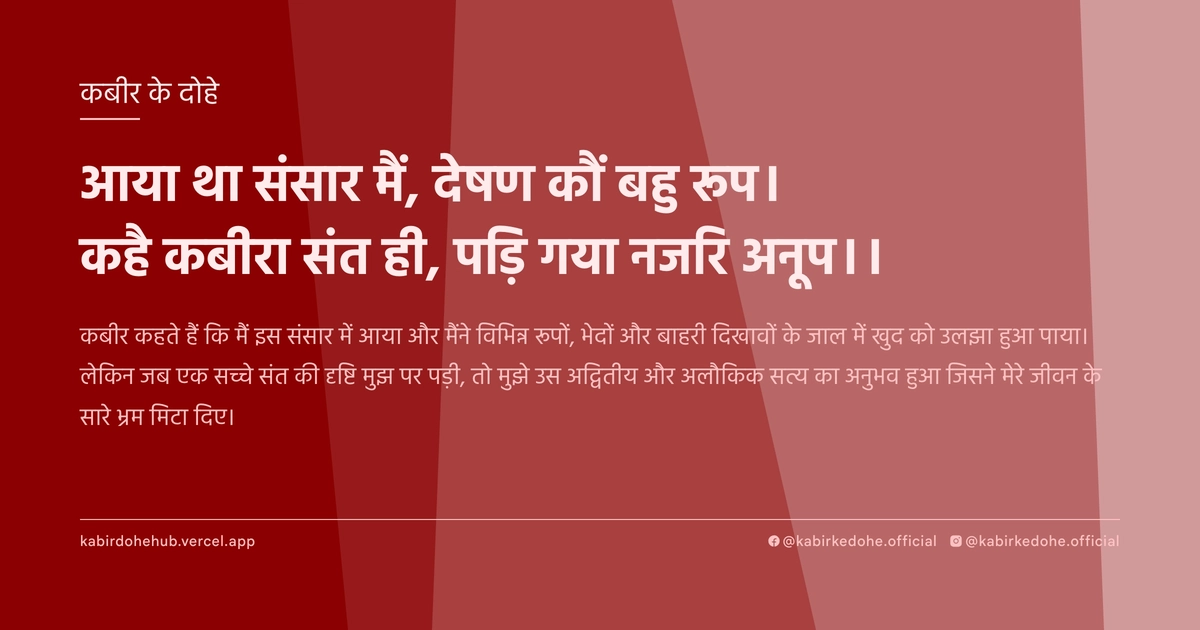
आया था संसार मैं, देषण कौं बहु रूप।
कहै कबीरा संत ही, पड़ि गया नजरि अनूप।।
Aaya tha sansar main, deshan kaun bahu roop. Kahe kabira sant hi, pad gaya najir anoop.
इस पृष्ठ पर इस कबीर दोहे का अर्थ (meaning), हिंदी व्याख्या और अंग्रेज़ी अनुवाद, दार्शनिक विश्लेषण और व्यावहारिक जीवन सीख दी गई है। यह दोहा जागृति (The Wake-up Call) विषय से जुड़ा है — Kabir doha meaning and explanation in Hindi and English.
अर्थ (Meaning):
कबीर कहते हैं कि मैं इस संसार में आया और मैंने विभिन्न रूपों, भेदों और बाहरी दिखावों के जाल में खुद को उलझा हुआ पाया। लेकिन जब एक सच्चे संत की दृष्टि मुझ पर पड़ी, तो मुझे उस अद्वितीय और अलौकिक सत्य का अनुभव हुआ जिसने मेरे जीवन के सारे भ्रम मिटा दिए।
Kabir reflects that he entered this world only to find himself entangled in the myriad forms of duality, distinctions, and worldly illusions. However, upon encountering the gaze of a true enlightened saint, he was struck by an unparalleled, divine vision that dissolved all misconceptions and revealed the singular, absolute truth.
व्याख्या (Interpretation):
इस दोहे का शाब्दिक अर्थ है कि मनुष्य संसार में जन्म लेकर विभिन्न सांसारिक पहचानों और द्वंद्वों में फंस जाता है। रूपक के स्तर पर, 'बहु रूप' माया के उन आवरणों को दर्शाता है जो आत्मा को उसकी वास्तविक प्रकृति से अलग करते हैं। यह निरगुण भक्ति का सार है, जहाँ ईश्वर किसी आकार में नहीं, बल्कि सर्वव्यापी चेतना में है। जब कबीर 'अनूप नजर' की बात करते हैं, तो वह उस आध्यात्मिक जागृति की ओर इशारा कर रहे हैं जो द्वैत (दो होने का भाव) को समाप्त कर अद्वैत (एकता) की स्थापना करती है। यह वह क्षण है जब साधक को समझ आता है कि वह शरीर या नाम नहीं, बल्कि वह अनंत ब्रह्म है।
Literally, the verse describes a soul entering the world and becoming lost in diverse identities. Metaphorically, 'bahu roop' (many forms) represents the veils of Maya that obscure the Atman's true nature. This aligns with Nirgun Bhakti, where the Divine is formless and omnipresent. The 'anoop najir' (unparalleled vision) symbolizes the catalyst of spiritual awakening—the moment the seeker transcends the illusion of separation. It highlights the paradox of the human condition: we seek the truth externally while being blinded by the very identities we cling to, until a master's grace reveals the non-duality of Atman and Brahman.
दार्शनिक विश्लेषण (Philosophical Analysis):
कबीर का यह दोहा उनके समय के कट्टरपंथ और कर्मकांडीय धर्म के विरुद्ध एक सशक्त प्रहार है। उन्होंने देखा कि लोग जाति, धर्म और बाहरी वेशभूषा के 'रूपों' में फंसे हुए हैं, जबकि सत्य इन सबसे परे है। यह विचार अद्वैत वेदांत के करीब है, जहाँ जगत को मिथ्या और ब्रह्म को एकमात्र सत्य माना गया है। कबीर यहाँ सूफी मत के 'फना' (अहंकार का विनाश) की बात कर रहे हैं, जहाँ व्यक्ति की अपनी पहचान मिट जाती है और केवल ईश्वर शेष रहता है।
ऐतिहासिक रूप से, कबीर ने बुनकर के रूप में जीवन व्यतीत किया, जहाँ उन्होंने देखा कि जैसे धागे अलग-अलग रंगों के होते हुए भी एक ही कपड़े का हिस्सा हैं, वैसे ही मनुष्य अलग दिखते हुए भी एक ही चेतना के अंश हैं। उनका विरोध किसी व्यक्ति से नहीं, बल्कि उस 'अहंकार' से था जो मनुष्य को दूसरे से अलग करता है।
मनोवैज्ञानिक स्तर पर, यह दोहा संज्ञानात्मक विस्थापन (cognitive shift) की बात करता है। जब तक हम स्वयं को 'रूप' (नाम, पद, जाति) से पहचानते हैं, हम सीमित रहते हैं। संत की दृष्टि वह दर्पण है जो हमें हमारे वास्तविक, असीमित स्वरूप से परिचित कराती है।
यह विश्लेषण स्पष्ट करता है कि कबीर केवल एक कवि नहीं, बल्कि एक मनोवैज्ञानिक थे जो जानते थे कि बाहरी ज्ञान केवल सूचना है, लेकिन आंतरिक अनुभव ही रूपांतरण है। उन्होंने ritualism को इसलिए नकारा क्योंकि वह 'रूप' को पुजता है, जबकि सत्य 'अरूप' है।
अंततः, यह दोहा इस सत्य को स्थापित करता है कि मोक्ष किसी तीर्थ या मंत्र से नहीं, बल्कि उस दृष्टि के परिवर्तन से आता है जो विविधता में एकता को देख सके।
This Doha serves as a potent critique of the sectarianism and ritualistic rigidity prevalent during Kabir's era. He observed humanity trapped in the 'forms' of caste, creed, and outward appearances, while the Truth remains transcendent. This philosophy mirrors Advaita Vedanta, which posits that the perceived world is Maya (illusion) and Brahman is the sole reality. Kabir here echoes the Sufi concept of 'Fana'—the annihilation of the ego—where the individual identity dissolves into the Divine.
Historically, as a weaver, Kabir witnessed how threads of different colors weave into a single fabric; similarly, diverse humans are expressions of one consciousness. His rebellion was not against people, but against the egoistic constructs that create separation.
Psychologically, the verse describes a profound cognitive shift. As long as we identify with 'roop' (labels, status, ethnicity), we remain fragmented. The 'vision of the saint' acts as a spiritual mirror, reflecting the seeker's infinite nature back to them, stripping away the false persona.
This analysis clarifies that Kabir was not merely a poet but a spiritual psychologist. He understood that intellectual knowledge is mere information, whereas direct experiential realization is the only path to transformation. He rejected ritualism because it worships the form, whereas the Truth is formless (Nirgun).
Ultimately, the Doha establishes that liberation is not found in pilgrimages or mantras, but in the transformation of perception—the ability to see the singular Unity within the chaotic diversity of existence.
मूल संदेश (Core Message):
- बाहरी पहचान एक भ्रम है जो आत्मा को सीमित करता है।
- सत्य किसी रूप में नहीं, बल्कि रूपहीनता में निहित है।
- गुरु या संत की कृपा अहंकार के पर्दे को हटा देती है।
- विविधता के पीछे छिपी एकता को पहचानना ही वास्तविक ज्ञान है।
- जब 'मैं' मिटता है, तब 'अनूप' (अद्वितीय सत्य) प्रकट होता है।
- External identity is an illusion that restricts the soul.
- Truth resides not in form, but in formlessness.
- The grace of a master dissolves the veils of the ego.
- True wisdom is recognizing the Unity hidden behind diversity.
- When the 'I' vanishes, the 'Unparalleled Truth' emerges.
व्यावहारिक उदाहरण (Practical Example):
एक समय की बात है, वाराणसी के घाटों पर माधव नाम का एक वृद्ध नाविक रहता था। माधव का पूरा जीवन केवल नाव चलाने और यात्रियों को पार कराने में बीता था। वह खुद को केवल एक 'नाविक' मानता था और अपनी पहचान को अपनी गरीबी और अपनी जाति के दायरे में सीमित रखता था। वह अक्सर सोचता था कि उसका जीवन व्यर्थ है क्योंकि उसने कभी कोई बड़ा शास्त्र नहीं पढ़ा और न ही वह किसी बड़े मंदिर का पुजारी था।
एक दिन, उसकी नाव पर एक मौन साधु सवार हुए। साधु ने कुछ नहीं कहा, लेकिन जब माधव ने उनकी आँखों में देखा, तो उसे एक अजीब सी शांति और गहराई महसूस हुई। उस साधु की दृष्टि में कोई निर्णय नहीं था, कोई भेदभाव नहीं था। उस एक क्षण के लिए, माधव को महसूस हुआ कि वह केवल एक नाविक नहीं है, बल्कि वह उसी अनंत जल की तरह है जिसे वह हर दिन पार कराता है।
उस दृष्टि ने माधव के भीतर के 'नाविक' के अहंकार और उसकी 'गरीबी' के दुख को मिटा दिया। उसे समझ आया कि वह जिसे अपनी पहचान मान रहा था, वह केवल एक मुखौटा था। वह अब खुद को किसी जाति या पेशे से नहीं जोड़ता था।
अगले दिन से माधव का व्यवहार बदल गया। वह अब यात्रियों को केवल पैसा कमाने के साधन के रूप में नहीं, बल्कि अपनी ही आत्मा के विभिन्न रूपों के रूप में देखने लगा। उसने नाव चलाने के काम को ही अपनी प्रार्थना बना लिया।
जब लोग उससे उसकी खुशी का राज पूछते, तो वह बस मुस्कुरा देता। उसने महसूस किया कि जिस ईश्वर को लोग मंदिरों में खोज रहे थे, वह तो उसके भीतर की उसी शांति में था जिसे उसने उस साधु की नजर में देखा था।
उसका जीवन अब संघर्ष नहीं, बल्कि एक उत्सव बन गया था। उसने अपनी छोटी सी झोपड़ी को उन लोगों के लिए खोल दिया जो बेघर थे, बिना यह सोचे कि वे कौन हैं या कहाँ से आए हैं।
माधव ने जान लिया था कि 'रूप' केवल बाहरी आवरण हैं। उसने अपनी पहचान के छोटे दायरे को तोड़कर ब्रह्मांडीय चेतना में प्रवेश कर लिया था।
यह 'कबीर ट्विस्ट' था—एक साधारण नाविक का एक आत्मज्ञानी मनुष्य में रूपांतरण, केवल एक सही दृष्टि के स्पर्श से।
Once, on the ghats of Varanasi, lived an elderly boatman named Madhav. Madhav's entire life had been spent rowing boats and ferrying passengers. He identified himself solely as a 'boatman,' limiting his existence to the boundaries of his poverty and his caste. He often lamented that his life was wasted because he had never read great scriptures nor held a position of prestige in a temple.
One day, a silent monk boarded his boat. The monk spoke no words, but when Madhav looked into his eyes, he felt an extraordinary peace and depth. There was no judgment in that gaze, no discrimination. For a single moment, Madhav felt that he was not just a boatman, but he was like the very infinite water he crossed every day.
That gaze dissolved the ego of the 'boatman' and the sorrow of his 'poverty.' He realized that what he had considered his identity was merely a mask. He no longer tethered himself to a caste or a profession.
From the next day, Madhav's behavior transformed. He stopped seeing passengers as mere sources of income and began seeing them as different reflections of his own soul. He turned the act of rowing into a living prayer.
When people asked the secret of his newfound joy, he would simply smile. He realized that the God people sought in temples resided in the same silence he had witnessed in the monk's eyes.
His life ceased to be a struggle and became a celebration. He opened his small hut to the homeless, regardless of their origin or status.
Madhav had understood that 'forms' are merely outer shells. By breaking the small circle of his identity, he entered the cosmic consciousness.
This was the 'Kabir Twist'—the transformation of a simple boatman into a self-realized being, triggered by the touch of a single, awakened gaze.
अभ्यास मार्गदर्शन (Practice Guidance):
- प्रतिदिन 20 मिनट मौन ध्यान करें, जहाँ आप अपनी सभी पहचानों (नाम, पेशा, रिश्ता) को मानसिक रूप से त्याग दें और केवल 'साक्षी' बनकर रहें।
- एक डायरी लिखें जिसमें आप उन 'रूपों' या मुखौटों की सूची बनाएं जिन्हें आप समाज में पहनते हैं, और विश्लेषण करें कि ये आपको आपकी वास्तविकता से कैसे दूर ले जाते हैं।
- दिन में कम से कम एक बार किसी अजनबी की आँखों में गहराई से देखें और यह महसूस करने का प्रयास करें कि उस व्यक्ति के भीतर भी वही चेतना है जो आपके भीतर है।
- डायग्नोस्टिक चेकलिस्ट: क्या आप अभी भी दूसरों को उनकी जाति, पद या रंग से आंक रहे हैं? क्या आप अपनी उपलब्धियों पर गर्व या अपनी कमियों पर शोक मना रहे हैं? यदि हाँ, तो आप अभी भी 'बहु रूप' के जाल में हैं।
- Practice 20 minutes of silent meditation daily, mentally shedding all identities (name, profession, relationships) and remaining solely as the 'Witness'.
- Maintain a journal listing the 'masks' or personas you wear in society, analyzing how these constructs distance you from your authentic self.
- Once a day, look deeply into the eyes of a stranger and consciously acknowledge that the same universal consciousness residing in you also resides in them.
- Diagnostic Checklist: Are you still judging others by their caste, status, or appearance? Do you feel pride in achievements or grief in failures? If yes, you are still entangled in the 'many forms' of Maya.
चिंतन प्रश्न (Reflection Questions):
- यदि आपसे आपका नाम, आपका पेशा और आपका सामाजिक स्तर छीन लिया जाए, तो वास्तव में आप कौन बचेंगे?
- आपकी वह कौन सी 'पहचान' है जिसे आप सबसे अधिक पकड़कर रखते हैं, और वह आपको सत्य से कैसे दूर कर रही है?
- क्या आप दूसरों में केवल उनके 'रूप' को देखते हैं, या उस चेतना को जो उनके भीतर धड़क रही है?
- आपके जीवन का वह कौन सा क्षण था जब आपने महसूस किया कि आप इस भौतिक शरीर से कहीं अधिक हैं?
- डिजिटल युग में, आपका 'ऑनलाइन व्यक्तित्व' किस प्रकार के नए 'रूप' पैदा कर रहा है जो आपकी आंतरिक शांति को बाधित करते हैं?
- If your name, profession, and social status were stripped away, who would you actually be?
- Which identity do you cling to most fiercely, and how is it distancing you from the Truth?
- Do you see only the 'form' in others, or the consciousness that beats within them?
- At what moment in your life did you feel that you are something far greater than this physical body?
- In the digital age, what new 'forms' is your online persona creating that disrupt your inner peace?