
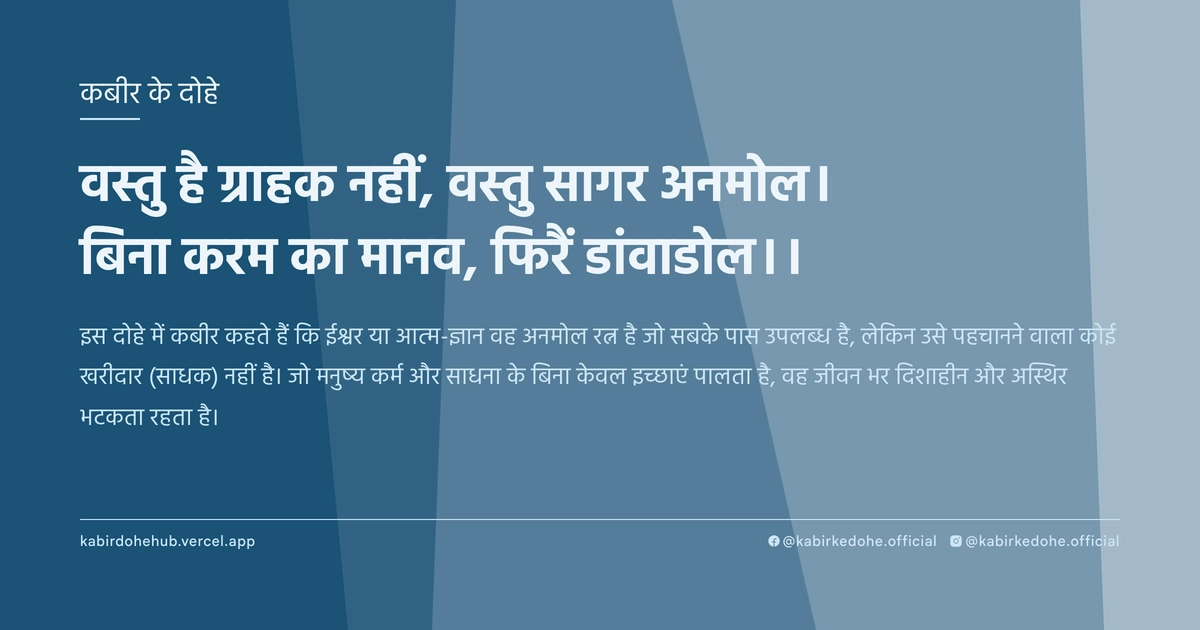
वस्तु है ग्राहक नहीं, वस्तु सागर अनमोल।
बिना करम का मानव, फिरैं डांवाडोल।।
Vastu hai grahak nahi, vastu sagar ownmol. Bina karam ka manav, phiraen dandaadol.
इस पृष्ठ पर इस कबीर दोहे का अर्थ (meaning), हिंदी व्याख्या और अंग्रेज़ी अनुवाद, दार्शनिक विश्लेषण और व्यावहारिक जीवन सीख दी गई है। यह दोहा जागृति (The Wake-up Call) विषय से जुड़ा है — Kabir doha meaning and explanation in Hindi and English.
अर्थ (Meaning):
इस दोहे में कबीर कहते हैं कि ईश्वर या आत्म-ज्ञान वह अनमोल रत्न है जो सबके पास उपलब्ध है, लेकिन उसे पहचानने वाला कोई खरीदार (साधक) नहीं है। जो मनुष्य कर्म और साधना के बिना केवल इच्छाएं पालता है, वह जीवन भर दिशाहीन और अस्थिर भटकता रहता है।
Kabir asserts that the Divine or Self-realization is a priceless treasure available to all, yet there is a lack of 'buyers'—those with the discernment to seek it. A human being who lacks purposeful spiritual action and discipline remains adrift, wandering aimlessly through the illusions of existence.
व्याख्या (Interpretation):
शाब्दिक अर्थ यह है कि बाजार में कीमती वस्तु तो है पर उसे खरीदने वाला नहीं। रूपकात्मक रूप से, 'वस्तु' यहाँ निर्गुण ब्रह्म या आत्मा का सत्य है। कबीर संकेत करते हैं कि माया के प्रभाव में मनुष्य बाहरी भौतिकता में उलझा है, जबकि आंतरिक 'अनमोल सागर' की उपेक्षा कर रहा है। यह अद्वैत वेदांत के उस सत्य को दर्शाता है जहाँ ब्रह्म सर्वव्यापी है, परंतु अज्ञानता के कारण हम उसे देख नहीं पाते। 'डांवाडोल' होना मानसिक अस्थिरता और अहंकार के द्वंद्व का प्रतीक है। जब तक साधक कर्म (साधना) को नहीं अपनाता, वह जन्म-मृत्यु के चक्र और मानसिक क्लेशों में भटकता रहता है।
Literally, it describes a priceless commodity lacking a buyer. Metaphorically, the 'commodity' is the Nirgun Brahman or the realization of the Self. Kabir suggests that under the veil of Maya, humans are preoccupied with external materialism, ignoring the 'priceless ocean' within. This aligns with Advaita Vedanta, where the Absolute is omnipresent but obscured by ignorance. Being 'danwadol' (unstable) symbolizes the psychological turmoil and the duality of the ego. Until the seeker engages in 'Karam'—not mere labor, but disciplined spiritual praxis—they remain adrift in the cycle of samsara and mental agitation.
दार्शनिक विश्लेषण (Philosophical Analysis):
कबीर का यह दोहा उनके युग के धार्मिक पाखंड और कर्मकांड के विरुद्ध एक सशक्त प्रहार है। उन्होंने देखा कि लोग तीर्थों और बाहरी अनुष्ठानों में समय व्यर्थ कर रहे थे, जबकि वास्तविक सत्य उनके भीतर था। यह दृष्टिकोण सूफी मत के 'इंसान-ए-कामिल' और वेदांत के 'आत्म-साक्षात्कार' का संगम है। कबीर यहाँ 'कर्म' शब्द का प्रयोग केवल शारीरिक कार्य के लिए नहीं, बल्कि 'साधना' के अर्थ में कर रहे हैं।
ऐतिहासिक रूप से, कबीर ने जाति और वर्ग की सीमाओं को तोड़कर यह संदेश दिया कि मोक्ष किसी विशेष कुल का अधिकार नहीं है, बल्कि वह 'ग्राहक' बनने की योग्यता पर निर्भर है। ग्राहक वह है जिसने अपनी इंद्रियों पर विजय प्राप्त की है और जो सत्य की कीमत (त्याग) चुकाने को तैयार है।
दार्शनिक स्तर पर, यह दोहा 'अविद्या' (Ignorance) और 'विद्या' (Knowledge) के बीच के संघर्ष को दर्शाता है। जब तक मनुष्य अपनी पहचान शरीर और मन से जोड़ता है, वह 'डांवाडोल' रहता है। जैसे ही वह अपनी पहचान उस 'अनमोल सागर' (ब्रह्म) से जोड़ता है, उसकी अस्थिरता समाप्त हो जाती है।
यहाँ 'सागर' शब्द अनंतता का प्रतीक है। जिस प्रकार सागर की गहराई असीम है, उसी प्रकार आत्मा का स्वरूप भी अनंत है। कबीर चेतावनी देते हैं कि बिना आंतरिक अनुशासन के, केवल इच्छा करना पर्याप्त नहीं है। आध्यात्मिक प्रगति के लिए 'तप' और 'साधना' अनिवार्य है।
अंततः, यह विश्लेषण हमें बताता है कि ईश्वर कहीं बाहर खोजने की वस्तु नहीं है, बल्कि वह एक अंतर्निहित वास्तविकता है। समस्या ईश्वर की अनुपस्थिति नहीं, बल्कि मनुष्य की 'खरीदने' की क्षमता (चेतना का स्तर) का अभाव है।
This couplet is a potent critique of the ritualistic hypocrisy prevalent during Kabir's era. He observed people wasting lives on pilgrimages and external rites while the ultimate truth resided within. This perspective merges the Sufi concept of 'Al-Insan al-Kamil' (the perfected human) with the Vedantic pursuit of 'Atman-Bodha' (Self-awareness).
Historically, Kabir dismantled caste and class barriers, asserting that liberation is not a birthright of any specific lineage but depends on one's capacity to become a 'buyer'—a seeker. The 'buyer' is one who has mastered the senses and is willing to pay the price of spiritual discipline through the sacrifice of the ego.
Philosophically, the verse highlights the conflict between 'Avidya' (ignorance) and 'Vidya' (knowledge). As long as a human identifies with the transient body and fluctuating mind, they remain 'danwadol' (unstable). The moment they align their identity with the 'priceless ocean' (Brahman), the instability ceases.
The metaphor of the 'ocean' signifies infinity. Just as the ocean's depth is boundless, the nature of the Soul is infinite. Kabir warns that mere longing is insufficient; spiritual evolution requires 'Tapas' (discipline) and 'Sadhana' (practice).
Ultimately, this analysis reveals that the Divine is not an object to be sought externally but an inherent reality. The crisis is not the absence of God, but the lack of the seeker's capacity—their level of consciousness—to recognize and 'purchase' this truth.
मूल संदेश (Core Message):
- बाहरी खोज एक भ्रम है; वास्तविक खजाना भीतर है।
- बिना आत्म-अनुशासन के आध्यात्मिक इच्छाएं व्यर्थ हैं।
- अस्थिरता का कारण बाहरी अभाव नहीं, आंतरिक अज्ञान है।
- सत्य सबके लिए उपलब्ध है, पर केवल योग्य ही उसे पाते हैं।
- कर्म का अर्थ यहाँ केवल कार्य नहीं, बल्कि आंतरिक रूपांतरण है।
- External searching is an illusion; the real treasure is within.
- Spiritual desires are futile without the discipline of practice.
- Instability stems not from external lack, but from inner ignorance.
- Truth is available to all, but only the discerning attain it.
- Action here means not mere labor, but internal transformation.
व्यावहारिक उदाहरण (Practical Example):
वाराणसी के घाटों पर रहने वाली एक वृद्ध विधवा, जानकी, का जीवन केवल भिक्षा और दूसरों की दया पर निर्भर था। वह दिन भर मंदिर के चक्कर लगाती और ईश्वर से अपनी गरीबी दूर करने की प्रार्थना करती, लेकिन उसके मन में हमेशा दूसरों के प्रति ईर्ष्या और अपने भाग्य के प्रति क्रोध रहता था। वह मानती थी कि उसकी समस्याएँ उसकी किस्मत हैं।
एक दिन उसने एक फकीर को देखा जो फटे कपड़ों में था, फिर भी उसके चेहरे पर एक ऐसी शांति थी जिसे जानकी ने बड़े-बड़े पंडितों के चेहरे पर भी नहीं देखा था। जानकी ने उससे पूछा, 'मैं सालों से पूजा कर रही हूँ, फिर भी मेरा मन अशांत है। आप कौन सी पूजा करते हैं?'
फकीर ने मुस्कुराकर कहा, 'मैं पूजा नहीं करता, मैं बस उस अनमोल सागर को खोज रहा हूँ जो मेरे भीतर है। तुम बाहर की वस्तुओं को खरीदने की कोशिश कर रही हो, जबकि सबसे कीमती वस्तु तुम्हारे पास है, बस तुम उसकी ग्राहक नहीं बनी हो।'
जानकी को पहले तो यह बात समझ नहीं आई, लेकिन 'ग्राहक' शब्द उसके दिमाग में घर कर गया। उसने सोचा कि वह अब तक केवल माँगने वाली रही है, उसने कभी अपने भीतर झाँकने का 'कर्म' नहीं किया।
अगले कुछ महीनों तक, जानकी ने मंदिर जाना कम किया और मौन का अभ्यास शुरू किया। उसने अपनी ईर्ष्या को देखना शुरू किया और महसूस किया कि उसका क्रोध ही उसकी सबसे बड़ी गरीबी थी।
उसने अपने जीवन के छोटे-छोटे कार्यों—जैसे दूसरों को पानी पिलाना या किसी दुखी व्यक्ति की बात सुनना—को ही अपनी साधना बना लिया। उसने बाहरी चमत्कार की उम्मीद छोड़ दी।
धीरे-धीरे, उसकी मानसिक अस्थिरता कम होने लगी। वह अब भाग्य को कोसने के बजाय वर्तमान क्षण में जीना सीख गई।
एक दिन उसे एहसास हुआ कि जिस शांति की तलाश में वह सालों से भटक रही थी, वह उसके भीतर ही थी। वह अब 'डांवाडोल' नहीं थी।
उसका जीवन बदल गया क्योंकि उसने बाहरी 'वस्तुओं' की लालसा छोड़कर आंतरिक 'अनमोल सागर' को पहचानने का कर्म किया।
जानकी अब केवल एक विधवा नहीं थी, वह एक जागृत आत्मा बन चुकी थी, जिसने अपनी आंतरिक संपदा को पा लिया था।
Janaki, an elderly widow living on the ghats of Varanasi, spent her days relying on alms and the mercy of others. She circled temples constantly, praying for the removal of her poverty, yet her heart was filled with envy toward others and rage toward her fate. She believed her suffering was predestined.
One day, she encountered a wandering dervish. Despite his tattered clothes, his face radiated a serenity Janaki had never seen even in the most learned priests. She asked him, 'I have prayed for years, yet my mind is restless. What rituals do you perform?'
The dervish smiled and replied, 'I do not perform rituals; I simply seek the priceless ocean within. You are trying to buy external things, while the most precious treasure is already yours—you simply haven't become the buyer.'
Janaki was initially confused, but the word 'buyer' haunted her. She realized she had always been a beggar, never once performing the 'Karam' (action) of looking inward.
Over the following months, Janaki reduced her temple visits and began practicing silence. She started observing her envy and realized that her inner anger was her true poverty.
She transformed simple acts—offering water to strangers or listening to the grieving—into her spiritual practice. She ceased hoping for external miracles.
Gradually, her mental instability vanished. Instead of cursing fate, she learned to dwell in the present moment.
One day, she realized that the peace she had spent years searching for externally had been residing within her all along. She was no longer 'danwadol' (adrift).
Her life transformed because she shifted from craving external 'objects' to the active work of recognizing the 'priceless ocean' inside.
Janaki was no longer just a widow; she had become an awakened soul who had claimed her internal wealth.
अभ्यास मार्गदर्शन (Practice Guidance):
- दैनिक मौन अभ्यास: प्रतिदिन 20 मिनट पूर्ण मौन में बैठें। बाहरी शोर को सुनें और फिर धीरे-धीरे अपना ध्यान अपनी सांसों और हृदय की धड़कन पर केंद्रित करें।
- आत्म-निरीक्षण जर्नल: हर रात लिखें कि आज आपने कितनी बार अपनी खुशी बाहरी वस्तुओं या लोगों की प्रशंसा पर निर्भर की। यह पहचानें कि कहाँ आप 'डांवाडोल' महसूस कर रहे थे।
- अहंकार का विसर्जन: दिन में एक बार ऐसा कार्य करें जिससे आपके अहंकार को चोट पहुँचे (जैसे किसी ऐसे व्यक्ति की मदद करना जो आपकी मदद कभी नहीं कर सकता), ताकि आप 'ग्राहक' बनने की पात्रता विकसित कर सकें।
- निदान चेकलिस्ट: यदि आप छोटी बातों पर विचलित होते हैं, दूसरों की सफलता से जलते हैं, या हमेशा 'कल' में सुख खोजते हैं, तो आप अभी भी 'डांवाडोल' हैं। यदि आप वर्तमान में स्थिर हैं, तो आप सत्य के करीब हैं।
- Daily Silence Practice: Sit in absolute silence for 20 minutes daily. Listen to the external noise first, then gradually shift your focus to your breath and heartbeat.
- Self-Inquiry Journaling: Every night, record instances where your happiness depended on external objects or validation. Identify the moments you felt 'danwadol' (unstable).
- Ego Dissolution: Once a day, perform an act that challenges your ego (e.g., helping someone who can offer you nothing in return) to develop the capacity of a true 'buyer'.
- Diagnostic Checklist: If you are easily triggered by trivialities, envious of others' success, or constantly seeking happiness in 'tomorrow', you are still 'adrift'. If you are anchored in the present, you are nearing the Truth.
चिंतन प्रश्न (Reflection Questions):
- मैं अपनी पहचान किन बाहरी वस्तुओं या उपाधियों से जोड़ता हूँ, और यदि वे छीन ली जाएं, तो क्या मैं 'डांवाडोल' हो जाऊंगा?
- क्या मेरी आध्यात्मिक खोज वास्तव में सत्य को पाने के लिए है, या केवल मानसिक शांति का एक 'उपभोग' है?
- मेरे जीवन का वह कौन सा 'अनमोल सागर' है जिसे मैं अपनी रोजमर्रा की भागदौड़ में अनदेखा कर रहा हूँ?
- क्या मैं सत्य की कीमत चुकाने (अहंकार के त्याग) के लिए तैयार हूँ, या मैं केवल मुफ्त में चमत्कार चाहता हूँ?
- मेरी डिजिटल पहचान (सोशल मीडिया) मेरे वास्तविक आंतरिक स्वरूप से कितनी अलग है, और यह दूरी मुझे कितना विचलित करती है?
- What external objects or titles do I tie my identity to, and if they were stripped away, would I become 'danwadol'?
- Is my spiritual quest truly for the Truth, or is it merely a 'consumption' of mental peace?
- What is the 'priceless ocean' in my own life that I am ignoring in the rush of daily existence?
- Am I prepared to pay the price for Truth (the sacrifice of ego), or am I merely seeking free miracles?
- How far does my digital persona diverge from my internal reality, and how much does this gap destabilize me?