
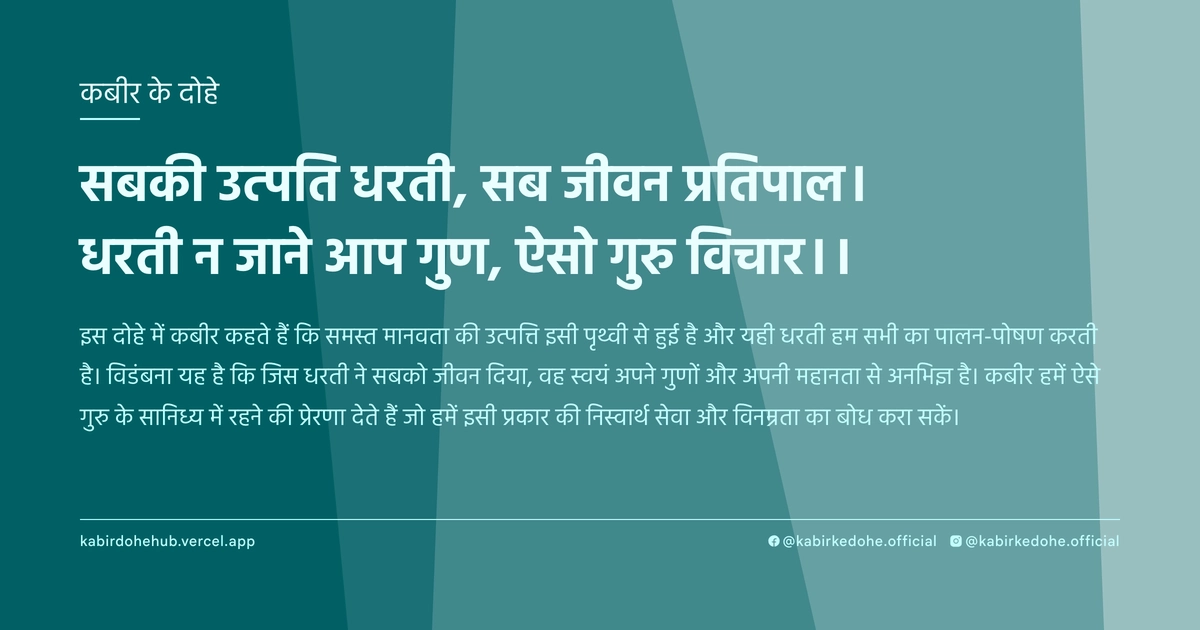
सबकी उत्पति धरती, सब जीवन प्रतिपाल।
धरती न जाने आप गुण, ऐसो गुरु विचार।।
Sabki utpati dharti, sab jeevan pratipal. Dharti na jaane aap gun, aiso guru vichaar.
इस पृष्ठ पर इस कबीर दोहे का अर्थ (meaning), हिंदी व्याख्या और अंग्रेज़ी अनुवाद, दार्शनिक विश्लेषण और व्यावहारिक जीवन सीख दी गई है। यह दोहा समानता (Gender Equality) विषय से जुड़ा है — Kabir doha meaning and explanation in Hindi and English.
अर्थ (Meaning):
इस दोहे में कबीर कहते हैं कि समस्त मानवता की उत्पत्ति इसी पृथ्वी से हुई है और यही धरती हम सभी का पालन-पोषण करती है। विडंबना यह है कि जिस धरती ने सबको जीवन दिया, वह स्वयं अपने गुणों और अपनी महानता से अनभिज्ञ है। कबीर हमें ऐसे गुरु के सानिध्य में रहने की प्रेरणा देते हैं जो हमें इसी प्रकार की निस्वार्थ सेवा और विनम्रता का बोध करा सकें।
In this couplet, Kabir asserts that all of humanity originates from the earth, and it is this very earth that sustains and nurtures every living being. The profound irony lies in the fact that the earth, despite providing life to all, remains unaware of its own virtues and greatness. Kabir urges us to seek a teacher or a state of consciousness that embodies this same selfless service and profound humility.
व्याख्या (Interpretation):
शाब्दिक अर्थ में यह दोहा प्रकृति की उदारता का वर्णन करता है, परंतु आध्यात्मिक स्तर पर यह 'अहंकार' के विसर्जन का प्रतीक है। धरती यहाँ 'परम तत्व' या 'निर्गुण ब्रह्म' का रूपक है, जो बिना किसी भेदभाव के सबको पोषण देता है। माया का प्रभाव यह है कि मनुष्य अपनी उपलब्धियों का श्रेय स्वयं लेना चाहता है, जबकि वास्तविक सत्य यह है कि हम सब एक ही स्रोत से उपजे हैं। अद्वैत वेदांत के अनुसार, जब साधक यह अनुभव करता है कि वह और संपूर्ण ब्रह्मांड एक ही तत्व हैं, तब वह 'स्व' के भ्रम से मुक्त हो जाता है। यह विरोधाभास है कि जो सबसे शक्तिशाली (धरती) है, वही सबसे विनम्र है। कबीर यहाँ संकेत दे रहे हैं कि वास्तविक ज्ञान वह है जो व्यक्ति को शून्य कर दे, ताकि वह ईश्वरीय गुणों को आत्मसात कर सके।
Literally, the verse describes the generosity of nature, but spiritually, it serves as a metaphor for the dissolution of the ego. The earth here represents the 'Supreme Element' or 'Nirgun Brahman,' which nurtures all beings without discrimination. The influence of Maya creates the illusion that humans should claim credit for their achievements, whereas the ultimate truth is that we all originate from a single source. According to Advaita Vedanta, when a seeker realizes that they and the entire universe are one essence, they are liberated from the delusion of the separate 'self.' There is a divine paradox here: the most powerful entity (the earth) is also the most humble. Kabir suggests that true wisdom is that which reduces the individual to zero, allowing them to absorb the qualities of the Divine.
दार्शनिक विश्लेषण (Philosophical Analysis):
कबीर का यह विचार उनके युग के सामाजिक और धार्मिक पाखंडों पर एक गहरा प्रहार है। उस समय जाति और वर्ण व्यवस्था के आधार पर मनुष्य को ऊँचा या नीचा माना जाता था, लेकिन कबीर 'धरती' का उदाहरण देकर यह सिद्ध करते हैं कि मूलतः हम सब समान हैं। यह विचार सूफीवाद के 'वहदत-अल-वजूद' (अस्तित्व की एकता) के करीब है, जहाँ ईश्वर को सृष्टि के कण-कण में देखा जाता है।
यहाँ कबीर ritualism (कर्मकांड) का खंडन करते हुए यह समझाते हैं कि मंदिर या मस्जिद जाने से अधिक महत्वपूर्ण यह समझना है कि हम किस तत्व से बने हैं। यदि हम मिट्टी से बने हैं और अंततः मिट्टी में ही मिल जाना है, तो अहंकार का कोई आधार नहीं बचता। यह मनोवैज्ञानिक रूपांतरण की प्रक्रिया है जहाँ 'मैं' का विलोपन होता है और 'हम' का उदय होता है।
अद्वैत वेदांत के परिप्रेक्ष्य में, यह दोहा जीव और ब्रह्म की एकता को दर्शाता है। जिस प्रकार धरती अपनी महानता का ढिंढोरा नहीं पीटती, उसी प्रकार एक आत्मज्ञानी व्यक्ति अपनी आध्यात्मिक उपलब्धियों का प्रदर्शन नहीं करता। वह जानता है कि जो कुछ भी है, वह उस एक निराकार सत्ता का ही प्रतिबिंब है।
कबीर का 'गुरु' यहाँ केवल एक व्यक्ति नहीं, बल्कि वह 'बोध' है जो हमें हमारी वास्तविक प्रकृति से परिचित कराता है। यह बोध हमें सिखाता है कि सेवा ही सर्वोच्च धर्म है और विनम्रता ही वास्तविक शक्ति है। जब मनुष्य अपनी लघुता को स्वीकार करता है, तभी वह अनंतता से जुड़ पाता है।
अंततः, यह विश्लेषण हमें इस निष्कर्ष पर ले जाता है कि आध्यात्मिक प्रगति का मार्ग बाहरी आडंबरों से नहीं, बल्कि आंतरिक सरलता और कृतज्ञता से होकर गुजरता है। अहंकार का विनाश ही मोक्ष का द्वार है, और धरती की यह निस्वार्थता ही वह आदर्श है जिसे हर साधक को अपने जीवन में उतारना चाहिए।
Kabir's perspective here is a profound critique of the social and religious hypocrisies of his era. At a time when humans were categorized as superior or inferior based on caste and varna, Kabir uses the 'earth' as evidence that we are all fundamentally equal. This thought aligns closely with the Sufi concept of 'Wahdat-al-Wujud' (Unity of Existence), where the Divine is seen in every particle of creation.
By rejecting ritualism, Kabir explains that it is more vital to understand the element from which we are composed than to visit temples or mosques. If we are made of clay and shall return to clay, there remains no logical basis for ego. This is a process of psychological transformation where the 'I' is dissolved and the 'We' emerges.
From the lens of Advaita Vedanta, this verse illustrates the non-duality of the Jiva (individual soul) and Brahman (universal soul). Just as the earth does not trumpet its own greatness, an enlightened being does not flaunt their spiritual achievements. They recognize that everything is merely a reflection of that one formless reality.
Kabir's 'Guru' here is not merely a person, but the 'Awakening' that introduces us to our true nature. This awakening teaches us that selfless service is the highest religion and humility is the true power. Only when a human accepts their own smallness can they connect with the Infinite.
Ultimately, this analysis leads to the conclusion that the path of spiritual progress does not lie through external pomposity, but through internal simplicity and gratitude. The annihilation of the ego is the gateway to liberation, and the selfless nature of the earth is the ideal every seeker must embody in their life.
मूल संदेश (Core Message):
- अहंकार एक भ्रम है; विनम्रता ही वास्तविक शक्ति है।
- हम सब एक ही मिट्टी के हैं, इसलिए भेदभाव व्यर्थ है।
- निस्वार्थ सेवा ही ईश्वर की सच्ची प्रार्थना है।
- सच्चा ज्ञान वह है जो हमें शून्य कर दे।
- प्रकृति की उदारता को अपने जीवन का आदर्श बनाएं।
- Ego is an illusion; humility is the only true power.
- We are all made of the same earth; therefore, discrimination is futile.
- Selfless service is the truest form of prayer to the Divine.
- True knowledge is that which reduces the self to zero.
- Make the generosity of nature the guiding ideal of your life.
व्यावहारिक उदाहरण (Practical Example):
वाराणसी के घाटों पर रहने वाले एक वृद्ध विधवा, जानकी, का जीवन अत्यंत कठिन था। वह दूसरों के घरों में छोटे-मोटे काम करती और जो मिलता, उसमें संतोष करती। शहर के लोग उसे तुच्छ समझते थे क्योंकि उसके पास न धन था, न सामाजिक प्रतिष्ठा।
जानकी का एक ही नियम था—वह हर सुबह घाट की सीढ़ियों पर जमी गंदगी को साफ करती, बिना किसी से उम्मीद किए या किसी को बताए। लोग उसे पागल कहते कि वह मुफ्त में दूसरों की गंदगी क्यों साफ कर रही है।
एक दिन शहर का एक अहंकारी विद्वान पंडित, जो अपनी शास्त्र-निपुणता के लिए प्रसिद्ध था, जानकी को देखते हुए उपहास करने लगा। उसने कहा, "तुम जैसी अज्ञानी स्त्री इस गंदगी को साफ करके क्या पा लेगी? ज्ञान ही मुक्ति का मार्ग है, श्रम नहीं।"
जानकी ने शांति से मुस्कुराते हुए उत्तर दिया, "महाराज, मैं तो बस इस धरती का कर्ज उतार रही हूँ। इसने मुझे जन्म दिया, मुझे अन्न दिया, और आज मैं इसके ऊपर चल रही हूँ। यह धरती सब कुछ सहती है, फिर भी कभी शिकायत नहीं करती। मैं बस उसकी छोटी सी नकल करने की कोशिश कर रही हूँ।"
पंडित जी को लगा कि यह कोई साधारण बात है, लेकिन जानकी के शब्दों में एक ऐसी गूँज थी जिसने उनके भीतर के अहंकार को झकझोर दिया। उन्होंने महसूस किया कि वे शास्त्रों के बोझ तले दबे थे, लेकिन जीवन की सरलता से कोसों दूर थे।
पंडित जी ने देखा कि जानकी के चेहरे पर एक ऐसा तेज और शांति थी, जो उन्हें अपनी हज़ारों पुस्तकों और वाद-विवादों में कभी नहीं मिली। उन्हें समझ आया कि वास्तविक ज्ञान 'जानने' में नहीं, बल्कि 'होने' में है।
उस दिन पंडित जी ने अपनी पोथियाँ किनारे रखीं और जानकी के साथ मिलकर घाट की सफाई करने लगे। उन्होंने महसूस किया कि जब वे झुककर मिट्टी को छूते हैं, तो उनका अहंकार टूटता है और वे वास्तव में स्वतंत्र महसूस करते हैं।
यह 'कबीर ट्विस्ट' था—जहाँ एक अनपढ़ वृद्ध महिला ने एक महान विद्वान को यह सिखा दिया कि विनम्रता ही सबसे बड़ा ज्ञान है। पंडित जी का जीवन बदल गया; वे अब केवल उपदेश नहीं देते थे, बल्कि सेवा के माध्यम से प्रेम बाँटते थे।
जानकी की निस्वार्थता ने पंडित जी को यह अहसास कराया कि हम सब अंततः इसी मिट्टी के हैं, और जो इस सत्य को जान लेता है, वह वास्तव में मुक्त हो जाता है।
इस प्रकार, एक साधारण कार्य ने एक जटिल अहंकार को नष्ट कर दिया और एक नए, करुणामयी मनुष्य का जन्म हुआ।
Janaki, an elderly widow living on the ghats of Varanasi, led a very difficult life. She performed odd jobs in other people's homes and found contentment in whatever little she received. The townspeople looked down upon her because she possessed neither wealth nor social status.
Janaki had one unwavering rule—every morning, she would clean the filth accumulated on the steps of the ghats, without expecting anything from anyone or informing anyone of her deed.
People called her foolish, questioning why she was cleaning others' waste for free. One day, an arrogant scholar, a Pandit famous for his mastery of scriptures, began to mock Janaki as he watched her.
He said, "You ignorant woman, what will you gain by cleaning this filth? Knowledge is the path to liberation, not manual labor."
Janaki smiled peacefully and replied, "Maharaj, I am merely trying to repay the debt I owe to this earth. It gave me birth, it gave me food, and today I walk upon it. This earth endures everything, yet it never complains. I am just trying to imitate its small part."
The Pandit thought this was a trivial remark, but there was an echo in Janaki's words that shook the foundations of his ego. He realized that while he was burdened by scriptures, he was miles away from the simplicity of life.
He noticed a radiance and peace on Janaki's face that he had never found in his thousands of books or intellectual debates. He understood that true knowledge is not in 'knowing,' but in 'being.'
That day, the Pandit set aside his manuscripts and began cleaning the ghats alongside Janaki. He felt that as he bowed down to touch the soil, his ego shattered, and he felt truly free for the first time.
This was the 'Kabir Twist'—where an unlettered elderly woman taught a great scholar that humility is the highest form of knowledge. The Pandit's life changed; he no longer just gave sermons but distributed love through service.
Janaki's selflessness made the Pandit realize that we are all ultimately of this soil, and he who recognizes this truth becomes truly liberated.
Thus, a simple act destroyed a complex ego and gave birth to a new, compassionate human being.
अभ्यास मार्गदर्शन (Practice Guidance):
- दैनिक चिंतन: प्रतिदिन 10 मिनट मौन रहकर यह विचार करें कि आपका शरीर किन प्राकृतिक तत्वों से बना है और आप प्रकृति के कितने ऋणी हैं।
- सेवा अभ्यास: सप्ताह में एक बार ऐसा कार्य करें जिससे किसी अन्य का भला हो, लेकिन इस शर्त के साथ कि आप उस कार्य का श्रेय किसी को न दें और न ही उसे सार्वजनिक करें।
- आत्म-पूछताछ जर्नल: अपनी डायरी में लिखें—"आज मैंने किस बात पर अहंकार महसूस किया? क्या वह अहंकार मेरी वास्तविक पहचान है या केवल एक मुखौटा?"
- निदान चेकलिस्ट: यदि आप दूसरों की आलोचना कर रहे हैं या अपनी उपलब्धियों पर गर्व महसूस कर रहे हैं, तो समझ लें कि आप इस ज्ञान से दूर जा रहे हैं। यदि आप दूसरों की सेवा में शांति पाते हैं, तो आप सही मार्ग पर हैं।
- Daily Contemplation: Spend 10 minutes in silence daily reflecting on the natural elements that compose your body and how deeply indebted you are to nature.
- Service Practice: Once a week, perform an act of service for another, with the strict condition that you claim no credit and keep the act completely anonymous.
- Self-Inquiry Journal: Write in your journal: "In what moment did I feel ego today? Was that ego my true identity, or merely a mask?"
- Diagnostic Checklist: If you find yourself criticizing others or feeling pride in your achievements, recognize that you are drifting from this wisdom. If you find peace in serving others, you are aligned with the truth.
चिंतन प्रश्न (Reflection Questions):
- यदि आपकी सारी उपलब्धियाँ और पद छीन लिए जाएँ, तो आपकी वास्तविक पहचान क्या रह जाएगी?
- आप अपनी सार्वजनिक छवि (Public Image) को बनाए रखने के लिए अपने भीतर की कितनी सच्चाई को दबाते हैं?
- क्या आप वास्तव में दूसरों की मदद करते हैं, या मदद करने के बाद मिलने वाले 'संतोष' के अहसास से प्यार करते हैं?
- आपके जीवन में वह कौन सा 'मिट्टी जैसा' गुण है जिसे आप अपनी कमजोरी समझते हैं, लेकिन वह वास्तव में आपकी ताकत हो सकता है?
- क्या आप अपनी सफलता का श्रेय केवल स्वयं को देते हैं, या आप उन अदृश्य शक्तियों और लोगों को पहचानते हैं जिन्होंने आपको यहाँ पहुँचाया?
- If all your achievements and titles were stripped away, what would remain of your true identity?
- How much of your inner truth do you suppress to maintain your public image?
- Do you truly help others, or are you in love with the feeling of 'satisfaction' that comes after helping?
- What 'earth-like' quality in your life do you perceive as a weakness, which might actually be your greatest strength?
- Do you attribute your success solely to yourself, or do you recognize the invisible forces and people who brought you here?