
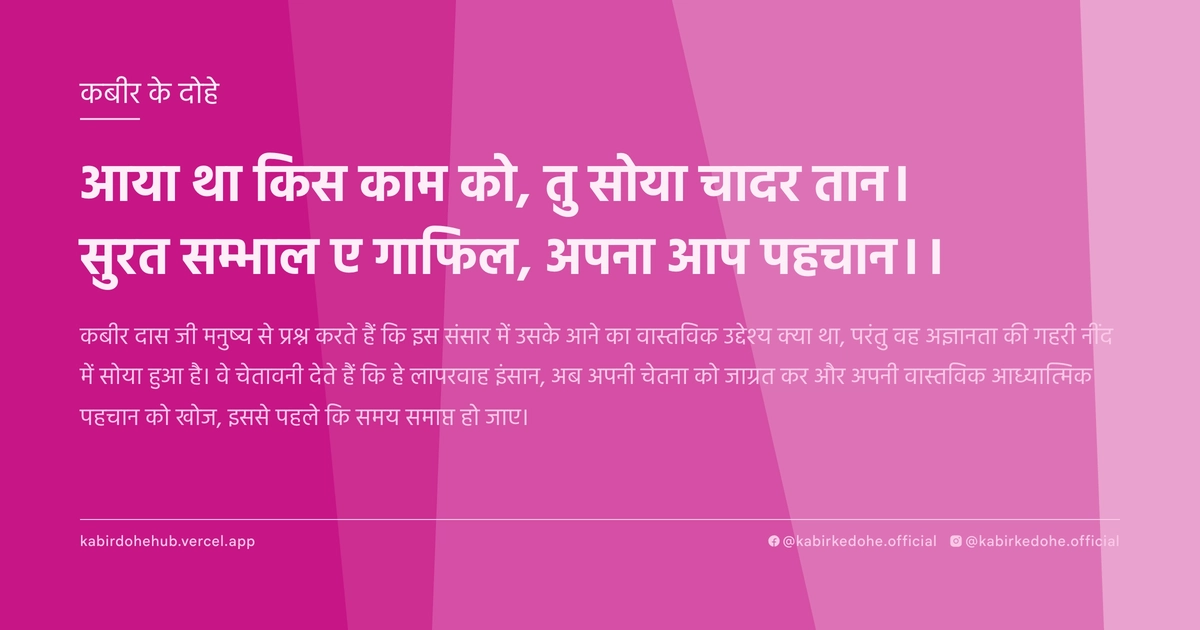
आया था किस काम को, तु सोया चादर तान।
सुरत सम्भाल ए गाफिल, अपना आप पहचान।।
Aaya tha kis kaam ko, tu soya chadar taan. Surat sambhaal e gafil, apna aap pehchan.
इस पृष्ठ पर इस कबीर दोहे का अर्थ (meaning), हिंदी व्याख्या और अंग्रेज़ी अनुवाद, दार्शनिक विश्लेषण और व्यावहारिक जीवन सीख दी गई है। यह दोहा जागृति (The Wake-up Call) विषय से जुड़ा है — Kabir doha meaning and explanation in Hindi and English.
अर्थ (Meaning):
कबीर दास जी मनुष्य से प्रश्न करते हैं कि इस संसार में उसके आने का वास्तविक उद्देश्य क्या था, परंतु वह अज्ञानता की गहरी नींद में सोया हुआ है। वे चेतावनी देते हैं कि हे लापरवाह इंसान, अब अपनी चेतना को जाग्रत कर और अपनी वास्तविक आध्यात्मिक पहचान को खोज, इससे पहले कि समय समाप्त हो जाए।
Kabir asks the human soul about the true purpose of its earthly incarnation, noting that the individual remains slumbering under the blanket of ignorance. He urgently calls upon the heedless soul to awaken its consciousness and recognize its true divine identity before the window of opportunity closes forever.
व्याख्या (Interpretation):
इस दोहे का शाब्दिक अर्थ है कि मनुष्य जीवन के लक्ष्य को भूलकर सांसारिक सुखों में खो गया है। 'चादर तान कर सोना' यहाँ भौतिक मोह और अज्ञानता (माया) का प्रतीक है, जो आत्मा को उसके वास्तविक स्वरूप से अलग करती है। 'सुरत' का अर्थ है एकाग्र चेतना या ध्यान। कबीर यहाँ निर्गुण भक्ति के सिद्धांत पर जोर देते हैं, जहाँ ईश्वर बाहर नहीं बल्कि भीतर है। 'गाफिल' शब्द सूफी प्रभाव को दर्शाता है, जिसका अर्थ है वह व्यक्ति जो सत्य से बेखबर है। यह दोहा अद्वैत वेदांत के उस विचार को पुष्ट करता है कि आत्मा और ब्रह्म एक ही हैं, लेकिन अहंकार और अविद्या के कारण हम स्वयं को शरीर मान बैठते हैं। यह एक आध्यात्मिक आह्वान है कि व्यक्ति अपनी बाहरी पहचान को त्यागकर आंतरिक सत्य का साक्षात्कार करे।
Literally, the verse questions the purpose of existence while criticizing the state of spiritual slumber. 'Sleeping under a blanket' is a potent metaphor for Maya (illusion) and the suffocating comfort of material attachments that blind the soul. 'Surat' refers to the focused consciousness or the spiritual gaze. Kabir emphasizes the Nirgun Bhakti path, asserting that the Divine is not a distant entity but the innermost essence of the self. The term 'Gafil' reflects Sufi influence, denoting one who is heedless or oblivious to the Divine Presence. This aligns with Advaita Vedanta's non-duality, where the perceived separation between Atman (individual soul) and Brahman (universal consciousness) is an illusion. The central paradox is that the seeker is searching for the very thing they already are, provided they awaken from the dream of ego.
दार्शनिक विश्लेषण (Philosophical Analysis):
कबीर का यह दोहा मध्यकालीन भारत के उस सामाजिक-धार्मिक परिवेश में रचा गया था जहाँ कर्मकांड और बाहरी आडंबर चरम पर थे। कबीर ने स्पष्ट रूप से उन सभी रीति-रिवाजों को खारिज किया जो मनुष्य को आत्म-साक्षात्कार से दूर ले जाते थे। उनके लिए, मंदिर, मस्जिद या तीर्थयात्रा केवल बाहरी दिखावा थे यदि व्यक्ति के भीतर की 'सुरत' जाग्रत नहीं है। वे तर्क देते हैं कि मोक्ष किसी बाहरी अनुष्ठान से नहीं, बल्कि 'स्वयं को पहचानने' (Self-realization) से मिलता है।
दार्शनिक स्तर पर, यह दोहा अद्वैत वेदांत के 'अहं ब्रह्मास्मि' (मैं ही ब्रह्म हूँ) के विचार से गहराई से जुड़ा है। कबीर कहते हैं कि हम अपनी पहचान को नाम, जाति, धर्म और पद के साथ जोड़ लेते हैं, जो वास्तव में एक 'चादर' की तरह है जो सत्य को ढंक लेती है। जब यह अहंकार नष्ट होता है, तभी वास्तविक ज्ञान का उदय होता है।
सूफी मत के 'फना' (अहंकार का विनाश) और 'बका' (ईश्वर में अस्तित्व) की अवधारणा यहाँ स्पष्ट है। कबीर का 'गाफिल' वह है जो अपनी ईश्वरीय प्रकृति को भूलकर नश्वर शरीर और उसकी इच्छाओं को ही सत्य मान बैठा है। यह मनोवैज्ञानिक रूपांतरण की प्रक्रिया है, जहाँ व्यक्ति अपनी बाहरी पहचान (Persona) को हटाकर अपने शुद्ध स्वरूप (Pure Consciousness) में प्रवेश करता है।
कबीर की यह दृष्टि अत्यंत क्रांतिकारी थी क्योंकि उन्होंने ज्ञान का लोकतंत्रीकरण किया। उन्होंने बताया कि आत्म-ज्ञान के लिए किसी पंडित या मौलवी की आवश्यकता नहीं है, बल्कि केवल सजगता और आंतरिक ईमानदारी की आवश्यकता है। यह संदेश उस समय के जातिगत भेदभाव और धार्मिक कट्टरता पर एक सीधा प्रहार था।
अंततः, यह दोहा समय की नश्वरता की याद दिलाता है। 'सोना' केवल नींद नहीं, बल्कि वह मानसिक जड़ता है जो हमें यह विश्वास दिलाती है कि हमारे पास अनंत समय है। कबीर चेतावनी देते हैं कि आध्यात्मिक जागरण में देरी का अर्थ है जीवन की सार्थकता को खो देना।
This Doha emerged during a medieval Indian era dominated by rigid ritualism and religious stratification. Kabir vehemently rejected any practice that prioritized external form over internal essence. For him, temples, mosques, and pilgrimages were mere distractions if the 'Surat' (inner consciousness) remained dormant. He argued that liberation is not a product of ritual performance but of 'Self-realization.'
Philosophically, this verse is deeply rooted in the Advaita Vedanta principle of 'Aham Brahmasmi' (I am Brahman). Kabir suggests that we mistake our identity for our name, caste, religion, and social status—a 'blanket' of ego that obscures the light of truth. Only when this artificial identity is stripped away does the realization of the non-dual nature of existence occur.
There is a clear resonance with the Sufi concepts of 'Fana' (annihilation of the ego) and 'Baqa' (subsistence in God). The 'Gafil' is the one who has fallen for the trickery of the material world, forgetting that the physical body is a temporary vessel for an eternal spark. This is a call for a psychological shift from the 'small self' to the 'Universal Self.'
Kabir’s approach was revolutionary because he democratized spirituality. He asserted that divine knowledge is not the monopoly of a priestly class but is accessible to anyone with the courage to look within. By emphasizing internal awakening over external scripture, he challenged the very foundations of the caste system and religious hegemony.
Finally, the verse addresses the urgency of the human condition. 'Sleep' represents the spiritual inertia and the delusion of permanence. Kabir warns that the window for awakening is narrow, and to remain oblivious is to waste the rare opportunity of human birth, which is the only gateway to liberation.
मूल संदेश (Core Message):
- सांसारिक पहचान एक भ्रम है जो सत्य को ढंक लेती है।
- जागरूकता ही वह एकमात्र कुंजी है जो अज्ञान की नींद तोड़ती है।
- बाहरी खोज व्यर्थ है; वास्तविक सत्य आपके भीतर स्थित है।
- अहंकार का विसर्जन ही ईश्वर से मिलन का एकमात्र मार्ग है।
- जीवन का उद्देश्य केवल जीवित रहना नहीं, बल्कि स्वयं को जानना है।
- Worldly identity is a veil that obscures the ultimate truth.
- Awareness is the only key that can break the sleep of ignorance.
- External quests are futile; the real truth resides within you.
- The dissolution of ego is the only path to divine union.
- The purpose of life is not mere survival, but self-realization.
व्यावहारिक उदाहरण (Practical Example):
वाराणसी के एक पुराने घाट पर रहने वाले माधव एक कुशल बुनकर थे, जो रेशमी साड़ियों में अद्भुत बारीकी लाते थे। उनकी ख्याति दूर-दूर तक थी, और वे अपने काम और धन के अहंकार में डूबे रहते थे। वे मानते थे कि उनकी श्रेष्ठता उनके कौशल और उनकी जाति की परंपरा से आती है। माधव का जीवन एक ऐसी ही 'चादर' के नीचे था—सफलता और प्रतिष्ठा की चादर।
एक दिन, उनके पास एक फकीर आया जिसने उनकी सबसे महंगी साड़ी को देखा और मुस्कुराते हुए कहा, 'धागे तो सुंदर हैं, पर बुनने वाला अभी भी अंधेरे में सो रहा है।' माधव को यह बात चुभी, उन्होंने पूछा, 'मैं अंधेरे में कैसे हो सकता हूँ? पूरी दुनिया मेरी कला की प्रशंसा करती है।'
फकीर ने शांति से उत्तर दिया, 'दुनिया तुम्हारी कला को देख रही है, लेकिन तुम अपनी आत्मा को देखना भूल गए हो। तुम जिसे अपनी पहचान मानते हो—यह रेशम, यह नाम, यह सम्मान—वह सब एक सपना है। जिस दिन यह शरीर मिट्टी होगा, क्या यह रेशम तुम्हारे साथ जाएगा?'
माधव को पहली बार महसूस हुआ कि वे जीवन भर केवल बाहरी आवरणों को सजाते रहे, जबकि उनके भीतर का मनुष्य प्यासा और सोया हुआ था। उन्हें समझ आया कि उनकी सारी उपलब्धियां केवल एक 'चादर' थीं जिसने उन्हें वास्तविक सत्य से दूर रखा था।
अगले कुछ महीनों तक माधव ने अपने काम को पूजा बनाया, लेकिन अहंकार को त्याग दिया। उन्होंने अपनी कमाई का एक बड़ा हिस्सा उन लोगों की मदद में लगाया जो बुनियादी जरूरतों के लिए तरस रहे थे।
वे अब केवल साड़ियाँ नहीं बुनते थे, बल्कि हर धागे के साथ अपनी चेतना को जोड़ने का प्रयास करते थे। उन्होंने महसूस किया कि असली खुशी दूसरों की प्रशंसा में नहीं, बल्कि स्वयं के भीतर की शांति में है।
उनकी पहचान अब 'मशहूर बुनकर' से बदलकर 'एक सरल साधक' की हो गई। उन्होंने पाया कि जब अहंकार की चादर हटती है, तब जीवन का असली रंग दिखाई देता है।
माधव का यह रूपांतरण उनके परिवार और समाज के लिए एक उदाहरण बन गया। उन्होंने सिखाया कि सफलता तब तक बोझ है जब तक वह हमें स्वयं से अलग करती है, और वरदान तब बनती है जब वह हमें स्वयं से मिलाती है।
In the ancient ghats of Varanasi lived Madhav, a master weaver known for the exquisite intricacy of his silk sarees. His fame extended far and wide, and he lived enveloped in the pride of his skill and ancestral lineage. Madhav’s life was spent under a 'blanket'—the blanket of success, prestige, and social superiority.
One day, a wandering dervish visited his workshop. Looking at Madhav's most expensive creation, the dervish smiled and said, 'The threads are beautiful, but the weaver is still sleeping in the dark.' Offended, Madhav replied, 'How can I be in the dark? The whole world admires my art!'
The dervish replied calmly, 'The world sees your art, but you have forgotten to see your soul. Everything you call your identity—this silk, this name, this honor—is but a dream. When this body returns to dust, will this silk accompany you?'
For the first time, Madhav realized that he had spent his entire life decorating the exterior while the man within remained thirsty and asleep. He understood that his achievements were merely a 'blanket' that had shielded him from the raw truth of existence.
Over the following months, Madhav continued his craft, but he transformed it into a form of worship, shedding his ego. He began dedicating a significant portion of his earnings to those struggling for basic survival.
He no longer just wove fabric; he attempted to weave his consciousness into every thread. He discovered that true joy did not lie in the applause of the crowd, but in the stillness of his own heart.
His identity shifted from being a 'famous weaver' to a 'simple seeker.' He found that when the blanket of ego is removed, the true colors of life finally reveal themselves.
Madhav’s transformation became a beacon for his community. He proved that success is a burden if it separates us from ourselves, but a blessing if it leads us back to our essence.
अभ्यास मार्गदर्शन (Practice Guidance):
- प्रतिदिन 20 मिनट मौन ध्यान करें, जहाँ आप केवल अपनी सांसों को देखें और यह विचार करें कि 'मैं यह शरीर या यह नाम नहीं हूँ'।
- एक 'अहंकार पत्रिका' (Ego Journal) बनाएँ। दिन भर में जब भी आपको लगे कि आप अपनी सामाजिक पहचान (पद, संपत्ति, ज्ञान) का उपयोग दूसरों को नीचा दिखाने के लिए कर रहे हैं, उसे लिखें और विश्लेषण करें।
- व्यवहार परिवर्तन: दिन में कम से कम एक बार किसी ऐसे व्यक्ति की निस्वार्थ सेवा करें जिससे आपका कोई व्यक्तिगत लाभ न जुड़ा हो, ताकि 'मैं' का भाव कम हो सके।
- निदान चेकलिस्ट: क्या मैं अपनी उपलब्धियों के बिना भी खुद को पूर्ण महसूस करता हूँ? क्या मैं दूसरों की आलोचना पर विचलित होता हूँ? यदि हाँ, तो इसका अर्थ है कि आप अभी भी 'अज्ञान की चादर' में सो रहे हैं।
- Practice 20 minutes of silent meditation daily, observing the breath and contemplating the thought: 'I am not this body, nor this name, nor this social role.'
- Maintain an 'Ego Journal.' Record every instance during the day where you used your social identity (status, wealth, knowledge) to feel superior to others, and analyze the root of that need.
- Behavioral Shift: Perform one act of selfless service daily for someone from whom you can gain nothing, specifically to dissolve the boundary of the 'I'.
- Diagnostic Checklist: Do I feel complete even without my achievements? Do I feel disturbed by the criticism of others? If yes, it indicates that you are still slumbering under the 'blanket of ignorance'.
चिंतन प्रश्न (Reflection Questions):
- यदि आपसे आपका नाम, आपका पेशा और आपकी सारी संपत्ति छीन ली जाए, तो आपके पास क्या बचेगा?
- आप अपनी सार्वजनिक छवि (Public Image) को बनाए रखने के लिए अपने आंतरिक सत्य का कितना बलिदान करते हैं?
- वह कौन सी 'चादर' है (डर, लालच, या गर्व) जिसने आपको आपकी वास्तविक क्षमता को देखने से रोका हुआ है?
- क्या आपकी आध्यात्मिक खोज वास्तव में सत्य को जानने के लिए है, या केवल मानसिक शांति पाने का एक साधन है?
- आपकी वह कौन सी छिपी हुई धारणा है जो आपको दूसरों में ईश्वर को देखने से रोकती है?
- If your name, profession, and all your possessions were stripped away, what would remain of you?
- How much of your internal truth do you sacrifice to maintain your curated public image?
- What is the specific 'blanket' (fear, greed, or pride) that prevents you from seeing your true potential?
- Is your spiritual quest truly about discovering the truth, or is it merely a tool for psychological comfort?
- What hidden bias within you prevents you from recognizing the Divine in the people you dislike?