
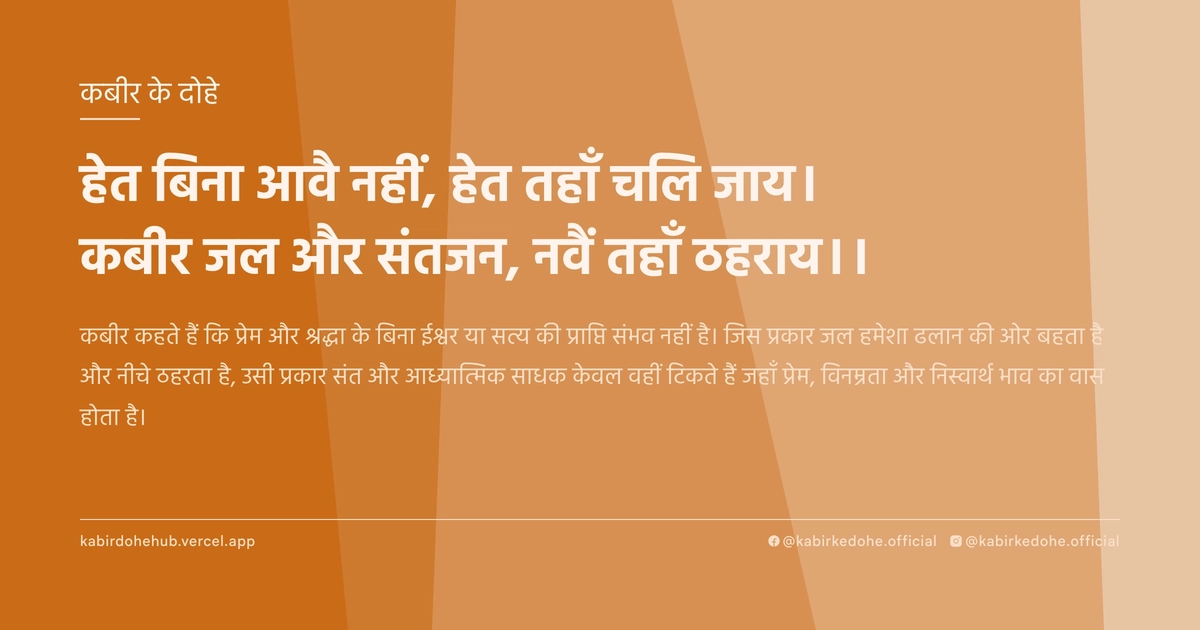
हेत बिना आवै नहीं, हेत तहाँ चलि जाय।
कबीर जल और संतजन, नवैं तहाँ ठहराय।।
Het bina aavai nahi, het tahan chali jaaye. Kabir jal aur santjan, navain tahan thahraye.
इस पृष्ठ पर इस कबीर दोहे का अर्थ (meaning), हिंदी व्याख्या और अंग्रेज़ी अनुवाद, दार्शनिक विश्लेषण और व्यावहारिक जीवन सीख दी गई है। यह दोहा सत्संग (Satsang) विषय से जुड़ा है — Kabir doha meaning and explanation in Hindi and English.
अर्थ (Meaning):
कबीर कहते हैं कि प्रेम और श्रद्धा के बिना ईश्वर या सत्य की प्राप्ति संभव नहीं है। जिस प्रकार जल हमेशा ढलान की ओर बहता है और नीचे ठहरता है, उसी प्रकार संत और आध्यात्मिक साधक केवल वहीं टिकते हैं जहाँ प्रेम, विनम्रता और निस्वार्थ भाव का वास होता है।
Kabir asserts that without genuine love and longing, one cannot reach the Divine. Just as water naturally flows downward to seek the lowest point, saints and seekers of truth are drawn only to those spaces and hearts where humility, compassion, and selfless love reside.
व्याख्या (Interpretation):
इस दोहे का शाब्दिक अर्थ है कि प्रेम के बिना कोई लक्ष्य प्राप्त नहीं होता। रूपक के माध्यम से कबीर 'जल' की प्रकृति का वर्णन करते हैं, जो गुरुत्वाकर्षण के कारण नीचे की ओर जाता है। यहाँ 'नीचे' जाना अहंकार के विसर्जन का प्रतीक है। निरगुण भक्ति में, ईश्वर किसी मंदिर या मस्जिद में नहीं, बल्कि उस हृदय में है जो शून्य हो चुका है। माया हमें ऊपर उठाने (अहंकार) की प्रेरणा देती है, जबकि सत्य हमें विनम्रता की गहराई में ले जाता है। जब साधक अपने 'मैं' को मिटा देता है, तब वह उस 'अद्वैत' स्थिति में पहुँचता है जहाँ आत्मा और परमात्मा एक हो जाते हैं। यह विरोधाभास है कि उच्चतम आध्यात्मिक शिखर तक पहुँचने का एकमात्र मार्ग पूर्ण समर्पण और विनम्रता की गहराई है।
Literally, the verse suggests that without love, the path remains closed. Kabir employs the metaphor of water, which inherently flows toward the lowest point. In this spiritual context, 'flowing downward' symbolizes the dissolution of the ego. In Nirgun Bhakti, the Divine is not found in external structures but in a heart that has become a void of selflessness. While Maya lures the ego toward perceived 'heights' of status and pride, Truth pulls the seeker toward the depths of humility. This highlights the central paradox of the human condition: to ascend to the highest spiritual realization, one must first descend into absolute surrender. The non-duality of Atman and Brahman is realized only when the barrier of 'I' is washed away by the current of love.
दार्शनिक विश्लेषण (Philosophical Analysis):
कबीर का यह विचार उनके युग के कट्टरपंथ और बाहरी आडंबरों के विरुद्ध एक सशक्त प्रहार है। उन्होंने देखा कि लोग तीर्थों और कर्मकांडों के माध्यम से मोक्ष खोज रहे थे, जबकि वास्तविक मार्ग आंतरिक रूपांतरण था। यह दर्शन अद्वैत वेदांत के करीब है, जहाँ यह माना जाता है कि अज्ञान (माया) ही वह पर्दा है जो हमें हमारी वास्तविक प्रकृति से अलग करता है। कबीर के अनुसार, यह पर्दा केवल 'प्रेम' और 'विनम्रता' से हटाया जा सकता है।
सूफी मत के 'इश्क-ए-हकीकी' (ईश्वरीय प्रेम) का प्रभाव यहाँ स्पष्ट है। जिस प्रकार एक सूफी फना (अहंकार का विनाश) की बात करता है, कबीर भी जल की तरह 'बह जाने' और 'ठहरने' की बात करते हैं। उनके लिए संत वह नहीं है जिसने शास्त्र पढ़े हैं, बल्कि वह है जिसने अपने अहंकार को पूरी तरह मिटा दिया है।
ऐतिहासिक रूप से, कबीर ने जाति व्यवस्था को चुनौती दी क्योंकि जाति 'ऊँच-नीच' के अहंकार पर आधारित थी। जल का उदाहरण देकर वे यह समझाते हैं कि आध्यात्मिक श्रेष्ठता 'ऊपर' होने में नहीं, बल्कि 'नीचे' (विनम्र) होने में है। यह एक मनोवैज्ञानिक क्रांति है जहाँ व्यक्ति अपनी सामाजिक पहचान को त्यागकर एक सार्वभौमिक चेतना में विलीन होने का प्रयास करता है।
अक्सर लोग इस दोहे को केवल सामाजिक शिष्टाचार के रूप में देखते हैं, लेकिन यह वास्तव में चेतना के स्तर के परिवर्तन की बात है। जब तक मन में 'मैं' का भाव है, तब तक वह 'ऊँचा' महसूस करता है और सत्य उससे दूर रहता है। सत्य केवल उसी शून्य में प्रवेश करता है जहाँ कोई अवरोध न हो।
अंततः, कबीर यह स्थापित करते हैं कि भक्ति कोई बौद्धिक व्यायाम नहीं है, बल्कि एक भावनात्मक और आध्यात्मिक समर्पण है। बिना प्रेम के ज्ञान केवल एक बोझ है, जबकि प्रेम के साथ अज्ञान भी प्रकाश बन जाता है।
Kabir’s insight serves as a potent critique of the rigid orthodoxy and external ritualism of his era. He observed people seeking liberation through pilgrimages and complex rites, whereas the true path lay in internal transformation. This philosophy aligns closely with Advaita Vedanta, which posits that ignorance (Maya) is the only veil separating the individual from their true nature. According to Kabir, this veil can only be dissolved through 'Love' and 'Humility'.
The influence of the Sufi concept of 'Ishq-e-Haqiqi' (Divine Love) is evident here. Just as a Sufi speaks of 'Fana' (the annihilation of the self), Kabir speaks of 'flowing' and 'settling' like water. For him, a saint is not one who has mastered scriptures, but one who has completely eradicated the ego.
Historically, Kabir challenged the caste system because it was predicated on the illusion of 'high' and 'low'. By using the metaphor of water, he demonstrates that spiritual superiority is not found in being 'above' others, but in being 'below'—in the state of absolute humility. This represents a psychological revolution where the individual discards social identity to merge into a universal consciousness.
Common literalist interpretations often mistake this for a lesson in social etiquette, but it is actually about a shift in the level of consciousness. As long as the 'I' persists, the mind perceives itself as 'high,' and Truth remains distant. Truth enters only that void where no resistance exists.
Ultimately, Kabir establishes that Bhakti is not an intellectual exercise but an emotional and spiritual surrender. Without love, knowledge is merely a burden; with love, even ignorance becomes a gateway to enlightenment.
मूल संदेश (Core Message):
- अहंकार वह अवरोध है जो सत्य के प्रवाह को रोकता है।
- विनम्रता केवल एक गुण नहीं, बल्कि आध्यात्मिक प्राप्ति की पूर्व शर्त है।
- प्रेम के बिना ज्ञान शुष्क है; प्रेम ही वह सेतु है जो आत्मा को परमात्मा से जोड़ता है।
- सत्य हमेशा वहां ठहरता है जहां 'मैं' का विसर्जन होता है।
- ऊपर उठने की चाहत बंधन है, नीचे झुकने का साहस मुक्ति है।
- Ego is the primary obstruction that blocks the flow of Truth.
- Humility is not merely a virtue, but a prerequisite for spiritual attainment.
- Knowledge without love is arid; love is the bridge connecting the soul to the Divine.
- Truth dwells only where the 'I' has been dissolved.
- The desire to rise is a bondage; the courage to bow is liberation.
व्यावहारिक उदाहरण (Practical Example):
वाराणसी के एक पुराने घाट पर माधव नाम का एक वृद्ध नाविक रहता था। माधव अपनी नाव चलाने में निपुण था, लेकिन उसका स्वभाव अत्यंत कठोर और अहंकारी था। वह मानता था कि वह शहर का सबसे अनुभवी नाविक है और किसी की सलाह सुनना उसे अपनी तौहीन लगता था। वह अक्सर अन्य नाविकों का उपहास करता और खुद को उनसे श्रेष्ठ समझता था।
एक दिन, एक शांत और सौम्य संन्यासी उसकी नाव पर सवार हुए। संन्यासी ने माधव के अहंकार को तुरंत पहचान लिया। यात्रा के दौरान, संन्यासी ने माधव से पूछा, 'बेटा, क्या तुमने कभी सोचा है कि यह गंगा इतनी शक्तिशाली क्यों है?' माधव ने गर्व से कहा, 'क्योंकि यह महान नदी है, इसमें अपार शक्ति है!'
संन्यासी मुस्कुराए और बोले, 'नहीं माधव, गंगा इसलिए शक्तिशाली है क्योंकि वह हमेशा नीचे की ओर बहती है। वह सबसे निचले स्तर तक जाने का साहस रखती है, और इसीलिए पूरी दुनिया का जल उसमें समाता है। जो ऊपर उठने की कोशिश करता है, वह सूख जाता है; जो नीचे झुकता है, वह सागर बन जाता है।'
माधव को पहले तो यह बात समझ नहीं आई, लेकिन वह वाक्य उसके मन में घर कर गया। कुछ दिनों बाद, एक भीषण तूफान आया और माधव की नाव एक चट्टान से टकराकर पलट गई। वह पानी में डूब रहा था और अपनी पूरी ताकत लगाकर ऊपर आने की कोशिश कर रहा था, लेकिन लहरें उसे बार-बार नीचे धकेल रही थीं।
अचानक उसे संन्यासी की बात याद आई—'जो नीचे झुकता है, वह बचता है'। उसने संघर्ष करना छोड़ दिया और खुद को पानी के बहाव के हवाले कर दिया। जैसे ही उसने प्रतिरोध करना बंद किया, पानी की एक लहर ने उसे धीरे से किनारे की ओर धकेल दिया।
किनारे पर पहुँचकर माधव फूट-फूट कर रोने लगा। उसे समझ आया कि उसका अहंकार ही वह चट्टान थी जिसने उसे डुबोया होता। उसने महसूस किया कि वह अब तक खुद को 'ऊँचा' समझकर वास्तव में कितना अकेला और छोटा था।
उस दिन के बाद माधव बदल गया। उसने अन्य नाविकों से माफी मांगी और उनकी मदद करना शुरू किया। अब वह अपनी नाव को केवल पैसे कमाने का साधन नहीं, बल्कि सेवा का माध्यम मानता था।
उसका व्यवहार इतना विनम्र हो गया कि घाट के सभी लोग उसका सम्मान करने लगे। वह अब 'सबसे बड़ा नाविक' नहीं था, बल्कि 'सबसे प्रिय नाविक' बन गया था।
माधव ने सीखा कि जब हम अपने अहंकार को जल की तरह नीचे गिरा देते हैं, तभी हम वास्तव में दूसरों के दिलों में ठहर पाते हैं।
On an ancient ghat in Varanasi lived an elderly boatman named Madhav. Madhav was skilled in navigating his boat, but his nature was harsh and arrogant. He believed he was the most experienced boatman in the city, and listening to anyone's advice felt like an insult to his pride. He often mocked other boatmen, viewing himself as superior.
One day, a serene and gentle sanyasi (monk) boarded his boat. The sanyasi immediately recognized Madhav's ego. During the journey, the monk asked, 'Son, have you ever wondered why the Ganges is so powerful?' Madhav replied proudly, 'Because it is a great river; it possesses immense power!'
The sanyasi smiled and said, 'No, Madhav. The Ganges is powerful because it always flows downward. It has the courage to seek the lowest point, and that is why the waters of the entire world merge into it. He who tries to rise above dries up; he who bows low becomes an ocean.'
Madhav didn't grasp the meaning initially, but the words lingered in his mind. A few days later, a fierce storm struck, and Madhav's boat collided with a rock and capsized. He was drowning, struggling violently to push himself upward, but the waves kept slamming him down.
Suddenly, he remembered the sanyasi's words—'He who bows low, survives.' He stopped fighting and surrendered himself to the flow of the water. The moment he ceased resistance, a current gently pushed him toward the shore.
Upon reaching the bank, Madhav wept uncontrollably. He realized that his ego was the very rock that had almost drowned him. He understood that by trying to remain 'high,' he had actually become small and isolated.
From that day on, Madhav changed. He apologized to the other boatmen and began helping them. He no longer saw his boat merely as a means of earning money, but as a vehicle for service.
His demeanor became so humble that everyone on the ghat began to respect him. He was no longer the 'greatest boatman,' but he became the 'most beloved boatman.'
Madhav learned that when we let our ego flow downward like water, only then can we truly find a place to dwell in the hearts of others.
अभ्यास मार्गदर्शन (Practice Guidance):
- प्रतिदिन 15 मिनट 'शून्य ध्यान' का अभ्यास करें, जहाँ आप अपने सभी सामाजिक पदों और उपलब्धियों को मानसिक रूप से त्याग कर केवल एक 'साधारण मनुष्य' के रूप में स्वयं को देखें।
- एक 'विनम्रता डायरी' बनाएँ। प्रतिदिन एक ऐसी घटना लिखें जहाँ आपने अपनी गलती स्वीकार की या किसी ऐसे व्यक्ति की मदद की जिसने आपको कुछ नहीं दिया।
- व्यवहार परिवर्तन: दिन में कम से कम एक बार किसी ऐसे व्यक्ति की बात सुनें जिसे समाज 'नीचा' समझता है, और उनकी दृष्टि से दुनिया को देखने का प्रयास करें।
- निदान चेकलिस्ट: क्या मैं चर्चा के दौरान दूसरों को नीचा दिखाने की कोशिश करता हूँ? क्या मैं अपनी उपलब्धियों का श्रेय केवल स्वयं को देता हूँ? क्या मैं दूसरों की सलाह को अपनी कमजोरी मानता हूँ? (यदि हाँ, तो अहंकार अभी भी सक्रिय है)।
- Practice 15 minutes of 'Void Meditation' daily, where you mentally strip away all social titles and achievements, viewing yourself simply as a 'common human being'.
- Maintain a 'Humility Journal'. Each day, record one instance where you admitted a mistake or helped someone who could offer you nothing in return.
- Behavioral Shift: At least once a day, listen intently to someone whom society deems 'lowly,' and genuinely attempt to see the world through their perspective.
- Diagnostic Checklist: Do I attempt to belittle others during conversations? Do I take sole credit for my achievements? Do I perceive others' advice as a sign of my own weakness? (If yes, the ego is still active).
चिंतन प्रश्न (Reflection Questions):
- मेरी कौन सी ऐसी उपलब्धियाँ हैं जिन्हें मैं अपनी पहचान मानता हूँ, और यदि वे छीन ली जाएँ, तो मेरा अस्तित्व क्या बचेगा?
- मैं अपनी सार्वजनिक छवि (Public Image) को बनाए रखने के लिए अपने भीतर के किस सच को दबा रहा हूँ?
- क्या मेरा 'विनम्र' दिखना वास्तव में विनम्रता है, या यह दूसरों को प्रभावित करने की एक सूक्ष्म रणनीति है?
- मेरे जीवन में वह कौन सा व्यक्ति है जिसे मैं मानसिक रूप से 'नीचा' समझता हूँ, और यह धारणा मेरे अपने विकास को कैसे रोक रही है?
- यदि मुझे पूरी दुनिया के सामने अपनी सबसे बड़ी कमजोरी स्वीकार करनी पड़े, तो मुझे किस बात का डर लगेगा?
- Which achievements do I consider my core identity, and if they were stripped away, what would remain of my existence?
- What internal truth am I suppressing in order to maintain my curated public image?
- Is my appearance of humility genuine, or is it a subtle strategy to influence and manipulate others?
- Who is the person in my life whom I mentally perceive as 'inferior,' and how is this bias hindering my own growth?
- If I were forced to admit my greatest weakness before the entire world, what specifically would I fear losing?