
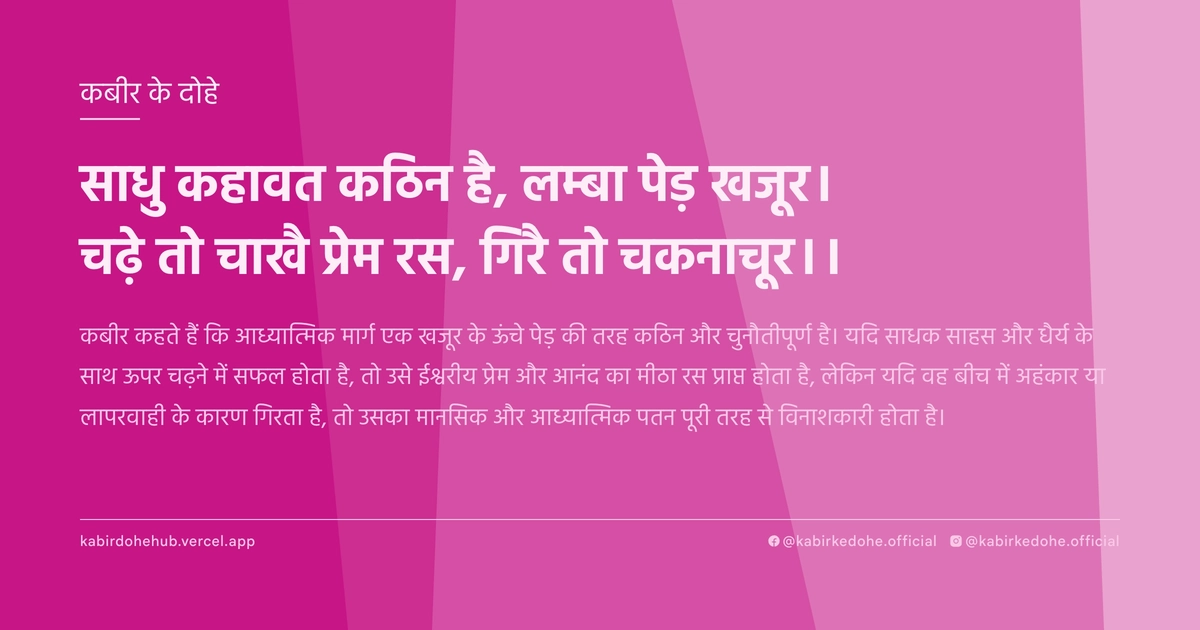
साधु कहावत कठिन है, लम्बा पेड़ खजूर।
चढ़े तो चाखै प्रेम रस, गिरै तो चकनाचूर।।
Sadhu kahavat kathin hai, lamba ped khajur. Chade to chaakhai prem ras, girai to chaknachoor.
इस पृष्ठ पर इस कबीर दोहे का अर्थ (meaning), हिंदी व्याख्या और अंग्रेज़ी अनुवाद, दार्शनिक विश्लेषण और व्यावहारिक जीवन सीख दी गई है। यह दोहा भक्ति (Bhakti) विषय से जुड़ा है — Kabir doha meaning and explanation in Hindi and English.
अर्थ (Meaning):
कबीर कहते हैं कि आध्यात्मिक मार्ग एक खजूर के ऊंचे पेड़ की तरह कठिन और चुनौतीपूर्ण है। यदि साधक साहस और धैर्य के साथ ऊपर चढ़ने में सफल होता है, तो उसे ईश्वरीय प्रेम और आनंद का मीठा रस प्राप्त होता है, लेकिन यदि वह बीच में अहंकार या लापरवाही के कारण गिरता है, तो उसका मानसिक और आध्यात्मिक पतन पूरी तरह से विनाशकारी होता है।
Kabir asserts that the spiritual path is as arduous and daunting as climbing a towering date palm tree. If the seeker possesses the courage and perseverance to ascend, they shall taste the sweet nectar of divine love; however, should they falter due to ego or negligence, the resulting spiritual fall is absolute and shattering.
व्याख्या (Interpretation):
यहाँ खजूर का पेड़ 'साधना' का प्रतीक है, जो अपनी ऊंचाई और चिकनी छाल के कारण दुर्गम है। 'प्रेम रस' उस अद्वैत अनुभूति को दर्शाता है जहाँ आत्मा और परमात्मा एक हो जाते हैं, जो निर्गुण भक्ति का चरम लक्ष्य है। गिरकर 'चकनाचूर' होने का अर्थ शारीरिक मृत्यु नहीं, बल्कि अहंकार का खंडन या भ्रम में फंसकर मानसिक संतुलन खोना है। यह दोहा माया के प्रलोभनों और आध्यात्मिक अनुशासन के बीच के तनाव को उजागर करता है। यह दर्शाता है कि सत्य की खोज कोई साधारण कार्य नहीं, बल्कि एक पूर्ण समर्पण की प्रक्रिया है। अंततः, यह मानव स्थिति के उस विरोधाभास को दर्शाता है जहाँ उच्चतम उपलब्धि के लिए उच्चतम जोखिम उठाना पड़ता है।
The date palm serves as a metaphor for 'Sadhana' (spiritual discipline), characterized by its daunting height and slippery trunk. The 'nectar of love' represents the state of non-duality (Advaita), where the individual soul merges with the formless Brahman, the ultimate goal of Nirgun Bhakti. Being 'shattered' upon falling does not signify physical death, but rather the crushing of the ego or the psychic collapse resulting from spiritual delusion. This verse highlights the tension between the lures of Maya (illusion) and the rigor of discipline. It suggests that the quest for Truth is not a casual endeavor but a process of total surrender. Ultimately, it mirrors the human paradox: the highest spiritual realization requires the highest existential risk.
दार्शनिक विश्लेषण (Philosophical Analysis):
कबीर का यह दोहा मध्यकालीन भारत के उस सामाजिक-धार्मिक परिवेश में रचा गया जहाँ कर्मकांड और बाहरी आडंबरों का बोलबाला था। कबीर ने इन बाहरी दिखावों को नकारते हुए 'सहज' और 'कठिन' मार्ग के बीच के अंतर को स्पष्ट किया है। वे बताते हैं कि मोक्ष केवल तीर्थयात्रा या मंत्रोच्चार से नहीं, बल्कि आंतरिक रूपांतरण से मिलता है।
अद्वैत वेदांत के परिप्रेक्ष्य में, यह चढ़ाई वास्तव में अज्ञान (Avidya) से ज्ञान की ओर संक्रमण है। जब साधक अपनी पहचान शरीर और मन से हटाकर शुद्ध चेतना (Atman) पर केंद्रित करता है, तो वह उस 'प्रेम रस' को चखता है। यह सूफी मत के 'फना' (अहंकार का विनाश) के समान है, जहाँ प्रेमी अपने अस्तित्व को मिटाकर प्रिय (ईश्वर) में विलीन हो जाता है।
यहाँ 'कठिन' शब्द का प्रयोग यह बताने के लिए किया गया है कि आध्यात्मिक मार्ग पर चलने वाले को सामाजिक बहिष्कार और आंतरिक द्वंद्वों का सामना करना पड़ता है। कबीर जाति और धर्म के बंधनों को तोड़कर एक ऐसे मार्ग की बात करते हैं जो सार्वभौमिक है लेकिन अत्यंत व्यक्तिगत है।
मनोवैज्ञानिक स्तर पर, यह दोहा 'संज्ञानात्मक विसंगति' (Cognitive Dissonance) को संबोधित करता है। जब व्यक्ति अपनी पुरानी मान्यताओं को छोड़ता है, तो वह एक अस्थिर स्थिति में होता है। यदि वह इस अस्थिरता को धैर्य से पार करता है, तो वह प्रबुद्ध होता है, अन्यथा वह मानसिक अवसाद या भ्रम का शिकार हो जाता है।
अंततः, कबीर यह चेतावनी देते हैं कि आधा-अधूरा ज्ञान या दिखावटी भक्ति खतरनाक होती है। केवल वही व्यक्ति सफल होता है जो पूर्ण निष्ठा के साथ अपने अहंकार का त्याग करता है और सत्य की ऊंचाइयों की ओर अग्रसर होता है।
This couplet was composed within the socio-religious landscape of medieval India, a time dominated by rigid rituals and outward displays of piety. Kabir rejects these superficialities, distinguishing between the 'easy' path of ritualism and the 'arduous' path of genuine internal transformation.
From the lens of Advaita Vedanta, this ascent is the transition from ignorance (Avidya) to enlightenment. As the seeker shifts their identity from the physical body and transient mind to pure consciousness (Atman), they experience the 'nectar of love.' This mirrors the Sufi concept of 'Fana' (annihilation), where the lover dissolves their ego to merge with the Beloved.
The emphasis on 'difficulty' underscores the social ostracization and internal conflicts a seeker must endure. Kabir advocates for a path that transcends caste and creed, one that is universal in its availability but intensely personal in its execution.
Psychologically, the verse addresses the state of cognitive dissonance. When an individual strips away long-held beliefs, they enter a precarious void. If navigated with patience, this leads to awakening; if handled with arrogance, it leads to a psychic crash or spiritual disillusionment.
Ultimately, Kabir warns that partial knowledge or performative spirituality is perilous. Success is reserved for those who approach the Truth with absolute sincerity, systematically dismantling the ego to reach the summit of realization.
मूल संदेश (Core Message):
- अहंकार का त्याग ही आध्यात्मिक आरोहण की पहली सीढ़ी है।
- आधा-अधूरा ज्ञान विनाश का कारण बनता है, पूर्ण समर्पण ही मार्ग है।
- ईश्वरीय प्रेम की प्राप्ति के लिए कठिन अनुशासन अनिवार्य है।
- सत्य की खोज में बाहरी दिखावा सबसे बड़ी बाधा है।
- जब 'मैं' मिटता है, तभी 'वह' (परमात्मा) प्रकट होता है।
- The surrender of ego is the first step toward spiritual ascent.
- Partial knowledge leads to ruin; total surrender is the only way.
- Rigorous discipline is mandatory to taste the nectar of divine love.
- External performative piety is the greatest obstacle to Truth.
- Only when the 'I' vanishes does the 'Divine' manifest.
व्यावहारिक उदाहरण (Practical Example):
वाराणसी के एक पुराने घाट पर माधव नाम का एक वृद्ध नाविक रहता था। वह जीवन भर नाव चलाता रहा, लेकिन उसका मन हमेशा इस बात में उलझा रहता था कि लोग उसे केवल एक नाविक समझते हैं, जबकि वह खुद को बहुत ज्ञानी मानता था।
माधव अक्सर अन्य नाविकों को उपदेश देता था कि जीवन का सत्य क्या है, लेकिन वह स्वयं क्रोध और ईर्ष्या से भरा रहता था। वह अपनी नाव को 'सत्य की सवारी' कहता था, पर वास्तव में वह केवल अपनी श्रेष्ठता सिद्ध करना चाहता था।
एक दिन, एक मौन साधु उसकी नाव पर सवार हुए। साधु ने माधव की बातों को सुना और केवल एक मुस्कान के साथ कहा, 'नाविक, तुम किनारे पर खड़े होकर समुद्र की गहराई की बातें कर रहे हो, लेकिन क्या तुमने कभी खुद को डुबोया है?'
यह बात माधव के हृदय में गहरे तक चुभ गई। उसे अहसास हुआ कि उसका ज्ञान केवल शब्दों का ढेर था, अनुभव का नहीं। वह उस खजूर के पेड़ के नीचे खड़ा था, लेकिन चढ़ने का साहस नहीं जुटा पा रहा था क्योंकि उसे डर था कि उसकी 'ज्ञानी' छवि टूट जाएगी।
अगले कुछ महीनों तक, माधव ने बोलना कम कर दिया। उसने अपने भीतर के क्रोध को देखना शुरू किया। वह अब दूसरों को उपदेश देने के बजाय, अपनी छोटी-छोटी गलतियों को सुधारने लगा।
एक दिन, जब एक अन्य नाविक की नाव दुर्घटनाग्रस्त हो गई और वह डूबने लगा, तो माधव ने बिना सोचे अपनी जान जोखिम में डालकर उसे बचाया। उस क्षण, उसे अपनी श्रेष्ठता का कोई गर्व नहीं था, केवल करुणा थी।
उसे महसूस हुआ कि जिस 'प्रेम रस' की वह बातें करता था, वह वास्तव में दूसरों के दुख में खुद को मिटा देने में था। उसका अहंकार, जो एक ऊंचे पेड़ की तरह था, अब टूट चुका था।
लेकिन इस टूटने के बाद ही उसे वह शांति मिली जिसे वह वर्षों से शब्दों में खोज रहा था। वह अब केवल एक नाविक नहीं था, बल्कि एक जागृत आत्मा बन गया था।
उसने सीखा कि आध्यात्मिक ऊंचाई पाने के लिए पहले अपनी झूठी पहचान के मलबे को साफ करना पड़ता है।
अब माधव की नाव केवल यात्रियों को पार नहीं कराती थी, बल्कि उसकी उपस्थिति ही लोगों को शांति का अनुभव कराती थी।
On an ancient ghat in Varanasi lived an elderly boatman named Madhav. He had spent his life rowing, yet his mind was perpetually entangled in the belief that while others saw him as a mere boatman, he was a profound scholar of truth.
Madhav frequently lectured other boatmen on the mysteries of life, yet he remained consumed by anger and jealousy. He called his boat the 'Vehicle of Truth,' but in reality, he was merely seeking validation of his own superiority.
One day, a silent monk boarded his boat. After listening to Madhav's discourse, the monk smiled and said, 'Boatman, you speak of the ocean's depths while standing on the shore. Have you ever actually drowned yourself?'
These words pierced Madhav's heart. He realized his knowledge was a heap of words, devoid of experience. He was standing beneath the date palm, but lacked the courage to climb because he feared losing his image as a 'wise man.'
For the next few months, Madhav practiced silence. He began to observe the anger within him. Instead of preaching to others, he focused on correcting his own minute failings.
One afternoon, another boatman's vessel capsized, and the man began to drown. Without a second thought, Madhav risked his own life to save him. In that moment, there was no pride of superiority—only pure compassion.
He realized that the 'nectar of love' he had spoken of was actually found in the act of erasing oneself for the sake of another's suffering.
His ego, which had stood like a towering tree, finally shattered. But only after this shattering did he find the peace he had spent years searching for in books and words.
He learned that to reach spiritual heights, one must first clear the rubble of their false identity.
From then on, Madhav's boat did not just transport passengers; his very presence became a sanctuary of peace for all who crossed his path.
अभ्यास मार्गदर्शन (Practice Guidance):
- प्रतिदिन 20 मिनट 'साक्षी भाव' का अभ्यास करें: अपने विचारों को बिना किसी निर्णय के देखें, जैसे आप किसी और को देख रहे हों।
- आत्म-पूछताछ जर्नल: प्रतिदिन एक ऐसी घटना लिखें जहाँ आपका अहंकार (Ego) चोटिल हुआ और विश्लेषण करें कि वह 'मैं' कौन था जिसे चोट लगी।
- मौन व्रत: सप्ताह में एक बार 3 घंटे का पूर्ण मौन रखें ताकि बाहरी शोर कम हो और आंतरिक संवाद शुरू हो सके।
- निदान चेकलिस्ट: क्या मैं दूसरों को सुधारने की कोशिश कर रहा हूँ? (यदि हाँ, तो आप अभी भी पेड़ के नीचे हैं)। क्या मैं अपनी गलतियों पर वास्तव में दुखी हूँ या केवल दिखावा कर रहा हूँ? (यदि दिखावा है, तो गिरने का जोखिम है)।
- Practice 'Witness Consciousness' for 20 minutes daily: Observe your thoughts without judgment, as if you are watching a stranger.
- Self-Inquiry Journaling: Record one daily incident where your ego was bruised and analyze which 'version' of yourself felt the pain.
- Vow of Silence: Maintain absolute silence for 3 hours once a week to diminish external noise and ignite internal dialogue.
- Diagnostic Checklist: Am I trying to 'fix' others? (If yes, you are still at the base of the tree). Am I genuinely grieving my mistakes or merely performing regret? (If performing, the risk of falling is high).
चिंतन प्रश्न (Reflection Questions):
- मेरी वह कौन सी 'श्रेष्ठता' है जिसे मैं खोने से डरता हूँ, और क्या वही मेरी प्रगति में बाधा है?
- क्या मेरा आध्यात्मिक झुकाव वास्तव में सत्य की खोज है, या केवल एक नया 'बौद्धिक अहंकार' बनाने का तरीका?
- यदि आज मेरी सारी सामाजिक पहचान (पद, प्रतिष्ठा, धर्म) छीन ली जाए, तो मेरे भीतर क्या बचेगा?
- मैं जिन लोगों को 'अज्ञानी' मानता हूँ, क्या उनमें वह सरलता है जो मुझमें अपनी जटिलता के कारण गायब है?
- क्या मैं सत्य के मार्ग पर इसलिए नहीं चल रहा क्योंकि मैं 'गिरने' (अपनी छवि टूटने) से डरता हूँ?
- What specific 'superiority' am I afraid to lose, and is that very thing hindering my progress?
- Is my spiritual inclination a genuine quest for Truth, or merely a way to construct a new 'intellectual ego'?
- If all my social identities (rank, prestige, religion) were stripped away today, what would remain within me?
- Do the people I deem 'ignorant' possess a simplicity that I have lost due to my own complexity?
- Am I avoiding the path of Truth simply because I fear 'falling' (the shattering of my public image)?