
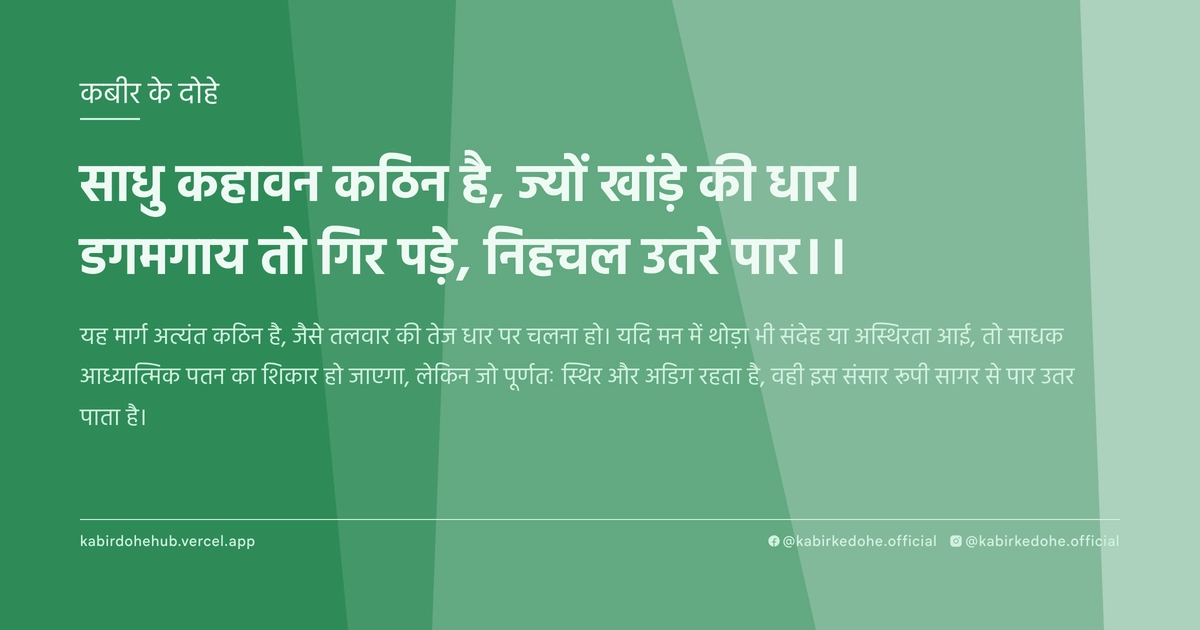
साधु कहावन कठिन है, ज्यों खांड़े की धार।
डगमगाय तो गिर पड़े, निहचल उतरे पार।।
Sadhu kahavan kathin hai, jyon khande ki dhaar. Dagmagay to gir pade, nihchal utre paar.
इस पृष्ठ पर इस कबीर दोहे का अर्थ (meaning), हिंदी व्याख्या और अंग्रेज़ी अनुवाद, दार्शनिक विश्लेषण और व्यावहारिक जीवन सीख दी गई है। यह दोहा संयम (Self-discipline) विषय से जुड़ा है — Kabir doha meaning and explanation in Hindi and English.
अर्थ (Meaning):
यह मार्ग अत्यंत कठिन है, जैसे तलवार की तेज धार पर चलना हो। यदि मन में थोड़ा भी संदेह या अस्थिरता आई, तो साधक आध्यात्मिक पतन का शिकार हो जाएगा, लेकिन जो पूर्णतः स्थिर और अडिग रहता है, वही इस संसार रूपी सागर से पार उतर पाता है।
The spiritual path is exceedingly difficult, akin to balancing on the razor-sharp edge of a sword. Should the seeker waver or succumb to doubt, they will fall into the abyss of illusion; however, those who remain steadfast and unwavering in their resolve shall successfully cross the ocean of existence.
व्याख्या (Interpretation):
शाब्दिक अर्थ में, कबीर यहाँ साधना की सूक्ष्मता और जोखिम की बात कर रहे हैं। 'खांड़े की धार' केवल शारीरिक खतरा नहीं, बल्कि मानसिक और आध्यात्मिक संतुलन का प्रतीक है। यह निरगुण भक्ति की उस अवस्था को दर्शाता है जहाँ अहंकार का पूर्ण विसर्जन अनिवार्य है। माया का प्रभाव इतना प्रबल है कि एक क्षण की असावधानी साधक को पुनः सांसारिक मोहपाश में बांध सकती है। यहाँ 'निहचल' होने का अर्थ जड़ता नहीं, बल्कि आत्म-साक्षात्कार में ऐसी स्थिरता है जो द्वंद्वों से परे हो। यह अद्वैत वेदांत के उस सत्य की ओर संकेत है जहाँ आत्मा और ब्रह्म के बीच का भेद मिट जाता है, लेकिन उस बिंदु तक पहुँचने का मार्ग अत्यंत संकीर्ण है। अंततः, यह दोहा मानवीय चेतना की उस चरम स्थिति का वर्णन करता है जहाँ भय और इच्छा का पूर्ण अंत हो जाता है।
Literally, Kabir speaks of the precision and peril inherent in spiritual discipline. The 'razor's edge' is not a physical threat but a metaphor for the precarious balance of mental and spiritual equilibrium. It represents the path of Nirgun Bhakti, where the total dissolution of the ego is mandatory. The influence of Maya is so pervasive that a single moment of distraction can pull the seeker back into the shackles of worldly attachment. To be 'nihchal' or unwavering does not imply rigidity, but a profound stability in self-realization that transcends all dualities. This aligns with Advaita Vedanta, pointing toward the non-duality of Atman and Brahman, though the bridge to this realization is infinitesimally narrow. Ultimately, the couplet describes the peak of human consciousness where fear and desire are completely extinguished.
दार्शनिक विश्लेषण (Philosophical Analysis):
कबीर का यह दोहा उस युग की उपज है जब धर्म कर्मकांडों और बाहरी आडंबरों में सिमट गया था। उन्होंने स्पष्ट किया कि मोक्ष किसी मंदिर, मस्जिद या तीर्थयात्रा से नहीं, बल्कि आंतरिक अनुशासन और सत्य के प्रति अडिग निष्ठा से मिलता है। यह विचार सूफी मत के 'फना' (अहंकार का विनाश) और वेदांत के 'विवेक' के करीब है। कबीर का तर्क है कि सत्य का मार्ग संकीर्ण है क्योंकि यह हमारी स्वाभाविक प्रवृत्तियों—लोभ, क्रोध और मोह—के विपरीत है।
यहाँ 'कठिन' होने का अर्थ बाहरी संघर्ष नहीं, बल्कि आंतरिक युद्ध है। साधक को अपनी ही कंडीशनिंग और सामाजिक पहचान से लड़ना पड़ता है। जब कबीर 'गिरने' की बात करते हैं, तो उनका तात्पर्य आध्यात्मिक पतन से है, जहाँ व्यक्ति पुनः 'मैं' और 'मेरा' के भ्रम में फंस जाता है। यह मनोवैज्ञानिक रूपांतरण की प्रक्रिया है जहाँ पुराना व्यक्तित्व मरता है ताकि नया, जागृत स्वरूप जन्म ले सके।
यह दर्शन जाति और वर्ग के भेदों को नकारता है। तलवार की धार पर चलने के लिए किसी विशेष कुल या शास्त्र के ज्ञान की आवश्यकता नहीं, बल्कि केवल एक अडिग संकल्प की आवश्यकता है। यह लोकतंत्रात्मक आध्यात्मिकता है, जहाँ केवल प्रयास और स्थिरता ही मापदंड हैं।
सूफीवाद के प्रभाव में, यह मार्ग 'तारीकत' की तरह है, जहाँ गुरु का मार्गदर्शन और स्वयं का अनुशासन अनिवार्य है। बिना स्थिरता के, ज्ञान केवल बौद्धिक विलास बन जाता है, जो वास्तव में एक और सूक्ष्म अहंकार पैदा करता है।
अंतिम विश्लेषण में, यह दोहा चेतावनी और प्रोत्साहन दोनों है। यह चेतावनी देता है कि आधा-अधूरा प्रयास खतरनाक है, और प्रोत्साहित करता है कि पूर्ण समर्पण ही एकमात्र मुक्ति का मार्ग है। यह द्वैत से अद्वैत की ओर संक्रमण की कठिनता को रेखांकित करता है।
This couplet emerges from an era where religion had devolved into mere ritualism and outward displays of piety. Kabir asserts that liberation is attained not through temples, mosques, or pilgrimages, but through internal discipline and unwavering loyalty to Truth. This perspective closely aligns with the Sufi concept of 'Fana' (annihilation of the self) and the Vedantic principle of 'Viveka' (discernment).
Kabir argues that the path is 'difficult' not because of external obstacles, but because it runs counter to our innate tendencies—greed, anger, and attachment. The struggle is an internal war against one's own conditioning and social identity. When he speaks of 'falling,' he refers to spiritual regression, where the seeker is recaptured by the illusions of 'I' and 'Mine.'
This is a process of psychological transformation where the old persona must perish for the awakened self to emerge. By emphasizing the razor's edge, Kabir strips away the necessity of caste or scriptural scholarship; the only prerequisite is an indomitable will. This is a democratic spirituality where effort and stability are the sole metrics of progress.
Influenced by Sufism, this path mirrors the 'Tariqat,' where the guidance of a Satguru and rigorous self-discipline are essential. Without stability, knowledge becomes mere intellectual vanity, which ironically creates a more subtle form of ego.
In final analysis, the verse serves as both a warning and an encouragement. It warns that half-hearted efforts are perilous and encourages the belief that total surrender is the only gateway to liberation. It underscores the sheer difficulty of transitioning from duality to non-duality.
मूल संदेश (Core Message):
- अहंकार का सूक्ष्मतम अंश भी आध्यात्मिक पतन का कारण बन सकता है।
- स्थिरता का अर्थ जड़ता नहीं, बल्कि द्वंद्वों के बीच संतुलन है।
- सत्य का मार्ग संकीर्ण है, इसलिए पूर्ण जागरूकता अनिवार्य है।
- बाहरी अनुष्ठानों से अधिक आंतरिक अनुशासन महत्वपूर्ण है।
- अडिग संकल्प ही माया के भ्रम को भेदने का एकमात्र शस्त्र है।
- Even the smallest fragment of ego can lead to spiritual regression.
- Stability is not rigidity, but balance amidst opposing forces.
- The path to Truth is narrow, making absolute mindfulness essential.
- Internal discipline outweighs the value of external rituals.
- Unwavering resolve is the only weapon to pierce the veil of Maya.
व्यावहारिक उदाहरण (Practical Example):
एक समय की बात है, वाराणसी के घाटों पर माधव नाम का एक वृद्ध बुनकर रहता था। वह अपनी कला में निपुण था, लेकिन उसका मन हमेशा अशांत रहता था। वह धर्म के नाम पर बड़े-बड़े वाद-विवाद करता और स्वयं को दूसरों से श्रेष्ठ समझता था।
एक दिन उसने एक फकीर को देखा जो शांत भाव से बैठा था। माधव ने उससे पूछा, 'मोक्ष का सरल मार्ग क्या है?' फकीर ने मुस्कुराकर कहा, 'मार्ग सरल नहीं, बल्कि सटीक है। यह तलवार की धार पर चलने जैसा है।'
माधव ने इसे एक चुनौती माना। उसने तय किया कि वह अब से हर परिस्थिति में शांत रहेगा और किसी की बुराई नहीं करेगा। पहले कुछ दिन वह सफल रहा, लेकिन धीरे-धीरे उसकी पुरानी आदतें लौटने लगीं।
एक दोपहर, एक ग्राहक ने उसके बुने हुए कपड़े में एक छोटी सी त्रुटि निकाल दी और उसे खरी-खोटी सुनाई। माधव का पुराना अहंकार जाग उठा। वह चिल्लाने ही वाला था कि उसे फकीर की 'तलवार की धार' याद आई।
उसने महसूस किया कि उसका क्रोध उसे उसी गहरे गड्ढे में धकेल रहा है जिससे वह अभी निकला था। वह डगमगा रहा था। उसने अपनी आँखें बंद कीं और अपनी सांसों पर ध्यान केंद्रित किया।
उसने महसूस किया कि ग्राहक की आलोचना वास्तव में उसके अपने अहंकार का दर्पण थी। उसने क्रोध को त्यागकर विनम्रता से गलती स्वीकार की और कपड़े को सुधारने का वादा किया।
उस क्षण माधव को एक असीम शांति का अनुभव हुआ। उसने समझा कि 'निहचल' होने का अर्थ यह नहीं है कि जीवन में समस्याएँ नहीं आएंगी, बल्कि यह है कि उन समस्याओं के बीच भी आप विचलित नहीं होंगे।
उसने अपनी पूरी जीवनशैली बदल दी। अब वह केवल कपड़े नहीं बुनता था, बल्कि अपने भीतर धैर्य और प्रेम का ताना-बाना बुनने लगा।
उसकी इस स्थिरता ने उसके परिवार और आस-पड़ोस के लोगों को भी प्रभावित किया। वह अब विवादों को सुलझाने वाला एक सम्मानित व्यक्ति बन गया था।
माधव ने जान लिया था कि आध्यात्मिक मार्ग पर एक छोटा सा विचलन भी वर्षों की तपस्या को नष्ट कर सकता है, और केवल निरंतर जागरूकता ही पार उतरने का एकमात्र तरीका है।
Once, in the ghats of Varanasi, lived an elderly weaver named Madhav. He was a master of his craft, but his mind was perpetually turbulent. He often engaged in fierce religious debates, believing himself superior to others.
One day, he encountered a wandering dervish sitting in profound silence. Madhav asked, 'What is the simplest path to liberation?' The dervish smiled and replied, 'The path is not simple, but precise. It is like walking on the edge of a sword.'
Madhav took this as a challenge. He decided that from that day forward, he would remain calm in every situation and never speak ill of anyone. For the first few days, he succeeded, but slowly his old habits began to resurface.
One afternoon, a customer found a tiny flaw in a cloth Madhav had woven and began to insult him harshly. Madhav's old ego flared up instantly. He was about to scream back when he remembered the dervish's 'razor's edge.'
He realized that his anger was pushing him back into the very abyss he had just escaped. He was wavering. He closed his eyes and focused intensely on his breath.
He perceived that the customer's criticism was actually a mirror reflecting his own hidden pride. Choosing to let go of the anger, he humbly accepted the mistake and promised to fix the cloth.
In that moment, Madhav experienced an unbound peace. He understood that being 'unwavering' does not mean the absence of conflict, but remaining centered despite the storm.
He transformed his entire way of living. He no longer just wove fabric; he began weaving a tapestry of patience and love within his own heart.
This newfound stability influenced his family and neighbors. He became a respected mediator who resolved disputes with grace and impartiality.
Madhav realized that on the spiritual path, a single lapse in awareness can undo years of discipline, and only constant mindfulness allows one to cross over.
अभ्यास मार्गदर्शन (Practice Guidance):
- प्रतिदिन 20 मिनट 'साक्षी भाव' का अभ्यास करें: अपने विचारों को बिना किसी निर्णय के केवल देखें, जैसे वे आकाश में तैरते बादल हों।
- आत्म-पूछताछ जर्नल: प्रतिदिन एक ऐसी घटना लिखें जहाँ आपका अहंकार जागृत हुआ और विश्लेषण करें कि उस क्षण आप 'डगमगाए' क्यों।
- मौन व्रत: सप्ताह में एक बार कुछ घंटों के लिए पूर्ण मौन धारण करें ताकि बाहरी शोर कम हो और आंतरिक स्थिरता बढ़े।
- डायग्नोस्टिक चेकलिस्ट: क्या मैं प्रतिक्रिया देने से पहले रुकता हूँ? क्या मेरी शांति बाहरी परिस्थितियों पर निर्भर है? क्या मैं अभी भी दूसरों को सही साबित करने की कोशिश कर रहा हूँ?
- Practice 'Witness Consciousness' for 20 minutes daily: Observe your thoughts without judgment, as if they were clouds drifting across the sky.
- Self-Inquiry Journaling: Record one incident daily where your ego was triggered and analyze why you 'wavered' in that specific moment.
- Vow of Silence: Observe complete silence for a few hours once a week to diminish external noise and cultivate internal stillness.
- Diagnostic Checklist: Do I pause before reacting? Is my peace dependent on external circumstances? Am I still striving to prove others wrong?
चिंतन प्रश्न (Reflection Questions):
- मेरे जीवन का वह कौन सा 'अदृश्य अहंकार' है जो मुझे वास्तव में स्थिर होने से रोकता है?
- जब मैं खुद को आध्यात्मिक या नैतिक रूप से श्रेष्ठ महसूस करता हूँ, तो क्या मैं वास्तव में तलवार की धार पर हूँ या अपने भ्रम में?
- क्या मेरी शांति केवल तब तक है जब तक सब कुछ मेरी इच्छा के अनुसार चल रहा है?
- मैं किन सामाजिक मुखौटों को ओढ़े हुए हूँ जो मेरी वास्तविक आत्मा की स्थिरता को छिपा रहे हैं?
- यदि आज मेरी सारी पहचान (पद, प्रतिष्ठा, संबंध) छीन ली जाए, तो क्या मेरे भीतर कुछ ऐसा बचेगा जो 'निहचल' है?
- What is the 'invisible ego' in my life that prevents me from achieving true stability?
- When I feel spiritually or morally superior to others, am I truly on the razor's edge or merely lost in my own illusion?
- Is my peace sustainable, or does it only exist as long as circumstances align with my desires?
- Which social masks am I wearing that obscure the inherent stillness of my true self?
- If all my identities—status, reputation, relationships—were stripped away today, would there be anything left within me that is 'unwavering'?