
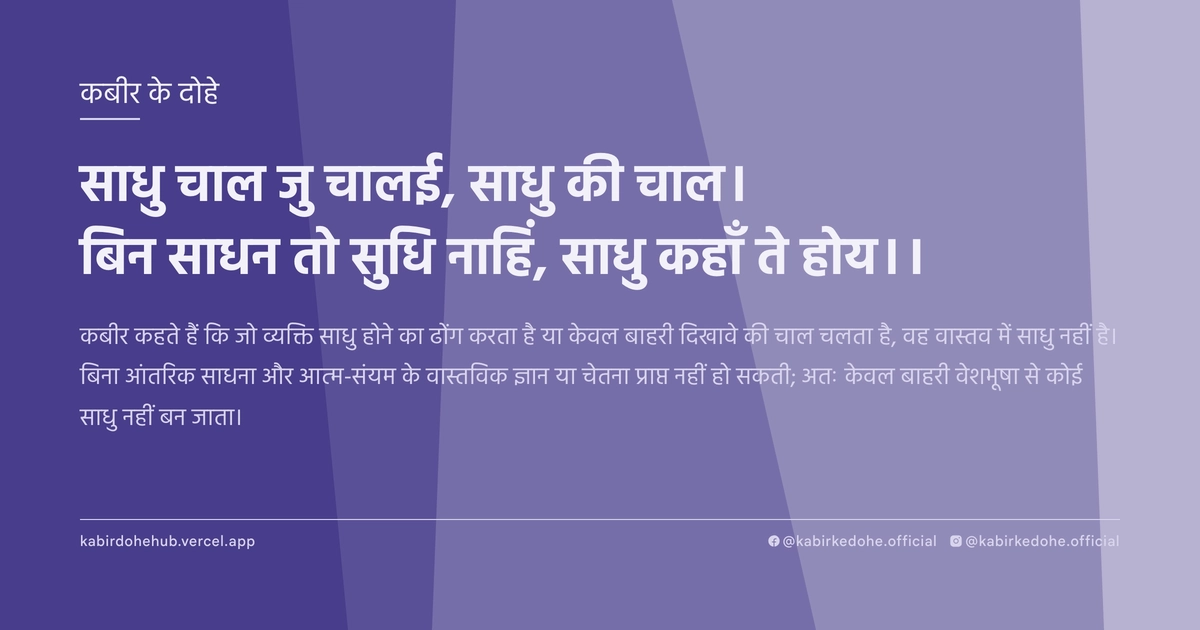
साधु चाल जु चालई, साधु की चाल।
बिन साधन तो सुधि नाहिं, साधु कहाँ ते होय।।
Sadhu chaal ju chaalai, sadhu ki chaal. Bin sadhan to sudhi naahin, sadhu kahan te hoye.
इस पृष्ठ पर इस कबीर दोहे का अर्थ (meaning), हिंदी व्याख्या और अंग्रेज़ी अनुवाद, दार्शनिक विश्लेषण और व्यावहारिक जीवन सीख दी गई है। यह दोहा सहज योग (Sahaja Yoga) विषय से जुड़ा है — Kabir doha meaning and explanation in Hindi and English.
अर्थ (Meaning):
कबीर कहते हैं कि जो व्यक्ति साधु होने का ढोंग करता है या केवल बाहरी दिखावे की चाल चलता है, वह वास्तव में साधु नहीं है। बिना आंतरिक साधना और आत्म-संयम के वास्तविक ज्ञान या चेतना प्राप्त नहीं हो सकती; अतः केवल बाहरी वेशभूषा से कोई साधु नहीं बन जाता।
Kabir asserts that one who merely mimics the outward conduct or 'walk' of a saint is not truly enlightened. Without rigorous internal spiritual practice (Sadhana) and disciplined mindfulness, true consciousness cannot be attained; therefore, mere external appearances cannot create a genuine seeker.
व्याख्या (Interpretation):
इस दोहे में 'चाल' शब्द का प्रयोग दोहरा अर्थ रखने के लिए किया गया है—एक शारीरिक चाल और दूसरा जीवन जीने का तरीका। कबीर यहाँ पाखंड और वास्तविकता के बीच के अंतर को स्पष्ट कर रहे हैं। वे बताते हैं कि साधुता कोई वस्त्र नहीं है जिसे पहना जा सके, बल्कि यह एक आंतरिक रूपांतरण है। निरगुण भक्ति के संदर्भ में, यह इस बात पर जोर देता है कि ईश्वर का अनुभव बाहरी कर्मकांडों से नहीं, बल्कि अंतर्मन की शुद्धि से होता है। माया यहाँ उस भ्रम के रूप में है जो व्यक्ति को विश्वास दिलाता है कि बाहरी प्रतीकों से आध्यात्मिक ऊंचाई प्राप्त की जा सकती है। अंततः, यह आत्मा और परमात्मा के अभेद संबंध को समझने के लिए अहंकार के विसर्जन की मांग करता है।
In this couplet, the word 'chaal' (walk/conduct) serves a dual purpose—referring to both physical gait and the overall way of life. Kabir highlights the chasm between hypocrisy and authenticity. He argues that sainthood is not a garment to be worn but an internal alchemy. In the context of Nirgun Bhakti, this emphasizes that the experience of the Formless Divine is not achieved through ritualistic performance but through the purification of the inner self. Maya manifests here as the illusion that external symbols equate to spiritual elevation. Ultimately, it demands the dissolution of the ego to realize the non-duality of Atman and Brahman, suggesting that the 'walk' of a saint is actually the absence of the 'I'.
दार्शनिक विश्लेषण (Philosophical Analysis):
कबीर का यह दोहा उस सामाजिक और धार्मिक परिवेश की प्रतिक्रिया है जहाँ मध्यकालीन भारत में बाहरी आडंबरों और जाति-आधारित श्रेष्ठता का बोलबाला था। वे उन लोगों पर प्रहार करते हैं जो केवल तिलक, माला या गेरुए वस्त्र धारण कर समाज में सम्मान पाना चाहते थे, जबकि उनके भीतर क्रोध, लोभ और अहंकार यथावत थे। यह दृष्टिकोण अद्वैत वेदांत के उस सिद्धांत से मेल खाता है जहाँ 'अहं ब्रह्मास्मि' का अनुभव केवल ज्ञान और अनुभव से होता है, न कि किसी बाहरी पहचान से।
सूफी मत के 'फना' (अहंकार का विनाश) की अवधारणा यहाँ स्पष्ट दिखती है। कबीर का मानना है कि जब तक व्यक्ति अपनी पुरानी पहचान और सामाजिक मुखौटों को नहीं त्यागता, वह सत्य के मार्ग पर नहीं चल सकता। वे ritualism (कर्मकांड) को एक बाधा मानते हैं क्योंकि यह व्यक्ति को बाहरी दुनिया में उलझाए रखता है और उसे आंतरिक मौन से दूर ले जाता है।
मनोवैज्ञानिक स्तर पर, कबीर 'संज्ञानात्मक विसंगति' (cognitive dissonance) की बात कर रहे हैं—जहाँ व्यक्ति का व्यवहार उसकी आंतरिक स्थिति के विपरीत होता है। वे चेतावनी देते हैं कि बिना 'साधन' (अनुशासन और अभ्यास) के 'सुधि' (जागरूकता) असंभव है। यह केवल धार्मिक उपदेश नहीं है, बल्कि एक कठोर मनोवैज्ञानिक विश्लेषण है कि कैसे मनुष्य अपनी कमियों को छिपाने के लिए आध्यात्मिक मुखौटों का सहारा लेता है।
भक्ति आंदोलन के भीतर, कबीर की यह दृष्टि क्रांतिकारी थी क्योंकि उन्होंने साधुता को किसी विशेष वर्ग या जाति के एकाधिकार से मुक्त कर उसे 'आचरण' और 'अनुभव' से जोड़ दिया। उनके लिए साधु वह है जिसने अपनी इंद्रियों को जीत लिया है, न कि वह जिसने शास्त्रों को रट लिया है।
अंततः, यह विश्लेषण हमें यह समझने पर मजबूर करता है कि आध्यात्मिक यात्रा 'बनने' (becoming) की नहीं, बल्कि 'हटने' (unbecoming) की प्रक्रिया है। जब तक 'मैं साधु हूँ' का अहंकार बना रहता है, तब तक वास्तविक साधुता का जन्म नहीं हो सकता।
This couplet is a visceral reaction to the socio-religious climate of medieval India, where external ostentation and caste-based superiority prevailed. Kabir attacks those who sought social validation through tilaks, beads, or saffron robes while harboring anger, greed, and ego within. This aligns with the Advaita Vedanta principle that the realization of 'Aham Brahmasmi' (I am Brahman) comes through direct experience and gnosis, not through external identifiers.
The Sufi concept of 'Fana' (annihilation of the self) is evident here. Kabir believes that unless an individual sheds their old identity and social masks, they cannot walk the path of Truth. He views ritualism as a barrier that keeps the seeker entangled in the external world, diverting them from the profound silence of the inner sanctuary.
Psychologically, Kabir addresses 'cognitive dissonance'—where a person's outward behavior contradicts their internal state. He warns that without 'Saadhan' (disciplined practice) and 'Sadhana', 'Sudhi' (pure consciousness/awareness) is impossible. This is not merely religious preaching but a rigorous psychological analysis of how humans use spiritual masks to camouflage their inadequacies.
Within the Bhakti movement, Kabir's perspective was revolutionary because he decoupled sainthood from the monopoly of a specific class or caste, linking it instead to 'conduct' and 'realization'. For him, a saint is one who has conquered their senses, not one who has memorized scriptures.
Ultimately, this analysis forces us to understand that the spiritual journey is not a process of 'becoming' but a process of 'unbecoming'. As long as the ego persists in the thought 'I am a saint,' the actual state of sainthood cannot emerge.
मूल संदेश (Core Message):
- दिखावा आध्यात्मिक प्रगति का सबसे बड़ा अवरोध है।
- वास्तविक ज्ञान बाहरी प्रतीकों में नहीं, आंतरिक शुद्धि में है।
- अहंकार का त्याग ही सच्ची साधुता की पहली सीढ़ी है।
- अनुशासन (साधन) के बिना जागरूकता (सुधि) असंभव है।
- सत्य वह है जो एकांत और समाज, दोनों में समान रहे।
- Performative spirituality is the greatest obstacle to actual progress.
- True gnosis resides in internal purity, not in external symbols.
- The surrender of ego is the first step toward genuine sainthood.
- Awareness (Sudhi) is impossible without disciplined practice (Saadhan).
- Truth is that which remains consistent in both solitude and society.
व्यावहारिक उदाहरण (Practical Example):
वाराणसी के एक पुराने घाट पर माधव नाम का एक वृद्ध व्यक्ति रहता था। वह हमेशा सफेद सूती वस्त्र पहनता, माथे पर चंदन लगाता और अपनी वाणी में अत्यंत विनम्रता रखता था। शहर के लोग उसे एक महान संत मानते थे और दूर-दूर से लोग उससे आशीर्वाद लेने आते थे। माधव को इस सम्मान की आदत हो गई थी और धीरे-धीरे वह अपनी इस 'छवि' का गुलाम बन गया।
वह घंटों प्रवचन देता कि कैसे मोह-माया का त्याग करना चाहिए, लेकिन घर के भीतर वह अपनी पत्नी और बच्चों पर छोटी-छोटी बातों के लिए चिल्लाता था। उसका बाहरी व्यक्तित्व एक शांत झील की तरह था, लेकिन भीतर ईर्ष्या और क्रोध की लहरें उठती रहती थीं। वह अपनी छवि को बनाए रखने के लिए और अधिक कठोर नियमों का पालन करने लगा, लेकिन उसका मन और अधिक अशांत होता गया।
एक दिन, घाट पर एक साधारण सा बुनकर आया, जिसने फटे हुए कपड़े पहने थे और जिसकी भाषा बेबाक थी। उसने माधव के प्रवचन सुने और फिर मुस्कुराकर कहा, 'बाबा, आपकी चाल तो साधु की है, पर क्या आपके भीतर का शोर शांत हुआ? क्योंकि बिना भीतर की सफाई के, बाहर का रंग केवल एक पर्दा है।'
यह बात माधव के हृदय में तीर की तरह लगी। उसे एहसास हुआ कि वह वर्षों से केवल 'साधु होने का अभिनय' कर रहा था। उसने महसूस किया कि उसने समाज की नजरों में तो जगह बना ली, लेकिन अपनी आत्मा की नजरों में वह गिर चुका था।
माधव ने उस दिन तय किया कि वह अब बाहरी दिखावे की चिंता नहीं करेगा। उसने चंदन लगाना और सफेद वस्त्रों का प्रदर्शन करना कम कर दिया और अपना पूरा ध्यान अपने क्रोध और अहंकार को समझने में लगाया।
उसने अपनी पत्नी से माफी मांगी और अपने बच्चों के साथ समय बिताना शुरू किया। उसने पाया कि जब उसने 'संत' होने का बोझ उतार फेंका, तब वह वास्तव में शांत महसूस करने लगा।
अब वह लोगों को यह नहीं बताता था कि क्या करना चाहिए, बल्कि वह अपने व्यवहार से यह दिखाने लगा कि कैसे जीना चाहिए। उसकी वाणी अब केवल शब्दों का समूह नहीं थी, बल्कि उसके अनुभव की गूँज थी।
उसने सीखा कि वास्तविक साधना मंदिर या घाट पर नहीं, बल्कि अपने भीतर के अंधेरे को रोशनी में बदलने में है।
अंततः, माधव की 'चाल' बदल गई। अब वह केवल एक साधु जैसा दिखने वाला व्यक्ति नहीं था, बल्कि एक ऐसा मनुष्य था जिसने अपनी त्रुटियों को स्वीकार कर लिया था।
यही कबीर का 'ट्विस्ट' था—बाहरी पहचान का विनाश ही वास्तविक पहचान की शुरुआत है।
On an ancient ghat in Varanasi lived an elderly man named Madhav. He always wore pristine white cotton clothes, applied sandalwood paste to his forehead, and spoke with immense humility. The townspeople regarded him as a great saint, and people traveled from afar to seek his blessings. Madhav grew accustomed to this reverence and gradually became a slave to this 'image'.
He would spend hours lecturing on the necessity of renouncing worldly attachments, yet within his home, he would scream at his wife and children over trivial matters. His external persona was like a still lake, but inside, waves of jealousy and anger surged constantly. To maintain his image, he began following even stricter rituals, yet his mind became increasingly turbulent.
One day, a simple weaver arrived at the ghat, dressed in tattered clothes and speaking with blunt honesty. He listened to Madhav's discourse and then smiled, saying, 'Baba, your walk is that of a saint, but has the noise within you fallen silent? For without internal cleansing, external color is merely a curtain.'
These words pierced Madhav's heart like an arrow. He realized that for years, he had merely been 'acting the part' of a saint. He understood that while he had gained a place in the eyes of society, he had fallen in the eyes of his own soul.
Madhav decided that day that he would no longer worry about external appearances. He stopped the performative use of sandalwood and white robes and focused all his energy on understanding his own anger and ego.
He apologized to his wife and began spending genuine time with his children. He discovered that once he dropped the burden of 'being a saint,' he actually began to feel peace.
He stopped telling people what they should do and instead began showing them how to live through his behavior. His speech was no longer just a collection of words, but an echo of his lived experience.
He learned that true Sadhana does not happen at a temple or a ghat, but in the process of transforming one's internal darkness into light.
Eventually, Madhav's 'walk' changed. He was no longer just a man who looked like a saint, but a human who had accepted his flaws.
This was the 'Kabir Twist'—the destruction of the external identity is the beginning of the true identity.
अभ्यास मार्गदर्शन (Practice Guidance):
- दैनिक आत्म-निरीक्षण: प्रतिदिन 15 मिनट मौन बैठें और यह विश्लेषण करें कि आज आपने कितनी बार अपनी छवि (Image) को बचाने के लिए झूठ बोला या दिखावा किया।
- साधना जर्नल: एक डायरी लिखें जिसमें आप अपने उन व्यवहारों को दर्ज करें जो आपके सार्वजनिक व्यक्तित्व और निजी व्यवहार के बीच के अंतर को दर्शाते हैं।
- व्यवहारिक परिवर्तन: किसी ऐसे कार्य की करें जो आपकी सामाजिक प्रतिष्ठा के विपरीत हो लेकिन नैतिक रूप से सही हो, ताकि आप अपनी 'छवि' के मोह को तोड़ सकें।
- डायग्नोस्टिक चेकलिस्ट: क्या मैं दूसरों की प्रशंसा के लिए आध्यात्मिक शब्दों का प्रयोग करता हूँ? क्या मैं अपनी गलतियों को 'अध्यात्म' के पीछे छिपाता हूँ? यदि हाँ, तो आप 'चाल' चल रहे हैं, साधना नहीं।
- Daily Self-Audit: Sit in silence for 15 minutes daily and analyze how many times today you lied or performed a gesture simply to protect your public image.
- Sadhana Journaling: Maintain a diary recording behaviors that highlight the discrepancy between your public persona and your private conduct.
- Behavioral Shift: Perform an act that may contradict your social prestige but is ethically right, specifically to break the attachment to your 'image'.
- Diagnostic Checklist: Do I use spiritual terminology to gain admiration? Do I hide my flaws behind a veil of spirituality? If yes, you are merely 'walking the walk' without the internal transformation.
चिंतन प्रश्न (Reflection Questions):
- यदि समाज से आपकी सारी उपाधियाँ और पहचान छीन ली जाएँ, तो आपके भीतर क्या बचेगा?
- क्या आपका 'आध्यात्मिक' व्यवहार वास्तव में करुणा से प्रेरित है, या यह केवल एक सामाजिक सुरक्षा कवच है?
- आप अपनी डिजिटल पहचान (सोशल मीडिया) पर जो 'शांति' दिखाते हैं, क्या वह आपके वास्तविक मानसिक स्वास्थ्य का प्रतिबिंब है?
- वह कौन सा सच है जिसे आप अपनी 'पवित्र' छवि के डर से स्वीकार करने से डरते हैं?
- क्या आप वास्तव में सत्य की खोज कर रहे हैं, या आप केवल 'सत्य खोजने वाले' की छवि को पसंद करते हैं?
- If all your titles and social identities were stripped away, what would remain within you?
- Is your 'spiritual' behavior truly driven by compassion, or is it merely a social safety shield?
- Is the 'peace' you project through your digital identity a true reflection of your actual mental health?
- What is the truth you are afraid to acknowledge because it might shatter your 'pure' image?
- Are you actually seeking the Truth, or do you simply enjoy the identity of being a 'seeker'?