
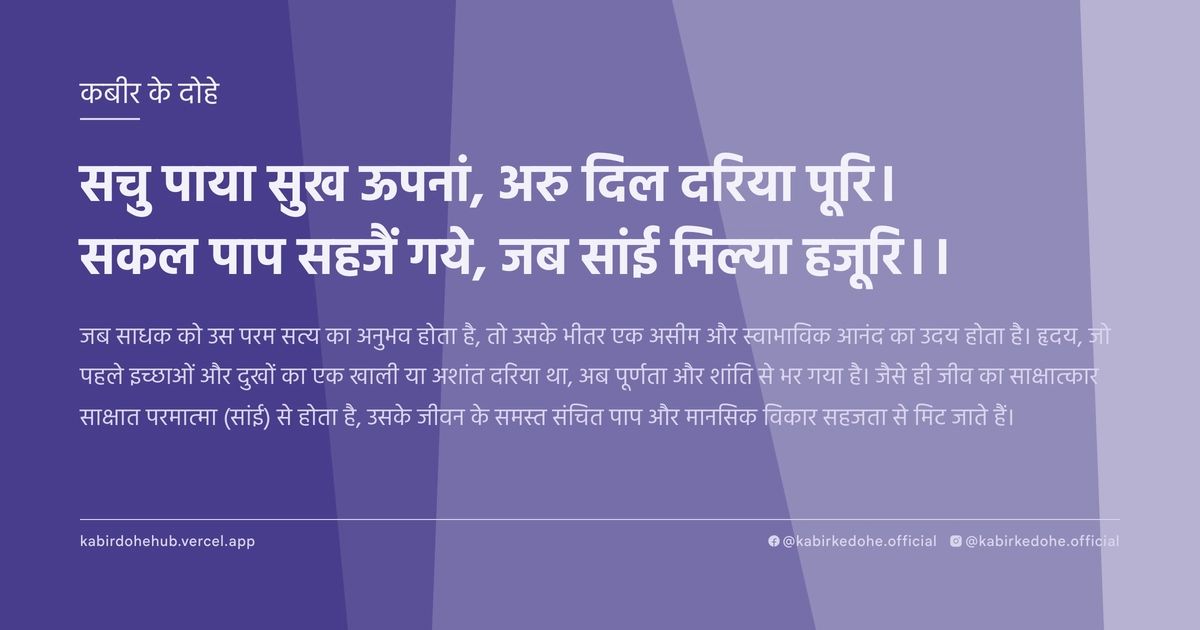
सचु पाया सुख ऊपनां, अरु दिल दरिया पूरि।
सकल पाप सहजैं गये, जब सांई मिल्या हजूरि।।
Sachu paaya sukh upnan, aru dil dariya poori. Sakal paap sahajain gaye, jab sai milya hazoori.
इस पृष्ठ पर इस कबीर दोहे का अर्थ (meaning), हिंदी व्याख्या और अंग्रेज़ी अनुवाद, दार्शनिक विश्लेषण और व्यावहारिक जीवन सीख दी गई है। यह दोहा मुक्ति (Liberation) विषय से जुड़ा है — Kabir doha meaning and explanation in Hindi and English.
अर्थ (Meaning):
जब साधक को उस परम सत्य का अनुभव होता है, तो उसके भीतर एक असीम और स्वाभाविक आनंद का उदय होता है। हृदय, जो पहले इच्छाओं और दुखों का एक खाली या अशांत दरिया था, अब पूर्णता और शांति से भर गया है। जैसे ही जीव का साक्षात्कार साक्षात परमात्मा (सांई) से होता है, उसके जीवन के समस्त संचित पाप और मानसिक विकार सहजता से मिट जाते हैं।
When the seeker attains the Ultimate Truth, an innate and boundless bliss arises within. The heart, once a turbulent river of longing and void, becomes overflowing with divine fulfillment. Upon the direct realization of the Eternal Presence (the Beloved/Sai), all accumulated sins and spiritual impurities dissolve effortlessly, leaving only purity.
व्याख्या (Interpretation):
यह दोहा आत्मा और परमात्मा के मिलन की पराकाष्ठा को दर्शाता है। 'सचु' यहाँ केवल नैतिक सत्य नहीं, बल्कि वह निर्गुण ब्रह्म है जो सृष्टि का आधार है। 'दिल दरिया पूरि' का अर्थ है कि मानवीय हृदय की अनंत प्यास, जिसे संसार की कोई भी वस्तु नहीं भर सकती थी, अब उस दिव्य अमृत से तृप्त हो गई है। यह स्थिति अद्वैत वेदांत के 'पूर्णता' के भाव को दर्शाती है, जहाँ ज्ञाता और ज्ञेय का भेद समाप्त हो जाता है। 'सहजैं' शब्द अत्यंत महत्वपूर्ण है; यह संकेत देता है कि जब प्रकाश आता है, तो अंधकार (पाप) को हटाने के लिए संघर्ष नहीं करना पड़ता, वह स्वतः ही विलीन हो जाता है। यह माया के पर्दे के हटने और आत्म-साक्षात्कार की प्रक्रिया है।
This couplet depicts the pinnacle of the union between the individual soul and the Universal Consciousness. 'Sachu' (Truth) here refers not to moral truth, but to the Nirgun Brahman—the formless absolute. The phrase 'dil dariya poori' signifies that the infinite void of the human heart, which no worldly pleasure could fill, is now saturated with divine nectar. This aligns with the Advaita Vedanta concept of 'Purnata' (Fullness), where the duality between the knower and the known vanishes. The word 'Sahajain' (effortlessly) is crucial; it suggests that when the light of realization dawns, the darkness of sin does not need to be fought—it simply ceases to exist. It is the dissolution of Maya and the emergence of the Atman.
दार्शनिक विश्लेषण (Philosophical Analysis):
कबीर का यह दर्शन सूफीवाद और भारतीय भक्ति परंपरा का एक अद्भुत संगम है। 'सांई' और 'हजूर' जैसे शब्दों का प्रयोग स्पष्ट रूप से सूफी प्रभाव को दर्शाता है, जहाँ ईश्वर को 'माशूक' या प्रियतम के रूप में देखा जाता है। कबीर यहाँ कर्मकांडीय शुद्धि (जैसे गंगा स्नान या व्रत) का खंडन कर रहे हैं। उनके अनुसार, पापों का नाश किसी बाहरी अनुष्ठान से नहीं, बल्कि आंतरिक रूपांतरण और परमात्मा के सानिध्य से होता है।
ऐतिहासिक रूप से, कबीर एक ऐसे समय में थे जब धर्म बाहरी प्रतीकों और जातिगत श्रेष्ठता में जकड़ा हुआ था। उन्होंने इस विचार को चुनौती दी कि मोक्ष केवल कुछ विशेष वर्गों के लिए है। उनके लिए 'सत्य' वह अनुभव है जो किसी मंदिर या मस्जिद का मोहताज नहीं है। यह विश्लेषण हमें बताता है कि अहंकार (I-ness) ही वह एकमात्र बाधा है जो हमें 'सचु' से दूर रखती है।
अद्वैत वेदांत के परिप्रेक्ष्य में, 'पाप' वास्तव में अविद्या (अज्ञान) है। जब साधक को यह बोध होता है कि वह स्वयं ब्रह्म का अंश है, तो पृथकता का भ्रम टूट जाता है। यह 'अहं ब्रह्मास्मि' की स्थिति है। यहाँ पाप का मिटना वास्तव में उस झूठी पहचान का मिटना है जिसे हमने समाज और वासनाओं के आधार पर गढ़ा था।
मनोवैज्ञानिक स्तर पर, यह दोहा 'कैथार्सिस' या भावनात्मक विरेचन की बात करता है। जब मनुष्य को एक उच्चतर उद्देश्य या सार्वभौमिक प्रेम का अनुभव होता है, तो उसके पुराने अपराधबोध (guilt) और मानसिक द्वंद्व समाप्त हो जाते हैं। यह एक ऐसी मानसिक अवस्था है जहाँ व्यक्ति स्वयं को क्षमा कर पाता है क्योंकि वह स्वयं को संपूर्ण ब्रह्मांड के साथ एकीकृत महसूस करता है।
अंततः, कबीर यह संदेश देते हैं कि आध्यात्मिक यात्रा का लक्ष्य केवल ज्ञान प्राप्त करना नहीं, बल्कि 'प्रेम' में विलीन होना है। जब 'सांई' (परमात्मा) की उपस्थिति महसूस होती है, तो अनुशासन और प्रयास की आवश्यकता नहीं रहती; जीवन स्वयं एक सहज प्रवाह बन जाता है। यह 'सहज मार्ग' ही कबीर की सबसे बड़ी देन है, जो कठिन तपस्या के बजाय आंतरिक समर्पण पर बल देता है।
Kabir's philosophy here is a sublime synthesis of Sufism and the Indian Bhakti tradition. The use of terms like 'Sai' and 'Hazoor' clearly indicates a Sufi influence, where the Divine is viewed as the 'Mashooq' or the Beloved. Kabir is explicitly rejecting ritualistic purification—such as ceremonial baths or fasts—arguing that the eradication of sin occurs not through external rites, but through internal transformation and the direct presence of the Divine.
Historically, Kabir lived in an era where religion was shackled by external symbols and caste hierarchies. He challenged the notion that liberation was reserved for specific social classes. For him, 'Truth' is an experiential reality that does not depend on temples or mosques. This analysis reveals that the ego (Ahamkara) is the sole barrier separating the seeker from the 'Sachu'.
From the perspective of Advaita Vedanta, 'sin' is essentially 'Avidya' or ignorance. When the seeker realizes they are an extension of the Brahman, the illusion of separation shatters. This is the state of 'Aham Brahmasmi' (I am Brahman). The 'dissolution of sin' is, in reality, the dissolution of the false identity constructed through social conditioning and worldly desires.
Psychologically, this couplet speaks to a state of spiritual catharsis. When a human experiences a higher purpose or universal love, old patterns of guilt and mental conflict dissolve. It is a state where the individual can finally forgive themselves because they feel integrated with the entire cosmos.
Ultimately, Kabir suggests that the goal of the spiritual journey is not merely the acquisition of knowledge, but the total immersion in Love. When the presence of the 'Sai' is felt, the need for rigorous discipline or forced effort vanishes; life becomes a spontaneous flow. This 'Sahaj Marg' (the Natural Path) is Kabir's greatest contribution, emphasizing surrender over ascetic struggle.
मूल संदेश (Core Message):
- सत्य का अनुभव ही वास्तविक आनंद का एकमात्र स्रोत है।
- हृदय की पूर्णता बाहरी उपलब्धियों से नहीं, आंतरिक मिलन से आती है।
- पाप कोई स्थायी दाग नहीं, बल्कि चेतना का एक अस्थायी अंधकार है।
- परमात्मा का सानिध्य सभी मानसिक विकारों को सहजता से मिटा देता है।
- अहंकार का विसर्जन ही ईश्वर से मिलन की एकमात्र शर्त है।
- प्रेम और समर्पण, कठिन तपस्या से अधिक शक्तिशाली मार्ग हैं।
- The experience of Truth is the only source of authentic bliss.
- Fullness of heart comes from internal union, not external achievements.
- Sin is not a permanent stain, but a temporary darkness of consciousness.
- The presence of the Divine effortlessly erases all mental impurities.
- The dissolution of ego is the sole prerequisite for union with God.
- Love and surrender are more powerful paths than rigorous asceticism.
व्यावहारिक उदाहरण (Practical Example):
वाराणसी के एक पुराने मोहल्ले में माधव नाम का एक वृद्ध बुनकर रहता था। माधव का जीवन केवल धागों और करघे के बीच बीता, लेकिन उसका मन हमेशा एक गहरे अपराधबोध से भरा रहता था। दशकों पहले, उसने अपने भाई के साथ एक छोटी सी जमीन के विवाद में कड़वाहट पैदा की थी, जिसके कारण दोनों अलग हो गए थे। माधव ने मंदिर की सीढ़ियों पर हजारों बार माथा टेका, दान दिया और कठिन उपवास रखे, इस उम्मीद में कि उसका 'पाप' धुल जाएगा। लेकिन उसके दिल का 'दरिया' अशांत था, उसमें केवल पछतावे की लहरें उठती थीं।
एक दिन, माधव की मुलाकात एक घुमक्कड़ फकीर से हुई जो शहर के किनारे एक पीपल के पेड़ के नीचे बैठा था। फकीर ने माधव की आँखों में वही पुराना दर्द देखा और उससे कहा, "तू जिस पाप को धोने के लिए गंगा में डुबकी लगा रहा है, वह पाप पानी से नहीं, प्रेम से मिटेगा। तू बाहर जिसे खोज रहा है, वह तेरे भीतर ही 'सांई' बनकर बैठा है।"
माधव ने पूछा, "मैं उसे कैसे पाऊं?" फकीर ने मुस्कुराकर कहा, "बस अपनी पकड़ ढीली कर दे। इस अहंकार को छोड़ दे कि तू एक 'पापी' है। तू केवल एक अंश है, और वह पूर्ण है। जब तू खुद को उसके हवाले कर देगा, तो बोझ अपने आप उतर जाएगा।"
माधव ने उस रात अपनी आँखें बंद कीं और पहली बार किसी मंत्र का जाप नहीं किया, बल्कि बस अपने हृदय की शून्यता को महसूस किया। उसने कल्पना की कि वह एक छोटा सा कतरा है जो एक विशाल सागर में मिल रहा है। धीरे-धीरे, उसे अपने भीतर एक ऐसी शांति महसूस हुई जिसे उसने पहले कभी नहीं जाना था। उसे लगा जैसे कोई अत्यंत स्नेही शक्ति उसे गले लगा रही है।
उस क्षण, माधव को वह 'सचु' (सत्य) मिला। उसे महसूस हुआ कि उसका भाई, उसका विवाद, और उसका अहंकार—सब उस एक विराट चेतना का हिस्सा थे। उसके भीतर एक असीम सुख उपजा। वह बोझ, जो उसने तीस सालों से ढोया था, अचानक गायब हो गया। उसे समझ आया कि पाप कोई बाहरी दाग नहीं था, बल्कि स्वयं से अलगाव का अहसास था।
अगली सुबह, माधव बिना किसी हिचकिचाहट के अपने भाई के घर गया। उसने कोई लंबी सफाई नहीं दी, कोई तर्क नहीं किया। उसने बस अपने भाई का हाथ पकड़ा और उसकी आँखों में देखा। भाई ने भी वही शांति महसूस की। दोनों के बीच की कड़वाहट उस एक पल में विलीन हो गई।
माधव अब भी बुनता था, लेकिन अब उसके करघे से निकलने वाले कपड़ों में एक अलग ही चमक थी। वह अब मंदिर जाने के लिए नहीं, बल्कि उस आंतरिक 'सांई' के साथ रहने के लिए जागता था।
उसका जीवन अब एक 'पूर्ण दरिया' बन चुका था। उसने सीखा कि जब हम स्वयं को परमात्मा के प्रति पूरी तरह समर्पित कर देते हैं, तो जीवन की सारी जटिलताएँ सहजता से सुलझ जाती हैं।
In an old neighborhood of Varanasi lived an elderly weaver named Madhav. Madhav's life had passed between threads and looms, but his mind was always clouded by a deep sense of guilt. Decades ago, a petty dispute over a small piece of land had created a rift between him and his brother, leading to a lifelong separation. Madhav had bowed his head thousands of times on the temple steps, gave lavish donations, and observed rigorous fasts, hoping his 'sins' would be washed away. Yet, the 'river' of his heart remained turbulent, churning only with waves of regret.
One day, Madhav encountered a wandering fakir sitting under a peepal tree on the outskirts of the city. The fakir saw the ancient pain in Madhav's eyes and said, "The sin you are trying to wash away in the Ganges will not be cleansed by water, but by love. The one you seek outside is already sitting within you as the 'Sai'."
Madhav asked, "How do I find Him?" The fakir smiled and replied, "Just loosen your grip. Let go of the ego that tells you that you are a 'sinner'. You are but a drop, and He is the Ocean. When you surrender yourself to Him, the burden will lift on its own."
That night, Madhav closed his eyes. For the first time, he did not chant any mantra; instead, he simply felt the void within his heart. He imagined himself as a tiny droplet merging into a vast, shimmering sea. Gradually, he felt a peace he had never known before. He felt as if an infinitely loving power was embracing him.
In that moment, Madhav found the 'Sachu' (Truth). He realized that his brother, the dispute, and his own ego were all parts of one singular, cosmic consciousness. An immense bliss arose within him. The burden he had carried for thirty years vanished instantly. He understood that sin was not an external stain, but the feeling of separation from the Whole.
The next morning, Madhav went to his brother's house without hesitation. He offered no long explanations, no arguments. He simply took his brother's hand and looked into his eyes. The brother felt the same peace. The bitterness between them dissolved in that single moment.
Madhav continued to weave, but the fabrics emerging from his loom now had a different radiance. He no longer woke up to go to the temple, but to abide with the internal 'Sai'.
His life had become a 'full river'. He learned that when we surrender ourselves completely to the Divine, all the complexities of life are resolved effortlessly.
अभ्यास मार्गदर्शन (Practice Guidance):
- प्रतिदिन 20 मिनट 'शून्य ध्यान' का अभ्यास करें, जहाँ आप किसी मंत्र के बजाय केवल अपने हृदय की धड़कन और श्वास के प्रवाह को महसूस करें, यह अनुभव करें कि आप ब्रह्मांडीय चेतना में विलीन हो रहे हैं।
- एक 'क्षमा जर्नल' बनाएँ। उन सभी घटनाओं को लिखें जिनके लिए आप स्वयं को दोषी मानते हैं, और फिर प्रत्येक प्रविष्टि के अंत में लिखें: "मैं इस मानवीय त्रुटि को उस अनंत प्रेम में विसर्जित करता हूँ जो मुझसे बड़ा है।"
- दिन भर में कम से कम तीन बार रुककर स्वयं से पूछें: "क्या इस समय मैं अपनी छोटी पहचान (अहंकार) से बात कर रहा हूँ, या अपनी आत्मा से?"
- व्यवहार परिवर्तन: जब भी किसी के प्रति क्रोध या द्वेष महसूस हो, तो आँखें बंद कर कल्पना करें कि सामने वाला व्यक्ति भी उसी 'सांई' का रूप है जिसे आप खोज रहे हैं।
- डायग्नोस्टिक चेकलिस्ट: यदि आप अभी भी बाहरी अनुष्ठानों के बिना असुरक्षित महसूस करते हैं, या पुराने अपराधबोध को बार-बार याद करते हैं, तो इसका अर्थ है कि आप अभी भी 'माया' के प्रभाव में हैं और 'सहज' अवस्था से दूर हैं।
- Practice 20 minutes of 'Shunya Dhyana' (Void Meditation) daily. Instead of mantras, focus on your heartbeat and the flow of breath, visualizing yourself merging into the cosmic consciousness.
- Maintain a 'Forgiveness Journal'. Write down all events for which you feel guilty, and end each entry with: "I dissolve this human error into the Infinite Love that is greater than I."
- Pause at least three times a day and ask yourself: "Am I speaking from my small identity (ego) right now, or from my soul?"
- Behavioral Shift: Whenever you feel anger or malice toward someone, close your eyes and imagine that the other person is a manifestation of the same 'Sai' you are seeking.
- Diagnostic Checklist: If you still feel insecure without external rituals or frequently dwell on old guilt, it indicates you are still under the influence of 'Maya' and distant from the 'Sahaj' state.
चिंतन प्रश्न (Reflection Questions):
- मेरी वह कौन सी 'छिपी हुई पहचान' है जिसे मैं दुनिया के सामने बनाए रखता हूँ, लेकिन वह मुझे आंतरिक शांति से दूर रखती है?
- क्या मैं वास्तव में पापों से मुक्ति चाहता हूँ, या मैं अपने अपराधबोध (guilt) के साथ एक अजीब सा लगाव महसूस करता हूँ?
- मेरे जीवन का वह कौन सा 'खाली दरिया' है जिसे मैं भौतिक सुखों से भरने की कोशिश कर रहा हूँ?
- यदि आज मेरे सभी सामाजिक पद और उपलब्धियाँ छीन ली जाएँ, तो क्या मेरे भीतर का 'सत्य' मुझे पर्याप्त महसूस कराएगा?
- मैं ईश्वर को एक न्यायाधीश के रूप में देखता हूँ या एक प्रेमी के रूप में? यह धारणा मेरे व्यवहार को कैसे प्रभावित करती है?
- क्या मेरी भक्ति केवल डर पर आधारित है, या इसमें वास्तव में समर्पण का भाव है?
- What is that 'hidden identity' I maintain for the world, which actually keeps me distant from inner peace?
- Do I truly desire liberation from sins, or do I feel a strange attachment to my own guilt?
- What is the 'empty river' in my life that I am trying to fill with material pleasures?
- If all my social titles and achievements were stripped away today, would the 'Truth' within me be enough?
- Do I perceive the Divine as a Judge or as a Lover? How does this perception shape my behavior?
- Is my devotion based merely on fear, or is there a genuine sense of surrender?