
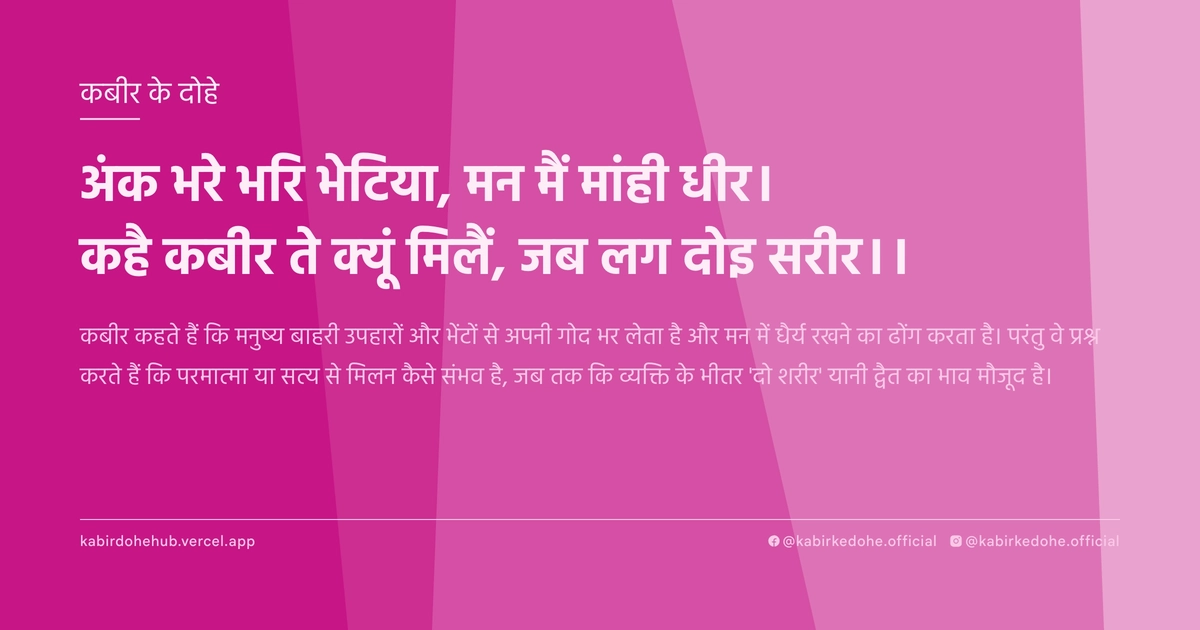
अंक भरे भरि भेटिया, मन मैं मांही धीर।
कहै कबीर ते क्यूं मिलैं, जब लग दोइ सरीर।।
Ank bhare bhari bhetiya, man main maahi dheer. Kahai Kabir te kyun milain, jab lag doi sareer.
इस पृष्ठ पर इस कबीर दोहे का अर्थ (meaning), हिंदी व्याख्या और अंग्रेज़ी अनुवाद, दार्शनिक विश्लेषण और व्यावहारिक जीवन सीख दी गई है। यह दोहा आत्मा और शरीर (Soul and Body) विषय से जुड़ा है — Kabir doha meaning and explanation in Hindi and English.
अर्थ (Meaning):
कबीर कहते हैं कि मनुष्य बाहरी उपहारों और भेंटों से अपनी गोद भर लेता है और मन में धैर्य रखने का ढोंग करता है। परंतु वे प्रश्न करते हैं कि परमात्मा या सत्य से मिलन कैसे संभव है, जब तक कि व्यक्ति के भीतर 'दो शरीर' यानी द्वैत का भाव मौजूद है।
Kabir observes that humans fill their arms with material offerings and pretend to possess patience in their hearts. However, he poses a profound question: how can one truly unite with the Divine or the Ultimate Truth as long as the perception of 'two bodies'—the duality between the self and the other—persists?
व्याख्या (Interpretation):
यहाँ 'दो शरीर' का अर्थ भौतिक शरीर नहीं, बल्कि 'द्वैत' (Duality) है। कबीर संकेत करते हैं कि जब तक साधक स्वयं को ईश्वर से अलग या स्वयं को दूसरे से भिन्न मानता है, तब तक वह केवल बाहरी कर्मकांडों में उलझा रहता है। यह स्थिति माया का प्रभाव है, जहाँ जीव अपनी सीमित पहचान (अहंकार) को सत्य मानता है। निर्गुण भक्ति के अनुसार, परमात्मा कहीं बाहर नहीं बल्कि अंतरात्मा में है। जब तक 'मैं' और 'तू' का भेद बना रहता है, तब तक मिलन असंभव है। वास्तविक मिलन तब होता है जब अद्वैत की स्थिति प्राप्त होती है और साधक यह अनुभव करता है कि वह स्वयं ही ब्रह्म है। यह विरोधाभास है कि हम जिसे खोजने बाहर जाते हैं, वह हमारी अपनी खोज की बाधा है।
The phrase "two bodies" does not refer to physical forms but to the state of 'Duality' (Dvaita). Kabir suggests that as long as the seeker perceives themselves as separate from the Divine or distinct from others, they remain trapped in external rituals. This is the veil of Maya, where the individual clings to a limited identity (the ego) as the ultimate truth. In Nirgun Bhakti, the Divine is not an external entity but the immanent consciousness within. True union is impossible as long as the distinction between "I" and "Thou" exists. The union occurs only in the state of Advaita (Non-duality), where the seeker realizes they are one with Brahman. The central paradox is that the very 'I' searching for God is the primary obstacle to finding Him.
दार्शनिक विश्लेषण (Philosophical Analysis):
कबीर का यह दोहा उनके युग के धार्मिक पाखंड और कर्मकांडीय अंधविश्वास पर एक तीखा प्रहार है। उस समय समाज बाहरी दिखावे, जैसे कि महंगे चढ़ावे और कठिन अनुष्ठानों को मोक्ष का मार्ग मानता था। कबीर ने इस 'भेंट' की संस्कृति को निरर्थक बताया, क्योंकि बाहरी वस्तुएं मन के भीतर के द्वैत को समाप्त नहीं कर सकतीं।
दार्शनिक स्तर पर, यह विचार अद्वैत वेदांत के करीब है, जहाँ 'अहं ब्रह्मास्मि' (मैं ही ब्रह्म हूँ) का सिद्धांत सर्वोपरि है। कबीर का तर्क है कि जब तक आप स्वयं को एक अलग इकाई मानते हैं, आप वास्तव में अलग हैं। यह अलगाव ही दुख और अज्ञान का मूल कारण है। सूफी मत के 'फना' (Fana) के सिद्धांत की तरह, यहाँ भी अहंकार के पूर्ण विनाश की बात कही गई है। जब तक 'मैं' जीवित है, तब तक 'वह' अप्राप्य है।
कबीर जाति और धर्म के बंधनों को इसलिए नकारते थे क्योंकि ये बंधन 'दो शरीर' या 'दो समूहों' की भावना को पुख्ता करते हैं। उनके लिए मानवता एक ही धागे में पिरोई हुई है। ritualism केवल अहंकार को संतुष्ट करता है, जबकि वास्तविक भक्ति अहंकार को मिटाती है।
मनोवैज्ञानिक रूप से, यह दोहा संज्ञानात्मक विसंगति (Cognitive Dissonance) को दर्शाता है। मनुष्य बाहर से शांत और धैर्यवान दिखने का प्रयास करता है, लेकिन भीतर वह अपनी अलग पहचान को बचाने के लिए संघर्ष करता रहता है। यह आंतरिक संघर्ष ही आध्यात्मिक प्रगति को रोकता है।
अंततः, कबीर यह स्पष्ट करते हैं कि सत्य कोई वस्तु नहीं है जिसे भेंट देकर प्राप्त किया जा सके, बल्कि यह एक अवस्था है जिसे केवल द्वैत के विसर्जन के माध्यम से ही अनुभव किया जा सकता है। यह ज्ञान की यात्रा नहीं, बल्कि विस्मृति की यात्रा है—अपनी सीमित पहचान को भूलकर अनंत में विलीन हो जाने की यात्रा।
This couplet is a sharp critique of the religious hypocrisy and ritualistic superstitions prevalent during Kabir's era. Society at the time viewed external displays, such as expensive offerings and rigorous rituals, as the primary path to liberation. Kabir dismisses this culture of 'offerings' as futile, arguing that external objects cannot dissolve the internal duality of the mind.
Philosophically, this aligns with Advaita Vedanta, where the principle of 'Aham Brahmasmi' (I am Brahman) is paramount. Kabir argues that as long as you perceive yourself as a separate entity, you effectively remain separate. This perceived separation is the root cause of all suffering and ignorance. Similar to the Sufi concept of 'Fana' (annihilation of the self), Kabir emphasizes the total dissolution of the ego. As long as the 'I' exists, the 'Divine' remains elusive.
Kabir rejected caste and religious boundaries because these constructs reinforce the notion of 'two bodies' or 'two groups.' For him, humanity is woven from a single thread. Ritualism merely feeds the ego, whereas true devotion annihilates it.
Psychologically, the verse highlights a state of cognitive dissonance. A person may project an image of patience and piety to the world, while internally struggling to maintain their separate identity. This internal conflict is the primary barrier to spiritual evolution.
Ultimately, Kabir clarifies that Truth is not a commodity to be acquired through offerings, but a state of being realized only through the surrender of duality. It is not a journey of accumulation, but a journey of unlearning—forgetting the limited self to merge into the Infinite.
मूल संदेश (Core Message):
- बाहरी आडंबर केवल अहंकार की परछाइयाँ हैं।
- सत्य तक पहुँचने का मार्ग 'प्राप्ति' नहीं, बल्कि 'त्याग' है।
- द्वैत का भाव ही ईश्वर और जीव के बीच की दीवार है।
- जब 'मैं' मिटता है, तभी 'वह' प्रकट होता है।
- अद्वैत का अनुभव ही वास्तविक मोक्ष और मिलन है।
- प्रेम वह सेतु है जो दो शरीरों के भ्रम को मिटाता है।
- External rituals are merely shadows cast by the ego.
- The path to Truth is not about 'acquisition' but 'surrender'.
- The sense of duality is the only wall between the soul and the Divine.
- Only when the 'I' vanishes does the 'Infinite' appear.
- The experience of non-duality is the only true liberation.
- Love is the bridge that dissolves the illusion of separate bodies.
व्यावहारिक उदाहरण (Practical Example):
वाराणसी के घाटों पर रहने वाली एक वृद्ध विधवा, जानकी, का जीवन केवल पूजा-पाठ और दान-पुण्य के इर्द-गिर्द घूमता था। वह प्रतिदिन मंदिर में महंगे फूल और फल चढ़ाती और मानती कि उसकी यह भक्ति उसे मोक्ष दिलाएगी। वह दूसरों को उपदेश देती कि धैर्य रखें और ईश्वर पर विश्वास करें, लेकिन उसके मन में हमेशा यह डर रहता कि कहीं उसकी पूजा में कोई कमी न रह जाए।
एक दिन उसकी मुलाकात एक फकीर से हुई जो घाट की सीढ़ियों पर चुपचाप बैठा था। जानकी ने उसे कुछ फल देने की कोशिश की और अपनी लंबी साधना के बारे में बताया। फकीर ने मुस्कुराकर पूछा, "माता, आप जिसे खोज रही हैं, वह कहाँ है? और आप कौन हैं जो उसे खोज रही हैं?"
जानकी ने उत्तर दिया, "मैं एक भक्त हूँ और ईश्वर ऊपर स्वर्ग में हैं।"
फकीर ने जवाब दिया, "जब तक आप खुद को 'भक्त' और उसे 'ईश्वर' मानती रहेंगी, आप दो अलग-अलग किनारों पर खड़ी रहेंगी। यह दूरी आपके चढ़ावे से कम नहीं होगी, बल्कि इस भ्रम को मिटाने से होगी कि आप उनसे अलग हैं।"
यह बात जानकी के हृदय पर गहरी चोट कर गई। उसने महसूस किया कि उसकी सारी पूजा वास्तव में उसके अपने 'अहंकार' की तुष्टि थी—यह अहंकार कि "मैं एक महान भक्त हूँ।"
अगले कुछ महीनों में, जानकी ने महंगे चढ़ावे बंद कर दिए। उसने मंदिर जाना कम किया और अपना समय उन लोगों की सेवा में लगाया जिन्हें समाज ने त्याग दिया था। उसने महसूस किया कि जब वह किसी भूखे को भोजन कराती है, तो वह 'दान' नहीं कर रही होती, बल्कि वह स्वयं को ही खिला रही होती है।
उसने पाया कि जब उसने 'मैं' और 'वह' का भेद मिटाया, तो उसे मंदिर की मूर्तियों से अधिक शांति एक अजनबी की मुस्कुराहट में मिली।
उसका धैर्य अब दिखावा नहीं था, बल्कि एक गहरा मौन बन गया था। उसने जान लिया कि मोक्ष किसी भेंट में नहीं, बल्कि इस बोध में है कि पूरा ब्रह्मांड एक ही चेतना का विस्तार है।
अंततः, जानकी ने अपनी पहचान एक 'धार्मिक विधवा' से बदलकर एक 'साक्षी' की बना ली, जहाँ न कोई देने वाला था और न कोई लेने वाला।
Janaki, an elderly widow living on the ghats of Varanasi, spent her entire existence revolving around rituals and charity. She offered expensive flowers and fruits at the temple daily, believing these acts would secure her salvation. She preached patience and faith to others, yet internally, she was plagued by the fear that her rituals might be imperfect.
One day, she encountered a wandering dervish sitting silently on the temple steps. Janaki attempted to offer him some fruit and spoke proudly of her long years of spiritual discipline.
The dervish smiled and asked, "Mother, where is the One you seek? And who is the 'you' that is seeking?"
Janaki replied, "I am a devotee, and God resides in the heavens above."
The dervish responded, "As long as you view yourself as the 'devotee' and Him as 'God,' you will remain on two separate shores. This distance cannot be bridged by offerings, but only by erasing the illusion that you are separate from Him."
These words struck a chord deep within Janaki. She realized that her lifelong devotion was actually a feeding of her own ego—the ego that whispered, "I am a great devotee."
Over the following months, Janaki stopped the expensive offerings. She reduced her temple visits and devoted her time to serving those abandoned by society. She discovered that when she fed a hungry stranger, she wasn't performing 'charity,' but was essentially feeding herself.
She found that once the distinction between 'I' and 'Other' dissolved, she felt more peace in a stranger's smile than in the stone idols of the temple.
Her patience was no longer a mask of piety but had become a profound inner silence.
She understood that liberation does not lie in any gift or ritual, but in the realization that the entire universe is an extension of a single consciousness.
Ultimately, Janaki transformed her identity from a 'religious widow' to a 'witness,' where there was no longer a giver or a receiver, only existence.
अभ्यास मार्गदर्शन (Practice Guidance):
- दैनिक ध्यान: प्रतिदिन 20 मिनट मौन बैठें। जब भी मन में 'मैं' या 'मेरा' शब्द आए, तो उसे एक विचार के रूप में देखें और पूछें, "यह 'मैं' कौन है?"।
- आत्म-पूछताछ जर्नल: प्रतिदिन एक ऐसी घटना लिखें जहाँ आपने किसी के प्रति श्रेष्ठता या हीनता महसूस की। विश्लेषण करें कि उस क्षण में आपने खुद को दूसरे से 'अलग' कैसे माना।
- व्यवहारिक परिवर्तन: दिन में कम से कम एक बार किसी ऐसे व्यक्ति की मदद करें जिससे आपका कोई संबंध न हो, और यह भाव रखें कि आप अपनी ही आत्मा की सेवा कर रहे हैं।
- निदान चेकलिस्ट: क्या मैं अपनी धार्मिक पहचान पर गर्व करता हूँ? क्या मैं दूसरों को अपनी तुलना में कम आध्यात्मिक मानता हूँ? क्या मेरी शांति बाहरी परिस्थितियों या प्रशंसा पर निर्भर है? (यदि हाँ, तो द्वैत अभी भी मौजूद है)।
- Daily Meditation: Sit in silence for 20 minutes. Whenever the words 'I' or 'Mine' arise, observe them as mere thoughts and ask, "Who is this 'I' that claims ownership?"
- Self-Inquiry Journal: Record one daily instance where you felt superior or inferior to someone. Analyze how you created a mental separation between yourself and the other in that moment.
- Behavioral Shift: Perform one act of selfless service daily for a complete stranger, consciously maintaining the feeling that you are serving your own soul in another form.
- Diagnostic Checklist: Do I take pride in my religious or spiritual identity? Do I perceive others as less evolved than myself? Is my peace dependent on external validation? (If yes, duality still persists).
चिंतन प्रश्न (Reflection Questions):
- मेरी वह कौन सी 'धार्मिक पहचान' है जिसे मैं खोने से डरता हूँ?
- क्या मेरी करुणा वास्तव में दूसरे के लिए है, या यह मेरे स्वयं के 'अच्छे इंसान' होने के अहंकार को संतुष्ट करती है?
- यदि मेरी सारी उपलब्धियाँ और पद छीन लिए जाएँ, तो क्या मेरा 'मैं' बचेगा?
- मैं किन लोगों को 'अलग' या 'विपरीत' मानता हूँ, और यह अलगाव मेरे भीतर किस डर से पैदा होता है?
- क्या मैं ईश्वर को खोजने का प्रयास कर रहा हूँ, या मैं वास्तव में उस 'मैं' को बनाए रखना चाहता हूँ जो खोज रहा है?
- मेरे जीवन का कौन सा हिस्सा केवल बाहरी दुनिया को दिखाने के लिए 'धैर्यवान' बना हुआ है?
- What is the specific 'spiritual identity' I am most afraid of losing?
- Is my compassion truly for the other, or does it merely satisfy the ego's need to feel like a 'good person'?
- If all my achievements and titles were stripped away, would this 'I' still exist?
- Whom do I perceive as 'different' or 'opposite,' and what internal fear fuels this separation?
- Am I truly seeking the Divine, or am I secretly clinging to the 'seeker' identity?
- Which part of my life is merely a performance of 'patience' for the benefit of an external audience?