
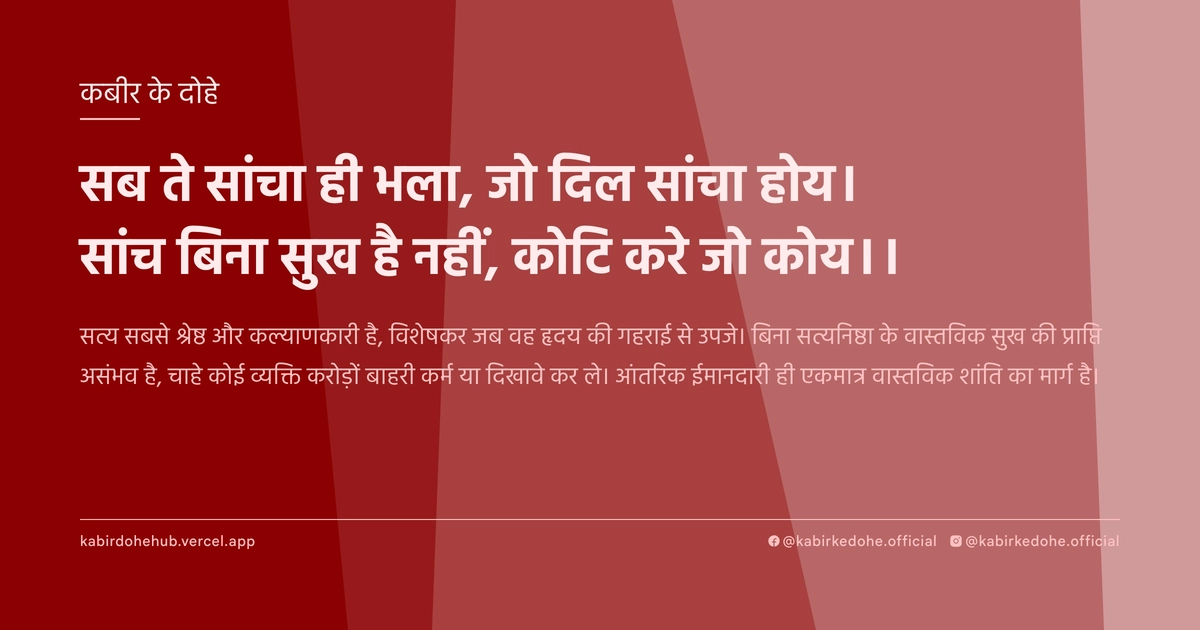
सब ते सांचा ही भला, जो दिल सांचा होय।
सांच बिना सुख है नहीं, कोटि करे जो कोय।।
Sab te sancha hi bhala, jo dil sancha hoye. Saanch bina sukh hai nahi, koti kare jo koy.
इस पृष्ठ पर इस कबीर दोहे का अर्थ (meaning), हिंदी व्याख्या और अंग्रेज़ी अनुवाद, दार्शनिक विश्लेषण और व्यावहारिक जीवन सीख दी गई है। यह दोहा सत्य (Truth) विषय से जुड़ा है — Kabir doha meaning and explanation in Hindi and English.
अर्थ (Meaning):
सत्य सबसे श्रेष्ठ और कल्याणकारी है, विशेषकर जब वह हृदय की गहराई से उपजे। बिना सत्यनिष्ठा के वास्तविक सुख की प्राप्ति असंभव है, चाहे कोई व्यक्ति करोड़ों बाहरी कर्म या दिखावे कर ले। आंतरिक ईमानदारी ही एकमात्र वास्तविक शांति का मार्ग है।
Truth is the highest virtue and the ultimate good, especially when it resides deeply within the heart. Without genuine truthfulness, true happiness remains unattainable, regardless of how many millions of external rituals or superficial acts of piety one performs. Inner integrity is the only path to lasting peace.
व्याख्या (Interpretation):
इस दोहे का शाब्दिक अर्थ है कि सत्य सबसे बड़ा मित्र है। गहरे स्तर पर, कबीर 'सांच' को केवल शब्दों की सच्चाई नहीं, बल्कि 'सत्य' (Brahman) के साथ तादात्म्य मानते हैं। जब हृदय 'सांचा' होता है, तो वह माया के आवरण से मुक्त हो जाता है। यह निर्गुण भक्ति का सार है जहाँ बाहरी आडंबरों का कोई मूल्य नहीं है। यहाँ 'कोटि' शब्द बाहरी दिखावे और कर्मकांडों की बहुलता को दर्शाता है जो आत्मा को भ्रमित करते हैं। अंततः, यह अद्वैत वेदांत की उस स्थिति की ओर संकेत करता है जहाँ व्यक्ति और सत्य एक हो जाते हैं, जिससे द्वैत का अंत और वास्तविक आनंद का उदय होता है।
Literally, the verse asserts that truth is the greatest ally. On a deeper level, Kabir views 'Saanch' not merely as factual honesty, but as alignment with the Ultimate Truth (Brahman). When the heart is 'true,' it is liberated from the veils of Maya (illusion). This is the essence of Nirgun Bhakti, where external rituals hold no value. The word 'Koti' (millions) symbolizes the abundance of superficial acts and rituals that distract the soul. Ultimately, this points toward the Advaita Vedanta state where the individual self merges with the Universal Truth, ending duality and awakening primordial bliss.
दार्शनिक विश्लेषण (Philosophical Analysis):
कबीर का यह दर्शन उनके युग के धार्मिक पाखंड और सामाजिक स्तरीकरण के विरुद्ध एक सशक्त प्रहार है। उन्होंने देखा कि लोग तीर्थयात्राओं और कठिन व्रतों (कोटि कर्म) में लगे थे, जबकि उनके हृदय ईर्ष्या और असत्य से भरे थे। कबीर का तर्क है कि सत्य कोई बाहरी गंतव्य नहीं, बल्कि एक आंतरिक अवस्था है।
यह विचार सूफीवाद के 'हक़' (Haqq) और वेदांत के 'सत्य' के करीब है। सूफी मत में ईश्वर को 'अल-हक़' कहा गया है, जिसका अर्थ है परम सत्य। कबीर सिखाते हैं कि जब तक अहंकार (Ego) जीवित है, सत्य केवल एक शब्द है; जब अहंकार मिटता है, तब सत्य एक अनुभव बन जाता है।
ritualism (कर्मकांड) का विरोध करते हुए कबीर स्पष्ट करते हैं कि ईश्वर मंदिर या मस्जिद में नहीं, बल्कि उस हृदय में बसता है जो छल-कपट से मुक्त है। यह मनोवैज्ञानिक रूपांतरण की प्रक्रिया है जहाँ व्यक्ति अपनी सामाजिक पहचान को त्यागकर अपनी वास्तविक आध्यात्मिक पहचान को खोजता है।
अद्वैत वेदांत के परिप्रेक्ष्य में, असत्य वह है जो परिवर्तनशील है। संसार की सभी भौतिक उपलब्धियाँ और सामाजिक प्रतिष्ठा 'असत्य' हैं क्योंकि वे नश्वर हैं। केवल वह 'सांच' सत्य है जो अपरिवर्तनीय है।
अतः, यह दोहा केवल नैतिकता की बात नहीं करता, बल्कि अस्तित्वगत सत्य की बात करता है। यह हमें चेतावनी देता है कि बाहरी धार्मिकता एक भ्रम है यदि वह आंतरिक ईमानदारी से प्रेरित नहीं है।
Kabir's philosophy is a potent strike against the religious hypocrisy and social stratification of his era. He observed people immersed in pilgrimages and rigorous fasts (Koti Karma) while their hearts remained filled with envy and falsehood. Kabir argues that Truth is not an external destination but an internal state of being.
This perspective closely aligns with the Sufi concept of 'Haqq' and the Vedantic 'Satya.' In Sufism, God is referred to as 'Al-Haqq,' meaning the Absolute Truth. Kabir teaches that as long as the ego persists, truth is merely a word; when the ego is annihilated, truth becomes a lived experience.
By rejecting ritualism, Kabir clarifies that the Divine does not reside in temples or mosques, but in the heart liberated from deceit. This is a process of psychological transformation where the individual sheds their social persona to discover their authentic spiritual identity.
From the lens of Advaita Vedanta, that which is 'untrue' is that which is subject to change. All material achievements and social prestige are 'untrue' because they are ephemeral. Only the 'Saanch'—the Unchanging—is truly real.
Thus, this couplet does not merely discuss morality but existential truth. It warns that external religiosity is a delusion if it is not fueled by internal integrity.
मूल संदेश (Core Message):
- बाहरी दिखावा आत्मा की भूख को कभी शांत नहीं कर सकता।
- सत्य केवल शब्दों का अभाव नहीं, बल्कि हृदय की ईमानदारी है।
- अहंकार का विसर्जन ही वास्तविक सुख की एकमात्र कुंजी है।
- ईश्वर कर्मकांडों में नहीं, बल्कि सत्यनिष्ठा में निवास करता है।
- आंतरिक सत्य ही व्यक्ति को ब्रह्मांडीय चेतना से जोड़ता है।
- External pretension can never satiate the hunger of the soul.
- Truth is not just the absence of lies, but the integrity of the heart.
- The dissolution of ego is the only key to authentic happiness.
- The Divine resides in integrity, not in the performance of rituals.
- Inner truth is the bridge connecting the individual to universal consciousness.
व्यावहारिक उदाहरण (Practical Example):
एक समय की बात है, वाराणसी के घाटों पर रामू नाम का एक वृद्ध बुनकर रहता था। वह अपनी कला में निपुण था, लेकिन उसके मन में एक गहरी टीस थी। वह शहर के सबसे बड़े मंदिर के पुजारी का सम्मान करता था, जो दिन भर मंत्रोच्चार करते और हज़ारों लोगों को उपदेश देते थे।
रामू ने देखा कि पुजारी जी बाहरी रूप से अत्यंत पवित्र दिखते थे, लेकिन वे गुप्त रूप से गरीब भक्तों से दान के नाम पर पैसे ठगते थे और अपने करीबियों के साथ भेदभाव करते थे। पुजारी जी का जीवन 'कोटि' कर्मों से भरा था, फिर भी उनके चेहरे पर एक अजीब सी बेचैनी रहती थी।
दूसरी ओर, रामू एक साधारण जीवन जीता था। एक दिन, रामू की एक कीमती रेशमी साड़ी चोरी हो गई, जिसे उसने एक अमीर सेठ के लिए बनाया था। रामू ने उस साड़ी को ढूंढने के बजाय, सेठ को सच बता दिया कि साड़ी खो गई है और वह उसके पैसे वापस कर देगा, भले ही वह खुद भूखा रहे।
सेठ रामू की इस ईमानदारी से इतना प्रभावित हुआ कि उसने उसे और अधिक काम दिया और उसे अपना मित्र बना लिया। रामू को उस दिन एक अद्भुत शांति का अनुभव हुआ, जिसे उसने पहले कभी महसूस नहीं किया था।
उसी समय, पुजारी जी एक बड़े धार्मिक आयोजन की तैयारी कर रहे थे, जहाँ हज़ारों लोग जुटे थे। लेकिन उस भीड़ के बीच भी पुजारी जी को अपनी चोरी और झूठ का डर सता रहा था। वे सोने के सिंहासन पर बैठे थे, फिर भी उनका मन अशांत था।
रामू ने जब यह देखा, तो उसे कबीर की वाणी याद आई। उसने महसूस किया कि पुजारी जी के पास 'कोटि' बाहरी आडंबर थे, लेकिन 'सांच' (सत्य) गायब था।
रामू ने पुजारी जी से विनम्रतापूर्वक कहा, "महाराज, सोने के बर्तनों में रखा ज़हर भी ज़हर ही रहता है, और मिट्टी के बर्तन में रखा अमृत अमृत ही रहता है।"
पुजारी जी को पहली बार अपनी आंतरिक शून्यता का अहसास हुआ। उन्होंने महसूस किया कि उनकी सारी पूजा-पाठ व्यर्थ थी क्योंकि उनका हृदय 'सांचा' नहीं था।
उस दिन पुजारी जी ने अपना अहंकार त्याग दिया और रामू की सरलता से सीखना शुरू किया। उन्होंने बाहरी दिखावे को छोड़कर हृदय की सच्चाई को अपना लिया।
अंततः, रामू की ईमानदारी ने न केवल उसे मानसिक शांति दी, बल्कि एक अहंकारी व्यक्ति का भी उद्धार कर दिया। यह सत्य की वह शक्ति थी जिसने दिखावे के साम्राज्य को ढहा दिया।
Once, on the ghats of Varanasi, lived an elderly weaver named Ramu. He was skilled in his craft, but his heart carried a deep longing for genuine peace. He looked up to the head priest of the city's largest temple, a man who spent his days chanting mantras and preaching to thousands.
Ramu noticed that while the priest appeared externally pious, he secretly cheated poor devotees out of their donations and practiced favoritism. The priest's life was filled with 'Koti' (millions) of rituals, yet a strange restlessness always clouded his face.
Ramu, conversely, lived a simple life. One day, a precious silk saree that Ramu had woven for a wealthy merchant was stolen. Instead of hiding the loss or making excuses, Ramu told the merchant the truth: the saree was gone, and he would refund the money even if it meant going hungry.
The merchant was so moved by Ramu's honesty that he gave him more work and treated him as a trusted friend. That day, Ramu experienced a profound sense of peace he had never known before.
At that same time, the priest was organizing a massive religious festival with thousands of attendees. Yet, amidst the crowd, the priest was haunted by the fear of his lies and thefts being discovered. He sat on a golden throne, but his mind was a storm of anxiety.
Observing this, Ramu remembered Kabir's words. He realized that the priest possessed 'Koti' external ornaments of faith, but lacked 'Saanch' (Truth).
Ramu humbly said to the priest, "Maharaj, poison in a golden vessel remains poison, and nectar in a clay pot remains nectar."
The priest was struck by a sudden realization of his own internal emptiness. He understood that all his rituals were futile because his heart was not 'true.'
That day, the priest shed his ego and began to learn from Ramu's simplicity. He abandoned the facade of piety for the reality of integrity.
Ultimately, Ramu's honesty not only brought him mental serenity but also liberated a trapped soul. This was the power of Truth, which dismantled the empire of pretense.
अभ्यास मार्गदर्शन (Practice Guidance):
- प्रतिदिन 15 मिनट मौन बैठें और अपने दिनभर के कार्यों का विश्लेषण करें: क्या मैंने किसी स्थिति में अपनी छवि बचाने के लिए छोटा सा झूठ बोला?
- एक 'सत्य-डायरी' लिखें जहाँ आप उन क्षणों को दर्ज करें जब आपने डर के बावजूद सच बोला और उसके बाद आपको कैसा महसूस हुआ।
- व्यवहार परिवर्तन: जब भी आप किसी की प्रशंसा करें, तो सुनिश्चित करें कि वह केवल सामाजिक शिष्टाचार नहीं, बल्कि आपके हृदय की वास्तविक भावना हो।
- निदान चेकलिस्ट: यदि आप दूसरों की आलोचना करते समय खुद को श्रेष्ठ महसूस करते हैं, या अपनी गलतियों को छिपाने के लिए तर्क गढ़ते हैं, तो समझें कि आपका हृदय अभी 'सांचा' नहीं हुआ है।
- Sit in silence for 15 minutes daily and analyze your day: Did I tell a 'white lie' just to protect my image or ego?
- Maintain a 'Truth Journal' recording moments where you spoke the truth despite fear, and note the subsequent emotional shift.
- Behavioral Shift: Whenever you praise someone, ensure it is not mere social etiquette but a genuine reflection of your heart's feeling.
- Diagnostic Checklist: If you feel superior while criticizing others or construct elaborate rationalizations to hide your mistakes, recognize that your heart is not yet 'true'.
चिंतन प्रश्न (Reflection Questions):
- मैं दुनिया के सामने जो 'आदर्श' व्यक्तित्व प्रस्तुत करता हूँ, वह मेरे वास्तविक आंतरिक स्वरूप से कितना अलग है?
- क्या मेरी धार्मिकता या नैतिकता केवल दूसरों की नजरों में अच्छा दिखने का एक साधन है?
- जब मैं अकेला होता हूँ, तो क्या मैं अपने उन सचों का सामना कर पाता हूँ जिन्हें मैं समाज से छिपाता हूँ?
- क्या मैं सत्य को इसलिए अपनाता हूँ क्योंकि वह सही है, या इसलिए क्योंकि वह मुझे लाभ पहुँचाता है?
- मेरे जीवन का वह कौन सा हिस्सा है जहाँ मैं अभी भी 'कोटि' दिखावे के पीछे अपनी शून्यता छिपा रहा हूँ?
- How different is the 'ideal' persona I present to the world from my actual internal state?
- Is my religiosity or morality merely a tool to be perceived as 'good' in the eyes of others?
- When I am alone, can I face the truths about myself that I hide from society?
- Do I embrace truth because it is right, or because it serves my interests?
- Which part of my life is still hiding a void behind 'millions' of external pretenses?