
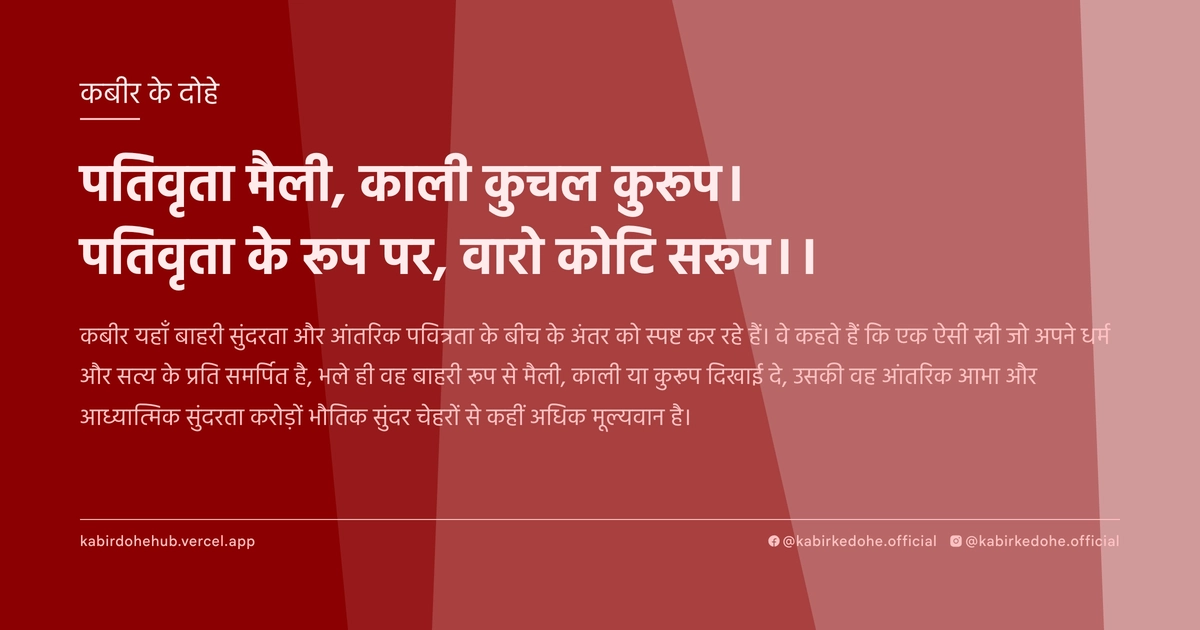
पतिवृता मैली, काली कुचल कुरूप।
पतिवृता के रूप पर, वारो कोटि सरूप।।
Pativrita maili, kali kuchal kurup. Pativrita ke rup par, vaaro koti sarup.
इस पृष्ठ पर इस कबीर दोहे का अर्थ (meaning), हिंदी व्याख्या और अंग्रेज़ी अनुवाद, दार्शनिक विश्लेषण और व्यावहारिक जीवन सीख दी गई है। यह दोहा समानता (Gender Equality) विषय से जुड़ा है — Kabir doha meaning and explanation in Hindi and English.
अर्थ (Meaning):
कबीर यहाँ बाहरी सुंदरता और आंतरिक पवित्रता के बीच के अंतर को स्पष्ट कर रहे हैं। वे कहते हैं कि एक ऐसी स्त्री जो अपने धर्म और सत्य के प्रति समर्पित है, भले ही वह बाहरी रूप से मैली, काली या कुरूप दिखाई दे, उसकी वह आंतरिक आभा और आध्यात्मिक सुंदरता करोड़ों भौतिक सुंदर चेहरों से कहीं अधिक मूल्यवान है।
Kabir emphasizes the profound contrast between superficial physical beauty and internal spiritual purity. He asserts that a soul devoted to Truth and righteousness, even if they appear physically soiled, dark, or unattractive to the world, possesses an inner radiance that far outweighs the value of millions of conventionally beautiful faces.
व्याख्या (Interpretation):
शाब्दिक रूप से यह दोहा एक समर्पित पत्नी की प्रशंसा प्रतीत होता है, परंतु आध्यात्मिक स्तर पर 'पति' का अर्थ परमात्मा है और 'पतिव्रता' वह आत्मा है जो केवल उस एक निराकार ईश्वर के प्रति समर्पित है। बाहरी 'मैलापन' और 'कुरूपता' संसार की दृष्टि में भौतिक अभाव या सामाजिक तिरस्कार का प्रतीक है। कबीर यहाँ माया के भ्रम को तोड़ते हैं, जहाँ मनुष्य केवल बाहरी आवरण को देखता है। यह निर्गुण भक्ति का सार है, जहाँ ईश्वर रूप, रंग या जाति में नहीं, बल्कि हृदय की शुद्धता और अटूट निष्ठा में निवास करता है। यह आत्मा और ब्रह्म के अद्वैत संबंध को दर्शाता है, जहाँ भौतिक शरीर केवल एक वस्त्र है और वास्तविक सौंदर्य आत्मा का सत्य है।
Literally, the couplet seems to praise a devoted wife, but metaphorically, the 'Husband' represents the Supreme Soul (Paramatma), and the 'Pativrata' is the individual soul (Atman) exclusively devoted to the Formless Divine. The 'dirt' and 'ugliness' symbolize the physical limitations and social insignificance perceived by the world. Kabir dismantles the illusion of Maya, where humanity is blinded by external aesthetics. This is the essence of Nirgun Bhakti, asserting that the Divine resides not in form or color, but in the purity of intent and unwavering loyalty. It reflects the Advaita non-duality, suggesting that the physical body is merely a garment, while true beauty is the realization of the Eternal Truth within.
दार्शनिक विश्लेषण (Philosophical Analysis):
कबीर का यह दोहा तत्कालीन समाज की सौंदर्यपरक और जातिगत मान्यताओं पर एक तीखा प्रहार है। उस युग में बाहरी दिखावे और अनुष्ठानों को पवित्रता का पैमाना माना जाता था। कबीर ने इस धारणा को उलट दिया और यह स्थापित किया कि पवित्रता का संबंध शरीर की स्वच्छता या रंग से नहीं, बल्कि चेतना की गहराई से है।
यह विचार अद्वैत वेदांत के करीब है, जो कहता है कि 'ब्रह्म' सत्य है और यह दृश्य जगत मिथ्या है। जब हम किसी को 'कुरूप' कहते हैं, तो हम केवल माया के एक प्रतिबिंब को देख रहे होते हैं। कबीर हमें उस प्रतिबिंब से परे देखने की चुनौती देते हैं।
सूफी मत के 'इश्क-ए-हकीकी' (ईश्वरीय प्रेम) के साथ इसका गहरा संबंध है, जहाँ प्रेमी (भक्त) अपने प्रिय (ईश्वर) के लिए दुनिया की सारी भौतिक सुख-सुविधाओं और सुंदरता को त्याग देता है। यहाँ 'पतिव्रता' होना वास्तव में एक आध्यात्मिक अनुशासन है, जहाँ मन बाहरी दुनिया के प्रलोभनों से हटकर केवल एक केंद्र पर केंद्रित होता है।
कबीर ritualism (कर्मकांड) का विरोध करते हैं क्योंकि कर्मकांड अक्सर बाहरी शुद्धता पर जोर देते हैं। वे तर्क देते हैं कि एक व्यक्ति जो घंटों स्नान करता है लेकिन जिसका मन ईर्ष्या से भरा है, वह वास्तव में 'कुरूप' है, जबकि एक साधारण श्रमिक जिसका हृदय प्रेम से भरा है, वह 'सुंदर' है।
मनोवैज्ञानिक स्तर पर, यह दोहा अहंकार के विसर्जन की बात करता है। जब हम बाहरी सुंदरता की पूजा करते हैं, तो हम अपने अहंकार को पुष्ट करते हैं। लेकिन जब हम आंतरिक सत्य को पहचानते हैं, तो हम उस सार्वभौमिक चेतना में विलीन हो जाते हैं जहाँ कोई भेद नहीं रहता।
This couplet is a sharp critique of the aesthetic and caste-based prejudices of Kabir's era. In a society where external appearances and rigid rituals were the benchmarks of purity, Kabir inverted this logic, establishing that purity is a matter of consciousness, not physical cleanliness or complexion.
This aligns closely with Advaita Vedanta, which posits that Brahman is the only reality and the perceived world is Maya (illusion). When we label someone as 'ugly,' we are merely reacting to a reflection of Maya. Kabir challenges us to look beyond this reflection to the unchanging essence of the soul.
There is a profound connection to the Sufi concept of 'Ishq-e-Haqiqi' (Divine Love), where the seeker renounces all worldly attractions for the sake of the Beloved. Being 'Pativrata' in this context is a spiritual discipline—a state of 'Ekagrata' (one-pointedness) where the mind ceases to wander toward worldly lures and anchors itself in the Divine.
Kabir rejects ritualism because rituals often prioritize external purity over internal transformation. He argues that a person who bathes for hours but harbors hatred is truly 'ugly,' whereas a simple laborer whose heart overflows with compassion is genuinely 'beautiful.'
Psychologically, this teaching focuses on the annihilation of the ego. The obsession with external beauty reinforces the fragmented ego. By shifting focus to internal truth, the practitioner transcends the duality of 'beautiful' and 'ugly,' merging into the universal consciousness where all distinctions vanish.
मूल संदेश (Core Message):
- बाहरी रूप केवल एक पर्दा है, सत्य इसके पीछे छिपा है।
- परमात्मा के प्रति अटूट निष्ठा ही वास्तविक सौंदर्य है।
- माया के सौंदर्य का मोह आत्मा को अंधा कर देता है।
- अहंकार का विसर्जन ही आंतरिक प्रकाश का मार्ग है।
- सच्ची पवित्रता कर्मकांडों में नहीं, बल्कि करुणा में है।
- आत्मा का सौंदर्य समय और शरीर से परे शाश्वत है।
- External form is but a veil; Truth hides behind it.
- Unwavering loyalty to the Divine is the only true beauty.
- The lure of Maya's aesthetics blinds the awakening soul.
- The dissolution of ego is the only path to inner light.
- True purity lies in compassion, not in ritualistic cleansing.
- The beauty of the soul is eternal, transcending time and body.
व्यावहारिक उदाहरण (Practical Example):
वाराणसी के एक पुराने घाट पर एक वृद्ध विधवा रहती थी, जिसे लोग 'काली माई' कहते थे। वह फटे पुराने कपड़ों में रहती थी, उसके चेहरे पर झुर्रियां थीं और वह दिन भर घाट की सीढ़ियों पर बैठकर लोगों के जूते सिलती थी। शहर के अमीर लोग और पंडित उसे देखकर नाक सिकोड़ते थे और उसे 'अशुभ' या 'कुरूप' मानकर अनदेखा कर देते थे।
उसी घाट पर एक युवा मूर्तिकार आया, जो दुनिया की सबसे सुंदर मूर्तियां बनाने का दावा करता था। वह सुंदरता का दीवाना था और केवल पूर्णता (perfection) की तलाश में रहता था। उसने देखा कि काली माई के पास कोई नहीं आता, फिर भी उसके चेहरे पर एक ऐसी शांति और मुस्कान थी जो उसने किसी राजमहल में नहीं देखी थी।
एक दिन मूर्तिकार ने उससे पूछा, "माई, आप इस गरीबी और तिरस्कार में भी इतनी प्रसन्न कैसे हैं? लोग आपको कुरूप कहते हैं, फिर भी आपकी आँखों में एक अजीब सी चमक है।"
काली माई ने धीरे से मुस्कुराते हुए कहा, "बेटा, यह शरीर तो मिट्टी का एक पुतला है। जैसे तुम पत्थर को तराश कर रूप देते हो, वैसे ही मैंने अपने दुखों और एकांत को तराश कर अपने भीतर के राम को खोज लिया है। बाहर की मैल तो पानी से धुल जाएगी, लेकिन भीतर की मैल केवल प्रेम से धुलती है।"
मूर्तिकार को लगा कि वह अब तक केवल पत्थरों की सुंदरता देख रहा था, जबकि वह असली सुंदरता से अनजान था। उसने महसूस किया कि उसकी अपनी 'सुंदर' दुनिया वास्तव में कितनी खोखली और अहंकार से भरी थी।
उस दिन के बाद, मूर्तिकार ने अपनी कला का उद्देश्य बदल दिया। उसने अब केवल सुंदर चेहरों की मूर्तियां बनाना छोड़ दिया और उन लोगों के चित्रों और मूर्तियों को बनाना शुरू किया जिन्हें समाज 'कुरूप' या 'अदृश्य' मानता था।
उसने पाया कि जब वह एक मजदूर के फटे हाथों या एक बूढ़ी औरत की झुर्रियों को उकेरता था, तो उसमें एक ऐसी सच्चाई और गहराई होती थी जो किसी चिकने चेहरे में नहीं मिल सकती थी।
काली माई की उस साधारण सी बात ने मूर्तिकार के अहंकार को तोड़ दिया। उसने सीखा कि सच्ची सुंदरता वह नहीं जो आँखों को लुभाए, बल्कि वह है जो आत्मा को झकझोर दे और उसमें करुणा जगाए।
On an ancient ghat in Varanasi lived an elderly widow whom people called 'Kali Mai.' She wore tattered clothes, her face was etched with deep wrinkles, and she spent her days stitching shoes for pilgrims on the stone steps. The wealthy citizens and priests of the city would wrinkle their noses in disgust, ignoring her as 'inauspicious' or 'ugly.'
To this ghat came a young sculptor who claimed to create the most beautiful statues in the world. He was obsessed with physical perfection and spent his life searching for the ideal form. He noticed that although Kali Mai was shunned by all, her face bore a serenity and a smile that he had never encountered in any royal palace.
One day, the sculptor asked her, "Mai, how are you so content in this poverty and neglect? People call you ugly, yet there is a strange radiance in your eyes."
Kali Mai smiled gently and replied, "Son, this body is but a puppet of clay. Just as you carve stone to create a form, I have carved my sorrows and solitude to find the Ram within me. The dirt on the outside is washed away by water, but the dirt on the inside is washed only by love."
The sculptor realized that he had been admiring the beauty of stones while remaining blind to the beauty of the spirit. He felt that his own 'beautiful' world was actually hollow and saturated with ego.
From that day forward, the sculptor changed the purpose of his art. He stopped creating statues of conventionally beautiful faces and began depicting those whom society deemed 'ugly' or 'invisible.'
He discovered that when he carved the calloused hands of a laborer or the wrinkles of an old woman, there was a truth and depth there that no smooth face could ever possess.
Kali Mai's simple words shattered the sculptor's ego. He learned that true beauty is not that which pleases the eye, but that which stirs the soul and awakens compassion.
अभ्यास मार्गदर्शन (Practice Guidance):
- दैनिक चिंतन: प्रतिदिन 15 मिनट मौन बैठें और विचार करें कि आपकी कौन सी आदतें केवल दूसरों को प्रभावित करने के लिए हैं और कौन सी आपकी आत्मा की सच्चाई हैं।
- आत्म-पूछताछ जर्नल: एक डायरी लिखें जिसमें उन क्षणों का वर्णन करें जब आपने किसी को उसके बाहरी रूप के कारण जज किया, और फिर विश्लेषण करें कि उस निर्णय के पीछे आपका कौन सा पूर्वाग्रह था।
- व्यवहार परिवर्तन: सप्ताह में एक बार ऐसे व्यक्ति की मदद करें या उससे बात करें जिसे समाज 'अदृश्य' या 'निम्न' मानता है, और उनमें छिपी मानवीय गरिमा को खोजने का प्रयास करें।
- निदान चेकलिस्ट: यदि आप किसी की प्रशंसा केवल उसके रूप, पद या धन के कारण कर रहे हैं, तो समझ लें कि आप अभी भी माया के प्रभाव में हैं। यदि आप किसी की आंतरिक शांति को देखकर प्रभावित होते हैं, तो आप सही मार्ग पर हैं।
- Daily Contemplation: Spend 15 minutes in silence daily, reflecting on which of your habits are merely for social validation and which are rooted in your soul's truth.
- Self-Inquiry Journal: Keep a journal documenting moments when you judged someone based on their external appearance, then analyze the hidden bias that drove that judgment.
- Behavioral Shift: Once a week, consciously engage with or help someone whom society deems 'invisible' or 'lowly,' striving to recognize the inherent human dignity within them.
- Diagnostic Checklist: If your admiration for someone is based solely on their looks, status, or wealth, recognize that you are still under the influence of Maya. If you are moved by someone's inner peace, you are aligning with the Truth.
चिंतन प्रश्न (Reflection Questions):
- यदि आपकी सारी भौतिक उपलब्धियां और आपकी शारीरिक सुंदरता छीन ली जाए, तो आपके व्यक्तित्व में क्या बचेगा?
- आप अपनी 'डिजिटल पहचान' (सोशल मीडिया) को सुंदर बनाने में जितना समय लगाते हैं, क्या उसका दसवां हिस्सा भी आप अपने आंतरिक मौन को निखारने में देते हैं?
- क्या आप वास्तव में किसी व्यक्ति को प्यार करते हैं, या आप उस छवि को प्यार करते हैं जो आपने उनके बारे में अपने मन में बनाई है?
- आपके जीवन में वह कौन सा 'कुरूप' सच है जिसे आप स्वीकार करने से डरते हैं, लेकिन जिसे स्वीकार करना आपको मुक्त कर सकता है?
- क्या आपकी भक्ति केवल तब तक है जब तक ईश्वर आपकी इच्छाएं पूरी करता है, या आप उसके 'निराकार' और 'कठोर' रूप को भी स्वीकार कर सकते हैं?
- If all your material achievements and physical beauty were stripped away, what would remain of your identity?
- Do you spend even a tenth of the time you spend curating your 'digital identity' on refining your internal silence?
- Do you truly love a person, or do you love the image of them that you have constructed in your mind?
- What is the 'ugly' truth in your life that you are afraid to acknowledge, but which could actually set you free?
- Is your devotion conditional upon the Divine fulfilling your desires, or can you embrace the Formless and austere aspect of Truth?